수리논술, 배움에서 논증의 완성까지.

자연계열 2번

문제

[문제 2] 다음 제시문을 읽고 문항별로 풀이와 함께 답하시오. (50점)

1. [정적분] 함수 f(x)\displaystyle f(x)가 닫힌 구간 [a,b]\displaystyle [a,b]에서 연속일 때,

abf(x)dx=limnk=1nf(xk)Δx\displaystyle \int_a^bf(x)\,dx=\lim_{n\to\infty}\sum_{k=1}^nf(x_k)\Delta x (단, Δx=ban, xk=a+kΔx\displaystyle \Delta x=\frac{b-a}n,~x_k=a+k\Delta x)

2. [정적분의 기본 정리] 함수 f(x)\displaystyle f(x)가 닫힌 구간 [a,b]\displaystyle [a,b]에서 연속이고, f(x)\displaystyle f(x)의 한 부정적분을 F(x)\displaystyle F(x)라고 하면 다음이 성립한다.

abf(x)dx=[F(x)]ab=F(b)F(a)\displaystyle \int _{ a} ^{b } {f(x)dx } = \Biggl[ F(x) \Biggr]_a ^b = F(b) - F(a)

3. [평균값의 정리] 함수 y=f(x)\displaystyle y=f(x)가 닫힌 구간 [a,b]\displaystyle [a,b]에서 연속이고, 열린 구간 (a,b)\displaystyle (a,b)에서 미분가능하면

f(b)f(a)ba=f(c)   (a<c<b)\displaystyle \frac{f(b)-f(a)}{b-a}=f^{\prime}(c)~~~(a<c<b)

c\displaystyle c가 적어도 하나 존재한다.

4. [함수의 증가] 함수 f(x)\displaystyle f(x)가 어떤 구간의 임의의 두 수 x1,x2\displaystyle x_{1} , x_{2}에 대하여 다음 성질을 만족하면 f(x)\displaystyle f(x)는 그 구간에서 증가한다고 말한다.

x1<x2\displaystyle x_{1} < x_{2}일 때, f(x1)<f(x2)\displaystyle f( x_{1} ) < f(x_{2} )

5. [부분적분법] 두 함수 f(x),g(x)\displaystyle f(x) , g(x)가 각각 연속인 도함수를 가질 때

f(x)g(x)dx=f(x)g(x)f(x)g(x)dx\displaystyle \int _{ } ^{ } { f(x)g^{\prime}(x) dx = f(x) g(x) - \int _{ } ^{ } {f^{\prime}(x)g(x)dx } }

[1] 제시문 1의 정적분을 이용하여 다음 극한값을 구하시오. [9점]

limnk=2n+13nnkn2\displaystyle \lim_{n\to\infty}\sum_{k=2n+1}^{3n}\frac{\sqrt{nk}}{n^2}

[2] 양의 실수 t\displaystyle t에 대하여 함수 L(t)\displaystyle L(t)를 다음과 같이 정의하자.

L(t)=tt+11+4x4dx\displaystyle L(t)=\int_t^{t+1}\sqrt{1+\frac4{x^4}}\,dx

이때 도함수 L(t)\displaystyle L^{\prime}(t)에 대한 다음 합을 구하시오. [9점]

k=1nL(k)\displaystyle \sum _{ k=1} ^{ n} L^{\prime}(k)

[3] 함수 y=f(x)\displaystyle y= f(x)가 닫힌 구간 [t,t+h]\displaystyle [t, t+h]에서 연속이고, 열린 구간 (t,t+h)\displaystyle (t, t+h)에서 미분가능하면

ddttt+hf(x)dx=hf(c)\displaystyle \frac{d}{dt} \int _{ t} ^{ t+h} {f(x)dx } = h f^{\prime}(c)

c\displaystyle c가 구간 (t,t+h)\displaystyle (t, t+h)에 적어도 하나 존재함을 제시문 2,3을 이용하여 증명하시오. (단, h>0\displaystyle h>0) [11점]

[4] 다음 물음에 답하시오.

(1) 함수 y=ex\displaystyle y= e^x는 구간 (,)\displaystyle ( -\infty , \infty )에서 증가함을 증명하시오. [3점]

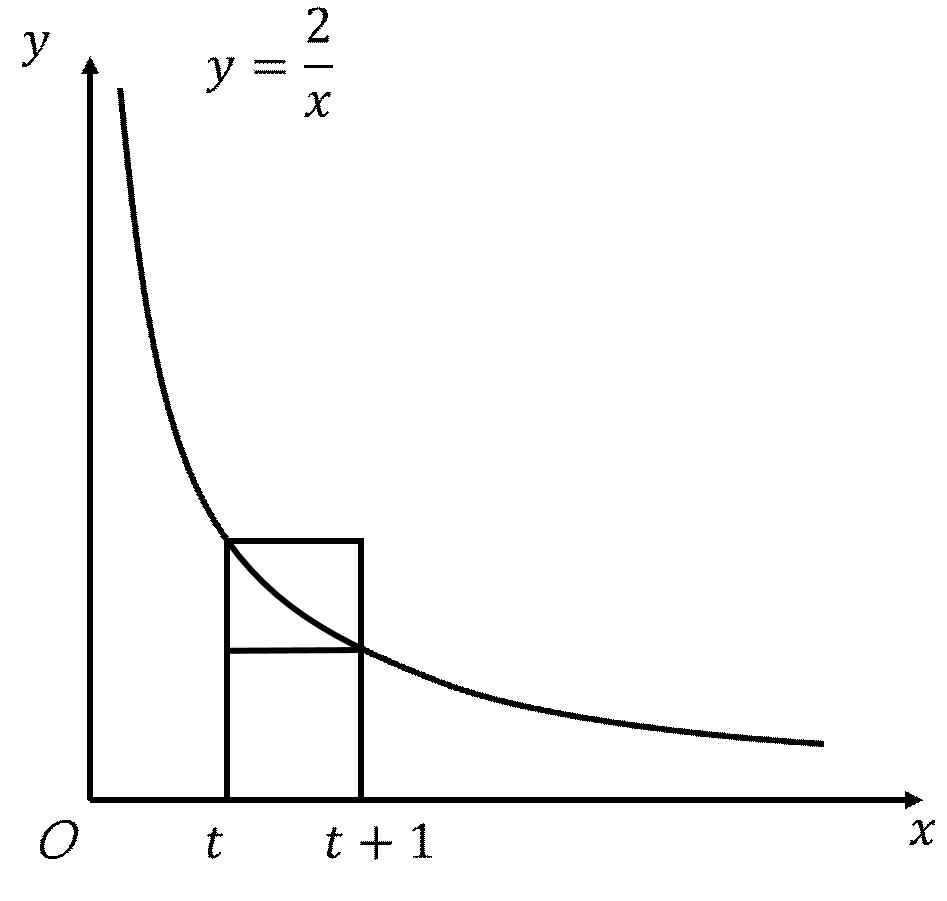
(2) 제시문 4와 <그림 1>을 이용하여 다음 부등식을 증명하시오. [7점]

ett+1<(1+1t)t<e   (t>0)\displaystyle e^ {\frac{t}{t+1}} < \left ( 1+ \frac{1}{t} \right )^t < e ~~~(t>0)

y=2/x와 두 직사각형의 넓이 비교
<그림 1>

[5] 두 함수 f(x),g(x)\displaystyle f(x) , g(x)가 각각 미분가능하고 f(x)=g(x)\displaystyle f^{\prime}(x) = g(x)이고, g(x)=f(x)\displaystyle g^{\prime}(x) = f(x)라고 하자. 제시문 5의 부분적분법을 이용하여 다음 등식이 성립함을 증명하시오. [11점]

cosx{f(x)+g(x)}dx=22cos(xπ4){f(x)+g(x)}+C\displaystyle \int { \cos x \left\{ f(x) + g(x) \right\} dx} = \frac{\sqrt 2}{2} \cos \left ( x- \frac{\pi}{4} \right ) \left\{ f(x) + g(x) \right\} + C(단, C\displaystyle C는 적분상수)

해설강의 준비중

정적분과 급수

🔒
멤버십 회원 전용 개념강의입니다.
멤버십 가입하기

정적분으로 정의된 함수의 미분

관련 개념강의 준비중

부분적분법

관련 개념강의 준비중
+5점 · [1]limnk=2n+13nnkn2=limn1nk=2n+13n(kn)\displaystyle \lim_{n\to\infty}\sum_{k=2n+1}^{3n}\frac{\sqrt{nk}}{n^2}=\lim_{n\to\infty}\frac1n\sum_{k=2n+1}^{3n}\left(\sqrt{\frac kn}\right)=limn1n(2n+1n+2n+2n++2n+nn)\displaystyle = \lim _{ n\to \infty } { }\frac{1}{n} \left ( \sqrt { \frac{2n+1}{n}} + \sqrt { \frac{2n+2}{n}} +\cdots + \sqrt { \frac{2n+n}{n}} \right )=limn1n(2+1n+2+2n++2+nn)=limn1nk=1n2+kn\displaystyle = \lim _{ n\to \infty } { }\frac{1}{n} \left ( \sqrt { 2+\frac{1}{n}} + \sqrt { 2+\frac{2}{n}} +\cdots + \sqrt { 2+\frac{n}{n}} \right )= \lim _{ n\to \infty } { }\frac{1}{n} \sum _{ k=1} ^{ n} \sqrt { 2+ \frac{k}{n}}

[1]

limnk=2n+13nnkn2=limn1nk=2n+13n(kn)\displaystyle \lim_{n\to\infty}\sum_{k=2n+1}^{3n}\frac{\sqrt{nk}}{n^2}=\lim_{n\to\infty}\frac1n\sum_{k=2n+1}^{3n}\left(\sqrt{\frac kn}\right)

=limn1n(2n+1n+2n+2n++2n+nn)\displaystyle = \lim _{ n\to \infty } { }\frac{1}{n} \left ( \sqrt { \frac{2n+1}{n}} + \sqrt { \frac{2n+2}{n}} +\cdots + \sqrt { \frac{2n+n}{n}} \right )

=limn1n(2+1n+2+2n++2+nn)=limn1nk=1n2+kn\displaystyle = \lim _{ n\to \infty } { }\frac{1}{n} \left ( \sqrt { 2+\frac{1}{n}} + \sqrt { 2+\frac{2}{n}} +\cdots + \sqrt { 2+\frac{n}{n}} \right )= \lim _{ n\to \infty } { }\frac{1}{n} \sum _{ k=1} ^{ n} \sqrt { 2+ \frac{k}{n}}

+4점 · =012+xdx=[23(2+x)32]01=23432\displaystyle =\int _{ 0} ^{1 } { \sqrt { 2+x} }dx = \Biggl[ \frac{2}{3} (2+x)^ {\frac{3}{2}} \Biggr]_{0}^{1} = 2\sqrt 3 - \frac{4}{3} \sqrt 2또는23xdx=[23x32]23=23432\displaystyle \int _{ 2} ^{3 } {\sqrt x }dx= \Biggl[ \frac{2}{3} x^{\frac{3}{2}} \Biggr]_{2}^{3} = 2\sqrt 3 - \frac{4}{3} \sqrt 2

=012+xdx=[23(2+x)32]01=23432\displaystyle =\int _{ 0} ^{1 } { \sqrt { 2+x} }dx = \Biggl[ \frac{2}{3} (2+x)^ {\frac{3}{2}} \Biggr]_{0}^{1} = 2\sqrt 3 - \frac{4}{3} \sqrt 2또는

23xdx=[23x32]23=23432\displaystyle \int _{ 2} ^{3 } {\sqrt x }dx= \Biggl[ \frac{2}{3} x^{\frac{3}{2}} \Biggr]_{2}^{3} = 2\sqrt 3 - \frac{4}{3} \sqrt 2

+5점 · [2]h(x)=1+4x4\displaystyle h(x)=\sqrt{1+\frac4{x^4}}라고 놓으면, L(t)=ddttt+1h(x)dx=h(t+1)h(t)\displaystyle L^{\prime}(t)=\frac d{dt}\int_t^{t+1}h(x)\,dx=h(t+1)-h(t)이다. 따라서,L(t)=1+4(t+1)41+4t4\displaystyle L^{\prime}(t)=\sqrt{1+\frac4{(t+1)^4}}-\sqrt{1+\frac4{t^4}}이고,

[2]

h(x)=1+4x4\displaystyle h(x)=\sqrt{1+\frac4{x^4}}라고 놓으면, L(t)=ddttt+1h(x)dx=h(t+1)h(t)\displaystyle L^{\prime}(t)=\frac d{dt}\int_t^{t+1}h(x)\,dx=h(t+1)-h(t)이다. 따라서,

L(t)=1+4(t+1)41+4t4\displaystyle L^{\prime}(t)=\sqrt{1+\frac4{(t+1)^4}}-\sqrt{1+\frac4{t^4}}이고,

+4점 · k=1nL(k)=(h(2)h(1))+(h(3)h(2))++(h(n+1)h(n))\displaystyle \sum _{ k=1} ^{ n} L^{\prime}(k) = (h(2)-h(1)) + (h(3) - h(2)) + \cdots + (h(n+1) - h(n))이다.여기서 상쇄되는 항들을 제거하면 남는 항은 h(n+1)h(1)\displaystyle h(n+1) - h(1)이므로 정답은 1+4(n+1)45\displaystyle \sqrt { 1+ \frac{4}{(n+1)^{4}} }- \sqrt 5이다.

k=1nL(k)=(h(2)h(1))+(h(3)h(2))++(h(n+1)h(n))\displaystyle \sum _{ k=1} ^{ n} L^{\prime}(k) = (h(2)-h(1)) + (h(3) - h(2)) + \cdots + (h(n+1) - h(n))이다.

여기서 상쇄되는 항들을 제거하면 남는 항은 h(n+1)h(1)\displaystyle h(n+1) - h(1)이므로 정답은 1+4(n+1)45\displaystyle \sqrt { 1+ \frac{4}{(n+1)^{4}} }- \sqrt 5이다.

+5점 · [3]F(x)=f(x)\displaystyle F^{\prime}(x) = f(x)라고 하자. 제시문 2에 의해 tt+hf(x)dx=F(t+h)F(t)\displaystyle \int _{ t} ^{t+h } {f(x) dx } = F(t+h ) - F(t)이다. 이 식의 양변을 t\displaystyle t에 대해 미분하면ddttt+hf(x)dx=f(t+h)f(t)\displaystyle \frac{d}{dt} \int _{ t} ^{t+h } { f(x)}dx = f(t+h) - f(t)

[3]

F(x)=f(x)\displaystyle F^{\prime}(x) = f(x)라고 하자. 제시문 2에 의해 tt+hf(x)dx=F(t+h)F(t)\displaystyle \int _{ t} ^{t+h } {f(x) dx } = F(t+h ) - F(t)이다. 이 식의 양변을 t\displaystyle t에 대해 미분하면

ddttt+hf(x)dx=f(t+h)f(t)\displaystyle \frac{d}{dt} \int _{ t} ^{t+h } { f(x)}dx = f(t+h) - f(t)

+6점 · 우변에 평균값의 정리를 적용하면 다음을 만족하는 c(t<c<t+h)\displaystyle c( t<c<t+h)가 적어도 하나 존재한다.f(t+h)f(t)=hf(c)\displaystyle f(t+h ) - f(t) = h f^{\prime}(c)

우변에 평균값의 정리를 적용하면 다음을 만족하는 c(t<c<t+h)\displaystyle c( t<c<t+h)가 적어도 하나 존재한다.

f(t+h)f(t)=hf(c)\displaystyle f(t+h ) - f(t) = h f^{\prime}(c)

+3점 · [4] (1) 실수 전 구간에서 y(x)=ex>0\displaystyle y^{\prime}(x) = e^x >0이므로 이 함수는 증가한다.

[4]

(1) 실수 전 구간에서 y(x)=ex>0\displaystyle y^{\prime}(x) = e^x >0이므로 이 함수는 증가한다.

+3점 · (2) 밑변의 길이가 1이고 높이가 2t+1\displaystyle \frac{2}{t+1}인 사각형의 넓이 S1\displaystyle S_{1}2t+1\displaystyle \frac{2}{t+1}이다.곡선 y=2x\displaystyle y= \frac{2}{x}x\displaystyle x축 및 x=t\displaystyle x=t, x=t+1 (t>0)\displaystyle x= t+1 ~(t>0)로 둘러싸인 도형의 넓이 S\displaystyle SS=tt+12xdx=[2lnx2]tt+1=2lnt+1t=2ln(1+1t)\displaystyle S = \int _{ t} ^{t+1 } {\frac{2}{x} }dx = \Biggl[ 2 \ln \frac{x}{2} \Biggr]_t ^{t+1} = 2 \ln \frac{t+1}{t} = 2 \ln \left ( 1+ \frac{1}{t} \right )이다.한편, 밑변의 길이가 1이고 높이가 2t\displaystyle \frac{2}{t}인 사각형의 넓이 S2\displaystyle S_{2}2t\displaystyle \frac{2}{t}이다.<그림 1>에 의해 S1<S<S2\displaystyle S_{1} < S < S_{2}이므로 다음이 성립한다.2t+1<2ln(1+1t)<2t   (t>0)\displaystyle \frac{2}{t+1} < 2 \ln \left ( 1 + \frac{1}{t} \right )< \frac{2}{t} ~~~(t>0)

(2) 밑변의 길이가 1이고 높이가 2t+1\displaystyle \frac{2}{t+1}인 사각형의 넓이 S1\displaystyle S_{1}2t+1\displaystyle \frac{2}{t+1}이다.

곡선 y=2x\displaystyle y= \frac{2}{x}x\displaystyle x축 및 x=t\displaystyle x=t, x=t+1 (t>0)\displaystyle x= t+1 ~(t>0)로 둘러싸인 도형의 넓이 S\displaystyle S

S=tt+12xdx=[2lnx2]tt+1=2lnt+1t=2ln(1+1t)\displaystyle S = \int _{ t} ^{t+1 } {\frac{2}{x} }dx = \Biggl[ 2 \ln \frac{x}{2} \Biggr]_t ^{t+1} = 2 \ln \frac{t+1}{t} = 2 \ln \left ( 1+ \frac{1}{t} \right )이다.

한편, 밑변의 길이가 1이고 높이가 2t\displaystyle \frac{2}{t}인 사각형의 넓이 S2\displaystyle S_{2}2t\displaystyle \frac{2}{t}이다.

<그림 1>에 의해 S1<S<S2\displaystyle S_{1} < S < S_{2}이므로 다음이 성립한다.

2t+1<2ln(1+1t)<2t   (t>0)\displaystyle \frac{2}{t+1} < 2 \ln \left ( 1 + \frac{1}{t} \right )< \frac{2}{t} ~~~(t>0)

+4점 · 이 식들에 t2\displaystyle \frac{t}{2}를 곱하면 이 값이 양수이므로tt+1<ln(1+1t)t<1   (t>0)\displaystyle \frac{t}{t+1} < \ln \left ( 1+ \frac{1}{t} \right )^t <1 ~~~(t>0)이다. y=ex\displaystyle y= e^x는 실수 전 구간에서 증가하므로 제시문 4에 의해 다음을 얻는다.ett+1<(1+1t)t<e   (t>0)\displaystyle e^ {\frac{t}{t+1}} < \left ( 1+ \frac{1}{t} \right )^t < e ~~~(t>0)

이 식들에 t2\displaystyle \frac{t}{2}를 곱하면 이 값이 양수이므로

tt+1<ln(1+1t)t<1   (t>0)\displaystyle \frac{t}{t+1} < \ln \left ( 1+ \frac{1}{t} \right )^t <1 ~~~(t>0)

이다. y=ex\displaystyle y= e^x는 실수 전 구간에서 증가하므로 제시문 4에 의해 다음을 얻는다.

ett+1<(1+1t)t<e   (t>0)\displaystyle e^ {\frac{t}{t+1}} < \left ( 1+ \frac{1}{t} \right )^t < e ~~~(t>0)

+3점 · [5]cosx{f(x)+g(x)}dx=(sinx){f(x)+g(x)}dx\displaystyle \int \cos x \left\{f(x) + g(x) \right\} dx = \int (\sin x)^{\prime} \left\{f(x) + g(x) \right\} dx=sinx{f(x)+g(x)}sinx{f(x)+g(x)}dx\displaystyle =\sin x \left\{f(x) + g(x) \right\} - \int \sin x \left\{f^{\prime}(x) + g^{\prime}(x) \right\} dx

[5]

cosx{f(x)+g(x)}dx=(sinx){f(x)+g(x)}dx\displaystyle \int \cos x \left\{f(x) + g(x) \right\} dx = \int (\sin x)^{\prime} \left\{f(x) + g(x) \right\} dx

=sinx{f(x)+g(x)}sinx{f(x)+g(x)}dx\displaystyle =\sin x \left\{f(x) + g(x) \right\} - \int \sin x \left\{f^{\prime}(x) + g^{\prime}(x) \right\} dx

+3점 · 이 식에서sinx{f(x)+g(x)}dx=sinx{f(x)+g(x)}dx\displaystyle - \int \sin x \left\{f^{\prime}(x) + g^{\prime}(x) \right\} dx = - \int \sin x \left\{f(x) + g(x) \right\} dx=(cosx){f(x)+g(x)}dx=cosx{f(x)+g(x)}cosx{f(x)+g(x)}dx\displaystyle =\int(\cos x)^{\prime}\{f(x)+g(x)\}\,dx=\cos x\{f(x)+g(x)\}-\int\cos x\{f^{\prime}(x)+g^{\prime}(x)\}\,dx=cosx{f(x)+g(x)}cosx{f(x)+g(x)}dx\displaystyle =\cos x \left\{f(x) + g(x) \right\} - \int \cos x \left\{f(x) + g(x) \right\}dx이다.

이 식에서

sinx{f(x)+g(x)}dx=sinx{f(x)+g(x)}dx\displaystyle - \int \sin x \left\{f^{\prime}(x) + g^{\prime}(x) \right\} dx = - \int \sin x \left\{f(x) + g(x) \right\} dx

=(cosx){f(x)+g(x)}dx=cosx{f(x)+g(x)}cosx{f(x)+g(x)}dx\displaystyle =\int(\cos x)^{\prime}\{f(x)+g(x)\}\,dx=\cos x\{f(x)+g(x)\}-\int\cos x\{f^{\prime}(x)+g^{\prime}(x)\}\,dx

=cosx{f(x)+g(x)}cosx{f(x)+g(x)}dx\displaystyle =\cos x \left\{f(x) + g(x) \right\} - \int \cos x \left\{f(x) + g(x) \right\}dx이다.

+3점 · 따라서2cosx{f(x)+g(x)}dx=(sinx+cosx){f(x)+g(x)}\displaystyle 2 \int \cos x \left\{f(x) + g(x) \right\}dx = (\sin x + \cos x) \left\{f(x) + g(x) \right\}=2{sinxsin(π4)+cosxcos(π4)}{f(x)+g(x)}\displaystyle =\sqrt 2 \left\{ \sin x \sin \left ( \frac{\pi}{4} \right ) + \cos x \cos \left ( \frac{\pi}{4} \right )\right\} \left\{f(x) + g(x) \right\}=2cos(xπ4){f(x)+g(x)}\displaystyle = \sqrt 2 \cos \left ( x- \frac{\pi}{4} \right ) \left\{f(x) + g(x) \right\}

따라서

2cosx{f(x)+g(x)}dx=(sinx+cosx){f(x)+g(x)}\displaystyle 2 \int \cos x \left\{f(x) + g(x) \right\}dx = (\sin x + \cos x) \left\{f(x) + g(x) \right\}

=2{sinxsin(π4)+cosxcos(π4)}{f(x)+g(x)}\displaystyle =\sqrt 2 \left\{ \sin x \sin \left ( \frac{\pi}{4} \right ) + \cos x \cos \left ( \frac{\pi}{4} \right )\right\} \left\{f(x) + g(x) \right\}

=2cos(xπ4){f(x)+g(x)}\displaystyle = \sqrt 2 \cos \left ( x- \frac{\pi}{4} \right ) \left\{f(x) + g(x) \right\}

+2점 · 따라서cosx{f(x)+g(x)}dx=22cos(xπ4){f(x)+g(x)}+C\displaystyle \int { \cos x \left\{f(x) + g(x) \right\}}dx = \frac{\sqrt 2}{2} \cos (x- \frac{\pi}{4} ) \left\{f(x) + g(x) \right\} + C이다. (여기서 C\displaystyle C는 적분상수)

따라서

cosx{f(x)+g(x)}dx=22cos(xπ4){f(x)+g(x)}+C\displaystyle \int { \cos x \left\{f(x) + g(x) \right\}}dx = \frac{\sqrt 2}{2} \cos (x- \frac{\pi}{4} ) \left\{f(x) + g(x) \right\} + C이다. (여기서 C\displaystyle C는 적분상수)

[5] ※ 부분적분법을 활용하지 않고 단지 우변을 미분하여 등식을 증명한 경우 최대 [3점] 부여.

첨삭 사례

아직 등록된 첨삭 사례가 없습니다.

질문과 답변 · 0개질문과 답변 · 고정 0개

아직 등록된 질문이 없습니다. 질문 작성은 멤버십 회원만 가능합니다.