+5점 · 매개변수 t \displaystyle t t [1]
cos t = x 2 \displaystyle \cos t=\frac x{\sqrt2} cos t = 2 x sin t = y − 2 \displaystyle \sin t=y-2 sin t = y − 2 cos 2 t + sin 2 t = 1 \displaystyle \cos^2t+\sin^2t=1 cos 2 t + sin 2 t = 1
x 2 2 + ( y − 2 ) 2 = 1 \displaystyle \frac{x^2}2+(y-2)^2=1 2 x 2 + ( y − 2 ) 2 = 1
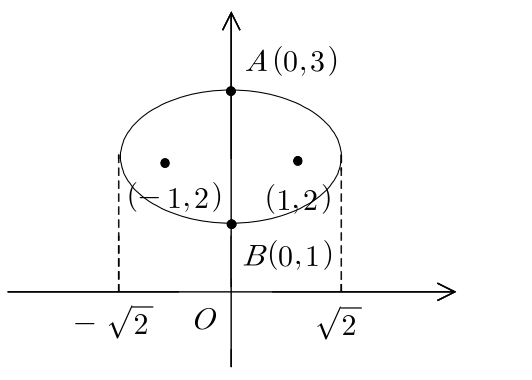
+3점 · 함수식을 이용하여 y \displaystyle y y y \displaystyle y y x = 0 \displaystyle x=0 x = 0
A ( 0 , 3 ) \displaystyle \mathrm{A}(0,~3) A ( 0 , 3 ) B ( 0 , 1 ) \displaystyle \mathrm{B}(0,~1) B ( 0 , 1 )
+6점 · 타원의 접선 방정식 구하여 접점의 좌표를 계산 [2] d x d t = − 2 sin t \displaystyle \frac{dx}{dt} = - \sqrt 2 \sin t d t d x = − 2 sin t d y d t = cos t \displaystyle \frac{dy}{dt} = \cos t d t d y = cos t
매개변수 함수의 미분공식에 의하여
d y d x = d y d t d x d t = cos t − 2 sin t = − 2 2 cos t sin t \displaystyle \frac{dy}{dx}=\frac{\frac{dy}{dt}}{\frac{dx}{dt}}=\frac{\cos t}{-\sqrt2\sin t}=-\frac{\sqrt2}2\frac{\cos t}{\sin t} d x d y = d t d x d t d y = − 2 sin t cos t = − 2 2 sin t cos t t ≠ 0 , t ≠ π \displaystyle t\ne0,~t\ne\pi t = 0 , t = π
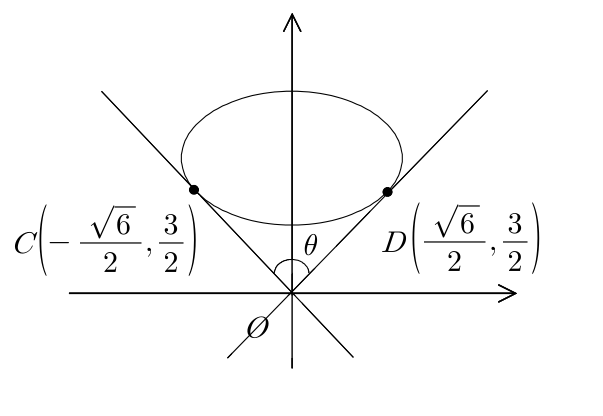
원점 O ( 0 , 0 ) \displaystyle \mathrm{O}(0,~0) O ( 0 , 0 ) y = a x \displaystyle y=ax y = a x t \displaystyle t t
2 + sin t = − 2 2 cos t sin t ⋅ 2 cos t \displaystyle 2+ \sin t = - \frac{\sqrt 2}{2} \frac{\cos t}{\sin t}\cdot \sqrt 2 \cos t 2 + sin t = − 2 2 sin t cos t ⋅ 2 cos t
t = 7 π 6 \displaystyle t= \frac{7\pi}6 t = 6 7 π 11 π 6 \displaystyle \frac{11\pi}{6} 6 11 π
따라서 두 접점의 좌표는 C ( − 6 2 , 3 2 ) \displaystyle \mathrm{C} \left ( - \frac{\sqrt6}{2} ,~ \frac{3}{2} \right ) C ( − 2 6 , 2 3 ) D ( 6 2 , 3 2 ) \displaystyle \mathrm{D} \left ( \frac{\sqrt 6}{2} ,~ \frac{3}{2} \right ) D ( 2 6 , 2 3 )
+4점 · 접점을 지나는 두 직선이 이루는 각을 계산 두 접선이 이루는 각의 코사인 값은 위치벡터 내적의 정의에 의하여
cos θ = O C → ⋅ O D → ∣ O C → ∣ ∣ O D → ∣ = ( − 6 2 ) ( 6 2 ) + ( 3 2 ) ( 3 2 ) ( − 6 2 ) 2 + ( 3 2 ) 2 ( 6 2 ) 2 + ( 3 2 ) 2 = 1 5 \displaystyle \cos\theta=\frac{\overrightarrow{\mathrm{OC}}\cdot\overrightarrow{\mathrm{OD}}}{|\overrightarrow{\mathrm{OC}}||\overrightarrow{\mathrm{OD}}|}=\frac{(-\frac{\sqrt6}2)(\frac{\sqrt6}2)+(\frac32)(\frac32)}{\sqrt{(-\frac{\sqrt6}2)^2+(\frac32)^2}\sqrt{(\frac{\sqrt6}2)^2+(\frac32)^2}}=\frac15 cos θ = ∣ OC ∣∣ OD ∣ OC ⋅ OD = ( − 2 6 ) 2 + ( 2 3 ) 2 ( 2 6 ) 2 + ( 2 3 ) 2 ( − 2 6 ) ( 2 6 ) + ( 2 3 ) ( 2 3 ) = 5 1
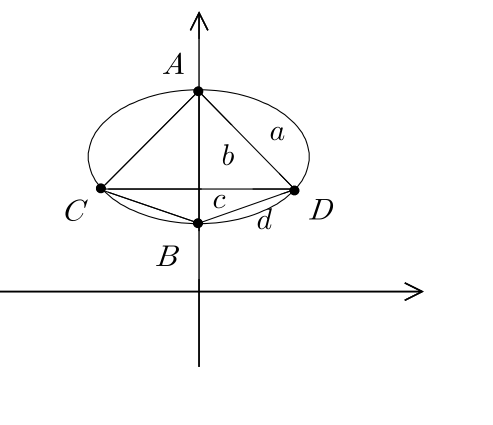
+5점 · 순서와 관계없이 같은 것이 포함된 경우의 수 계산 [3]
도형은 네 점을 잇는 선분들에 의해
y \displaystyle y y 4 \displaystyle 4 4 a , b , c , d \displaystyle a,~b,~c,~d a , b , c , d 2 \displaystyle 2 2
8 C 2 = 8 P 2 2 ! = 8 × 7 2 × 1 = 28 \displaystyle {}_8\mathrm{C}_2=\frac{{}_8\mathrm{P}_2}{2!}=\frac{8\times7}{2\times1}=28 8 C 2 = 2 ! 8 P 2 = 2 × 1 8 × 7 = 28
+3점 · 여사건의 경우의 수를 구하여 확률을 계산 선택된 두 영역이 y \displaystyle y y 4 \displaystyle 4 4
여사건의 확률에 의하여 두 영역이 대칭이 아닐 확률은
1 − 4 28 = 6 7 \displaystyle 1- \frac{4}{28} = \frac{6}{7} 1 − 28 4 = 7 6
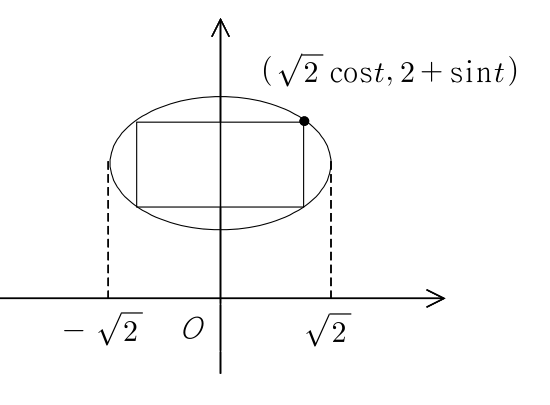
+6점 · 매개변수 t \displaystyle t t [4] 내접 직사각형의 한 꼭짓점의 좌표를 ( 2 cos t , 2 + sin t ) \displaystyle (\sqrt 2 \cos t ,~ 2+ \sin t ) ( 2 cos t , 2 + sin t ) 0 < t < π 2 \displaystyle 0 <t< \frac\pi2 0 < t < 2 π
직사각형의 가로 길이는 2 2 cos t \displaystyle 2\sqrt 2 \cos t 2 2 cos t 2 sin t \displaystyle 2 \sin t 2 sin t
따라서 넓이는 S ( t ) = 4 2 sin t cos t \displaystyle S(t) =4\sqrt 2 \sin t \cos t S ( t ) = 4 2 sin t cos t
+6점 · 이차함수의 증감을 이용하여 함수의 최댓값을 계산 Correction. 채점기준에서 ‘이차함수의 증감’이라고 쓴 부분은 S ( t ) = 4 2 sin t cos t \displaystyle S(t)=4\sqrt2\sin t\cos t S ( t ) = 4 2 sin t cos t
넓이의 최댓값을 구하기 위해
S ′ ( t ) = 4 2 ( cos 2 t − sin 2 t ) = 4 2 ( cos t + sin t ) ( cos t − sin t ) \displaystyle S^{\prime}(t) =4\sqrt 2 (\cos ^{2} t -\sin ^{2} t)= 4\sqrt 2 (\cos t +\sin t ) (\cos t -\sin t ) S ′ ( t ) = 4 2 ( cos 2 t − sin 2 t ) = 4 2 ( cos t + sin t ) ( cos t − sin t ) S ′ ( t ) = 0 \displaystyle S^{\prime}(t)=0 S ′ ( t ) = 0 t \displaystyle t t 0 < t < π 2 \displaystyle 0<t< \frac\pi2 0 < t < 2 π
S ( π 4 ) = 4 2 sin ( π 4 ) cos ( π 4 ) = 2 2 \displaystyle S \left ( \frac\pi4 \right )= 4 \sqrt 2 \sin \left ( \frac\pi4 \right ) \cos \left ( \frac\pi4 \right ) = 2\sqrt 2 S ( 4 π ) = 4 2 sin ( 4 π ) cos ( 4 π ) = 2 2
넓이 S ( t ) \displaystyle S(t) S ( t ) 2 2 \displaystyle 2\sqrt 2 2 2
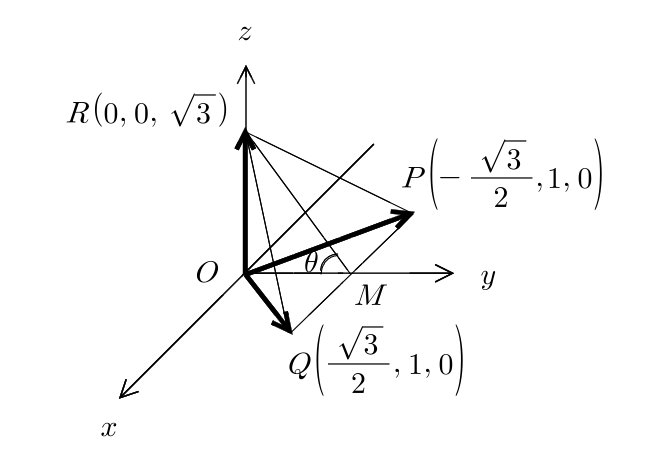
+6점 · 세 점을 지나는 평면의 방정식을 표현 [5]
P ( − 3 2 , 1 , 0 ) \displaystyle \mathrm{P} \left ( - \frac{\sqrt 3}{2} ,~ 1,~ 0 \right ) P ( − 2 3 , 1 , 0 ) Q ( 3 2 , 1 , 0 ) \displaystyle \mathrm{Q} \left ( \frac{\sqrt 3}{2} ,~ 1 ,~ 0 \right ) Q ( 2 3 , 1 , 0 )
P Q → = ( 3 , 0 , 0 ) \displaystyle \overrightarrow{\mathrm{PQ}} =(\sqrt 3 ,~ 0,~0) PQ = ( 3 , 0 , 0 ) ∣ P Q → ∣ = 3 \displaystyle |\overrightarrow{\mathrm{PQ}} | = \sqrt 3 ∣ PQ ∣ = 3
O R → = ( l , m , n ) \displaystyle \overrightarrow{\mathrm{OR}} =(l,~m,~n) OR = ( l , m , n )
O P → ⋅ O R → = − 3 2 l + m = 0 \displaystyle \overrightarrow{\mathrm{OP}} \cdot \overrightarrow{\mathrm{OR}} = - \frac{\sqrt 3}{2} l + m = 0 OP ⋅ OR = − 2 3 l + m = 0 O Q → ⋅ O R → = 3 2 l + m = 0 \displaystyle \overrightarrow{\mathrm{OQ}} \cdot \overrightarrow{\mathrm{OR}} = \frac{\sqrt 3}{2} l +m =0 OQ ⋅ OR = 2 3 l + m = 0
연립하면 l = m = 0 \displaystyle l= m=0 l = m = 0
구하는 위치벡터는 O R → = ( 0 , 0 , 3 ) \displaystyle \overrightarrow{\mathrm{OR}} =(0,~0,~\sqrt 3 ) OR = ( 0 , 0 , 3 )
평면의 방정식을 a x + b y + c z + d = 0 \displaystyle ax +by +cz +d=0 a x + b y + cz + d = 0
점 P ( − 3 2 , 1 , 0 ) \displaystyle \mathrm{P} \left ( - \frac{\sqrt 3}{2} ,~1,~0 \right ) P ( − 2 3 , 1 , 0 ) − 3 2 a + b + d = 0 \displaystyle - \frac{\sqrt 3}{2} a +b+ d=0 − 2 3 a + b + d = 0
점 Q ( 3 2 , 1 , 0 ) \displaystyle \mathrm{Q} \left ( \frac{\sqrt 3}{2} ,~1,~0 \right ) Q ( 2 3 , 1 , 0 ) 3 2 a + b + d = 0 \displaystyle \frac{\sqrt 3}{2} a + b+d=0 2 3 a + b + d = 0
점 R ( 0 , 0 , 3 ) \displaystyle \mathrm{R}(0,~0,~\sqrt 3 ) R ( 0 , 0 , 3 ) 3 c + d = 0 \displaystyle \sqrt 3 c +d =0 3 c + d = 0 a , b , c \displaystyle a,~b,~c a , b , c d \displaystyle d d a = 0 \displaystyle a=0 a = 0 b = − d \displaystyle b=-d b = − d c = − 3 3 d \displaystyle c=- \frac{\sqrt 3}{3} d c = − 3 3 d − d y − 3 3 d z + d = 0 \displaystyle -dy - \frac{\sqrt3}{3} dz +d =0 − d y − 3 3 d z + d = 0 Correction. 답안의 ‘직선의 방정식’은 문맥상 ‘평면의 방정식’의 오기이다. 해당 식은 세 점을 지나는 평면을 나타낸다. 그러나 원칙에 따라 원문 표기를 그대로 실었다.
d = 0 \displaystyle d=0 d = 0 a = b = c = 0 \displaystyle a=b=c=0 a = b = c = 0
d ≠ 0 \displaystyle d \ne 0 d = 0 P , Q , R \displaystyle \mathrm{P},~\mathrm{Q},~\mathrm{R} P , Q , R 3 y + 3 z − 3 = 0 \displaystyle 3y +\sqrt 3 z -3 =0 3 y + 3 z − 3 = 0
+6점 · 정사영의 넓이를 이용하여 두 평면이 이루는 각을 계산 세 점을 지나는 평면 위의 △ P Q R \displaystyle \triangle\mathrm{PQR} △ PQR x y \displaystyle xy x y △ P Q O \displaystyle \triangle\mathrm{PQO} △ PQO
△ P Q R \displaystyle \triangle\mathrm{PQR} △ PQR S \displaystyle S S △ P Q O \displaystyle \triangle\mathrm{PQO} △ PQO S ′ \displaystyle S^{\prime} S ′ θ \displaystyle \theta θ
따라서 cos θ = S ′ S = 1 2 ∣ P Q → ∣ ∣ M O → ∣ 1 2 ∣ P Q → ∣ ∣ M R → ∣ = 1 2 \displaystyle \cos\theta=\frac{S^{\prime}}S=\frac{\frac12|\overrightarrow{\mathrm{PQ}}||\overrightarrow{\mathrm{MO}}|}{\frac12|\overrightarrow{\mathrm{PQ}}||\overrightarrow{\mathrm{MR}}|}=\frac12 cos θ = S S ′ = 2 1 ∣ PQ ∣∣ MR ∣ 2 1 ∣ PQ ∣∣ MO ∣ = 2 1 θ = π 3 \displaystyle \theta=\frac\pi3 θ = 3 π
 수리논술, 배움에서 논증의 완성까지.