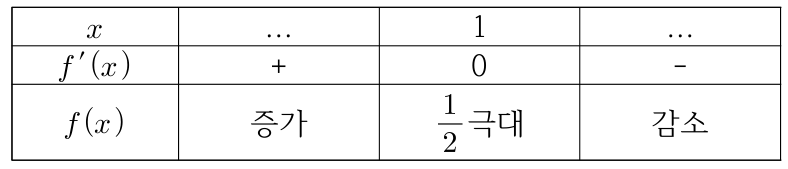
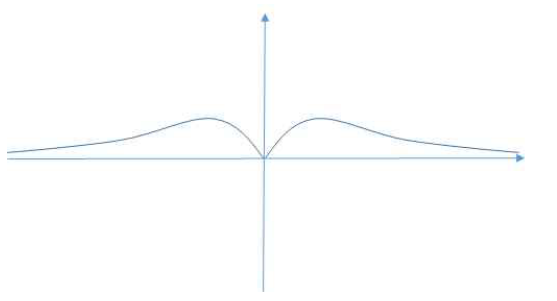
+5점 · f ′ ( x ) \displaystyle f^{\prime}(x) f ′ ( x ) f ′ ( 1 ) = 0 \displaystyle f^{\prime}(1)=0 f ′ ( 1 ) = 0 [1] f ( x ) = ∣ x 1 + x 2 ∣ \displaystyle f(x)=\left|\frac x{1+x^2}\right| f ( x ) = 1 + x 2 x y \displaystyle y y x > 0 \displaystyle x>0 x > 0
x > 0 \displaystyle x>0 x > 0 f ( x ) = x 1 + x 2 \displaystyle f(x)=\frac x{1+x^2} f ( x ) = 1 + x 2 x f ′ ( x ) = 1 − x 2 ( 1 + x 2 ) 2 \displaystyle f^{\prime}(x)=\frac{1-x^2}{(1+x^2)^2} f ′ ( x ) = ( 1 + x 2 ) 2 1 − x 2 f ′ ( 1 ) = 0 \displaystyle f^{\prime}(1)=0 f ′ ( 1 ) = 0
+5점 · lim x → ∞ x 1 + x 2 = 0 , ∣ x 1 + x 2 ∣ ≤ 1 2 \displaystyle \lim_{x\to\infty}\frac{x}{1+x^2}=0,~\left|\frac{x}{1+x^2}\right|\le\frac12 x → ∞ lim 1 + x 2 x = 0 , 1 + x 2 x ≤ 2 1 또 lim x → ∞ x 1 + x 2 = 0 \displaystyle \lim _{ x \to \infty } \frac{x}{ 1+x^{2} }=0 x → ∞ lim 1 + x 2 x = 0 f ( 0 ) = 0 \displaystyle f(0)=0 f ( 0 ) = 0
∣ x 1 + x 2 ∣ ≤ 1 2 \displaystyle \left|\frac x{1+x^2}\right|\le\frac12 1 + x 2 x ≤ 2 1 p \displaystyle p p 1 2 \displaystyle \frac12 2 1
+5점 · x 2 4 + y 2 = 1 \displaystyle \frac{x^2}4+y^2=1 4 x 2 + y 2 = 1 S \displaystyle S S [2] 타원의 방정식은 x 2 4 + y 2 = 1 \displaystyle \frac{x^2}4+y^2=1 4 x 2 + y 2 = 1 y = ± 1 − x 2 4 \displaystyle y=\pm\sqrt{1-\frac{x^2}4} y = ± 1 − 4 x 2 ( − 2 ≤ x ≤ 2 ) \displaystyle (-2\le x\le2) ( − 2 ≤ x ≤ 2 )
S = 2 ∫ − 3 3 1 − x 2 4 d x = 4 ∫ 0 3 1 − x 2 4 d x \displaystyle S=2\int_{-\sqrt3}^{\sqrt3}\sqrt{1-\frac{x^2}4}\,dx=4\int_0^{\sqrt3}\sqrt{1-\frac{x^2}4}\,dx S = 2 ∫ − 3 3 1 − 4 x 2 d x = 4 ∫ 0 3 1 − 4 x 2 d x
+5점 · 계산 한 적분값을 구하면 x = 2 cos θ \displaystyle x= 2 \cos \theta x = 2 cos θ ( 0 ≤ θ ≤ π 2 ) \displaystyle \left ( 0 \le \theta \le \frac\pi2 \right ) ( 0 ≤ θ ≤ 2 π ) d x = − 2 sin θ d θ \displaystyle dx = -2 \sin\theta d \theta d x = − 2 sin θ d θ
적분구간은 2 cos θ = 0 \displaystyle 2 \cos \theta =0 2 cos θ = 0 2 cos θ = 3 \displaystyle 2 \cos \theta = \sqrt 3 2 cos θ = 3 θ = π 2 \displaystyle \theta = \frac\pi2 θ = 2 π θ = π 6 \displaystyle \theta = \frac\pi6 θ = 6 π
S = 4 ∫ π 2 π 6 ( − 2 sin 2 θ ) d θ = − 4 ∫ π 2 π 6 ( 1 − cos 2 θ ) d θ = 3 + 4 3 π \displaystyle S= 4 \int _{ \frac\pi2 } ^{\frac\pi6 } {(-2 \sin ^{2} \theta )d \theta =-4 \int _{ \frac\pi2 } ^{\frac\pi6 } (1- \cos 2\theta ) d \theta = \sqrt 3 + \frac{4}{3} \pi { } } S = 4 ∫ 2 π 6 π ( − 2 sin 2 θ ) d θ = − 4 ∫ 2 π 6 π ( 1 − cos 2 θ ) d θ = 3 + 3 4 π
+5점 · H \displaystyle \mathrm{H} H ( − 2 3 , 4 3 , 2 3 ) \displaystyle (-\frac23,\frac43,\frac23) ( − 3 2 , 3 4 , 3 2 ) [3] 직선 O B \displaystyle \mathrm{OB} OB O B → \displaystyle \overrightarrow{\mathrm{OB}} OB ( − 1 , 2 , 1 ) \displaystyle (-1,2,1) ( − 1 , 2 , 1 ) O B \displaystyle \mathrm{OB} OB H \displaystyle \mathrm{H} H ( − t , 2 t , t ) \displaystyle (-t,2t,t) ( − t , 2 t , t ) A H \displaystyle \mathrm{AH} AH A H → = ( − t − 2 , 2 t − 3 , t ) \displaystyle \overrightarrow{\mathrm{AH}}=(-t-2,2t-3,t) AH = ( − t − 2 , 2 t − 3 , t ) O B → \displaystyle \overrightarrow{\mathrm{OB}} OB A H → ⋅ O B → = 6 t − 4 = 0 \displaystyle \overrightarrow{\mathrm{AH}}\cdot\overrightarrow{\mathrm{OB}}=6t-4=0 AH ⋅ OB = 6 t − 4 = 0 t = 2 3 \displaystyle t=\frac23 t = 3 2 H \displaystyle \mathrm{H} H ( − 2 3 , 4 3 , 2 3 ) \displaystyle (-\frac23,\frac43,\frac23) ( − 3 2 , 3 4 , 3 2 )
+5점 · O H ‾ \displaystyle \overline{\mathrm{OH}} OH 2 6 3 \displaystyle \frac{2\sqrt6}3 3 2 6 따라서 선분 O H ‾ \displaystyle \overline{\mathrm{OH}} OH 2 6 3 \displaystyle \frac{2\sqrt6}3 3 2 6
+5점 · g ( x ) = f ( x ) − x − cos ( π 2 x ) \displaystyle g(x)=f(x)-x-\cos(\frac\pi2x) g ( x ) = f ( x ) − x − cos ( 2 π x ) [4] g ( x ) = f ( x ) − x − cos ( π 2 x ) \displaystyle g(x)= f(x) -x -\cos \left ( \frac\pi2 x \right ) g ( x ) = f ( x ) − x − cos ( 2 π x )
+5점 · 양끝점에서 부호가 다름을 보이고 결론을 유도하면 g ( − 1 ) = f ( − 1 ) + 1 > 0 \displaystyle g(-1)=f(-1)+1>0 g ( − 1 ) = f ( − 1 ) + 1 > 0 g ( 1 ) = f ( 1 ) − 1 < 0 \displaystyle g(1)= f(1) -1<0 g ( 1 ) = f ( 1 ) − 1 < 0 g ( c ) = f ( c ) − c − cos ( π 2 c ) = 0 \displaystyle g(c)= f(c)- c-\cos \left ( \frac\pi2 c \right )=0 g ( c ) = f ( c ) − c − cos ( 2 π c ) = 0 c \displaystyle c c ( − 1 , 1 ) \displaystyle (-1,~1) ( − 1 , 1 ) f ( c ) = c + cos ( π 2 c ) \displaystyle f(c) =c+ \cos \left ( \frac\pi2 c \right ) f ( c ) = c + cos ( 2 π c ) c \displaystyle c c ( − 1 , 1 ) \displaystyle (-1,~1) ( − 1 , 1 )
+5점 · 부분 적분법을 올바로 한번 적용하면 [5] I n \displaystyle I_n I n
I n = ∫ 0 π / 2 x n sin x d x = ∫ 0 π / 2 x n ( − cos x ) ′ d x = − ∫ 0 π / 2 n x n − 1 ( − cos x ) d x − [ x n cos x ] 0 π / 2 = n ∫ 0 π / 2 x n − 1 cos x d x \displaystyle I_n=\int_0^{\pi/2}x^n\sin x\,dx=\int_0^{\pi/2}x^n(-\cos x)^{\prime}\,dx=-\int_0^{\pi/2}nx^{n-1}(-\cos x)\,dx-\Biggl[x^n\cos x\Biggr]_0^{\pi/2}=n\int_0^{\pi/2}x^{n-1}\cos x\,dx I n = ∫ 0 π /2 x n sin x d x = ∫ 0 π /2 x n ( − cos x ) ′ d x = − ∫ 0 π /2 n x n − 1 ( − cos x ) d x − [ x n cos x ] 0 π /2 = n ∫ 0 π /2 x n − 1 cos x d x n ≥ 1 \displaystyle n\ge1 n ≥ 1
+5점 · 부분 적분법을 올바로 두 번 적용하고 답이 맞으면 위 식에 부분 적분법을 적용하면
I n = n ∫ 0 π / 2 x n − 1 ( sin x ) ′ d x = − n ( n − 1 ) ∫ 0 π / 2 x n − 2 sin x d x + [ n x n − 1 sin x ] 0 π / 2 \displaystyle I_n=n\int_0^{\pi/2}x^{n-1}(\sin x)^{\prime}\,dx=-n(n-1)\int_0^{\pi/2}x^{n-2}\sin x\,dx+\Biggl[nx^{n-1}\sin x\Biggr]_0^{\pi/2} I n = n ∫ 0 π /2 x n − 1 ( sin x ) ′ d x = − n ( n − 1 ) ∫ 0 π /2 x n − 2 sin x d x + [ n x n − 1 sin x ] 0 π /2 n ≥ 2 \displaystyle n\ge2 n ≥ 2
여기서 ∫ 0 π / 2 x n − 2 sin x d x \displaystyle \int_0^{\pi/2}x^{n-2}\sin x\,dx ∫ 0 π /2 x n − 2 sin x d x I n − 2 \displaystyle I_{n-2} I n − 2 [ n x n − 1 sin x ] 0 π / 2 = n ( π 2 ) n − 1 \displaystyle \Biggl[nx^{n-1}\sin x\Biggr]_0^{\pi/2}=n(\frac\pi2)^{n-1} [ n x n − 1 sin x ] 0 π /2 = n ( 2 π ) n − 1
I n + n ( n − 1 ) I n − 2 = n ( π 2 ) n − 1 \displaystyle I_n+n(n-1)I_{n-2}=n(\frac\pi2)^{n-1} I n + n ( n − 1 ) I n − 2 = n ( 2 π ) n − 1 n = 100 \displaystyle n=100 n = 100 100 ( π 2 ) 99 \displaystyle 100(\frac\pi2)^{99} 100 ( 2 π ) 99
 수리논술, 배움에서 논증의 완성까지.