수리논술, 이게 다다.

자연계열 2번

오류 제보

문제

[문제 2] (50점) 다음 제시문을 읽고 문항별로 풀이와 함께 답하시오.

1. 속도

수직선 위를 움직이는 점 P\displaystyle \mathrm{P}의 시각 t\displaystyle t에서의 좌표가 x=f(t)\displaystyle x =f(t)일 때, 점 P\displaystyle \mathrm{P}의 시각 t\displaystyle t에서의 속도 v\displaystyle v는 v(t)=dxdt=f′(t)\displaystyle v(t)= \frac{dx}{dt} = f^{\prime}(t)이다.

2. 좌극한과 우극한

x\displaystyle x의 값이 a\displaystyle a보다 작으면서 a\displaystyle a에 한없이 가까워질 때, f(x)\displaystyle f(x)의 값이 일정한 값 p\displaystyle p에 한없이 가까워지면 p\displaystyle p를 x=a\displaystyle x=a에서 함수 f(x)\displaystyle f(x)의 좌극한이라 하고, 기호로 lim⁡x→a−f(x)=p\displaystyle \lim _{x \to a-} f(x)=p와 같이 나타낸다. 또 x\displaystyle x의 값이 a\displaystyle a보다 큰 값을 가지면서 a\displaystyle a에 한없이 가까워질 때, f(x)\displaystyle f(x)의 값이 일정한 값 q\displaystyle q에 한없이 가까워지면 q\displaystyle q를 x=a\displaystyle x=a에서 함수 f(x)\displaystyle f(x)의 우극한이라 하고, 기호로 lim⁡x→a+f(x)=q\displaystyle \lim _{x \to a+}f(x)=q와 같이 나타낸다.

3. 함수의 연속

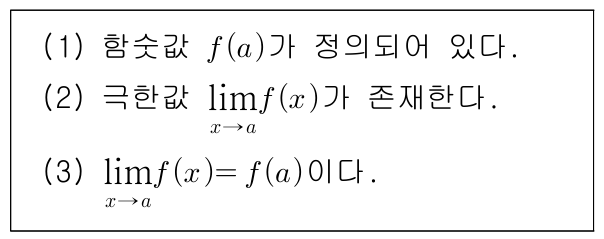
함수 f(x)\displaystyle f(x)가 실수 a\displaystyle a에 대하여 다음 조건을 만족시킬 때, 함수 f(x)\displaystyle f(x)는 x=a\displaystyle x=a에서 연속이라고 한다.

함수의 연속 조건: (1) 함숫값 f(a)가 정의되어 있다. (2) x가 a로 갈 때 f(x)의 극한값이 존재한다. (3) 그 극한값이 f(a)이다.

4. 함수의 극한의 대소 관계

lim⁡x→af(x)=p\displaystyle \lim _{x \to a} f(x)=p, lim⁡x→ag(x)=q\displaystyle \lim _{x \to a} g(x) =q (p, q\displaystyle p,~q는 실수)일 때, a\displaystyle a에 가까운 모든 x\displaystyle x의 값에 대하여

f(x)≤h(x)≤g(x)\displaystyle f(x)\le h(x)\le g(x)이고 p=q\displaystyle p=q이면 lim⁡x→ah(x)=p\displaystyle \lim _{x \to a} h(x)=p이다.

5. 미분 가능의 정의

함수 y=f(x)\displaystyle y=f(x)에서 x\displaystyle x의 값이 a\displaystyle a에서 a+h\displaystyle a+h까지 변할 때, x\displaystyle x의 증분은 Δx=(a+h)−a=h\displaystyle \Delta x = (a+h)-a=h이다. 이때 y\displaystyle y의 증분은 Δy=f(a+h)−f(a)\displaystyle \Delta y = f(a+h)-f(a)이므로 이 함수의 평균변화율은

ΔyΔx=f(a+h)−f(a)h\displaystyle \frac{\Delta y}{\Delta x} = \frac{f(a+h)-f(a)}{h}

이다. 여기서 Δx→0\displaystyle \Delta x\to0일 때, 평균변화율의 극한값

lim⁡Δx→0ΔyΔx=lim⁡h→0f(a+h)−f(a)h\displaystyle \lim _{\Delta x \to 0} \frac{\Delta y}{\Delta x}= \lim _{h \to 0} \frac{f(a+h)-f(a)}{h}

가 존재하면 함수 y=f(x)\displaystyle y=f(x)는 x=a\displaystyle x=a에서 미분가능하다고 한다.

6. 함수 f(x)\displaystyle f(x)가 구간 [a, b]\displaystyle [ a,~b ]에서 연속이고 구간 (a, b)\displaystyle \left ( a,~b \right )에서 미분가능하며, 구간 (a, b)\displaystyle \left ( a,~b \right )의 모든 x\displaystyle x에 대하여 f′(x)=0\displaystyle f^{\prime}(x) =0이면 f(x)\displaystyle f(x)는 구간 [a, b]\displaystyle [ a,~b ]에서 상수함수이다.

[1] 좌표가 0\displaystyle 0인 점을 출발하여 수직선 위를 움직이는 점 P\displaystyle \mathrm{P}의 시각 t\displaystyle t에서의 좌표가 x=−t3+15t2\displaystyle x=-t^{3} +15t^{2}이다. 점 P\displaystyle \mathrm{P}의 운동 방향이 처음으로 바뀌는 시각을 구하여라. (t>0)\displaystyle (t>0) [6점]

[2] 구간 (0, ∞)\displaystyle \left ( 0,~ \infty \right )에서 정의된 다음 함수 f(x)\displaystyle f(x)는 x=1\displaystyle x=1에서 연속이다. 이때 a\displaystyle a와 b\displaystyle b의 값을 구하시오. (a, b\displaystyle a,~b는 상수이고 b≠0\displaystyle b\ne 0) [10점]

f(x)={lim⁡n→∞axn+3−x2+x+bxn+1(x≠1)ab(x=1)\displaystyle f(x)=\begin{cases}\displaystyle\lim_{n\to\infty}\frac{ax^{n+3}-x^2+x+b}{x^n+1}&(x\ne1)\\\dfrac ab&(x=1)\end{cases}

[3] 함수 f(x)=∣2x−k∣\displaystyle f(x) = | 2x-k |의 그래프와 x\displaystyle x축, y\displaystyle y축 및 직선 x=1\displaystyle x=1로 둘러싸인 도형의 넓이를 S(k)\displaystyle S (k)라고 하자. S(12)\displaystyle S \left ( \frac{1}{2} \right )의 값과 S(k)\displaystyle S(k)의 최솟값을 구하시오. (0≤k≤2\displaystyle 0\le k\le 2) [14점]

[4] 함수 f(x)\displaystyle f(x)에 대한 다음 두 조건 p, q\displaystyle p,~q에 대하여 p\displaystyle p는 q\displaystyle q이기 위한 필요충분조건이다. p\displaystyle p가 q\displaystyle q이기 위한 충분조건임을 다음 순서에 따라 증명할 때, 물음에 답하시오.

p\displaystyle p : 모든 실수 x, y\displaystyle x,~y에 대하여, f(x+y)=f(x)+f(y)\displaystyle f(x+y)= f(x)+f(y)이고 ∣f(x)∣≤x2\displaystyle | f(x) |\le x^{2}이다.

q\displaystyle q : 모든 실수 x\displaystyle x에 대하여, f(x)=0\displaystyle f(x)=0이다.

(1) f(0)=0\displaystyle f(0)=0임을 보이시오. [3점]

(2) f(x)\displaystyle f(x)는 x=0\displaystyle x=0에서 미분 가능함을 보이시오. [8점]

(3) f(x)\displaystyle f(x)는 모든 실수 x\displaystyle x에서 미분 가능함을 보이시오. [6점]

(4) f(x)=0\displaystyle f(x)=0임을 보이시오. [3점]

해설강의 준비중

미분계수와 미분가능성

관련 개념강의 준비중
+4점 · 속도 dxdt=−3t2+30t\displaystyle \dfrac{dx}{dt}=-3t^2+30t를 올바로 구한다.

[1] 운동 방향이 바뀌는 시각의 속도는 0이다.

v(t)=−3t2+30t\displaystyle v(t)=-3t^2+30t

+2점 · 속도를 인수분해하여 정답 t=10\displaystyle t=10을 얻는다.

=−3t(t−10)=0\displaystyle =-3t(t-10)=0이다. t>0\displaystyle t>0이므로 t=10\displaystyle t=10이다.

+3점 · lim⁡x→1−f(x)=b\displaystyle \lim_{x\to1-}f(x)=b를 얻는다.

[2] 0<x<1\displaystyle 0<x<1일 때, lim⁡n→∞xn=0\displaystyle \lim_{n\to\infty}x^n=0이므로 lim⁡x→1−f(x)=b\displaystyle \lim_{x\to1-}f(x)=b

+4점 · lim⁡x→1+f(x)=a\displaystyle \lim_{x\to1+}f(x)=a를 얻는다.

x>1\displaystyle x>1일 때, lim⁡n→∞xn=∞\displaystyle \lim_{n\to\infty}x^n=\infty이므로

lim⁡n→∞axn+3−x2+x+bxn+1=lim⁡n→∞ax3−x2xn+xxn+bxn1+1xn=ax3\displaystyle \lim_{n\to\infty}\frac{ax^{n+3}-x^2+x+b}{x^n+1}=\lim_{n\to\infty}\frac{ax^3-\dfrac{x^2}{x^n}+\dfrac{x}{x^n}+\dfrac b{x^n}}{1+\dfrac1{x^n}}=ax^3

따라서 lim⁡x→1+f(x)=a\displaystyle \lim_{x\to1+}f(x)=a이다.

+3점 · 연속인 조건을 활용하여 a=1, b=1\displaystyle a=1,~b=1을 얻는다.

f(x)\displaystyle f(x)가 x=1\displaystyle x=1에서 연속이므로 a=b\displaystyle a=b이고 f(1)=ab=1\displaystyle f(1)=\dfrac ab=1이므로 a=1, b=1\displaystyle a=1,~b=1

+3점 · S(k)=∫0k2(k−2x) dx+∫k21(2x−k) dx\displaystyle S(k)=\displaystyle\int_0^{\frac k2}(k-2x)\,dx+\int_{\frac k2}^1(2x-k)\,dx를 얻는다.

[3] S(k)=∫0k2(k−2x) dx+∫k21(2x−k) dx\displaystyle S(k)=\displaystyle\int_0^{\frac k2}(k-2x)\,dx+\int_{\frac k2}^1(2x-k)\,dx

+3점 · 정적분의 계산을 통해 S(k)=k22−k+1\displaystyle S(k)=\dfrac{k^2}{2}-k+1을 얻는다.

=[kx−x2]0k2+[x2−kx]k21\displaystyle =\Biggl[kx-x^2\Biggr]_0^{\frac k2}+\Biggl[x^2-kx\Biggr]_{\frac k2}^1

=k22−k+1\displaystyle =\dfrac{k^2}2-k+1

+5점 · S(12)=58\displaystyle S\left(\dfrac12\right)=\dfrac58을 얻는다.

따라서 S(12)=58\displaystyle S\left(\dfrac12\right)=\dfrac58

+3점 · k=1\displaystyle k=1 (0≤k≤2\displaystyle 0\le k\le2)일 때 S(k)\displaystyle S(k)의 최솟값 12\displaystyle \dfrac12을 얻는다.

또한 S(k)=12(k2−2k+2)=12(k−1)2+12\displaystyle S(k)=\dfrac12(k^2-2k+2)=\dfrac12(k-1)^2+\dfrac12이므로 S(k)\displaystyle S(k)의 최솟값은 k=1\displaystyle k=1 (0≤k≤2\displaystyle 0\le k\le2)일 때 12\displaystyle \dfrac12이다.

+3점 · f(0)=f(0)+f(0)\displaystyle f(0)=f(0)+f(0) 또는 ∣f(0)∣≤0\displaystyle |f(0)|\le0를 통해 f(0)=0\displaystyle f(0)=0임을 보인다.

[4] (1) f(0)=f(0)+f(0)\displaystyle f(0)=f(0)+f(0)이므로 f(0)=0\displaystyle f(0)=0이다.

(또는 ∣f(0)∣≤0\displaystyle |f(0)|\le0이므로 f(0)=0\displaystyle f(0)=0이다.)

+4점 · 제시문 4를 활용하여 −∣h∣≤f(h)h≤∣h∣\displaystyle -|h|\le\dfrac{f(h)}h\le|h|을 얻는다.

(2) ∣f(x)∣≤x2\displaystyle |f(x)|\le x^2이므로 ∣f(h)h∣≤h2∣h∣=∣h∣\displaystyle \left|\dfrac{f(h)}h\right|\le\dfrac{h^2}{|h|}=|h| 즉, −∣h∣≤f(h)h≤∣h∣\displaystyle -|h|\le\dfrac{f(h)}h\le|h|

+4점 · f′(0)=lim⁡h→0f(h)−f(0)h=0\displaystyle f^{\prime}(0)=\lim_{h\to0}\dfrac{f(h)-f(0)}h=0이므로 f(x)\displaystyle f(x)는 0에서 미분가능하다는 결론을 도출한다.

따라서 lim⁡h→0f(h)h=0\displaystyle \lim_{h\to0}\dfrac{f(h)}h=0이고 f′(0)=lim⁡h→0f(h)−f(0)h=0\displaystyle f^{\prime}(0)=\lim_{h\to0}\dfrac{f(h)-f(0)}h=0이므로 f(x)\displaystyle f(x)는 0에서 미분 가능하다.

+4점 · f′(x)=lim⁡h→0f(x+h)−f(x)h=lim⁡h→0f(h)h=f′(0)=0\displaystyle f^{\prime}(x)=\lim_{h\to0}\dfrac{f(x+h)-f(x)}h=\lim_{h\to0}\dfrac{f(h)}h=f^{\prime}(0)=0임을 얻는다.

(3) f′(x)=lim⁡h→0f(x+h)−f(x)h=lim⁡h→0f(h)h=f′(0)=0\displaystyle f^{\prime}(x)=\lim_{h\to0}\dfrac{f(x+h)-f(x)}h=\lim_{h\to0}\dfrac{f(h)}h=f^{\prime}(0)=0

+2점 · f′(x)\displaystyle f^{\prime}(x)가 존재하므로 모든 실수 x\displaystyle x에 대해 미분가능하다고 결론짓는다.

따라서 f(x)\displaystyle f(x)는 모든 실수 x\displaystyle x에서 미분 가능하다.

+3점 · 모든 실수 x\displaystyle x에 대하여 f′(x)=0\displaystyle f^{\prime}(x)=0이므로 제시문 6을 활용하여 f(x)=0\displaystyle f(x)=0임을 도출한다.

(4) 모든 실수 x\displaystyle x에 대해 f′(x)=0\displaystyle f^{\prime}(x)=0이므로 f(x)\displaystyle f(x)는 상수함수이다. 그런데 f(0)=0\displaystyle f(0)=0이므로 모든 실수 x\displaystyle x에 대하여 f(x)=0\displaystyle f(x)=0이다.

첨삭 사례

아직 등록된 첨삭 사례가 없습니다.

질문과 답변 · 0개질문과 답변 · 고정 0개

아직 등록된 질문이 없습니다. 질문 작성은 멤버십 회원만 가능합니다.