+2점 · 근거를 제시하고 Q n \displaystyle Q_n Q n ( log 3 n , n ) \displaystyle (\log_3n,n) ( log 3 n , n ) [1] (1) 두 점 P n , Q n \displaystyle P_n,~Q_n P n , Q n y = x \displaystyle y=x y = x Q n \displaystyle Q_n Q n ( log 3 n , n ) \displaystyle (\log_3n,n) ( log 3 n , n )
+8점 · 삼각형의 넓이 a n \displaystyle a_n a n a n \displaystyle a_n a n (2) 세 점 A n ( n , 0 ) , B n ( n , n ) , C n ( 0 , n ) \displaystyle A_n(n,0),~B_n(n,n),~C_n(0,n) A n ( n , 0 ) , B n ( n , n ) , C n ( 0 , n ) O P n Q n \displaystyle OP_nQ_n O P n Q n a n \displaystyle a_n a n O A n B n C n \displaystyle OA_nB_nC_n O A n B n C n O A n P n \displaystyle OA_nP_n O A n P n O Q n C n \displaystyle OQ_nC_n O Q n C n P n B n Q n \displaystyle P_nB_nQ_n P n B n Q n
( 사각형 O A n B n C n 의 넓이 ) = n 2 \displaystyle (\text{사각형 }OA_nB_nC_n\text{의 넓이})=n^2 ( 사각형 O A n B n C n 의 넓이 ) = n 2
( 삼각형 O A n P n 의 넓이 ) = ( 삼각형 O Q n C n 의 넓이 ) = 1 2 n log 3 n \displaystyle (\text{삼각형 }OA_nP_n\text{의 넓이})=(\text{삼각형 }OQ_nC_n\text{의 넓이})=\dfrac12n\log_3n ( 삼각형 O A n P n 의 넓이 ) = ( 삼각형 O Q n C n 의 넓이 ) = 2 1 n log 3 n
( 삼각형 P n B n Q n 의 넓이 ) = 1 2 ( n − log 3 n ) 2 \displaystyle (\text{삼각형 }P_nB_nQ_n\text{의 넓이})=\dfrac12(n-\log_3n)^2 ( 삼각형 P n B n Q n 의 넓이 ) = 2 1 ( n − log 3 n ) 2
따라서 a n = n 2 − n log 3 n − 1 2 ( n − log 3 n ) 2 = 1 2 n 2 − 1 2 ( log 3 n ) 2 \displaystyle a_n=n^2-n\log_3n-\dfrac12(n-\log_3n)^2=\dfrac12n^2-\dfrac12(\log_3n)^2 a n = n 2 − n log 3 n − 2 1 ( n − log 3 n ) 2 = 2 1 n 2 − 2 1 ( log 3 n ) 2
+2점 · 제시된 수열의 합을 올바로 구한다. (3) ∑ k = 1 n { 2 a k + ( log 3 k ) 2 } = ∑ k = 1 n k 2 = n ( n + 1 ) ( 2 n + 1 ) 6 \displaystyle\sum_{k=1}^n\{2a_k+(\log_3k)^2\}=\sum_{k=1}^nk^2=\dfrac{n(n+1)(2n+1)}6 k = 1 ∑ n { 2 a k + ( log 3 k ) 2 } = k = 1 ∑ n k 2 = 6 n ( n + 1 ) ( 2 n + 1 )
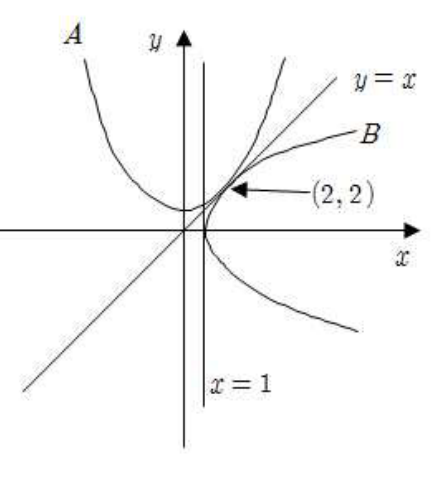
+2점 · 도형 A \displaystyle A A B \displaystyle B B [2] (1) 도형 A \displaystyle A A x 2 − 4 y + 4 = 0 \displaystyle x^2-4y+4=0 x 2 − 4 y + 4 = 0 B \displaystyle B B y 2 − 4 x + 4 = 0 \displaystyle y^2-4x+4=0 y 2 − 4 x + 4 = 0
y \displaystyle y y x 4 + 8 x 2 − 64 x + 80 = ( x − 2 ) 2 ( x 2 + 4 x + 20 ) = 0 \displaystyle x^4+8x^2-64x+80=(x-2)^2(x^2+4x+20)=0 x 4 + 8 x 2 − 64 x + 80 = ( x − 2 ) 2 ( x 2 + 4 x + 20 ) = 0
x 2 + 4 x + 20 = 0 \displaystyle x^2+4x+20=0 x 2 + 4 x + 20 = 0 D 4 = 4 − 20 < 0 \displaystyle \dfrac D4=4-20<0 4 D = 4 − 20 < 0 ( x − 2 ) 2 ( x 2 + 4 x + 20 ) = 0 \displaystyle (x-2)^2(x^2+4x+20)=0 ( x − 2 ) 2 ( x 2 + 4 x + 20 ) = 0 x = 2 \displaystyle x=2 x = 2
그러므로 도형 A \displaystyle A A B \displaystyle B B ( 2 , 2 ) \displaystyle (2,2) ( 2 , 2 )
+8점 · 입체도형의 부피를 올바로 구한다.
입체도형의 부피를 올바로 구하지 못한 경우, 풀이 과정 안에서 부분점수를 부여할 수 있지만 최대 4점까지로 제한한다. (2) 도형 A \displaystyle A A y = 1 4 x 2 + 1 \displaystyle y=\dfrac14x^2+1 y = 4 1 x 2 + 1 x = 2 \displaystyle x=2 x = 2 y = x \displaystyle y=x y = x [ 0 , 1 ] \displaystyle [0,1] [ 0 , 1 ] x \displaystyle x x x \displaystyle x x S ( x ) \displaystyle S(x) S ( x ) 1 4 x 2 − x + 1 \displaystyle \dfrac14x^2-x+1 4 1 x 2 − x + 1
S ( x ) = 1 2 ( 1 4 x 2 − x + 1 ) 2 sin π 3 = 3 4 ( x 4 16 − x 3 2 + 3 2 x 2 − 2 x + 1 ) \displaystyle S(x)=\dfrac12\left(\dfrac14x^2-x+1\right)^2\sin\dfrac\pi3=\dfrac{\sqrt3}4\left(\dfrac{x^4}{16}-\dfrac{x^3}2+\dfrac32x^2-2x+1\right) S ( x ) = 2 1 ( 4 1 x 2 − x + 1 ) 2 sin 3 π = 4 3 ( 16 x 4 − 2 x 3 + 2 3 x 2 − 2 x + 1 )
구하는 입체의 부피 V \displaystyle V V
V = 3 4 ∫ 0 1 ( x 4 16 − x 3 2 + 3 2 x 2 − 2 x + 1 ) d x = 3 4 [ x 5 80 − x 4 8 + x 3 2 − x 2 + x ] 0 1 = 31 3 320 \displaystyle \begin{aligned}V&=\dfrac{\sqrt3}4\int_0^1\left(\dfrac{x^4}{16}-\dfrac{x^3}2+\dfrac32x^2-2x+1\right)dx\\&=\dfrac{\sqrt3}4\Biggl[\dfrac{x^5}{80}-\dfrac{x^4}8+\dfrac{x^3}2-x^2+x\Biggr]_0^1=\dfrac{31\sqrt3}{320}\end{aligned} V = 4 3 ∫ 0 1 ( 16 x 4 − 2 x 3 + 2 3 x 2 − 2 x + 1 ) d x = 4 3 [ 80 x 5 − 8 x 4 + 2 x 3 − x 2 + x ] 0 1 = 320 31 3
+2점 · 근과 계수의 관계를 이용해 a \displaystyle a a [3] f ′ ( x ) = 3 a x 2 + 2 b x + 1 = 0 \displaystyle f^{\prime}(x)=3ax^2+2bx+1=0 f ′ ( x ) = 3 a x 2 + 2 b x + 1 = 0 cos θ , sec θ \displaystyle \cos\theta,~\sec\theta cos θ , sec θ
근과 계수의 관계에 의해 cos θ sec θ = 1 = 1 3 a \displaystyle \cos\theta\sec\theta=1=\dfrac1{3a} cos θ sec θ = 1 = 3 a 1 a = 1 3 \displaystyle a=\dfrac13 a = 3 1
+4점 · f ′ ( x ) \displaystyle f^{\prime}(x) f ′ ( x ) f ( x ) \displaystyle f(x) f ( x ) 만약 f ′ ( x ) = 0 \displaystyle f^{\prime}(x)=0 f ′ ( x ) = 0 θ = 0 \displaystyle \theta=0 θ = 0 x = cos 0 = sec 0 = 1 \displaystyle x=\cos0=\sec0=1 x = cos 0 = sec 0 = 1 f ′ ( x ) = ( x − 1 ) 2 ≥ 0 \displaystyle f^{\prime}(x)=(x-1)^2\ge0 f ′ ( x ) = ( x − 1 ) 2 ≥ 0 f ( x ) \displaystyle f(x) f ( x ) f ( x ) \displaystyle f(x) f ( x )
그러므로 방정식 f ′ ( x ) = 0 \displaystyle f^{\prime}(x)=0 f ′ ( x ) = 0
D 4 = b 2 − 3 a = b 2 − 1 > 0 \displaystyle \dfrac D4=b^2-3a=b^2-1>0 4 D = b 2 − 3 a = b 2 − 1 > 0 b > 1 \displaystyle b>1 b > 1 b < − 1 \displaystyle b<-1 b < − 1 ⋯ ⋯ \displaystyle \cdots\cdots ⋯⋯
+4점 · 근과 계수의 관계를 이용해 b \displaystyle b b 한편 근과 계수의 관계에 의해 − 2 b = cos θ + sec θ \displaystyle -2b=\cos\theta+\sec\theta − 2 b = cos θ + sec θ
주어진 범위 − π 2 < θ < π 2 \displaystyle -\dfrac\pi2<\theta<\dfrac\pi2 − 2 π < θ < 2 π cos θ \displaystyle \cos\theta cos θ sec θ \displaystyle \sec\theta sec θ
− 2 b = cos θ + sec θ ≥ 2 cos θ sec θ = 2 \displaystyle -2b=\cos\theta+\sec\theta\ge2\sqrt{\cos\theta\sec\theta}=2 − 2 b = cos θ + sec θ ≥ 2 cos θ sec θ = 2 b ≤ − 1 \displaystyle b\le-1 b ≤ − 1 ⋯ ⋯ \displaystyle \cdots\cdots ⋯⋯
+4점 · b \displaystyle b b x = cos θ \displaystyle x=\cos\theta x = cos θ x = sec θ \displaystyle x=\sec\theta x = sec θ ㉠과 ㉡에 의해 b < − 1 \displaystyle b<-1 b < − 1
이 경우 f ′ ( x ) = ( x − cos θ ) ( x − sec θ ) \displaystyle f^{\prime}(x)=(x-\cos\theta)(x-\sec\theta) f ′ ( x ) = ( x − cos θ ) ( x − sec θ ) ( − π 2 , π 2 ) \displaystyle \left(-\dfrac\pi2,\dfrac\pi2\right) ( − 2 π , 2 π ) 0 < cos θ ≤ 1 \displaystyle 0<\cos\theta\le1 0 < cos θ ≤ 1 1 ≤ sec θ \displaystyle 1\le\sec\theta 1 ≤ sec θ
따라서 제시문 3에 의해 f ( x ) \displaystyle f(x) f ( x ) x = cos θ \displaystyle x=\cos\theta x = cos θ x = sec θ \displaystyle x=\sec\theta x = sec θ
+6점 · a = 3 \displaystyle a=3 a = 3 a = 3 \displaystyle a=3 a = 3 [4] f ( x ) = tan 3 x − a x \displaystyle f(x)=\tan3x-ax f ( x ) = tan 3 x − a x
f ′ ( x ) = 3 sec 2 3 x − a \displaystyle f^{\prime}(x)=3\sec^23x-a f ′ ( x ) = 3 sec 2 3 x − a
f ′ ′ ( x ) = ( 18 sec 2 3 x ) tan 3 x \displaystyle f^{\prime\prime}(x)=(18\sec^23x)\tan3x f ′′ ( x ) = ( 18 sec 2 3 x ) tan 3 x
구간 ( 0 , π 6 ) \displaystyle \left(0,\dfrac\pi6\right) ( 0 , 6 π ) f ′ ′ ( x ) > 0 \displaystyle f^{\prime\prime}(x)>0 f ′′ ( x ) > 0
제시문 4에 의해 구간 ( 0 , π 6 ) \displaystyle \left(0,\dfrac\pi6\right) ( 0 , 6 π ) f ′ ( x ) \displaystyle f^{\prime}(x) f ′ ( x ) ⋯ ⋯ \displaystyle \cdots\cdots ⋯⋯
만약 f ′ ( 0 ) ≥ 0 \displaystyle f^{\prime}(0)\ge0 f ′ ( 0 ) ≥ 0 f ′ ( 0 ) = 3 − a ≥ 0 \displaystyle f^{\prime}(0)=3-a\ge0 f ′ ( 0 ) = 3 − a ≥ 0 ⋯ ⋯ \displaystyle \cdots\cdots ⋯⋯
㉠에 의해 구간 ( 0 , π 6 ) \displaystyle \left(0,\dfrac\pi6\right) ( 0 , 6 π ) f ′ ( x ) > 0 \displaystyle f^{\prime}(x)>0 f ′ ( x ) > 0 f ( x ) \displaystyle f(x) f ( x )
그런데 f ( 0 ) = 0 \displaystyle f(0)=0 f ( 0 ) = 0 ( 0 , π 6 ) \displaystyle \left(0,\dfrac\pi6\right) ( 0 , 6 π ) f ( x ) > 0 \displaystyle f(x)>0 f ( x ) > 0 tan 3 x > a x \displaystyle \tan3x>ax tan 3 x > a x
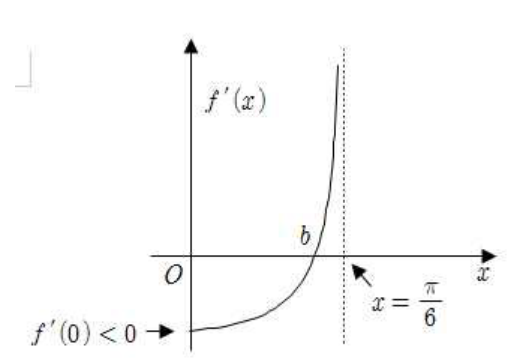
+8점 · a > 3 \displaystyle a>3 a > 3 a > 3 \displaystyle a>3 a > 3 만약 f ′ ( 0 ) < 0 \displaystyle f^{\prime}(0)<0 f ′ ( 0 ) < 0 f ′ ( 0 ) = 3 − a < 0 \displaystyle f^{\prime}(0)=3-a<0 f ′ ( 0 ) = 3 − a < 0
어떤 b \displaystyle b b ( 0 , b ) \displaystyle (0,b) ( 0 , b ) f ( x ) < 0 \displaystyle f(x)<0 f ( x ) < 0 tan 3 x < a x \displaystyle \tan3x<ax tan 3 x < a x
왜냐하면 lim x → π 6 + f ′ ( x ) = ∞ \displaystyle \lim_{x\to\frac\pi6+}f^{\prime}(x)=\infty x → 6 π + lim f ′ ( x ) = ∞ Correction. 구간 ( 0 , π 6 ) \displaystyle \left(0,\frac\pi6\right) ( 0 , 6 π ) lim x → π 6 − f ′ ( x ) = ∞ \displaystyle \lim_{x\to\frac\pi6-}f^{\prime}(x)=\infty x → 6 π − lim f ′ ( x ) = ∞ + \displaystyle + + − \displaystyle - −
f ′ ( x ) \displaystyle f^{\prime}(x) f ′ ( x ) f ′ ( 0 ) < 0 \displaystyle f^{\prime}(0)<0 f ′ ( 0 ) < 0 f ′ ( b ) = 0 \displaystyle f^{\prime}(b)=0 f ′ ( b ) = 0 b ∈ ( 0 , π 6 ) \displaystyle b\in\left(0,\dfrac\pi6\right) b ∈ ( 0 , 6 π )
그러면 구간 ( 0 , b ) \displaystyle (0,b) ( 0 , b ) f ′ ( x ) < 0 \displaystyle f^{\prime}(x)<0 f ′ ( x ) < 0 f ( x ) \displaystyle f(x) f ( x )
f ( 0 ) = 0 \displaystyle f(0)=0 f ( 0 ) = 0 ( 0 , b ) \displaystyle (0,b) ( 0 , b ) f ( x ) < 0 \displaystyle f(x)<0 f ( x ) < 0
그러므로 ㉡에 의해 a \displaystyle a a
 수리논술, 배움에서 논증의 완성까지.