수리논술, 이게 다다.

자연계열 1번

오류 제보

문제

[문제 1] (50점) 다음 제시문을 읽고 문항별로 풀이와 함께 답하시오.

1. lim⁡n→∞an=α, lim⁡n→∞bn=β\displaystyle\lim_{n\to\infty}a_n=\alpha,~\lim_{n\to\infty}b_n=\beta (α,β\displaystyle \alpha,\beta는 실수)일 때,

① lim⁡n→∞(an+bn)=lim⁡n→∞an+lim⁡n→∞bn=α+β\displaystyle \lim _{n \to \infty } \left (a_{n}+b_{n} \right )=\lim _{n \to \infty } a_{n}+\lim _{n \to \infty } b_{n}=\alpha +\beta

② lim⁡n→∞anbn=lim⁡n→∞an×lim⁡n→∞bn=αβ\displaystyle \lim _{n \to \infty } a_{n} b_{n}=\lim _{n \to \infty } a_{n} \times \lim _{n \to \infty } b_{n}=\alpha \beta

2. 유리함수 y=kx−p+q(k≠0)\displaystyle y=\frac{k}{x-p}+q(k \ne 0)의 그래프의 점근선은 두 직선 x=p, y=q\displaystyle x=p,~ y=q이다.

3. 집합 A\displaystyle A의 원소가 유한개일 때, 집합 A\displaystyle A의 원소의 개수를 기호 n(A)\displaystyle n(A)로 나타낸다.

[1] 수열 {an}\displaystyle \left\{a_{n} \right\}의 일반항이 an=ln⁡(2n+12n−1)\displaystyle a_{n}= \ln \left (\frac{2 n+1}{2 n-1} \right )일 때, 다음 물음에 답하시오.

(1) 극한값 lim⁡n→∞(2n+1)an\displaystyle \lim _{n \to \infty }(2 n+1) a_{n}을 구하시오. [6점]

(2) 수열 {bn}\displaystyle \left\{b_{n} \right\}의 일반항이 bn=−an2n+1\displaystyle b_{n}=-\frac{a_{n}}{2 n+1}일 때, 자연수 n\displaystyle n에 대하여 bn<bn+1\displaystyle b_{n}<b_{n+1}임을 증명하시오. [8점]

[2] 함수 f(x)=ax(x−2π)\displaystyle f(x)=a x(x-2 \pi )가 다음 조건을 만족시킬 때, 물음에 답하시오. (단, a\displaystyle a는 0\displaystyle 0이 아닌 실수)

0≤x≤2π\displaystyle 0 \le x \le 2 \pi에서 f(x)\displaystyle f(x)의 최댓값은 1\displaystyle 1이다.

(1) 0≤x≤2π\displaystyle 0 \le x \le 2 \pi에서 방정식 f(x)+∣cos⁡x∣=−xπ\displaystyle f(x)+| \cos x|=-\frac{x}{\pi }의 실근이 없음을 증명하시오. [8점]

(2) 함수 g(x)=x−px+2p\displaystyle g(x)=\frac{x-p}{x+2 p}에 대하여 0≤x≤2π\displaystyle 0 \le x \le 2 \pi에서 합성함수 (g∘f)(x)\displaystyle (g \circ f)(x)의 최댓값과 최솟값이 모두 존재하도록 하는 실수 p\displaystyle p의 범위를 구하시오. (단, p\displaystyle p는 0\displaystyle 0과 −12\displaystyle -\frac{1}{2}이 아닌 실수) [12점]

[3] 다음 두 집합 A, B\displaystyle A,~ B에 대하여 물음에 답하시오.

A={a∣a는 4의 배수인 자연수}\displaystyle A=\{a\mid a\text{는 4의 배수인 자연수}\}

B={b∣b는 7개의 숫자 0,1,2,3,4,5,6을 중복 없이 사용하여 만든 일곱 자리 자연수}\displaystyle B=\{b\mid b\text{는 7개의 숫자 }0,1,2,3,4,5,6\text{을 중복 없이 사용하여 만든 일곱 자리 자연수}\}

(1) n(A∩B)\displaystyle n(A \cap B)를 구하시오. [8점]

(2) 집합 B\displaystyle B의 원소를 큰 수부터 차례로 b1, b2, ⋯ , bn(B)\displaystyle b_{1},~ b_{2},~ \cdots ,~ b_{n(B)}라고 할 때, b1000\displaystyle b_{1000}의 값을 구하시오. [8점]

해설강의 준비중
+2점

[1] (1)

lim⁡n→∞{(2n+1)ln⁡(2n+12n−1)}=lim⁡n→∞{(2n+1)ln⁡(1+22n−1)}\displaystyle \lim_{n\to\infty}\left\{(2n+1)\ln\left(\dfrac{2n+1}{2n-1}\right)\right\}=\lim_{n\to\infty}\left\{(2n+1)\ln\left(1+\dfrac2{2n-1}\right)\right\}

+2점

=lim⁡n→∞ln⁡[{(1+22n−1)2n−12}2(1+22n−1)2]\displaystyle =\lim_{n\to\infty}\ln\left[\left\{\left(1+\dfrac2{2n-1}\right)^{\frac{2n-1}2}\right\}^2\left(1+\dfrac2{2n-1}\right)^2\right]

+2점

=lim⁡n→∞ln⁡{(1+22n−1)2n−12}2+lim⁡n→∞ln⁡{(1+22n−1)2}=2\displaystyle =\lim_{n\to\infty}\ln\left\{\left(1+\dfrac2{2n-1}\right)^{\frac{2n-1}2}\right\}^2+\lim_{n\to\infty}\ln\left\{\left(1+\dfrac2{2n-1}\right)^2\right\}=2

+2점 · f(x)=−12x+1ln⁡(1+22x−1)\displaystyle f(x)=-\dfrac1{2x+1}\ln\left(1+\dfrac2{2x-1}\right) 놓으면

(2)

bn=−an2n+1=−12n+1ln⁡(1+22n−1)\displaystyle b_{n}=-\frac{a_{n}}{2 n+1}=-\frac{1}{2 n+1} \ln \left (1+\frac{2}{2 n-1} \right )에서 자연수 n\displaystyle n을 실수 x\displaystyle x로 치환하여 함수 f(x)\displaystyle f(x)로 표현하면 f(x)=−12x+1ln⁡(1+22x−1)\displaystyle f(x)=-\frac{1}{2 x+1} \ln \left (1+\frac{2}{2 x-1} \right )

+2점 · f′(x)=2(2x+1)2ln⁡(1+22x−1)+12x+1×4(2x−1)21+22x−1\displaystyle f^{\prime}(x)=\dfrac2{(2x+1)^2}\ln\left(1+\dfrac2{2x-1}\right)+\dfrac1{2x+1}\times\dfrac{\frac4{(2x-1)^2}}{1+\frac2{2x-1}} 도함수를 계산하면

f′(x)=2(2x+1)2ln⁡(1+22x−1)+12x+1×4(2x−1)21+22x−1\displaystyle f^{\prime}(x)=\frac{2}{(2 x+1)^{2}} \ln \left (1+\frac{2}{2 x-1} \right )+\frac{1}{2 x+1} \times \frac{\frac{4}{(2 x-1)^{2}}}{1+\frac{2}{2 x-1}}

+2점 · x≥1\displaystyle x\ge1에서 f′(x)>0\displaystyle f^{\prime}(x)>0임을 근거를 제시하여 진술하면

x≥1\displaystyle x\ge1에서 2(2x+1)2ln⁡(1+22x−1)>0\displaystyle \dfrac2{(2x+1)^2}\ln\left(1+\dfrac2{2x-1}\right)>0이고 12x+1×4(2x−1)21+22x−1>0\displaystyle \dfrac1{2x+1}\times\dfrac{\frac4{(2x-1)^2}}{1+\frac2{2x-1}}>0이므로 f′(x)>0\displaystyle f^{\prime}(x)>0

f(x)\displaystyle f(x)는 x≥1\displaystyle x \ge 1에서 증가함수이므로 f(x)<f(x+1)\displaystyle f(x)<f(x+1)이다.

+2점 · 앞의 계산을 이용하여 논리적으로 bn<bn+1\displaystyle b_n<b_{n+1}임을 결론 내리면

따라서 f(n)<f(n+1)\displaystyle f(n)<f(n+1)이므로 bn<bn+1\displaystyle b_{n}<b_{n+1}이다.

+2점 · 주어진 조건을 활용하여 a\displaystyle a의 값을 얻으면

[2] (1)

f(0)=f(2π)=0\displaystyle f(0)=f(2 \pi )=0이고 0≤x≤2π\displaystyle 0 \le x \le 2 \pi에서 f(x)\displaystyle f(x)의 최댓값이 1\displaystyle 1이므로 f′(x)=2ax−2πa=0\displaystyle f^{\prime}(x)=2 a x-2 \pi a=0인 x=π\displaystyle x=\pi에서 f(x)\displaystyle f(x)는 최댓값을 갖는다.

f(π)=−aπ2=1\displaystyle f(\pi )=-a \pi ^{2}=1이므로 a=−1π2\displaystyle a=-\frac{1}{\pi ^{2}}

+4점 · 그래프를 그리거나 좌, 우변의 부호를 비교하여 해가 존재하지 않는 근거를 올바로 제시하면

따라서 주어진 방정식은 −1π2x2+2πx+∣cos⁡x∣=−xπ\displaystyle -\frac{1}{\pi ^{2}} x^{2}+\frac{2}{\pi } x+| \cos x|=-\frac{x}{\pi }

+2점 · 앞의 근거를 기반으로 올바로 결론을 도출하면

0≤x≤2π\displaystyle 0 \le x \le 2 \pi에서 좌변 f(x)+∣cos⁡x∣>0\displaystyle f(x)+| \cos x|>0이고 우변 −xπ≤0\displaystyle -\frac{x}{\pi } \le 0이므로 실근은 존재하지 않는다.

+3점 · g(t)=1−3pt+2p\displaystyle g(t)=1-\dfrac{3p}{t+2p}의 그래프의 점근선을 y=1\displaystyle y=1과 t=−2p\displaystyle t=-2p을 얻으면

(2)

0≤x≤2π\displaystyle 0 \le x \le 2 \pi에서 f(x)=t\displaystyle f(x)=t로 치환하면 0≤t≤1\displaystyle 0 \le t \le 1이고 (g∘f)(x)=g(t)\displaystyle (g \circ f)(x)=g(t)g(t)=1−3pt+2p\displaystyle g(t)=1-\frac{3 p}{t+2 p}의 그래프의 점근선은 y=1\displaystyle y=1과 t=−2p\displaystyle t=-2 p이다.

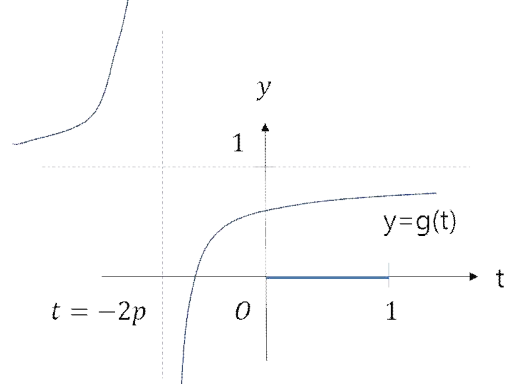
+3점 · −2p<0\displaystyle -2p<0인 경우를 올바로 다루면

( i ) −2p<0\displaystyle -2 p<0인 경우, p>0\displaystyle p>0

−3p<0\displaystyle -3 p<0이므로 g(t)\displaystyle g(t)의 그래프는 다음과 같다.

대학 원본의 p가 양수일 때 유리함수 그래프

0≤t≤1\displaystyle 0 \le t \le 1에서 (g∘f)(x)=g(t)\displaystyle (g \circ f)(x)=g(t)의 최댓값과 최솟값이 모두 존재한다.

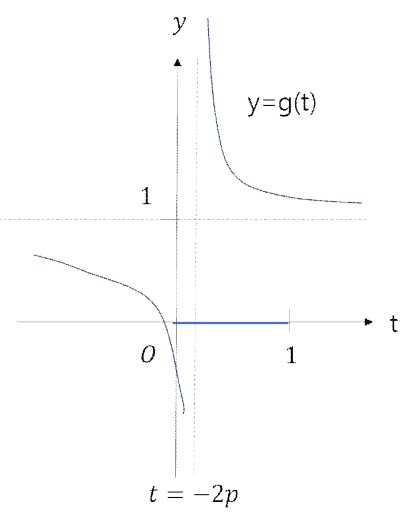
+3점 · 0<−2p<1\displaystyle 0<-2p<1인 경우를 올바로 다루면

( ii ) 0<−2p<1\displaystyle 0<-2 p<1인 경우, −12<p<0\displaystyle -\frac{1}{2}<p<0

대학 원본의 점근선이 구간 안에 있는 유리함수 그래프

−3p>0\displaystyle -3 p>0이므로 0≤t≤1\displaystyle 0 \le t \le 1에서 (g∘f)(x)=g(t)\displaystyle (g \circ f)(x)=g(t)의 최댓값과 최솟값이 모두 존재하지 않는다.

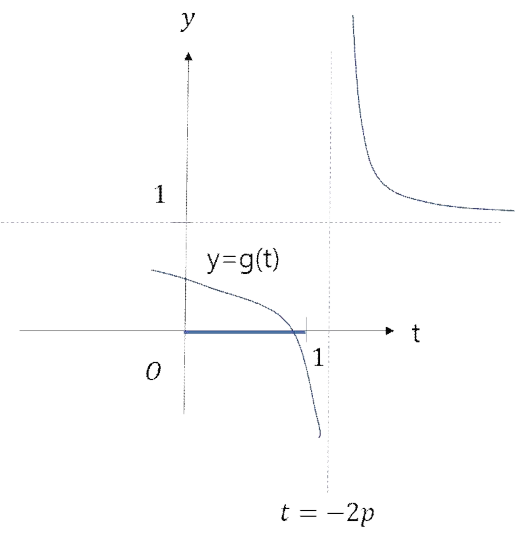
+3점 · 1<−2p\displaystyle 1<-2p인 경우를 올바로 다루면

( iii ) 1<−2p\displaystyle 1<-2 p인 경우 p<−12\displaystyle p<-\frac{1}{2}이므로 −3p>32\displaystyle -3 p>\frac{3}{2}

대학 원본의 점근선이 구간 오른쪽에 있는 유리함수 그래프

0≤t≤1\displaystyle 0 \le t \le 1에서 (g∘f)(x)=g(t)\displaystyle (g \circ f)(x)=g(t)의 최댓값과 최솟값이 모두 존재한다.

(i),(ii),(iii)으로부터 (g∘f)(x)\displaystyle (g \circ f)(x)의 최댓값과 최솟값이 모두 존재하는 p\displaystyle p의 범위는 p<−12\displaystyle p<-\frac{1}{2}또는 p>0\displaystyle p>0

+2점 · A∩B\displaystyle A\cap B의 원소의 성질에 대해 기술하면

[3] (1)

A={4n∣n=1, 2, ⋯ }\displaystyle A= \left\{4 n | n=1,~2,~ \cdots \right\}이므로 A∩B\displaystyle A \cap B의 원소는 B\displaystyle B의 원소 중에서 4\displaystyle 4의 배수인 자연수이다. 0, 1, 2, 3, 4, 5, 6\displaystyle 0,~1,~2,~3,~4,~5,~6으로 만든 일곱 자리 자연수가 4\displaystyle 4의 배수인 경우는 끝의 두 자릿수가 각각 04, 12, 16, 20, 24, 32, 36, 40, 52, 56, 60, 64\displaystyle 04,~12,~16,~20,~24,~32,~36,~40,~52,~56,~60,~64일 때이다.

+2점 · 5!×4=480\displaystyle 5!\times4=480인 경우를 계산하면

( i ) 끝의 두 자릿수가 0\displaystyle 0을 포함하는 경우 (04, 20, 40, 60)\displaystyle (04,~20,~40,~60)

앞의 다섯 자리에는 나머지 다섯 개의 숫자를 일렬로 배열하면 되므로

5!×4=480\displaystyle 5!\times 4=480

+2점 · 4×4!×8=768\displaystyle 4\times4!\times8=768인 경우를 계산하면

(ii) 끝의 두 자릿수가 0\displaystyle 0을 포함하지 않는 경우 (12, 16, 24, 32, 36, 52, 56, 64)\displaystyle (12,~16,~24,~32,~36,~52,~56,~64)

백만 자리는 나머지 5\displaystyle 5개의 숫자 중에서 0\displaystyle 0을 제외한 네 가지가 올 수 있고,

십만, 만, 천, 백의 자리는 이미 사용한 숫자를 제외한 나머지 네 개의 숫자를 일렬로 배열하면 되므로 4×4!×8=768\displaystyle 4 \times 4!\times 8=768

+2점 · n(A∩B)=480+768=1248\displaystyle n(A\cap B)=480+768=1248을 얻으면

( i ), ( ii )로부터 n(A∩B)=480+768=1248\displaystyle n(A \cap B)=480+768=1248

+2점 · 6□□□□□□\displaystyle 6\square\square\square\square\square\square 형태의 자연수의 개수는 6!=720\displaystyle 6!=720임을 계산하면

(2)

집합 B\displaystyle B의 원소를 큰 수부터 차례로 세어보면 다음과 같다.

6□□□□□□\displaystyle 6 \square \square \square \square \square \square형태의 자연수의 개수는 6!=720\displaystyle 6! =720

5□□□□□□\displaystyle 5 \square \square \square \square \square \square형태의 자연수의 개수는 6!=720\displaystyle 6! =720

따라서 a1000\displaystyle a_{1000}은 5\displaystyle 5로 시작하는 수이다.Correction. [3](2) 예시답안의 a1000\displaystyle a_{1000}은 b1000\displaystyle b_{1000}의 오기이다. 문제에서는 집합 B\displaystyle B의 원소를 큰 순서로 b1,b2,…\displaystyle b_1,b_2,\ldots라 정했다. 구한 값 b1000=5341206\displaystyle b_{1000}=5341206은 맞다. 원문 표기는 그대로 실었다.

+2점 · 올바른 계산을 통해 a1000\displaystyle a_{1000}은 53으로 시작하는 수임을 얻으면

56□□□□□\displaystyle 56 \square \square \square \square \square형태의 자연수의 개수는 5!=120\displaystyle 5! =120

54□□□□□\displaystyle 54 \square \square \square \square \square형태의 자연수의 개수는 5!=120\displaystyle 5! =120

여기까지 모두 960\displaystyle 960개이므로 a1000\displaystyle a_{1000}은 53\displaystyle 53으로 시작하는 수이다.

+2점 · 올바른 계산을 통해 a1000\displaystyle a_{1000}은 5341로 시작하는 수임을 얻으면

536□□□□\displaystyle 536 \square \square \square \square형태의 자연수의 개수는 4!=24\displaystyle 4! =24

여기까지가 모두 984\displaystyle 984개이므로 a1000\displaystyle a_{1000}은 534\displaystyle 534로 시작하는 수이다.

5346□□□\displaystyle 5346 \square \square \square형태의 자연수의 개수는 3!=6\displaystyle 3! =6

5342□□□\displaystyle 5342 \square \square \square형태의 자연수의 개수는 3!=6\displaystyle 3! =6

여기까지가 모두 996\displaystyle 996개이므로 a1000\displaystyle a_{1000}은 5341\displaystyle 5341로 시작하는 수이다.

+2점 · 올바른 계산을 통해 a1000=5341206\displaystyle a_{1000}=5341206을 얻으면

53416□□\displaystyle 53416 \square \square형태의 자연수의 개수는 2!=2\displaystyle 2! =2

53412□□\displaystyle 53412 \square \square형태의 자연수의 개수는 2!=2\displaystyle 2! =2

여기까지가 모두 1000\displaystyle 1000개이므로 a1000\displaystyle a_{1000}은 53412□□\displaystyle 53412 \square \square형태에서 나머지 0, 6\displaystyle 0,~6로 만들 수 있는 가장 작은 수이다. 따라서 a1000=5341206\displaystyle a_{1000}=5341206

첨삭 사례

아직 등록된 첨삭 사례가 없습니다.

질문과 답변 · 0개질문과 답변 · 고정 0개

아직 등록된 질문이 없습니다. 질문 작성은 멤버십 회원만 가능합니다.