수리논술, 배움에서 논증의 완성까지.

자연계열 1번

문제

🔒
짧은 시간에 너무 많은 문제를 여셔서 열람을 잠시 제한했습니다. 잠시 후 다시 시도하시거나 로그인해 주세요.
해설강의 준비중

[1] (1)

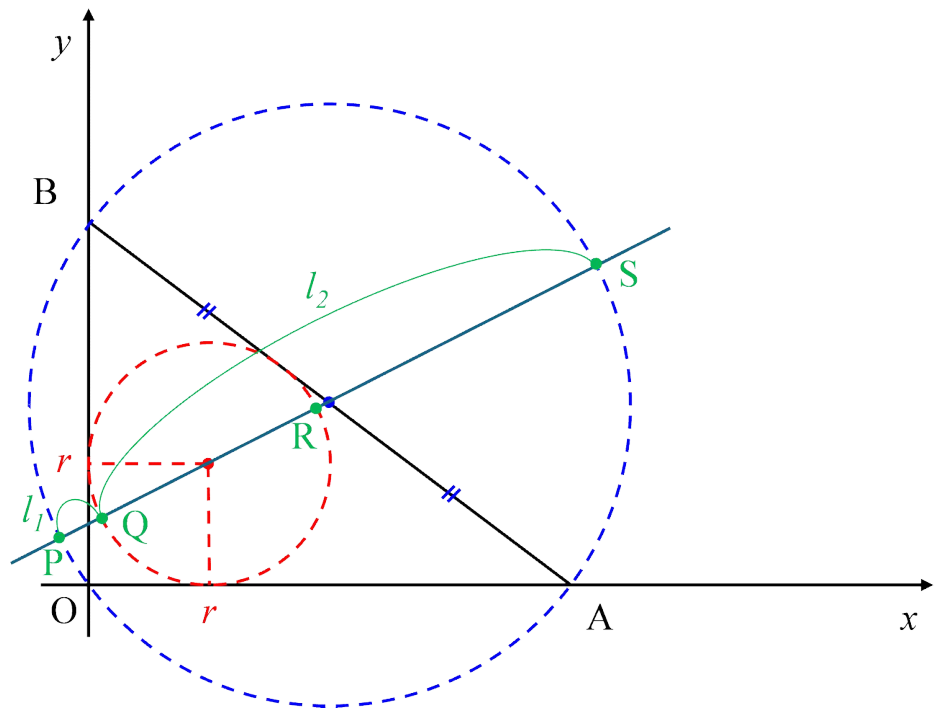
대학 원본의 내접원·외접원과 네 교점
+1점 · 삼각형 OAB\displaystyle \mathrm{OAB} 가 직각삼각형이기 때문에 빗변인 선분 AB\displaystyle \mathrm{AB} 가 외접원의 지름임을 알면 +1점 · 선분 AB\displaystyle \mathrm{AB} 의 중점의 좌표가 외접원의 중심(외심)의 좌표이기 때문에, 외접원의 중심 (외심)의 좌표는 (4, 3)\displaystyle (4,~3)임을 구하면 +1점 · 외접원의 반지름은 선분 AB\displaystyle \mathrm{AB} 의 길이의 반이기 때문에, 외접원의 반지름 5\displaystyle 5를 구하면

① 삼각형 OAB\displaystyle \mathrm{OAB} 의 외접원은 세점 O(0, 0), A(8, 0), B(0, 6)\displaystyle \mathrm{O}(0,~0),~ \mathrm{A}(8,~0),~ \mathrm{B}(0,~6)을 지나고, 삼각형 OAB\displaystyle \mathrm{OAB} 가 직각삼각형이기 때문에 선분 AB\displaystyle \mathrm{AB} 는 외접원의 지름이다. 따라서, 선분 AB\displaystyle \mathrm{AB} 의 중점의 좌표가 외접원의 중심(외심)의 좌표이다. 따라서, 외접원의 중심(외심)의 좌표는 (8+02, 0+62)=(4, 3)\displaystyle \left (\frac{8+0}{2},~ \frac{0+6}{2} \right )=(4,~3)이다. 외접원의 반지름은 선분 AB\displaystyle \mathrm{AB} 의 길이의 반이기 때문에, AB2=(80)2+(04)22=102=5\displaystyle \frac{\overline{\mathrm{AB}}}{2}=\frac{\sqrt {(8-0)^{2}+(0-4)^{2}}}{2}=\frac{10}{2}=5이다.Correction. 반지름을 구하는 거리식의 (04)2\displaystyle (0-4)^2(06)2\displaystyle (0-6)^2의 오기이다. 점 B\displaystyle B의 좌표는 (0,6)\displaystyle (0,6)이다.AB2=(80)2+(06)22=5\displaystyle \frac{\overline{AB}}2=\frac{\sqrt{(8-0)^2+(0-6)^2}}2=5뒤의 반지름과 원의 방정식은 맞다. 원문 표기는 그대로 실었다.

+1점 · 외접원의 방정식을 (x4)2+(y3)2=52\displaystyle (x-4)^{2}+(y-3)^{2}=5^{2} 또는 x2+y28x6y=0\displaystyle x^{2}+y^{2}-8 x-6 y=0로 표현하면

그러므로, 삼각형 OAB\displaystyle \mathrm{OAB} 의 외접원의 방정식은 (x4)2+(y3)2=52\displaystyle (x-4)^{2}+(y-3)^{2}=5^{2}이다. 이를 전개하면, x2+y28x6y=0\displaystyle x^{2}+y^{2}-8 x-6 y=0이다.

+1점 · 두 점 A(8, 0), B(0, 6)\displaystyle \mathrm{A}(8,~0),~ \mathrm{B}(0,~6)을 지나는 직선의 방정식이 3x+4y=24\displaystyle 3 x+4 y=24또는 3x+4y24=0\displaystyle 3 x+4 y-24=0임을 구하면

② 두 점 A(8, 0), B(0, 6)\displaystyle \mathrm{A}(8,~0),~ \mathrm{B}(0,~6)을 지나는 직선의 방정식은 y0=0680(x8)\displaystyle y-0=\frac{0-6}{8-0}(x-8)이기 때문에, y=34x+6\displaystyle y=-\frac{3}{4} x+6이다. 이를 정리하면, 3x+4y=24\displaystyle 3 x+4 y=24또는 3x+4y24=0\displaystyle 3 x+4 y-24=0이다.

+1점 · 내접원이 서로 수직인 x\displaystyle x축과 y\displaystyle y축에 동시에 접해서 내접원의 반지름을 r\displaystyle r이라고 하면, 내접원의 중심(내심)의 좌표는 (r, r)\displaystyle (r,~ r)임을 알면 +1점 · 내접원의 방정식을 (xr)2+(yr)2=r2\displaystyle (x-r)^{2}+(y-r)^{2}=r^{2}로 표현하면

직각삼각형 OAB\displaystyle \mathrm{OAB} 의 내접원은 서로 수직인 x\displaystyle x축과 y\displaystyle y축에 동시에 접한다. 따라서, 내접원의 반지름을 r\displaystyle r이라고 하면, 내접원의 중심(내심)의 좌표는 (r, r)\displaystyle (r,~ r)이기 때문에 내접원의 방정식은 (xr)2+(yr)2=r2\displaystyle (x-r)^{2}+(y-r)^{2}=r^{2}이다.

+1점 · 내접원의 중심(내심) (r, r)\displaystyle (r,~ r)에서 두 점 A(8, 0), B(0, 6)\displaystyle \mathrm{A}(8,~0),~ \mathrm{B}(0,~6)을 지나는 직선까지의 거리를 이용하여 3r+4r2432+42=r\displaystyle \frac{|3 r+4 r-24|}{\sqrt {3^{2}+4^{2}}}=r로 표현하면 +1점 · 방정식 (r2)(r12)=0\displaystyle (r-2)(r-12)=0에서 r<6\displaystyle r<6이기 때문에 r=2\displaystyle r=2만이 근임을 구하면

내접원은 두 점 A(8, 0), B(0, 6)\displaystyle \mathrm{A}(8,~0),~ \mathrm{B}(0,~6)을 지나는 직선에 접하기 때문에, 내접원의 중심(내심) (r, r)\displaystyle (r,~ r)에서 이 직선까지의 거리는 3r+4r2432+42=r\displaystyle \frac{|3 r+4 r-24|}{\sqrt {3^{2}+4^{2}}}=r이다. 7r24=5r\displaystyle |7 r-24|=5 r이므로, 양변을 제곱하여 전개하면, {7r24}2=49r2336r+576=25r2\displaystyle \left\{7 r-24 \right\}^{2}=49 r^{2}-336 r+576=25 r^{2}이다. 이를 정리하면, 24r2336r+576=0\displaystyle 24 r^{2}-336 r+576=0이기 때문에, r214r+24=(r2)(r12)=0\displaystyle r^{2}-14 r+24=(r-2)(r-12)=0이다. r<6\displaystyle r<6이기 때문에, r=2\displaystyle r=2이다.

+1점 · 내접원의 방정식을 (x2)2+(y2)2=22\displaystyle (x-2)^{2}+(y-2)^{2}=2^{2}또는 x2+y24x4y+4=0\displaystyle x^{2}+y^{2}-4 x-4 y+4=0로 표현하면

그러므로, 삼각형 OAB\displaystyle \mathrm{OAB} 의 내접원의 방정식은 (x2)2+(y2)2=22\displaystyle (x-2)^{2}+(y-2)^{2}=2^{2}이다. 이를 전개하면, x2+y24x4y+4=0\displaystyle x^{2}+y^{2}-4 x-4 y+4=0이다.

+2점 · 외심 (4, 3)\displaystyle (4,~3)와 내심 (2, 2)\displaystyle (2,~2)을 지나는 직선의 방정식 y=12x+1\displaystyle y=\frac{1}{2} x+1을 구하면 +2점 · 외접원 위의 점과 내접원 위의 점 사이의 거리의 최솟값과 최댓값은 이 직선과 외접원 및 내접원이 만나는 교점 사이의 거리를 이용하여 찾을 수 있음을 알면

(2)

삼각형 OAB\displaystyle \mathrm{OAB} 의 외심 (4, 3)\displaystyle (4,~3)와 내심 (2, 2)\displaystyle (2,~2)을 지나는 직선의 방정식을 구하면, y2=3242(x2)\displaystyle y-2=\frac{3-2}{4-2}(x-2)이기 때문에, y=12x+1\displaystyle y=\frac{1}{2} x+1이다. 삼각형 OAB\displaystyle \mathrm{OAB} 의 외접원 위의 점과 내접원 위의 점 사이의 거리의 최솟값과 최댓값은 이 직선과 외접원 및 내접원이 만나는 교점 사이의 거리를 이용하여 찾을 수 있다.

+4점 · 직선 y=12x+1\displaystyle y=\frac{1}{2} x+1과 외접원과 만나는 두 교점 P, S\displaystyle \mathrm{P},~ \mathrm{S}의 좌표를 구하면

이 직선과 삼각형 OAB\displaystyle \mathrm{OAB} 의 외접원과 만나는 두 교점 P, S\displaystyle \mathrm{P},~ \mathrm{S}의 좌표를 구하면,

x2+y28x6y=x2+(12x+1)28x6(12x+1)=0\displaystyle x^{2}+y^{2}-8 x-6 y=x^{2}+ \left (\frac{1}{2} x+1 \right )^{2}-8 x-6 \left (\frac{1}{2} x+1 \right )=0

4x2+(x+2)232x12(x+2)=4x2+x2+4x+432x12x24=5x240x20=5(x28x4)=0\displaystyle 4 x^{2}+(x+2)^{2}-32 x-12(x+2)=4 x^{2}+x^{2}+4 x+4-32 x-12 x-24=5 x^{2}-40 x-20=5 \left (x^{2}-8 x-4 \right )=0

x28x4=0x=8±644×1×(4)2=8±802=8±452=4±25\displaystyle x^{2}-8 x-4=0 \Rightarrow x=\frac{8 ± \sqrt {64-4 \times 1 \times (-4)}}{2}=\frac{8 ± \sqrt {80}}{2}=\frac{8 ± 4 \sqrt {5}}{2}=4 ± 2 \sqrt {5}

y=12x+1=12(4±25)+1=3±5\displaystyle y=\frac{1}{2} x+1=\frac{1}{2}(4 ± 2 \sqrt {5})+1=3 ± \sqrt {5}

따라서, 두 교점의 좌표는 P(425, 35), S(4+25, 3+5)\displaystyle \mathrm{P}(4-2 \sqrt {5},~ 3-\sqrt {5}),~ \mathrm{S}(4+2 \sqrt {5},~ 3+\sqrt {5})이다.

+2점 · 직선 y=12x+1\displaystyle y=\frac{1}{2} x+1과 내접원과 만나는 두 교점 Q\displaystyle \mathrm{Q} 의 좌표를 구하면

이 직선과 삼각형 OAB\displaystyle \mathrm{OAB} 의 내접원과 만나는 두 교점 Q, R\displaystyle \mathrm{Q},~ \mathrm{R}의 좌표를 구하면,

x2+y24x4y+4=x2+(12x+1)24x4(12x+1)+4=0\displaystyle x^{2}+y^{2}-4 x-4 y+4=x^{2}+ \left (\frac{1}{2} x+1 \right )^{2}-4 x-4 \left (\frac{1}{2} x+1 \right )+4=0

4x2+(x+2)216x8(x+2)+16=4x2+x2+4x+416x8x16+16=5x220x+4=0\displaystyle 4 x^{2}+(x+2)^{2}-16 x-8(x+2)+16=4 x^{2}+x^{2}+4 x+4-16 x-8 x-16+16=5 x^{2}-20 x+4=0

5x220x+4=0x=20±4004×5×42×5=20±32010=20±8510=10±455\displaystyle 5 x^{2}-20 x+4=0 \Rightarrow x=\frac{20 ± \sqrt {400-4 \times 5 \times 4}}{2 \times 5}=\frac{20 ± \sqrt {320}}{10}=\frac{20 ± 8 \sqrt {5}}{10}=\frac{10 ± 4 \sqrt {5}}{5}

y=12x+1=1210±455+1=5±255+1=10±255\displaystyle y=\frac{1}{2} x+1=\frac{1}{2} \frac{10 ± 4 \sqrt {5}}{5}+1=\frac{5 ± 2 \sqrt {5}}{5}+1=\frac{10 ± 2 \sqrt {5}}{5}

따라서, 두 교점의 좌표는 Q(10455, 10255), R(10+455, 10+255)\displaystyle \mathrm{Q} \left (\frac{10-4 \sqrt {5}}{5},~ \frac{10-2 \sqrt {5}}{5} \right ),~ \mathrm{R} \left (\frac{10+4 \sqrt {5}}{5},~ \frac{10+2 \sqrt {5}}{5} \right )이다.

+2점 · 두 원위의 점 사이의 거리의 최솟값이 선분 PQ\displaystyle \overline{\mathrm{PQ}}임을 알고, l1=35\displaystyle l_{1}=3-\sqrt {5}를 구하면

그러므로,

최솟값 l1=PQ=(42510455)2+(3510255)2\displaystyle l_{1}=\overline{\mathrm{PQ}}=\sqrt { \left (4-2 \sqrt {5}-\frac{10-4 \sqrt {5}}{5} \right )^{2}+ \left (3-\sqrt {5}-\frac{10-2 \sqrt {5}}{5} \right )^{2}},

=1465=(35)2=35\displaystyle =\sqrt {14-6 \sqrt {5}}=\sqrt {(3-\sqrt {5})^{2}}=3-\sqrt {5}

+2점 · 두 원위의 점 사이의 거리의 최댓값이 선분 QS\displaystyle \overline{\mathrm{QS}}임을 알고, l2=7+5\displaystyle l_{2}=7+\sqrt {5}를 구하면

최댓값 l2=QS=(4+2510455)2+(3+510255)2\displaystyle l_{2}=\overline{\mathrm{QS}}=\sqrt { \left (4+2 \sqrt {5}-\frac{10-4 \sqrt {5}}{5} \right )^{2}+ \left (3+\sqrt {5}-\frac{10-2 \sqrt {5}}{5} \right )^{2}}.

=54+145=(7+5)2=7+5\displaystyle =\sqrt {54+14 \sqrt {5}}=\sqrt {(7+\sqrt {5})^{2}}=7+\sqrt {5}

+2점 · (1\displaystyle 1번, 2\displaystyle 2번, 3\displaystyle 3번) 좌석을 제외하고 남은 4\displaystyle 4개의 좌석에 4\displaystyle 4등 이하의 도착순서를 가진 4\displaystyle 4명의 학생의 좌석을 배정하는 경우의 수 4P4=4!=24\displaystyle { }_{4} \mathrm P_{4}=4! =24를 구하면 +1점 · 도착순서가 가장 빠른 학생이 1\displaystyle 1번, 2\displaystyle 2번, 3\displaystyle 3번 좌석에서 자리를 바꾸는 경우의 수 3P3=3!=6\displaystyle { }_{3} \mathrm P_{3}=3! =6을 구하면

[2] (1)

좌석표에서 1\displaystyle 1번, 2\displaystyle 2번, 3\displaystyle 3번 좌석은 광운랜드 도착순서가 가장 빠른 3\displaystyle 3명의 학생에게 고정적으로 배정되어야 하기 때문에, ( 1\displaystyle 1번, 2\displaystyle 2번, 3\displaystyle 3번) 좌석을 제외하고 남은 4\displaystyle 4개의 좌석에 4\displaystyle 4등 이하의 도착순서를 가진 4\displaystyle 4명의 학생의 좌석을 배정한다. 4\displaystyle 4개의 좌석에 4\displaystyle 4명의 학생을 배열하는 경우의 수는 4P4=4!=4×3×2×1=24\displaystyle { }_{4} \mathrm P_{4}=4! =4 \times 3 \times 2 \times 1=24이다. 도착순서가 가장 빠른 박옥의, 정복지, 김화도 학생이 1\displaystyle 1번, 2\displaystyle 2번, 3\displaystyle 3번 좌석에서 자리를 바꾸는 것은 3\displaystyle 3개의 좌석에 3\displaystyle 3명의 학생을 배열하는 것과 같기 때문에, 경우의 수는 3P3=3!=3×2×1=6\displaystyle { }_{3} \mathrm P_{3}=3! =3 \times 2 \times 1=6이다.

+1점 · 앞에서 구한 두 결과를 곱하여 경우의 수 144\displaystyle 144를 구하면

그러므로, 도착순서가 가장 빠른 3\displaystyle 3명을 1\displaystyle 1번, 2\displaystyle 2번, 3\displaystyle 3번 좌석에 도착순서에 상관없이 나누어 배정하는 경우의 수는 4P4×3P3=4!×3!=24×6=144\displaystyle { }_{4} \mathrm P_{4} \times { }_{3} \mathrm P_{3}=4!\times 3! =24 \times 6=144이다.

+1점 · 2\displaystyle 2학년 학생과 3\displaystyle 3학년 학생 사이에 4\displaystyle 4명의 학생이 있는 경우는 각각 (2\displaystyle 2학년) \displaystyle \square \square \square \square( 3\displaystyle 3학년)과 (3\displaystyle 3학년) \displaystyle \square \square \square \square(2\displaystyle 2학년) 배열이 있는 경우이고, 경우의 수가 동일함을 알면

(2)

2\displaystyle 2학년 학생과 3\displaystyle 3학년 학생 사이에 4\displaystyle 4명의 학생이 있는 경우는 각각 (2\displaystyle 2학년) \displaystyle \square \square \square \square(3\displaystyle 3학년)과 (3\displaystyle 3학년) \displaystyle \square \square \square \square(2\displaystyle 2학년) 배열이 있는 경우이고, 각 경우의 수는 동일하다.

+1점 · (2\displaystyle 2학년) \displaystyle \square \square \square \square(3\displaystyle 3학년)을 하나의 학생이라고 생각하고, 나머지 1\displaystyle 1명의 학생과 합쳐 총 2(=1+1)\displaystyle 2(=1+1)명의 학생을 배열하는 경우의 수 2P2=2!=2\displaystyle { }_{2} \mathrm P_{2}=2! =2를 구하면

① (2\displaystyle 2학년) \displaystyle \square \square \square \square(3\displaystyle 3학년)을 하나의 학생이라고 생각하고, 나머지 1\displaystyle 1명의 학생과 합쳐 총 2(=1+1)\displaystyle 2(=1+1)명의 학생을 배열하는 경우의 수는 2P2=2!=2\displaystyle { }_{2} \mathrm P_{2}=2! =2이다.

+1점 · 1\displaystyle 1학년 여학생 3\displaystyle 3명중에서 2\displaystyle 2명을 선택하는 경우의 수 3C2=3!2!(32)!=3\displaystyle { }_{3} \mathrm C_{2}=\frac{3!}{2!(3-2)!}=3를 구하면 +1점 · 1\displaystyle 1학년 남학생 2\displaystyle 2명중에서 2\displaystyle 2명을 선택하는 경우의 수 2C2=2!2!(22)!=1\displaystyle { }_{2} \mathrm C_{2}=\frac{2!}{2!(2-2)!}=1를 구하면 +1점 · 선택된 1\displaystyle 1학년 여학생 2\displaystyle 2명과 남학생 2\displaystyle 2명을 \displaystyle \square \square \square \square에 배열하는 경우의 수 4P4=4!=24\displaystyle { }_{4} \mathrm P_{4}=4! =24를 구하면

그런데, 1\displaystyle 1학년 여학생 3\displaystyle 3명중에서 2\displaystyle 2명을 선택하는 경우의 수는 3C2=3!2!(32)!=3\displaystyle { }_{3} \mathrm C_{2}=\frac{3!}{2!(3-2)!}=3이고, 1\displaystyle 1학년 남학생 2\displaystyle 2명중에서 2\displaystyle 2명을 선택하는 경우의 수는 2C2=2!2!(22)!=1\displaystyle { }_{2} \mathrm C_{2}=\frac{2!}{2!(2-2)!}=1이다. 이렇게 선택된 1\displaystyle 1학년 여학생 2\displaystyle 2명과 남학생 2\displaystyle 2명을 \displaystyle \square \square \square \square에 배열하는 경우의 수는 4P4=4!=24\displaystyle { }_{4} \mathrm P_{4}=4! =24이다.

+1점 · (2\displaystyle 2학년) \displaystyle \square \square \square \square(3\displaystyle 3학년)일 때, 2\displaystyle 2학년 학생과 3\displaystyle 3학년 학생 사이에 1\displaystyle 1학년 여학생 2\displaystyle 2명과 1\displaystyle 1학년 남학생 2\displaystyle 2명만을 배정하는 경우의 수 144\displaystyle 144를 구하면

따라서, 2\displaystyle 2학년 학생과 3\displaystyle 3학년 학생 사이에 1\displaystyle 1학년 여학생 2\displaystyle 2명과 1\displaystyle 1학년 남학생 2\displaystyle 2명만을 배정하는 경우의 수는 2P2×3C2×2C2×4P4=2×3×1×24=144\displaystyle { }_{2} \mathrm P_{2} \times { }_{3} \mathrm C_{2} \times { }_{2} \mathrm C_{2} \times { }_{4} \mathrm P_{4}=2 \times 3 \times 1 \times 24=144이다.

② (3\displaystyle 3학년) \displaystyle \square \square \square \square(2\displaystyle 2학년) 인 경우도 같은 방법으로 구하면, 경우의 수는 144\displaystyle 144이다.

+1점 · 2\displaystyle 2학년 학생과 3\displaystyle 3학년 학생 사이에 1\displaystyle 1학년 여학생 2\displaystyle 2명과 1\displaystyle 1학년 남학생 2\displaystyle 2명만을 배정하는 경우의 수 288\displaystyle 288를 구하면

그러므로, 2\displaystyle 2학년 학생과 3\displaystyle 3학년 학생 사이에 1\displaystyle 1학년 여학생 2\displaystyle 2명과 1\displaystyle 1학년 남학생 2\displaystyle 2명만을 배정하는 경우의 수는 288\displaystyle 288(= 2×144\displaystyle 2 \times 144) 이다.

+1점 · ① (1\displaystyle 1여) (3) (1\displaystyle 1남) 및 (1\displaystyle 1여) (2) (1\displaystyle 1남) 경우에서, (1\displaystyle 1여) (3) (1\displaystyle 1남) 을 1\displaystyle 1명의 학생이라고 생각하고, (1\displaystyle 1여)(2)(1\displaystyle 1남)도 1\displaystyle 1명의 학생이라고 생각하고, 나머지 1\displaystyle 1명의 학생과 합쳐 총 3(=1+1+1)\displaystyle 3(=1+1+1)명의 학생을 배열하는 경우의 수 3P3=3!=6\displaystyle { }_{3} \mathrm P_{3}=3! =6을 구하면

(3)

좌석표에 3\displaystyle 3학년 학생 바로 앞번호 좌석과 바로 뒷번호 좌석중 하나에 1\displaystyle 1학년 여학생 1\displaystyle 1명, 나머지 하나에 1\displaystyle 1학년 남학생 1\displaystyle 1명을 배정하고, 2\displaystyle 2학년 학생 바로 앞번호 좌석과 바로 뒷번호 좌석중 하나에 1\displaystyle 1학년 여학생 1\displaystyle 1명, 나머지 하나에 1\displaystyle 1학년 남학생 1\displaystyle 1명을 배정하는 경우는 다음의 8\displaystyle 8가지이다.

① (1\displaystyle 1여)(3\displaystyle 3)(1\displaystyle 1남) 및 (1\displaystyle 1여)(2\displaystyle 2)(1\displaystyle 1남)

② (1\displaystyle 1여)(3\displaystyle 3)(1\displaystyle 1남) 및 (1\displaystyle 1남)(2\displaystyle 2)(1\displaystyle 1여)

③ (1\displaystyle 1남)(3\displaystyle 3)(1\displaystyle 1여) 및 (1\displaystyle 1여)(2\displaystyle 2)(1\displaystyle 1남)

④ (1\displaystyle 1남)(3\displaystyle 3)(1\displaystyle 1여) 및 (1\displaystyle 1남)(2\displaystyle 2)(1\displaystyle 1여)

⑤ (1\displaystyle 1여)(3\displaystyle 3)(1\displaystyle 1남)(2\displaystyle 2)(1\displaystyle 1여)

⑥ (1\displaystyle 1여)(2\displaystyle 2)(1\displaystyle 1남)(3\displaystyle 3)(1\displaystyle 1여)

⑦ (1\displaystyle 1남)(3\displaystyle 3)(1\displaystyle 1여)(2\displaystyle 2)(1\displaystyle 1남)

⑧ (1\displaystyle 1남)(2\displaystyle 2)(1\displaystyle 1여)(3\displaystyle 3)(1\displaystyle 1남)

① (1\displaystyle 1여)(3\displaystyle 3)(1\displaystyle 1남) 및 (1\displaystyle 1여)(2\displaystyle 2)(1\displaystyle 1남) 인 경우, (1\displaystyle 1여)(3\displaystyle 3)(1\displaystyle 1남) 을 1\displaystyle 1명의 학생이라고 생각하고, (1\displaystyle 1여)(2\displaystyle 2)(1\displaystyle 1남)도 1\displaystyle 1명의 학생이라고 생각하고, 나머지 1\displaystyle 1명의 학생과 합쳐 총 3(=1+1+1)\displaystyle 3(=1+1+1)명의 학생을 배열하는 경우의 수는 3P3=3!=6\displaystyle { }_{3} \mathrm P_{3}=3! =6이다.

+2점 · 1\displaystyle 1학년 여학생 3\displaystyle 3명중에서 2\displaystyle 2명을 선택하는 경우의 수는 3C2=3!2!(32)!=3\displaystyle { }_{3} \mathrm C_{2}=\frac{3!}{2!(3-2)!}=3이고, 선택된 2\displaystyle 2명을 배열하는 경우의 수는 2P2=2!=2\displaystyle { }_{2} \mathrm P_{2}=2! =2임을 구하고, 1\displaystyle 1학년 남학생 2\displaystyle 2명중에서 2\displaystyle 2명을 선택하는 경우의 수는 2C2=2!2!(22)!=1\displaystyle { }_{2} \mathrm C_{2}=\frac{2!}{2!(2-2)!}=1이고, 선택된 2\displaystyle 2명을 배열하는 경우의 수는 2P2=2!=2\displaystyle { }_{2} \mathrm P_{2}=2! =2임을 구하면

그런데, 1\displaystyle 1학년 여학생 3\displaystyle 3명중에서 2\displaystyle 2명을 선택하는 경우의 수는 3C2=3!2!(32)!=3\displaystyle { }_{3} \mathrm C_{2}=\frac{3!}{2!(3-2)!}=3이고, 선택된 2\displaystyle 2명을 배열하는 경우의 수는 2P2=2!=2\displaystyle { }_{2} \mathrm P_{2}=2! =2이다. 1\displaystyle 1학년 남학생 2\displaystyle 2명중에서 2\displaystyle 2명을 선택하는 경우의 수는 2C2=2!2!(22)!=1\displaystyle { }_{2} \mathrm C_{2}=\frac{2!}{2!(2-2)!}=1이고, 선택된 2\displaystyle 2명을 배열하는 경우의 수는 2P2=2!=2\displaystyle { }_{2} \mathrm P_{2}=2! =2이다.

+1점 · ① 경우의 수 3P3×(3C2×2P2)×(2C2×2P2)=72\displaystyle { }_{3} \mathrm P_{3} \times \left ({ }_{3} \mathrm C_{2} \times { }_{2} \mathrm P_{2} \right ) \times \left ({ }_{2} \mathrm C_{2} \times { }_{2} \mathrm P_{2} \right )=72를 구하면

따라서, (1\displaystyle 1여)(3)(1\displaystyle 1남) 및 (1\displaystyle 1여)(2)(1\displaystyle 1남)인 경우의 수는 3P3×(3C2×2P2)×(2C2×2P2)=6×(3×2)×(1×2)=72\displaystyle { }_{3} \mathrm P_{3} \times \left ({ }_{3} \mathrm C_{2} \times { }_{2} \mathrm P_{2} \right ) \times \left ({ }_{2} \mathrm C_{2} \times { }_{2} \mathrm P_{2} \right )=6 \times (3 \times 2) \times (1 \times 2)=72이다.

+1점 · ②, ③, ④인 경우에서 경우의 수가 ① 경우와 동일하게 각각 72\displaystyle 72임을 알면

② (1\displaystyle 1여)(3\displaystyle 3)(1\displaystyle 1남) 및 (1\displaystyle 1남)(2\displaystyle 2)(1\displaystyle 1여) 의 경우도 같은 방법으로 구하면, 경우의 수는 72\displaystyle 72이다.

③ (1\displaystyle 1남)(3\displaystyle 3)(1\displaystyle 1여) 및 (1\displaystyle 1여)(2\displaystyle 2)(1\displaystyle 1남) 의 경우도 같은 방법으로 구하면, 경우의 수는 72\displaystyle 72이다.

(1\displaystyle (1)(3)(1\displaystyle )(3)(1여) 및 (1\displaystyle 1남)(2\displaystyle 2)(1\displaystyle 1여) 의 경우도 같은 방법으로 구하면, 경우의 수는 72\displaystyle 72이다.

+1점 · ⑤ (1\displaystyle 1여)(3)(1\displaystyle 1남)(2)(1\displaystyle 1여)인 경우에서, (1\displaystyle 1여)(3)(1\displaystyle 1남)(2)(1\displaystyle 1여)를 1\displaystyle 1명의 학생이라고 생각하고, 나머지 2\displaystyle 2명의 학생과 합쳐 총 3(=1+2)\displaystyle 3(=1+2)명의 학생을 배열하는 경우의 수 3P3=3!=6\displaystyle { }_{3} \mathrm P_{3}=3! =6을 구하면

(1\displaystyle (1)(3)(1\displaystyle )(3)(1)(2)(1\displaystyle )(2)(1)\displaystyle )인 경우, (1\displaystyle (1)(3)(1\displaystyle )(3)(1)(2)(1\displaystyle )(2)(1)\displaystyle )1\displaystyle 1명의 학생이라고 생각하고, 나머지 2\displaystyle 2명의 학생과 합쳐 총 3(=1+2)\displaystyle 3(=1+2)명의 학생을 배열하는 경우의 수는 3P3=3!=6\displaystyle { }_{3} \mathrm P_{3}=3! =6이다.

+2점 · 1\displaystyle 1학년 여학생 3\displaystyle 3명중에서 2\displaystyle 2명을 선택하는 경우의 수는 3C2=3!2!(32)!=3\displaystyle { }_{3} \mathrm C_{2}=\frac{3!}{2!(3-2)!}=3이고, 선택된 2\displaystyle 2명을 배열하는 경우의 수는 2P2=2!=2\displaystyle { }_{2} \mathrm P_{2}=2! =2임을 구하고, 1\displaystyle 1학년 남학생 2\displaystyle 2명중에서 1\displaystyle 1명을 선택하는 경우의 수는 2C1=2!1!(21)!=2\displaystyle { }_{2} \mathrm C_{1}=\frac{2!}{1!(2-1)!}=2임을 구하면

그런데, 1\displaystyle 1학년 여학생 3\displaystyle 3명중에서 2\displaystyle 2명을 선택하는 경우의 수는 3C2=3!2!(32)!=3\displaystyle { }_{3} \mathrm C_{2}=\frac{3!}{2!(3-2)!}=3이고, 선택된 2\displaystyle 2명을 배열하는 경우의 수는 2P2=2!=2\displaystyle { }_{2} \mathrm P_{2}=2! =2이다. 1\displaystyle 1학년 남학생 2\displaystyle 2명중에서 1\displaystyle 1명을 선택하는 경우의 수는 2C1=2!1!(21)!=2\displaystyle { }_{2} \mathrm C_{1}=\frac{2!}{1!(2-1)!}=2이다.

+1점 · ⑤ 경우의 수 3P3×(3C2×2P2)×2C1=72\displaystyle { }_{3} \mathrm P_{3} \times \left ({ }_{3} \mathrm C_{2} \times { }_{2} \mathrm P_{2} \right ) \times { }_{2} \mathrm C_{1}=72를 구하면

따라서, (1\displaystyle 1여)(3\displaystyle 3)(1\displaystyle 1남)(2\displaystyle 2)(1\displaystyle 1여)인 경우의 수는

3P3×(3C2×2P2)×2C1=6×(3×2)×2=72\displaystyle { }_{3} \mathrm P_{3} \times \left ({ }_{3} \mathrm C_{2} \times { }_{2} \mathrm P_{2} \right ) \times { }_{2} \mathrm C_{1}=6 \times (3 \times 2) \times 2=72이다.

+1점 · ⑥ 경우에서 경우의 수가 ⑤ 경우와 동일하게 72\displaystyle 72임을 알면

⑥ (1\displaystyle 1여)(2\displaystyle 2)(1\displaystyle 1남)(3\displaystyle 3)(1\displaystyle 1여) 의 경우도 같은 방법으로 구하면, 경우의 수는 72\displaystyle 72이다.

+1점 · ⑦ (1\displaystyle 1남) (3) (1\displaystyle 1여) (2) (1\displaystyle 1남) 인 경우에서, (1\displaystyle 1남) (3) (1\displaystyle 1여) (2) (1\displaystyle 1남) 을 1\displaystyle 1명의 학생이라고 생각하고, 나머지 2\displaystyle 2명의 학생와 합쳐 총 3(=1+2)\displaystyle 3(=1+2)명의 학생을 배열하는 경우의 수 3P3=3!=6\displaystyle { }_{3} \mathrm P_{3}=3! =6을 구하면

⑦ (1\displaystyle 1남)(3\displaystyle 3)(1\displaystyle 1여)(2\displaystyle 2)(1\displaystyle 1남) 인 경우, (1\displaystyle 1남)(3\displaystyle 3)(1\displaystyle 1여)(2\displaystyle 2)(1\displaystyle 1남) 을 1\displaystyle 1명의 학생이라고 생각하고, 나머지 2\displaystyle 2명의 학생와 합쳐 총 3(=1+2)\displaystyle 3(=1+2)명의 학생을 배열하는 경우의 수는 3P3=3!=6\displaystyle { }_{3} \mathrm P_{3}=3 !=6이다.

+2점 · 1\displaystyle 1학년 여학생 3\displaystyle 3명중에서 1\displaystyle 1명을 선택하는 경우의 수는 3C1=3!1!(31)!=3\displaystyle { }_{3} \mathrm C_{1}=\frac{3!}{1!(3-1)!}=3이고, 1\displaystyle 1학년 남학생 2\displaystyle 2명중에서 2\displaystyle 2명을 선택하는 경우의 수는 2C2=2!2!(22)!=1\displaystyle { }_{2} \mathrm C_{2}=\frac{2!}{2!(2-2)!}=1이고, 선택된 2\displaystyle 2명을 배열하는 경우의 수는 2P2=2!=2\displaystyle { }_{2} \mathrm P_{2}=2! =2임을 구하면

그런데, 1\displaystyle 1학년 여학생 3\displaystyle 3명중에서 1\displaystyle 1명을 선택하는 경우의 수는 3C1=3!1!(31)!=3\displaystyle { }_{3} \mathrm C_{1}=\frac{3!}{1!(3-1)!}=3이다. 1\displaystyle 1학년 남학생 2\displaystyle 2명중에서 2\displaystyle 2명을 선택하는 경우의 수는 2C2=2!2!(22)!=1\displaystyle { }_{2} \mathrm C_{2}=\frac{2!}{2!(2-2)!}=1이고, 선택된 2\displaystyle 2명을 배열하는 경우의 수는 2P2=2!=2\displaystyle { }_{2} \mathrm P_{2}=2! =2이다.

+1점 · ⑦ 경우의 수 3P3×3C1×(2C2×2P2)=36\displaystyle { }_{3} \mathrm P_{3} \times { }_{3} \mathrm C_{1} \times \left ({ }_{2} \mathrm C_{2} \times { }_{2} \mathrm P_{2} \right )=36을 구하면

따라서, (1\displaystyle 1남)(3\displaystyle 3)(1\displaystyle 1여)(2\displaystyle 2)(1\displaystyle 1남)인 경우의 수는 3P3×3C1×(2C2×2P2)=6×3×(1×2)=36\displaystyle { }_{3} \mathrm P_{3} \times { }_{3} \mathrm C_{1} \times \left ({ }_{2} \mathrm C_{2} \times { }_{2} \mathrm P_{2} \right )=6 \times 3 \times (1 \times 2)=36이다.

+1점 · ⑧ 경우에서 경우의 수가 ⑦ 경우와 동일하게 36\displaystyle 36임을 이용하여 주어진 조건을 만족하는 모든 경우의 수의 합 504\displaystyle 504를 구하면

⑧ (1\displaystyle 1남)(2\displaystyle 2)(1\displaystyle 1여)(3\displaystyle 3)(1\displaystyle 1남) 의 경우도 같은 방법으로 구하면, 경우의 수는 36\displaystyle 36이다.

그러므로, 좌석표에 3\displaystyle 3학생 바로 앞번호 좌석과 바로 뒷번호 좌석중 하나에 1\displaystyle 1학년 여학생 1\displaystyle 1명, 나머지 하나에 1\displaystyle 1학년 남학생 1\displaystyle 1명이 배치되고, 2\displaystyle 2학생 바로 앞번호 좌석과 바로 뒷번호 좌석중 하나에 1\displaystyle 1학년 여학생 1\displaystyle 1명, 나머지 하나에 1\displaystyle 1학년 남학생 1\displaystyle 1명을 배정하는 경우의 수는 504(=4×72+2×72+2×36\displaystyle 504(=4 \times 72+ 2 \times 72+2 \times 36) 이다 .

첨삭 사례

아직 등록된 첨삭 사례가 없습니다.

질문과 답변 · 0개질문과 답변 · 고정 0개

아직 등록된 질문이 없습니다. 질문 작성은 멤버십 회원만 가능합니다.