수리논술, 이게 다다.

공학계열 2번

오류 제보

문제

문제2 (60%, 글자 수 제한 없음)

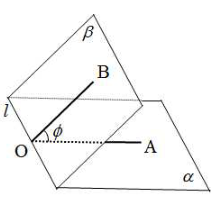
[가] 평면 위에 있는 한 직선은 그 평면을 두 부분으로 나누는데, 그 각각의 부분을 반평면이라고 한다. 직선 l\displaystyle l을 공유하는 두 반평면 α,β\displaystyle \alpha,\beta로 이루어진 도형을 이면각이라고 하고, 교선 l\displaystyle l을 이면각의 변, 두 반평면 α,β\displaystyle \alpha,\beta를 이면각의 면이라고 한다. 오른쪽 그림에서 이면각의 변 l\displaystyle l 위의 한 점 O를 지나고 l\displaystyle l에 수직인 반직선 OA, OB를 반평면 α,β\displaystyle \alpha,\beta 위에 각각 그으면 ∠AOB\displaystyle \angle\mathrm{AOB}의 크기는 O의 위치에 관계없이 일정하다. 이 각의 크기를 이면각의 크기라고 한다. 즉, 이면각의 크기 ϕ\displaystyle \phi는 공간에서 두 평면이 이루는 각이 된다.

반평면 α와 β 사이 이면각 φ의 정의

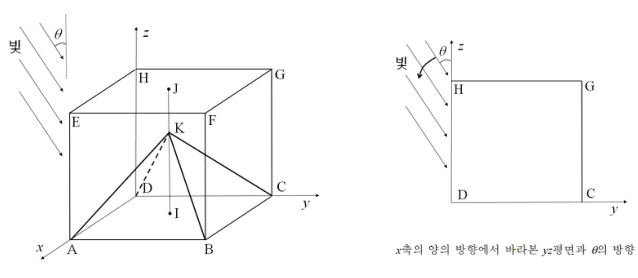
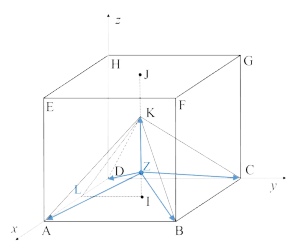
[나] 아래 그림과 같은 직교좌표축에 한 변의 길이가 2\displaystyle 2인 정육면체 ABCD-EFGH와 이 정육면체의 내부에 있는 사각뿔 K-ABCD를 생각하자. 이 사각뿔의 면 □ABCD\displaystyle \square\mathrm{ABCD}는 정육면체 ABCD-EFGH의 밑면과 같고 꼭지점 K는 정육면체 밑면의 중심 I(1,1,0)\displaystyle \mathrm I(1,1,0)와 윗면의 중심 J(1,1,2)\displaystyle \mathrm J(1,1,2)를 잇는 선분 위에 있다. 사각뿔의 옆면인 △ADK\displaystyle \triangle\mathrm{ADK}를 포함하는 평면과 밑면인 □ABCD\displaystyle \square\mathrm{ABCD}를 포함하는 평면이 이루는 이면각의 크기를 ϕ\displaystyle \phi라 하자. 빛은 yz\displaystyle yz평면에 평행하게 xz\displaystyle xz평면으로 입사한다. 입사각 θ\displaystyle \theta는 z\displaystyle z축의 양의 방향에서 반시계 방향으로 측정한다. 그리고 빛은 서로 평행하게 도달한다고 가정한다.

정육면체와 내부 사각뿔 및 yz평면에서 본 빛의 입사각

제시문 [가], [나]를 참고하여 다음에 답하시오.

【2-1】 빛이 θ=π6\displaystyle \theta=\frac\pi6로 입사할 때, 사각뿔 K-ABCD의 꼭지점 K는 밑면 □ABCD\displaystyle \square\mathrm{ABCD}의 중심 I에서 y\displaystyle y축의 양의 방향으로 12\displaystyle \frac12만큼 떨어진 점 (1,32,0)\displaystyle \left(1,\frac32,0\right)에 그림자를 만든다. 이때 cos⁡ϕ\displaystyle \cos\phi를 구하시오.

【2-2】 빛이 입사되는 각도 θ\displaystyle \theta는 반시계 방향으로 증가하고 있으며, 그 각속도는 2π/24h\displaystyle 2\pi/24h(h\displaystyle h는 시간)로 일정하다. 입사각이 θ\displaystyle \theta(단, 0<θ<π4\displaystyle 0<\theta<\frac\pi4)일 때 □ADHE\displaystyle \square\mathrm{ADHE}가 xy\displaystyle xy평면에 만드는 그림자의 면적에서 3시간 후에 만드는 그림자의 면적을 뺀 값을 f(θ)\displaystyle f(\theta)라고 한다. 이때 ∫θ1θ2f(θ) dθ\displaystyle \int_{\theta_1}^{\theta_2}f(\theta)\,d\theta를 구하시오.(단, 0<θ1<θ2<π4\displaystyle 0<\theta_1<\theta_2<\frac\pi4)

좌표공간에 있는 점 Z는 ZA→+ZB→+ZC→+ZD→+ZK→=0\displaystyle \overrightarrow{\mathrm{ZA}}+\overrightarrow{\mathrm{ZB}}+\overrightarrow{\mathrm{ZC}}+\overrightarrow{\mathrm{ZD}}+\overrightarrow{\mathrm{ZK}}=0을 만족한다. 사각뿔 K-ABCD의 옆면들이 정삼각형일 때, 문항 【2-3】과 문항【2-4】에 답하시오.

【2-3】 AZ→\displaystyle \overrightarrow{\mathrm{AZ}}와 AB→\displaystyle \overrightarrow{\mathrm{AB}}의 사이각을 ρ1\displaystyle \rho_1, AZ→\displaystyle \overrightarrow{\mathrm{AZ}}와 AD→\displaystyle \overrightarrow{\mathrm{AD}}의 사이각을 ρ2\displaystyle \rho_2, AZ→\displaystyle \overrightarrow{\mathrm{AZ}}와 AK→\displaystyle \overrightarrow{\mathrm{AK}}의 사이각을 ρ3\displaystyle \rho_3라 하자.이때 2cos⁡2ρ12−2sin⁡2ρ22+cos⁡2ρ32\displaystyle 2\cos^2\frac{\rho_1}2-2\sin^2\frac{\rho_2}2+\cos^2\frac{\rho_3}2를 구하시오.

【2-4】 사각뿔 K-ABCD를 △ADZ\displaystyle \triangle\mathrm{ADZ}를 포함하는 평면으로 자르면 윗부분에 K를 꼭지점으로 하는 사각뿔을 얻는다. 이 사각뿔 안에 들어가는 구 중에서 부피가 최대인 구의 표면적을 구하시오. (여기서 구는 사각뿔의 면들과 접할 수 있다.)

해설강의 준비중
2-1 · 이면각 및 정사영을 이해하여 삼각형을 제대로 그리고 삼각함수의 정의와 성질을 적용하여 이면각의 크기를 구할 수 있는지 평가한다.

[2-1]

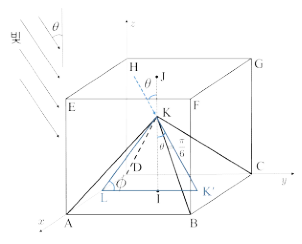
꼭지점 K의 그림자 K′와 이면각을 나타낸 정육면체

점 I에서 x\displaystyle x축에 내린 수선의 발을 L(1,0,0)\displaystyle \mathrm L(1,0,0), 점 K의 그림자를 K′(1,32,0)\displaystyle \mathrm K^{\prime}\left(1,\frac32,0\right)이라 하자. 점 I의 좌표가 (1,1,0)\displaystyle (1,1,0)이므로 IK′‾=12\displaystyle \overline{\mathrm{IK^{\prime}}}=\frac12이 되고, 직각삼각형 KIK′에서, θ=π6\displaystyle \theta=\frac\pi6이므로 KI‾=32\displaystyle \overline{\mathrm{KI}}=\frac{\sqrt3}2, KK′‾=1\displaystyle \overline{\mathrm{KK^{\prime}}}=1이다. 따라서 직각삼각형 KLI에서, LI‾=1\displaystyle \overline{\mathrm{LI}}=1이므로 피타고라스의 정리에 의하여 KL‾=72\displaystyle \overline{\mathrm{KL}}=\frac{\sqrt7}2.그러므로 cos⁡ϕ=LI‾KL‾=27\displaystyle \cos\phi=\frac{\overline{\mathrm{LI}}}{\overline{\mathrm{KL}}}=\frac2{\sqrt7}이다.

2-2 · 정사영의 면적을 구하고 삼각함수의 정리를 이용하여 간단히 나타낸 후 이의 정적분을 치환적분을 이용하여 구할 수 있는지 평가한다.

[2-2]

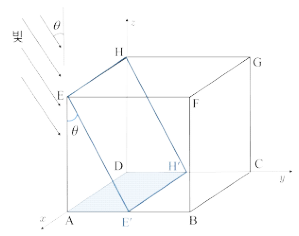
면 ADHE가 xy평면에 만드는 그림자 AE′H′D

빛이 입사되는 각도는 3시간 동안 π4\displaystyle \frac\pi4만큼 회전하므로 θ\displaystyle \theta일 때의 그림자의 면적에서 θ+π4\displaystyle \theta+\frac\pi4일 때의 그림자의 면적을 빼면 된다. 한편, 그림자의 면적은 AD‾ AE′‾=2⋅2tan⁡θ\displaystyle \overline{\mathrm{AD}}\,\overline{\mathrm{AE^{\prime}}}=2\cdot2\tan\theta이다. 그러므로f(θ)=4tan⁡θ−4tan⁡(θ+π4)=4(tan⁡θ−tan⁡θ+tan⁡π41−tan⁡θtan⁡π4)=4(tan⁡θ−tan⁡θ+11−tan⁡θ)=4(−tan⁡2θ−11−tan⁡θ)=−4sec⁡2θ1−tan⁡θ\displaystyle \begin{aligned}f(\theta)&=4\tan\theta-4\tan\left(\theta+\frac\pi4\right)\\&=4\left(\tan\theta-\frac{\tan\theta+\tan\frac\pi4}{1-\tan\theta\tan\frac\pi4}\right)\\&=4\left(\tan\theta-\frac{\tan\theta+1}{1-\tan\theta}\right)\\&=4\left(\frac{-\tan^2\theta-1}{1-\tan\theta}\right)=\frac{-4\sec^2\theta}{1-\tan\theta}\end{aligned}이 되고 이를 적분하면, 0<θ1<θ2<π4\displaystyle 0<\theta_1<\theta_2<\frac\pi4에 대하여∫θ1θ2f(θ) dθ=∫θ1θ2−4sec⁡2θ1−tan⁡θ dθ=4ln⁡(1−tan⁡θ21−tan⁡θ1)\displaystyle \int_{\theta_1}^{\theta_2}f(\theta)\,d\theta=\int_{\theta_1}^{\theta_2}\frac{-4\sec^2\theta}{1-\tan\theta}\,d\theta=4\ln\left(\frac{1-\tan\theta_2}{1-\tan\theta_1}\right)이다.

2-3 · 주어진 관계식으로부터 점의 좌표를 구하고 내적의 정의와 성질을 이해하며 삼각함수의 정리를 활용할 수 있는지 평가한다.

[2-3]

사각뿔의 점 Z와 꼭지점을 잇는 벡터

△ADK\displaystyle \triangle\mathrm{ADK}가 한 변의 길이가 2\displaystyle 2인 정삼각형이므로 KL‾=3\displaystyle \overline{\mathrm{KL}}=\sqrt3이고KI‾=(KL‾)2−(LI‾)2=3−1=2\displaystyle \overline{\mathrm{KI}}=\sqrt{(\overline{\mathrm{KL}})^2-(\overline{\mathrm{LI}})^2}=\sqrt{3-1}=\sqrt2가 된다.그러므로 K(1,1,2)\displaystyle \mathrm K(1,1,\sqrt2)이다.Z=(1,1,z)\displaystyle \mathrm Z=(1,1,z)라 놓고 ZA→+ZB→+ZC→+ZD→+ZK→=0\displaystyle \overrightarrow{\mathrm{ZA}}+\overrightarrow{\mathrm{ZB}}+\overrightarrow{\mathrm{ZC}}+\overrightarrow{\mathrm{ZD}}+\overrightarrow{\mathrm{ZK}}=0을 이용해서 풀면 Z(1,1,25)\displaystyle \mathrm Z\left(1,1,\frac{\sqrt2}5\right)이므로AZ→=(−1,1,25)\displaystyle \overrightarrow{\mathrm{AZ}}=\left(-1,1,\frac{\sqrt2}5\right), ∣AZ→∣=525\displaystyle |\overrightarrow{\mathrm{AZ}}|=\frac{\sqrt{52}}5이다.한편, AB→=(0,2,0)\displaystyle \overrightarrow{\mathrm{AB}}=(0,2,0), AD→=(−2,0,0)\displaystyle \overrightarrow{\mathrm{AD}}=(-2,0,0), AK→=(−1,1,2)\displaystyle \overrightarrow{\mathrm{AK}}=(-1,1,\sqrt2)이고 ∣AB→∣=∣AD→∣=∣AK→∣=2\displaystyle |\overrightarrow{\mathrm{AB}}|=|\overrightarrow{\mathrm{AD}}|=|\overrightarrow{\mathrm{AK}}|=2이다.그러므로cos⁡ρ1=AZ→⋅AB→∣AZ→∣ ∣AB→∣=552\displaystyle \cos\rho_1=\frac{\overrightarrow{\mathrm{AZ}}\cdot\overrightarrow{\mathrm{AB}}}{|\overrightarrow{\mathrm{AZ}}|\,|\overrightarrow{\mathrm{AB}}|}=\frac5{\sqrt{52}}, cos⁡ρ2=552\displaystyle \cos\rho_2=\frac5{\sqrt{52}},cos⁡ρ3=652\displaystyle \cos\rho_3=\frac6{\sqrt{52}}이 되어2(cos⁡2ρ12−sin⁡2ρ22)+cos⁡2ρ32=2(1+cos⁡ρ12−1−cos⁡ρ22)+1+cos⁡ρ32=cos⁡ρ1+cos⁡ρ2+cos⁡ρ32+12=13+12\displaystyle \begin{aligned}2\left(\cos^2\frac{\rho_1}2-\sin^2\frac{\rho_2}2\right)+\cos^2\frac{\rho_3}2&=2\left(\frac{1+\cos\rho_1}2-\frac{1-\cos\rho_2}2\right)+\frac{1+\cos\rho_3}2\\&=\cos\rho_1+\cos\rho_2+\frac{\cos\rho_3}2+\frac12\\&=\frac{\sqrt{13}+1}2\end{aligned}이다.

2-4 · 사각뿔에 내접하는 구가 갖는 성질을 이용하여 구의 반지름의 길이를 구할 수 있는지 평가한다.

[2-4]

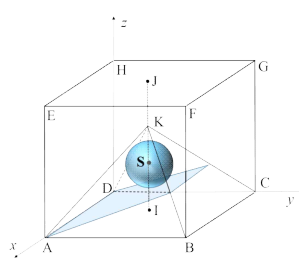
사각뿔을 평면 ADZ로 자른 윗부분에 들어간 최대 구
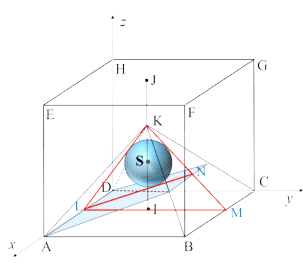
최대 구와 중심 S 및 절단면 삼각형 KLN
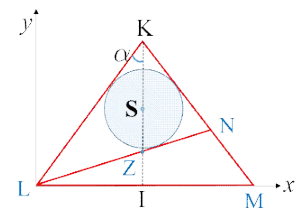
평면 단면의 삼각형 KLN과 그 내접원

부피가 최대가 되게 하는 구의 중심을 S, 그 반지름의 길이를 r\displaystyle r, BC‾\displaystyle \overline{\mathrm{BC}}의 중점을 M, LZ‾\displaystyle \overline{\mathrm{LZ}}의 연장선과 KM‾\displaystyle \overline{\mathrm{KM}}의 교점을 N이라 하자. 이 때, 평면 x=1\displaystyle x=1로 자른 단면을 마지막 그림과 같이 좌표평면 위에 놓으면L(0,0)\displaystyle \mathrm L(0,0), M(2,0)\displaystyle \mathrm M(2,0), K(1,2)\displaystyle \mathrm K(1,\sqrt2), Z(1,25)\displaystyle \mathrm Z\left(1,\frac{\sqrt2}5\right)이다. 점 N은 LZ‾\displaystyle \overline{\mathrm{LZ}}를 품는 직선 y=25x\displaystyle y=\frac{\sqrt2}5x와 KM‾\displaystyle \overline{\mathrm{KM}}를 품는 직선y=−2(x−2)\displaystyle y=-\sqrt2(x-2)의 교점이므로 N=(53,23)\displaystyle \mathrm N=\left(\frac53,\frac{\sqrt2}3\right)이다.따라서 KL‾=LN‾=3\displaystyle \overline{\mathrm{KL}}=\overline{\mathrm{LN}}=\sqrt3, NK‾=23\displaystyle \overline{\mathrm{NK}}=\frac2{\sqrt3}이다. 한편,α=∠LKI\displaystyle \alpha=\angle\mathrm{LKI}라 하면sin⁡α=LI‾KL‾=13\displaystyle \sin\alpha=\frac{\overline{\mathrm{LI}}}{\overline{\mathrm{KL}}}=\frac1{\sqrt3}, cos⁡α=KI‾KL‾=23\displaystyle \cos\alpha=\frac{\overline{\mathrm{KI}}}{\overline{\mathrm{KL}}}=\frac{\sqrt2}{\sqrt3}이므로△KLN=12KL‾ NK‾sin⁡2α=2sin⁡αcos⁡α=223\displaystyle \triangle\mathrm{KLN}=\frac12\overline{\mathrm{KL}}\,\overline{\mathrm{NK}}\sin2\alpha=2\sin\alpha\cos\alpha=\frac{2\sqrt2}3이다.또한△KLN=12(KL‾+LN‾+NK‾)r=(3+13)r\displaystyle \triangle\mathrm{KLN}=\frac12(\overline{\mathrm{KL}}+\overline{\mathrm{LN}}+\overline{\mathrm{NK}})r=\left(\sqrt3+\frac1{\sqrt3}\right)r이므로r=16\displaystyle r=\frac1{\sqrt6}이 되어 구의 표면적은 4πr2=2π3\displaystyle 4\pi r^2=\frac{2\pi}3이다.

평가방법: 구간별 등급 부여인원을 준수하여 상대평가

평가배점: 소문항을 모두 포함한 문제를 10점 만점으로 0~10등급 사이에서의 최종 평가등급을 부여함

답안이나 답안지 여백에 문제와 관계없는 불필요한 낙서나 이와 유사한 표식이 있는 경우 과락처리함

문제와 전혀 관계없는 내용으로 작성된 답안의 경우 과락처리함

첨삭 사례

아직 등록된 첨삭 사례가 없습니다.

질문과 답변 · 0개질문과 답변 · 고정 0개

아직 등록된 질문이 없습니다. 질문 작성은 멤버십 회원만 가능합니다.