수리논술, 배움에서 논증의 완성까지.

자연계열 4번

문제

🔒
짧은 시간에 너무 많은 문제를 여셔서 열람을 잠시 제한했습니다. 잠시 후 다시 시도하시거나 로그인해 주세요.
해설강의 준비중
4-1 · 평면의 법선벡터를 이해하고 이를 이용하여 평면의 방정식을 구할 수 있는지 평가한다.

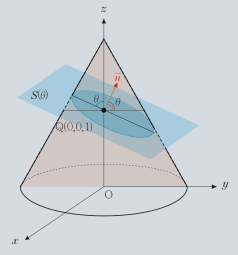
[4–1] 평면 S(θ)\displaystyle S(\theta)는 점 (0,0,1)\displaystyle (0,0,1)을 지나고 그림과 같이 법선벡터 n=(0,cosθ,sinθ)\displaystyle \vec n=(0,\cos\theta,\sin\theta)이므로평면 S(θ)\displaystyle S(\theta)의 방정식은 (cosθ)y+(sinθ)(z1)=0\displaystyle (\cos\theta)y+(\sin\theta)(z-1)=0이다. sinθ0(π4<θ<π2)\displaystyle \sin\theta\ne0\left(\frac\pi4<\theta<\frac\pi2\right)이므로 양변을 sinθ\displaystyle \sin\theta로 나누면 (cotθ)y+(z1)=0\displaystyle (\cot\theta)y+(z-1)=0, 즉, (cotθ)y+z=1\displaystyle (\cot\theta)y+z=1을 얻는다.

원뿔을 자르는 평면 S(θ)의 법선벡터와 각 θ
4-2 · 두 점 사이의 거리를 이해하고 이차식의 최솟값을 구할 수 있는지 평가한다.

[4–2] D=2AP2BP2=2[x2+(y1)2+(z2)2][x2+(y3)2+(z3)2]=x2+y2+z2+2y2z8=x2+(y+1)2+(z1)210\displaystyle \begin{aligned}D&=2\overline{\mathrm{AP}}^2-\overline{\mathrm{BP}}^2\\&=2[x^2+(y-1)^2+(z-2)^2]-[x^2+(y-3)^2+(z-3)^2]\\&=x^2+y^2+z^2+2y-2z-8\\&=x^2+(y+1)^2+(z-1)^2-10\end{aligned}이다. 그런데 P(x,y,z)\displaystyle \mathrm P(x,y,z)가 평면 S(π3)\displaystyle S\left(\frac\pi3\right)위의 점이므로 [4–1]에 의하여 (cotπ3)y+z=1\displaystyle \left(\cot\frac\pi3\right)y+z=1,즉, y3+z=1\displaystyle \frac y{\sqrt3}+z=1을 만족한다. 따라서D=x2+(y+1)2+y2310=x2+43(y+34)2394\displaystyle D=x^2+(y+1)^2+\frac{y^2}3-10=x^2+\frac43\left(y+\frac34\right)^2-\frac{39}4이 되어D\displaystyle D의 최솟값은 394\displaystyle -\frac{39}4이고 이 때의 점 P의 좌표는 (0,34,1+34)\displaystyle \left(0,-\frac34,1+\frac{\sqrt3}4\right)이다.

4-3 · 직선의 방정식, 두 직선의 교점 및 두 점 사이의 거리를 구할 수 있으며 선분의 정사영을 이해하는지 평가한다.

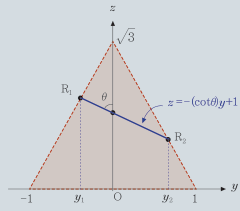
[4–3] 두 교점 R1,R2\displaystyle \mathrm R_1,\mathrm R_2yz\displaystyle yz평면 위에 있으므로 R1(y1,z1)\displaystyle \mathrm R_1(y_1,z_1), R2(y2,z2)\displaystyle \mathrm R_2(y_2,z_2)라 하자(단, y1<y2\displaystyle y_1<y_2).

yz평면 위 원뿔의 두 모선과 평면의 교선이 만나는 R1, R2

R1\displaystyle \mathrm R_1z=(cotθ)y+1\displaystyle z=-(\cot\theta)y+1z=3y+3\displaystyle z=\sqrt3y+\sqrt3의 교점이므로 y1=313+cotθ\displaystyle y_1=-\frac{\sqrt3-1}{\sqrt3+\cot\theta}이다.한편 R2\displaystyle \mathrm R_2z=(cotθ)y+1\displaystyle z=-(\cot\theta)y+1z=3y+3\displaystyle z=-\sqrt3y+\sqrt3의 교점이므로 y2=313cotθ\displaystyle y_2=\frac{\sqrt3-1}{\sqrt3-\cot\theta}이다.따라서 y2y1=2(33)3cot2θ\displaystyle y_2-y_1=\frac{2(3-\sqrt3)}{3-\cot^2\theta}이다.제시문 [나]의 정사영의 정의를 활용하면 l(θ)cos(π2θ)=y2y1\displaystyle l(\theta)\cdot\cos\left(\frac\pi2-\theta\right)=y_2-y_1이므로l(θ)=y2y1sinθ=2(33)(3cot2θ)sinθ\displaystyle l(\theta)=\frac{y_2-y_1}{\sin\theta}=\frac{2(3-\sqrt3)}{(3-\cot^2\theta)\sin\theta}이다.

4-4 · 삼각함수의 성질, 역함수의 존재성, 역함수의 미분법 및 로그함수의 미분법을 이해하는지 평가한다.

[4–4] π4<θ<π2\displaystyle \frac\pi4<\theta<\frac\pi2에서 y=cotθ\displaystyle y=\cot\theta는 감소함수, y=sinθ\displaystyle y=\sin\theta는 증가함수이므로l(θ)=2(33)(3cot2θ)sinθ\displaystyle l(\theta)=\frac{2(3-\sqrt3)}{(3-\cot^2\theta)\sin\theta}는 감소함수가 되어 일대일대응이다. 따라서 π4<θ<π2\displaystyle \frac\pi4<\theta<\frac\pi2에서 l(θ)\displaystyle l(\theta)의 역함수가 존재한다. l1(α)=π3\displaystyle l^{-1}(\alpha)=\frac\pi3이므로 l(π3)=α\displaystyle l\left(\frac\pi3\right)=\alpha이다. 따라서 역함수의 미분법에 의하여(l1)(α)=1l(π3)\displaystyle (l^{-1})^{\prime}(\alpha)=\frac1{l^{\prime}\left(\frac\pi3\right)}이다. 이제 l(π3)\displaystyle l^{\prime}\left(\frac\pi3\right)를 구해보자.제시문 [다]를 사용하여, 양변에 자연로그를 취하면lnl(θ)=ln(2(33))ln(3cot2θ)ln(sinθ)\displaystyle \ln l(\theta)=\ln(2(3-\sqrt3))-\ln(3-\cot^2\theta)-\ln(\sin\theta)이고 이 식의 양변을 미분하면l(θ)l(θ)=2cotθcsc2θ3cot2θcosθsinθ=cotθ(2csc2θ3cot2θ+1)\displaystyle \frac{l^{\prime}(\theta)}{l(\theta)}=-\frac{2\cot\theta\csc^2\theta}{3-\cot^2\theta}-\frac{\cos\theta}{\sin\theta}=-\cot\theta\left(\frac{2\csc^2\theta}{3-\cot^2\theta}+1\right)이다.따라서 l(π3)=l(π3)(23)=3(33)2(23)=33\displaystyle l^{\prime}\left(\frac\pi3\right)=l\left(\frac\pi3\right)\cdot\left(-\frac2{\sqrt3}\right)=\frac{\sqrt3(3-\sqrt3)}2\cdot\left(-\frac2{\sqrt3}\right)=\sqrt3-3이고(l1)(α)=1l(π3)=133\displaystyle (l^{-1})^{\prime}(\alpha)=\frac1{l^{\prime}\left(\frac\pi3\right)}=\frac1{\sqrt3-3}이다.

첨삭 사례

아직 등록된 첨삭 사례가 없습니다.

질문과 답변 · 0개질문과 답변 · 고정 0개

아직 등록된 질문이 없습니다. 질문 작성은 멤버십 회원만 가능합니다.