수리논술, 이게 다다.

자연계열 (1차) 2번

오류 제보

문제

[가] 무리수 e\displaystyle e의 정의lim⁡x→0(1+x)1x=e\displaystyle \lim_{x\to0}(1+x)^{\frac1x}=e

[나] 함수 f(x)\displaystyle f(x)가 어떤 열린구간에서 미분가능하고, 이 구간의 모든 x\displaystyle x에 대하여① f′(x)>0\displaystyle f^{\prime}(x)>0이면 f(x)\displaystyle f(x)는 이 구간에서 증가한다.② f′(x)<0\displaystyle f^{\prime}(x)<0이면 f(x)\displaystyle f(x)는 이 구간에서 감소한다.

[다] 함수 y=f(x)\displaystyle y=f(x)의 그래프의 개형은 다음과 같은 사항을 조사하여 그릴 수 있다.① 함수의 정의역과 치역② 곡선과 좌표축의 교점③ 곡선의 대칭성과 주기④ 함수의 증가와 감소, 극대와 극소⑤ 곡선의 오목과 볼록, 변곡점⑥ lim⁡x→∞f(x)\displaystyle \lim_{x\to\infty}f(x), lim⁡x→−∞f(x)\displaystyle \lim_{x\to-\infty}f(x), 점근선

[라] 함수 f(x)\displaystyle f(x)가 x=a\displaystyle x=a에서 미분가능할 때, 곡선 y=f(x)\displaystyle y=f(x) 위의 점 P(a,f(a))\displaystyle \mathrm{P}(a,f(a))에서의 접선의 기울기는 f′(a)\displaystyle f^{\prime}(a)이므로 접선의 방정식은 다음과 같다.y−f(a)=f′(a)(x−a)\displaystyle y-f(a)=f^{\prime}(a)(x-a)

【2-1】 좌표평면 위를 움직이는 점 P\displaystyle \mathrm{P}의 시각 t\displaystyle t에서 위치 (x,y)\displaystyle (x,y)가 x=13e3t+tet\displaystyle x=\frac13e^{3t}+te^t, y=∫ln⁡2t(2s−s2)e2s+2s ds\displaystyle y=\int_{\ln\sqrt2}^t\sqrt{(2s-s^2)e^{2s}+2s}\,ds일 때, 시각 t=12\displaystyle t=\frac12에서 t=ln⁡2\displaystyle t=\ln2까지 점 P\displaystyle \mathrm{P}가 움직인 거리를 구하시오.

【2-2】 x≥0\displaystyle x\ge0일 때 부등식 2ex>x2\displaystyle 2e^x>x^2이 성립함을 보이고, 이 부등식을 이용하여 극한값 lim⁡x→∞xe−x\displaystyle \lim_{x\to\infty}xe^{-x}을 구하시오. 그리고 구간 (−∞,∞)\displaystyle (-\infty,\infty)에서 함수 f(x)=xe−x\displaystyle f(x)=xe^{-x}의 그래프의 개형을 그리시오.

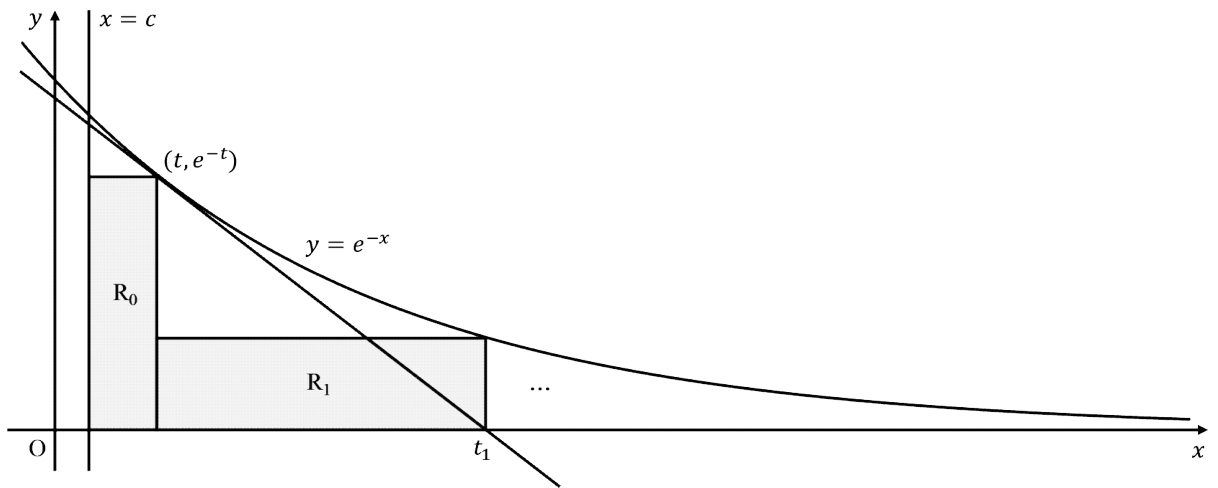
양수 c\displaystyle c에 대하여 다음 그림과 같이 직사각형 R0\displaystyle \mathrm{R}_0의 두 변은 각각 x\displaystyle x축, 직선 x=c\displaystyle x=c 위에 있고, 한 꼭짓점은 곡선 y=e−x\displaystyle y=e^{-x} 위에 있다. 이때, 곡선 y=e−x\displaystyle y=e^{-x} 위의 꼭짓점을 (t,e−t)\displaystyle (t,e^{-t})이라 하자. 곡선 y=e−x\displaystyle y=e^{-x} 위의 점 (t,e−t)\displaystyle (t,e^{-t})에서의 접선의 x\displaystyle x절편을 t1\displaystyle t_1이라 할 때, 두 변이 각각 x\displaystyle x축, 직선 x=t\displaystyle x=t 위에 있고 한 꼭짓점이 곡선 y=e−x\displaystyle y=e^{-x} 위의 점 (t1,e−t1)\displaystyle (t_1,e^{-t_1})인 직사각형을 R1\displaystyle \mathrm{R}_1이라 하자. 곡선 y=e−x\displaystyle y=e^{-x} 위의 점 (t1,e−t1)\displaystyle (t_1,e^{-t_1})에서의 접선의 x\displaystyle x절편을 t2\displaystyle t_2라 할 때, 두 변이 각각 x\displaystyle x축, 직선 x=t1\displaystyle x=t_1 위에 있고 한 꼭짓점이 곡선 y=e−x\displaystyle y=e^{-x} 위의 점 (t2,e−t2)\displaystyle (t_2,e^{-t_2})인 직사각형을 R2\displaystyle \mathrm{R}_2라 하자. 이 과정을 반복하여 직사각형 R1\displaystyle \mathrm{R}_1, R2\displaystyle \mathrm{R}_2, ⋯\displaystyle \cdots, Rn\displaystyle \mathrm{R}_n을 만든다. 문항 【2-3】과 【2-4】에 답하시오. (단, t>c\displaystyle t>c이고 n\displaystyle n은 자연수)

지수함수와 접선으로 만드는 직사각형 R0, R1

【2-3】 두 개의 직사각형 R0\displaystyle \mathrm{R}_0와 R1\displaystyle \mathrm{R}_1의 넓이의 합의 최댓값이 1e\displaystyle \frac1e일 때, c\displaystyle c의 값을 구하시오.

【2-4】 c=1e\displaystyle c=\frac1e일 때, n+1\displaystyle n+1개의 직사각형 R0\displaystyle \mathrm{R}_0, R1\displaystyle \mathrm{R}_1, R2\displaystyle \mathrm{R}_2, ⋯\displaystyle \cdots, Rn\displaystyle \mathrm{R}_n의 넓이의 합이 최대가 되는 t\displaystyle t를 an\displaystyle a_n이라 하자. 극한값 lim⁡n→∞an\displaystyle \lim_{n\to\infty}a_n을 구하시오.

해설강의 준비중
· 【2-1】 다양한 미분법과 적분과 미분의 관계를 이용하여 좌표평면 위에서 움직이는 점의 속도를 구하고 이를 이용하여 움직인 거리를 정적분으로 나타낼 수 있다. 치환적분법을 이용하여 정적분의 값을 구할 수 있다.

【2-1】 dxdt=e3t+(t+1)et\displaystyle \frac{dx}{dt}=e^{3t}+(t+1)e^t, dydt=(2t−t2)e2t+2t\displaystyle \frac{dy}{dt}=\sqrt{(2t-t^2)e^{2t}+2t}이므로 점 P\displaystyle \mathrm{P}가 움직인 거리는∫12ln⁡2(dxdt)2+(dydt)2 dt=∫12ln⁡2(e3t+tet+et)2+(2t−t2)e2t+2t dt\displaystyle \int_{\frac12}^{\ln2}\sqrt{\left(\frac{dx}{dt}\right)^2+\left(\frac{dy}{dt}\right)^2}\,dt=\int_{\frac12}^{\ln2}\sqrt{(e^{3t}+te^t+e^t)^2+(2t-t^2)e^{2t}+2t}\,dt근호 안의 식을 정리하면{e3t+(t+1)et}2+(2t−t2)e2t+2t=t(2e4t+4e2t+2)+e6t+2e4t+e2t=2t(e4t+2e2t+1)+e2t(e4t+2e2t+1)=(2t+e2t)(e2t+1)2\displaystyle \begin{aligned}\{e^{3t}+(t+1)e^t\}^2+(2t-t^2)e^{2t}+2t&=t(2e^{4t}+4e^{2t}+2)+e^{6t}+2e^{4t}+e^{2t}\\&=2t(e^{4t}+2e^{2t}+1)+e^{2t}(e^{4t}+2e^{2t}+1)\\&=(2t+e^{2t})(e^{2t}+1)^2\end{aligned}이므로 점 P\displaystyle \mathrm{P}가 움직인 거리는 ∫12ln⁡2(e2t+1)e2t+2t dt\displaystyle \int_{\frac12}^{\ln2}(e^{2t}+1)\sqrt{e^{2t}+2t}\,dt이다.e2t+2t=u\displaystyle e^{2t}+2t=u로 놓으면 dudt=2(e2t+1)\displaystyle \frac{du}{dt}=2(e^{2t}+1)이고, t=12\displaystyle t=\frac12일 때 u=e+1\displaystyle u=e+1, t=ln⁡2\displaystyle t=\ln2일 때 u=4+2ln⁡2\displaystyle u=4+2\ln2이므로 점 P\displaystyle \mathrm{P}가 움직인 거리는∫12ln⁡2(e2t+1)e2t+2t dt=12∫e+14+2ln⁡2u du=(4+2ln⁡2)32−(e+1)323\displaystyle \int_{\frac12}^{\ln2}(e^{2t}+1)\sqrt{e^{2t}+2t}\,dt=\frac12\int_{e+1}^{4+2\ln2}\sqrt{u}\,du=\frac{(4+2\ln2)^{\frac32}-(e+1)^{\frac32}}3

· 【2-2】 제시문 [나]에 주어진 도함수의 부호와 함수의 증가·감소의 관계를 이용하여 부등식이 성립함을 보일 수 있다. 제시문 [다]에 주어진 그래프 개형을 그리는 방법을 바탕으로, 도함수와 이계도함수를 이용하여 그래프의 개형을 그릴 수 있다.

【2-2】 g(x)=2ex−x2\displaystyle g(x)=2e^x-x^2이라고 하면, g′(x)=2(ex−x)>0\displaystyle g^{\prime}(x)=2(e^x-x)>0이므로 제시문 [나]에 의해 g(x)\displaystyle g(x)는 증가한다. g(0)=2>0\displaystyle g(0)=2>0이므로 x≥0\displaystyle x\ge0에서 g(x)>0\displaystyle g(x)>0이 되어 부등식 2ex>x2\displaystyle 2e^x>x^2이 성립한다. 따라서 x>0\displaystyle x>0일 때, 0<xe−x<2x\displaystyle 0<xe^{-x}<\frac2x이고 lim⁡x→∞2x=0\displaystyle \lim_{x\to\infty}\frac2x=0이므로 lim⁡x→∞xe−x=0\displaystyle \lim_{x\to\infty}xe^{-x}=0이다.함수 f(x)=xe−x\displaystyle f(x)=xe^{-x}의 정의역은 실수 전체의 집합이고, f(0)=0\displaystyle f(0)=0이므로 원점을 지난다. f′(x)=(1−x)e−x\displaystyle f^{\prime}(x)=(1-x)e^{-x}이고 f′′(x)=(x−2)e−x\displaystyle f^{\prime\prime}(x)=(x-2)e^{-x}이므로, 함수 f(x)\displaystyle f(x)의 증가와 감소를 표로 나타내면 다음과 같다.

xx⋯1⋯2⋯
f′(x)f^{\prime}(x)+0−−−
f′′(x)f^{\prime\prime}(x)−−−0+
f(x)f(x)e−1e^{-1}2e−22e^{-2}

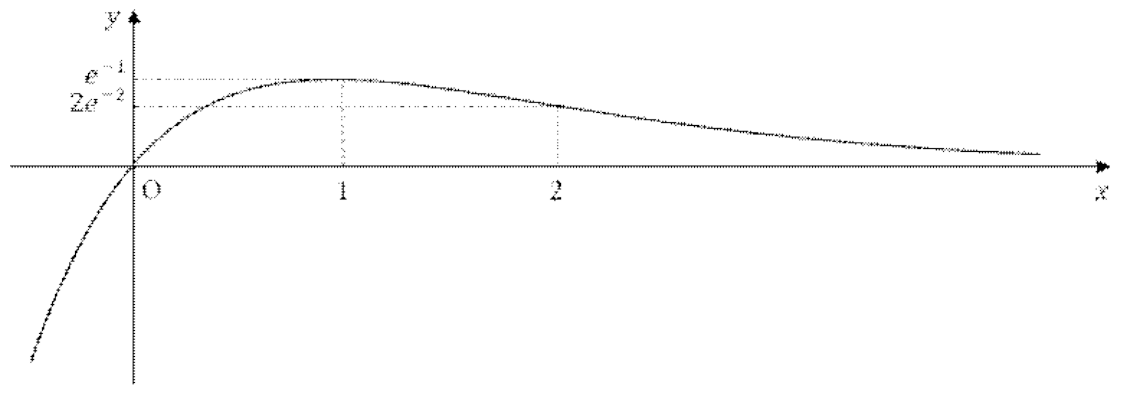
함수 f(x)\displaystyle f(x)는 x=1\displaystyle x=1에서 극댓값 e−1\displaystyle e^{-1}을 갖고, 곡선 y=f(x)\displaystyle y=f(x)의 변곡점의 좌표는 (2,2e−2)\displaystyle (2,2e^{-2})이다. 또 lim⁡x→−∞f(x)=−∞\displaystyle \lim_{x\to-\infty}f(x)=-\infty이고 lim⁡x→∞f(x)=0\displaystyle \lim_{x\to\infty}f(x)=0이다. 따라서 함수 f(x)\displaystyle f(x)의 그래프의 개형은 다음 그림과 같다.

함수 y=xe의 -x승의 그래프
· 【2-3】 제시문 [라]를 이용하여 지수함수 y=e−x\displaystyle y=e^{-x} 위의 한 점에서의 접선의 방정식을 구한 후, 직사각형 R1\displaystyle \mathrm{R}_1의 넓이를 구할 수 있다. 두 직사각형 R0\displaystyle \mathrm{R}_0와 R1\displaystyle \mathrm{R}_1의 넓이의 합이 최대가 되는 양수 c\displaystyle c의 값을 도함수를 이용하여 구할 수 있다.

【2-3】 직사각형 R0\displaystyle \mathrm{R}_0의 넓이는 (t−c)e−t\displaystyle (t-c)e^{-t}이다. 그리고, 제시문 [라]에 의하여, 곡선 y=e−x\displaystyle y=e^{-x} 위의 점 (t,e−t)\displaystyle (t,e^{-t})에서의 접선의 방정식은 y=−e−t(x−t)+e−t\displaystyle y=-e^{-t}(x-t)+e^{-t}이다. 따라서 이 접선의 x\displaystyle x절편은 t1=t+1\displaystyle t_1=t+1이 되어, 직사각형 R1\displaystyle \mathrm{R}_1의 넓이는 e−t−1\displaystyle e^{-t-1}이다. 직사각형 R0\displaystyle \mathrm{R}_0와 R1\displaystyle \mathrm{R}_1의 넓이의 합을 S(t)\displaystyle S(t)라고 하면S(t)=(t−c)e−t+e−t−1=(t−c+e−1)e−t(t>c)\displaystyle S(t)=(t-c)e^{-t}+e^{-t-1}=(t-c+e^{-1})e^{-t}\quad(t>c)이 되어 S′(t)=(1−t+c−e−1)e−t\displaystyle S^{\prime}(t)=(1-t+c-e^{-1})e^{-t}이므로, 함수 S(t)\displaystyle S(t)의 증가와 감소를 표로 나타내면 다음과 같다.tc⋯1+c−e−1⋯S′(t)+0−S(t)↗e−1−c+e−1↘\displaystyle \begin{array}{c|cccc}t&c&\cdots&1+c-e^{-1}&\cdots\\\hline S^{\prime}(t)&&+&0&-\\\hline S(t)&&\nearrow&e^{-1-c+e^{-1}}&\searrow\end{array}따라서 함수 S(t)\displaystyle S(t)는 t=c+1−e−1\displaystyle t=c+1-e^{-1}에서 최댓값 e−1−c+e−1\displaystyle e^{-1-c+e^{-1}}을 갖는다.최댓값이 1e\displaystyle \frac1e이므로 c=1e\displaystyle c=\frac1e이다.

· 【2-4】 자연수 k\displaystyle k에 대하여 직사각형 Rk\displaystyle \mathrm{R}_k의 넓이를 구할 수 있다. n+1\displaystyle n+1개의 직사각형 R0\displaystyle \mathrm{R}_0, R1\displaystyle \mathrm{R}_1, ⋯\displaystyle \cdots, Rn\displaystyle \mathrm{R}_n의 넓이의 합을 구할 수 있다. 직사각형의 넓이의 합이 최대가 되는 t=an\displaystyle t=a_n을 도함수를 이용하여 구할 수 있다. 등비급수를 이용하여 an\displaystyle a_n의 극한값을 구할 수 있다.

【2-4】 직사각형 R0\displaystyle \mathrm{R}_0의 넓이는 (t−e−1)e−t\displaystyle (t-e^{-1})e^{-t}이다. k=1,2,3,⋯ ,n\displaystyle k=1,2,3,\cdots,n일 때, 곡선 y=e−x\displaystyle y=e^{-x} 위의 점 (t+k−1,e−t−k+1)\displaystyle (t+k-1,e^{-t-k+1})에서의 접선의 방정식은 y=−e−t−k+1(x−t−k+1)+e−t−k+1\displaystyle y=-e^{-t-k+1}(x-t-k+1)+e^{-t-k+1}이다. 따라서 이 접선의 x\displaystyle x절편은 tk=t+k\displaystyle t_k=t+k이 되어, 직사각형 Rk\displaystyle \mathrm{R}_k의 넓이는 e−t−k\displaystyle e^{-t-k}이다. 직사각형 R0\displaystyle \mathrm{R}_0, R1\displaystyle \mathrm{R}_1, R2\displaystyle \mathrm{R}_2, ⋯\displaystyle \cdots, Rn\displaystyle \mathrm{R}_n의 넓이의 합을 A(t)\displaystyle A(t)라고 하면A(t)=(t−e−1)e−t+e−t∑k=1ne−k(t>e−1)\displaystyle A(t)=(t-e^{-1})e^{-t}+e^{-t}\sum_{k=1}^n e^{-k}\quad(t>e^{-1})Sn=∑k=1ne−k\displaystyle S_n=\sum_{k=1}^n e^{-k}이라고 하면, A(t)=(t−e−1+Sn)e−t\displaystyle A(t)=(t-e^{-1}+S_n)e^{-t}이 되어A′(t)=(1−t+e−1−Sn)e−t\displaystyle A^{\prime}(t)=(1-t+e^{-1}-S_n)e^{-t}그러므로 함수 A(t)\displaystyle A(t)의 증가와 감소를 표로 나타내면 다음과 같다.te−1⋯1+e−1−Sn⋯A′(t)+0−A(t)↗↘\displaystyle \begin{array}{c|cccc}t&e^{-1}&\cdots&1+e^{-1}-S_n&\cdots\\\hline A^{\prime}(t)&&+&0&-\\\hline A(t)&&\nearrow&&\searrow\end{array}따라서 함수 A(t)\displaystyle A(t)는 t=an=1+e−1−Sn\displaystyle t=a_n=1+e^{-1}-S_n에서 최댓값을 갖는다.lim⁡n→∞Sn=∑n=1∞e−n\displaystyle \lim_{n\to\infty}S_n=\sum_{n=1}^{\infty}e^{-n}은 첫째항이 e−1\displaystyle e^{-1}, 공비가 e−1\displaystyle e^{-1}인 등비급수이므로 lim⁡n→∞Sn=e−11−e−1=1e−1\displaystyle \lim_{n\to\infty}S_n=\frac{e^{-1}}{1-e^{-1}}=\frac1{e-1}이다. 따라서lim⁡n→∞an=1+1e−1e−1\displaystyle \lim_{n\to\infty}a_n=1+\frac1e-\frac1{e-1}

고등학교 교육과정에서 필수적으로 다루어지는 미적분의 기본적인 내용을 바탕으로 급수, 함수의 도함수와 정적분을 제대로 이해하고 이를 다양한 상황에 활용할 수 있는지 평가한다. 특히 평면 위를 움직이는 점의 움직인 거리, 함수의 증가와 감소, 극대와 극소, 함수의 그래프와 부등식, 접선의 방정식 및 등비급수를 활용할 수 있는지 평가한다. 구체적인 채점 기준은 다음과 같다.

첨삭 사례

아직 등록된 첨삭 사례가 없습니다.

질문과 답변 · 0개질문과 답변 · 고정 0개

아직 등록된 질문이 없습니다. 질문 작성은 멤버십 회원만 가능합니다.