수리논술, 이게 다다.

자연계열 1번

오류 제보

문제

[문제 1] (100점)

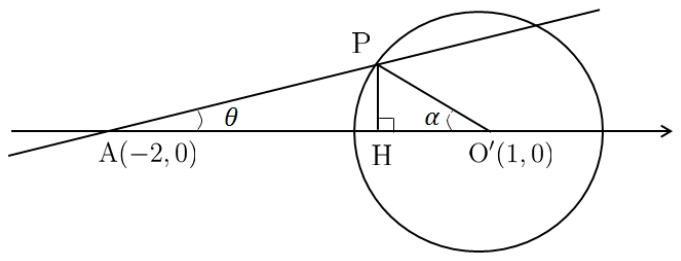
좌표평면에서 점 A(−2,0)\displaystyle \mathrm{A} ( - 2 , 0 )을 지나는 직선이 원 (x−1)2+y2=1\displaystyle ( x - 1 )^{2} + y^{2} = 1과 제1사분면의 서로 다른 두 점에서 만날 때, 두 점 중에서 점 A\displaystyle \mathrm{A}에 가까운 점을 P\displaystyle \mathrm{P}라 하자. ∠PAO=θ\displaystyle \angle \mathrm{PAO} = \theta라 할 때, lim⁡θ→0+AP‾−2θ2\displaystyle \lim_{\theta \to 0^{+}} {\frac{{{\overline{\mathrm{AP}}} - 2}}{\theta^{2}}}의 값을 구하여라. (단, O\displaystyle \mathrm{O}는 원점이다.)

해설강의 준비중

그림과 같이 점 P\displaystyle \mathrm{P}에서 x\displaystyle x축에 내린 수선의 발을 H\displaystyle \mathrm{H}라 하고, ∠PO′H=α\displaystyle \angle \mathrm{PO}^{\prime} \mathrm{H} = \alpha 라 하자. (단, O′(1,0)\displaystyle \mathrm{O}^{\prime} ( 1 , 0 )이다.)

원 위의 점 P에서 x축에 내린 수선의 발 H와 각 θ, α

이제 AP‾=x\displaystyle \overline{\mathrm{AP}}=x라 하자. 그러면 두 직각삼각형 PAH\displaystyle \mathrm{PAH}와 PHO′\displaystyle \mathrm{PHO}^{\prime}으로부터 PH‾=xsin⁡θ=sin⁡α\displaystyle \overline{\mathrm{PH}}=x\sin\theta=\sin\alpha이고 AO′‾=xcos⁡θ+cos⁡α\displaystyle \overline{\mathrm{AO}^{\prime}}=x\cos\theta+\cos\alpha인데, AO′‾=3\displaystyle \overline{\mathrm{AO}^{\prime}} = 3이므로1=cos⁡2α+sin⁡2α=(3−xcos⁡θ)2+(xsin⁡θ)2\displaystyle 1 = \cos^{2} \alpha + \sin^{2} \alpha = ( 3 - x \cos \theta )^{2} + ( x \sin \theta )^{2}이다. 그리고 이차방정식 x2−6cos⁡θx+8=0\displaystyle x^{2} - 6 \cos \theta x + 8 = 0을 풀면x=3cos⁡θ±9cos⁡2θ−8\displaystyle x = 3 \cos \theta \pm \sqrt{9 \cos^{2} \theta - 8}이다. 그런데 직선은 원과 두 점에서 만나야 하므로 θ\displaystyle \theta의 값은 직선이 원에 접할 때의 각 보다 작아야 한다. 원의 반지름이 1\displaystyle 1이고 AO′‾=3\displaystyle \overline{\mathrm{AO}^{\prime}} = 3이므로223<cos⁡θ<1\displaystyle \frac{{2 \sqrt{2}}}{3} < \cos \theta < 1이다. 따라서 9cos⁡2θ−8>0\displaystyle 9 \cos^{2} \theta - 8 > 0이고, lim⁡θ→0+x=2\displaystyle \lim_{\theta \to 0^{+}} x = 2이므로 x=3cos⁡θ−9cos⁡2θ−8\displaystyle x = 3 \cos \theta - \sqrt{9 \cos^{2} \theta - 8}이다. 그러므로lim⁡θ→0+x−2θ2=lim⁡θ→0+(3cos⁡θ−2)−9cos⁡2θ−8θ2=lim⁡θ→0+12(1−cos⁡θ)θ2((3cos⁡θ−2)+9cos⁡2θ−8)\displaystyle \lim_{\theta \to 0^{+}} {} \frac{{x - 2}}{\theta^{2}} = \lim_{\theta \to 0^{+}} {} \frac{{( 3 \cos \theta - 2 ) - \sqrt{9 \cos^{2} \theta - 8}}}{\theta^{2}} = \lim_{\theta \to 0^{+}} {} \frac{{12 ( 1 - \cos \theta )}}{\theta^{2} \left( ( 3 \cos \theta - 2 ) + \sqrt{9 \cos^{2} \theta - 8} \right)}이고, lim⁡θ→0+1−cos⁡θθ2=lim⁡θ→0+1−cos⁡2θθ2(1+cos⁡θ)=lim⁡θ→0+sin⁡2θθ2(1+cos⁡θ)=12\displaystyle \lim_{\theta \to 0^{+}} \frac{{1 - \cos \theta}}{\theta^{2}} = \lim_{\theta \to 0^{+}} \frac{{1 - \cos^{2} \theta}}{\theta^{2} ( 1 + \cos \theta )} = \lim_{\theta \to 0^{+}} \frac{{\sin^{2} \theta}}{\theta^{2} ( 1 + \cos \theta )} = \frac{1}{2}, lim⁡θ→0+12((3cos⁡θ−2)+9cos⁡2θ−8)=6\displaystyle \lim_{\theta \to 0^{+}} {} \frac{{12}}{\left( ( 3 \cos \theta - 2 ) + \sqrt{9 \cos^{2} \theta - 8} \right)} = 6이므로lim⁡θ→0+x−2θ2=3\displaystyle \lim_{\theta\to0^+}\frac{x-2}{\theta^2}=3이다.

첨삭 사례

아직 등록된 첨삭 사례가 없습니다.

질문과 답변 · 0개질문과 답변 · 고정 0개

아직 등록된 질문이 없습니다. 질문 작성은 멤버십 회원만 가능합니다.