수리논술, 배움에서 논증의 완성까지.

자연계열 2번

문제

🔒
짧은 시간에 너무 많은 문제를 여셔서 열람을 잠시 제한했습니다. 잠시 후 다시 시도하시거나 로그인해 주세요.
해설강의 준비중

(a) 네 점 B,C,D,E\displaystyle \mathrm{B} , \mathrm{C} , \mathrm{D} , \mathrm{E}B(1,1,0),C(1,1,0),D(1,1,0),E(1,1,0)\displaystyle \mathrm{B} ( - 1 , - 1 , 0 ) , \mathrm{C} ( 1 , - 1 , 0 ) , \mathrm{D} ( 1 , 1 , 0 ) , \mathrm{E} ( - 1 , 1 , 0 )이 되도록 좌표축을 정하자. 이 때, A(0,0,a)(a>0)\displaystyle \mathrm{A} ( 0 , 0 , a ) ( a > 0 )라 하면 AB=(1)2+(1)2+a2=a2+2=2\displaystyle \overline{\mathrm{AB}} = \sqrt{( - 1 )^{2} + ( - 1 )^{2} + a^{2}} = \sqrt{a^{2} + 2} = 2이므로 A(0,0,2)\displaystyle \mathrm{A} ( 0 , 0 , \sqrt{2} )이고, F(0,0,2)\displaystyle \mathrm{F} ( 0 , 0 , - \sqrt{2} )이다. AB=(1,1,2)\displaystyle \overrightarrow{\mathrm{AB}} = ( - 1 , - 1 , - \sqrt{2} )이고, G1(0,23,23),G2(0,23,23)\displaystyle \mathrm{G}_1\left(0,-\frac23,\frac{\sqrt2}3\right),\mathrm{G}_2\left(0,\frac23,-\frac{\sqrt2}3\right)이므로 G1G2=OG2OG1=(0,43,223)\displaystyle \overrightarrow{\mathrm{G}_1\mathrm{G}_2}=\overrightarrow{O\mathrm{G}_2}-\overrightarrow{O\mathrm{G}_1}=\left(0,\frac43,-\frac{2\sqrt2}3\right)이다. 따라서ABG1G2=(1,1,2)(0,43,223)=0\displaystyle \overrightarrow{\mathrm{AB}}\cdot\overrightarrow{\mathrm{G}_1\mathrm{G}_2}=(-1,-1,-\sqrt2)\cdot\left(0,\frac43,-\frac{2\sqrt2}3\right)=0이다.

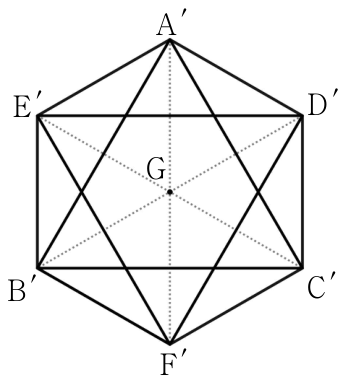
(b) ACG1G2=(1,1,2)(0,43,223)=0\displaystyle \overrightarrow{\mathrm{AC}} \cdot \overrightarrow{\mathrm{G}_{1} \mathrm{G}_{2}} = ( 1 , - 1 , - \sqrt{2} ) \cdot \left( 0 , \frac{4}{3} , - \frac{{2 \sqrt{2}}}{3} \right) = 0이므로, 평면 ABC\displaystyle \mathrm{ABC}와 벡터 G1G2\displaystyle \overrightarrow{\mathrm{G}_{1} \mathrm{G}_{2}}는 서로 수직이다. 마찬가지로 평면 DEF\displaystyle \mathrm{DEF}도 벡터 G1G2\displaystyle \overrightarrow{\mathrm{G}_{1} \mathrm{G}_{2}}에 수직이다. 따라서 평면 α\displaystyle \alpha는 평면 ABC\displaystyle \mathrm{ABC}와 평면 DEF\displaystyle \mathrm{DEF}에 각각 평행하다. 벡터 G1G2\displaystyle \overrightarrow{\mathrm{G}_{1} \mathrm{G}_{2}}와 평면 α\displaystyle \alpha가 서로 수직이므로 두 점 G1,G2\displaystyle \mathrm{G}_{1} , \mathrm{G}_{2}의 평면 α\displaystyle \alpha 위로의 정사영은 일치한다. 여섯 점 A,B,C,D,E,F\displaystyle \mathrm{A} , \mathrm{B} , \mathrm{C} , \mathrm{D} , \mathrm{E} , \mathrm{F}의 평면 α\displaystyle \alpha 위로의 정사영을 각각 A,B,C,D,E,F\displaystyle \mathrm{A}^{\prime} , \mathrm{B}^{\prime} , \mathrm{C}^{\prime} , \mathrm{D}^{\prime} , \mathrm{E}^{\prime} , \mathrm{F}^{\prime}이라 하면, 두 삼각형 ABC\displaystyle \mathrm{A}^{\prime} \mathrm{B}^{\prime} \mathrm{C}^{\prime}EDF\displaystyle \mathrm{E}^{\prime} \mathrm{D}^{\prime} \mathrm{F}^{\prime}은 한 변의 길이가 2\displaystyle 2이고 무게중심이 일치하는 정삼각형이다. 정사각형 BCDE\displaystyle \mathrm{BCDE}의 정사영 BCDE\displaystyle \mathrm{B}^{\prime} \mathrm{C}^{\prime} \mathrm{D}^{\prime} \mathrm{E}^{\prime}은 마주보는 두 쌍의 변의 길이가 각각 같으므로 평행사변형이다. 따라서 AEBFCD\displaystyle \mathrm{A}^{\prime} \mathrm{E}^{\prime} \mathrm{B}^{\prime} \mathrm{F}^{\prime} \mathrm{C}^{\prime} \mathrm{D}^{\prime}은 정육각형이고 이것이 정팔면체의 그림자이다. 삼각형 ABC\displaystyle \mathrm{A}^{\prime} \mathrm{B}^{\prime} \mathrm{C}^{\prime}의 무게중심을 G\displaystyle \mathrm{G}라 하면 AB=2\displaystyle \overline{\mathrm{A}^{\prime} \mathrm{B}^{\prime}} = 2이므로 AG=233\displaystyle \overline{\mathrm{A}^{\prime} \mathrm{G}} = \frac{{2 \sqrt{3}}}{3}이고, 정삼각형 GAE\displaystyle \mathrm{GA}^{\prime} \mathrm{E}^{\prime}의 넓이는 33\displaystyle \frac{{\sqrt{3}}}{3}이다. 그러므로 구하는 그림자의 넓이는 23\displaystyle 2 \sqrt{3}이다.

정팔면체를 평면에 정사영한 정육각형 A′E′B′F′C′D′

첨삭 사례

아직 등록된 첨삭 사례가 없습니다.

질문과 답변 · 0개질문과 답변 · 고정 0개

아직 등록된 질문이 없습니다. 질문 작성은 멤버십 회원만 가능합니다.