수리논술, 이게 다다.

자연계열 4번

오류 제보

문제

[문제 4] (100점)

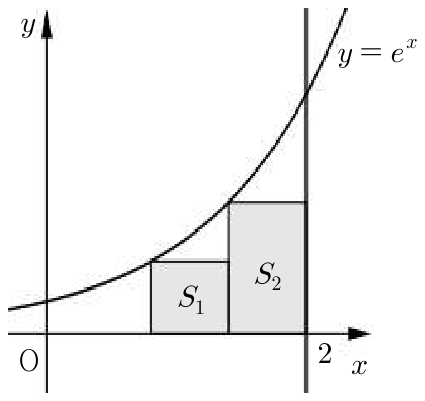
그림과 같이 곡선 y=ex\displaystyle y = e^{x}과 x\displaystyle x축 및 두 직선 x=0\displaystyle x = 0, x=2\displaystyle x = 2로 둘러싸인 영역에 한 변이 x\displaystyle x축에 있고 내부가 서로 겹치지 않는 두 직사각형이 있다. 두 직사각형의 넓이를 각각 S1\displaystyle S_{1}, S2\displaystyle S_{2}라 할 때, S1+S2\displaystyle S_{1} + S_{2}의 최댓값을 구하여라.

곡선 y=eˣ 아래 영역에 놓인 두 직사각형의 넓이 S1, S2
해설강의 준비중

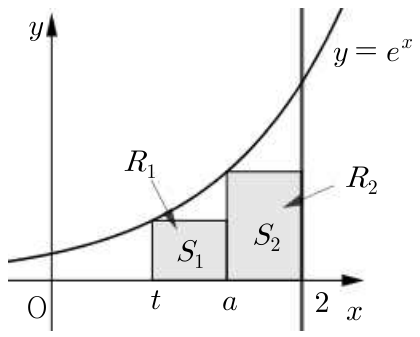
그림과 같이 두 직사각형 R1\displaystyle R_{1}, R2\displaystyle R_{2}가 한 변에서 맞닿아 있고, 직사각형 R2\displaystyle R_{2}의 오른쪽 변이 직선 x=2\displaystyle x = 2에 있으며, 각 직사각형의 한 꼭짓점이 곡선 y=ex\displaystyle y = e^{x}에 있을 때 두 직사각형 넓이의 합이 최대가 될 수 있다.

x=t, x=a, x=2 사이에서 한 변이 맞닿은 두 직사각형 R1, R2

0<a<2\displaystyle 0 < a < 2인 실수 a\displaystyle a에 대하여 두 직사각형이 직선 x=a\displaystyle x = a에서 맞닿아 있다고 가정하자. R1\displaystyle R_{1}의 왼쪽 변이 놓인 직선의 x\displaystyle x좌표를 t(0≤t<a)\displaystyle t ( 0 \le t < a )라 하면 S1=(a−t)et\displaystyle S_{1} = ( a - t ) e^{t}이다.실수 전체의 집합에서 정의된 함수 f(x)\displaystyle f ( x )를 f(x)=(a−x)ex\displaystyle f ( x ) = ( a - x ) e^{x}이라 하자.그러면 f′(x)=(−1+a−x)ex\displaystyle f^{\prime} ( x ) = ( - 1 + a - x ) e^{x}이고 f′(x)=0\displaystyle f^{\prime} ( x ) = 0의 해는 x=a−1\displaystyle x = a - 1이다.

xx⋯\cdotsa−1a-1⋯\cdots
f′(x)f'(x)+0−
f(x)f(x)↗최대↘

따라서 f(x)\displaystyle f ( x )의 최댓값은 f(a−1)=ea−1\displaystyle f(a-1)=e^{a-1}이므로 S1≤ea−1\displaystyle S_1\le e^{a-1}이다. 한편 S2=(2−a)ea\displaystyle S_{2} = ( 2 - a ) e^{a}이므로S1+S2≤ea−1+(2−a)ea=ea(2+1e−a)\displaystyle S_1+S_2\le e^{a-1}+(2-a)e^a=e^a\left(2+\frac1e-a\right)이다.

실수 전체의 집합에서 정의된 함수 g(x)\displaystyle g ( x )를 g(x)=ex(2+1e−x)\displaystyle g ( x ) = e^{x} \left( 2 + \frac{1}{e} - x \right)라 하자. 그러면 g′(x)=ex(1+1e−x)\displaystyle g^{\prime} ( x ) = e^{x} \left( 1 + \frac{1}{e} - x \right)이고 g′(x)=0\displaystyle g^{\prime} ( x ) = 0의 해는 x=1+1e\displaystyle x = 1 + \frac{1}{e}이다.

xx⋯\cdots1+1e1+\frac1e⋯\cdots
g′(x)g'(x)+0−
g(x)g(x)↗최대↘

따라서 g(x)\displaystyle g ( x )의 최댓값은 g(1+1e)=e1+1e\displaystyle g \left( 1 + \frac{1}{e} \right) = e^{1 + \frac{1}{e}}이므로S1+S2≤e1+1e\displaystyle S_{1} + S_{2} \le e^{1 + \frac{1}{e}}이다. 한편 R1\displaystyle R_{1}의 왼쪽 변이 직선 x=1e\displaystyle x = \frac{1}{e}에 있고, R2\displaystyle R_{2}의 왼쪽 변이 직선 x=1+1e(0<1+1e<2)\displaystyle x = 1 + \frac{1}{e} \left( 0 < 1 + \frac{1}{e} < 2 \right)에 있을 때,S1+S2=(1+1e−1e)e1e+{2−(1+1e)}e1+1e=e1+1e\displaystyle S_{1} + S_{2} = \left( 1 + \frac{1}{e} - \frac{1}{e} \right) e^{\frac{1}{e}} + \left\{ 2 - \left( 1 + \frac{1}{e} \right) \right\} e^{1 + \frac{1}{e}} = e^{1 + \frac{1}{e}}이다. 그러므로 S1+S2\displaystyle S_{1} + S_{2}의 최댓값은 e1+1e\displaystyle e^{1 + \frac{1}{e}}이다.

첨삭 사례

아직 등록된 첨삭 사례가 없습니다.

질문과 답변 · 0개질문과 답변 · 고정 0개

아직 등록된 질문이 없습니다. 질문 작성은 멤버십 회원만 가능합니다.