(문제 3-1)
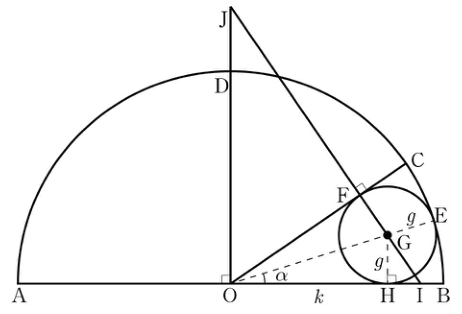
해설의 편의를 위해 α = θ / 2 \displaystyle \alpha=\theta/2 α = θ /2 O 1 \displaystyle O_1 O 1 g \displaystyle g g O 1 \displaystyle O_1 O 1 G \displaystyle G G O H ‾ = k \displaystyle \overline{OH}=k O H = k
선분 O E \displaystyle OE O E O E ‾ − G E ‾ = 1 − g \displaystyle \overline{OE}-\overline{GE}=1-g O E − GE = 1 − g H O G \displaystyle HOG H O G sin α = g 1 − g \displaystyle \sin\alpha=\frac g{1-g} sin α = 1 − g g
그러므로 g ( α ) = sin α 1 + sin α \displaystyle g(\alpha)=\frac{\sin\alpha}{1+\sin\alpha} g ( α ) = 1 + sin α sin α H O G \displaystyle HOG H O G k ( α ) = cos α 1 + sin α \displaystyle k(\alpha)=\frac{\cos\alpha}{1+\sin\alpha} k ( α ) = 1 + sin α cos α
타원 T \displaystyle T T 2 b \displaystyle 2b 2 b b 2 = 1 2 − k 2 = 1 − cos 2 α ( 1 + sin α ) 2 \displaystyle b^2=1^2-k^2=1-\frac{\cos^2\alpha}{(1+\sin\alpha)^2} b 2 = 1 2 − k 2 = 1 − ( 1 + sin α ) 2 cos 2 α
O H ‾ = O F ‾ = k ( α ) = cos α 1 + sin α \displaystyle \overline{OH}=\overline{OF}=k(\alpha)=\frac{\cos\alpha}{1+\sin\alpha} O H = O F = k ( α ) = 1 + sin α cos α
1 − cos 2 α ( 1 + sin α ) 2 = cos 2 α ( 1 + sin α ) 2 ⇒ sin α = 1 3 \displaystyle 1-\frac{\cos^2\alpha}{(1+\sin\alpha)^2}=\frac{\cos^2\alpha}{(1+\sin\alpha)^2}\quad\Rightarrow\quad\sin\alpha=\frac13 1 − ( 1 + sin α ) 2 cos 2 α = ( 1 + sin α ) 2 cos 2 α ⇒ sin α = 3 1
원 O 1 \displaystyle O_1 O 1 S \displaystyle S S S ( α ) = π g 2 = π sin 2 α ( 1 + sin α ) 2 \displaystyle S(\alpha)=\pi g^2=\frac{\pi\sin^2\alpha}{(1+\sin\alpha)^2} S ( α ) = π g 2 = ( 1 + sin α ) 2 π sin 2 α
d d t S ( α ) = d d t π sin 2 α ( 1 + sin α ) 2 = π ( 2 sin α cos α α ′ ⋅ ( 1 + sin α ) 2 − sin 2 α ⋅ 2 ( 1 + sin α ) cos α α ′ ( 1 + sin α ) 4 ) \displaystyle \begin{aligned}\frac d{dt}S(\alpha)&=\frac d{dt}\frac{\pi\sin^2\alpha}{(1+\sin\alpha)^2}\\&=\pi\left(\frac{2\sin\alpha\cos\alpha\,\alpha^{\prime}\cdot(1+\sin\alpha)^2-\sin^2\alpha\cdot2(1+\sin\alpha)\cos\alpha\,\alpha^{\prime}}{(1+\sin\alpha)^4}\right)\end{aligned} d t d S ( α ) = d t d ( 1 + sin α ) 2 π sin 2 α = π ( ( 1 + sin α ) 4 2 sin α cos α α ′ ⋅ ( 1 + sin α ) 2 − sin 2 α ⋅ 2 ( 1 + sin α ) cos α α ′ )
( α ′ = d α d t = d ( θ / 2 ) d t = 1 2 d θ d t = 2 2 이므로 ) \displaystyle \left(\alpha^{\prime}=\frac{d\alpha}{dt}=\frac{d(\theta/2)}{dt}=\frac12\frac{d\theta}{dt}=\frac{\sqrt2}2\text{이므로}\right) ( α ′ = d t d α = d t d ( θ /2 ) = 2 1 d t d θ = 2 2 이므로 )
= π 2 2 ( 2 sin α cos α ⋅ ( 1 + sin α ) − sin 2 α ⋅ 2 cos α ( 1 + sin α ) 3 ) = π 2 2 2 sin α cos α ( 1 + sin α ) 3 = π 2 sin α cos α ( 1 + sin α ) 3 \displaystyle \begin{aligned}&=\pi\frac{\sqrt2}2\left(\frac{2\sin\alpha\cos\alpha\cdot(1+\sin\alpha)-\sin^2\alpha\cdot2\cos\alpha}{(1+\sin\alpha)^3}\right)\\&=\pi\frac{\sqrt2}2\frac{2\sin\alpha\cos\alpha}{(1+\sin\alpha)^3}\\&=\pi\sqrt2\frac{\sin\alpha\cos\alpha}{(1+\sin\alpha)^3}\end{aligned} = π 2 2 ( ( 1 + sin α ) 3 2 sin α cos α ⋅ ( 1 + sin α ) − sin 2 α ⋅ 2 cos α ) = π 2 2 ( 1 + sin α ) 3 2 sin α cos α = π 2 ( 1 + sin α ) 3 sin α cos α
점 C \displaystyle C C B D \displaystyle BD B D α = θ / 2 \displaystyle \alpha=\theta/2 α = θ /2 sin α = 1 3 \displaystyle \sin\alpha=\frac13 sin α = 3 1 cos α = 2 2 3 \displaystyle \cos\alpha=\frac{2\sqrt2}3 cos α = 3 2 2
d d t S ( α ) = π 2 sin α cos α ( 1 + sin α ) 3 = π 2 ( 1 / 3 ) ( 2 2 / 3 ) ( 1 + ( 1 / 3 ) ) 3 = π 2 3 2 32 = 3 π 16 \displaystyle \begin{aligned}\frac d{dt}S(\alpha)&=\pi\sqrt2\frac{\sin\alpha\cos\alpha}{(1+\sin\alpha)^3}\\&=\pi\sqrt2\frac{(1/3)(2\sqrt2/3)}{(1+(1/3))^3}\\&=\pi\sqrt2\frac{3\sqrt2}{32}\\&=\frac{3\pi}{16}\end{aligned} d t d S ( α ) = π 2 ( 1 + sin α ) 3 sin α cos α = π 2 ( 1 + ( 1/3 ) ) 3 ( 1/3 ) ( 2 2 /3 ) = π 2 32 3 2 = 16 3 π
(문제 3-2)
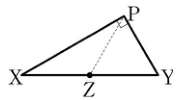
문제의 조건 O Q → ⊥ A Q → \displaystyle \overrightarrow{OQ}\perp\overrightarrow{AQ} O Q ⊥ A Q O Q → ⊥ C Q → \displaystyle \overrightarrow{OQ}\perp\overrightarrow{CQ} O Q ⊥ C Q Y P → ⊥ X P → \displaystyle \overrightarrow{YP}\perp\overrightarrow{XP} Y P ⊥ X P
Y P → ⊥ X P → ⇔ Y P → ⋅ X P → = 0 \displaystyle \overrightarrow{YP}\perp\overrightarrow{XP}\quad\Leftrightarrow\quad\overrightarrow{YP}\cdot\overrightarrow{XP}=0 Y P ⊥ X P ⇔ Y P ⋅ X P = 0
선분 X Y \displaystyle XY X Y Z \displaystyle Z Z
0 = Y P → ⋅ X P → = ( Y Z → + Z P → ) ⋅ ( X Z → + Z P → ) = Y Z → ⋅ X Z → + Y Z → ⋅ Z P → + Z P → ⋅ X Z → + Z P → ⋅ Z P → \displaystyle \begin{aligned}0=\overrightarrow{YP}\cdot\overrightarrow{XP}&=(\overrightarrow{YZ}+\overrightarrow{ZP})\cdot(\overrightarrow{XZ}+\overrightarrow{ZP})\\&=\overrightarrow{YZ}\cdot\overrightarrow{XZ}+\overrightarrow{YZ}\cdot\overrightarrow{ZP}+\overrightarrow{ZP}\cdot\overrightarrow{XZ}+\overrightarrow{ZP}\cdot\overrightarrow{ZP}\end{aligned} 0 = Y P ⋅ X P = ( Y Z + Z P ) ⋅ ( X Z + Z P ) = Y Z ⋅ X Z + Y Z ⋅ Z P + Z P ⋅ X Z + Z P ⋅ Z P
점 Z \displaystyle Z Z X Y \displaystyle XY X Y Y Z → = − X Z → \displaystyle \overrightarrow{YZ}=-\overrightarrow{XZ} Y Z = − X Z r ⃗ = Y Z → \displaystyle \vec r=\overrightarrow{YZ} r = Y Z
0 = Y Z → ⋅ X Z → + Y Z → ⋅ Z P → + Z P → ⋅ X Z → + Z P → ⋅ Z P → = r ⃗ ⋅ ( − r ⃗ ) + r ⃗ ⋅ Z P → + Z P → ⋅ ( − r ⃗ ) + Z P → ⋅ Z P → \displaystyle \begin{aligned}0&=\overrightarrow{YZ}\cdot\overrightarrow{XZ}+\overrightarrow{YZ}\cdot\overrightarrow{ZP}+\overrightarrow{ZP}\cdot\overrightarrow{XZ}+\overrightarrow{ZP}\cdot\overrightarrow{ZP}\\&=\vec r\cdot(-\vec r)+\vec r\cdot\overrightarrow{ZP}+\overrightarrow{ZP}\cdot(-\vec r)+\overrightarrow{ZP}\cdot\overrightarrow{ZP}\end{aligned} 0 = Y Z ⋅ X Z + Y Z ⋅ Z P + Z P ⋅ X Z + Z P ⋅ Z P = r ⋅ ( − r ) + r ⋅ Z P + Z P ⋅ ( − r ) + Z P ⋅ Z P
그러므로 ∣ Z P → ∣ 2 = ∣ r ⃗ ∣ 2 \displaystyle |\overrightarrow{ZP}|^2=|\vec r|^2 ∣ Z P ∣ 2 = ∣ r ∣ 2 P \displaystyle P P X Y \displaystyle XY X Y
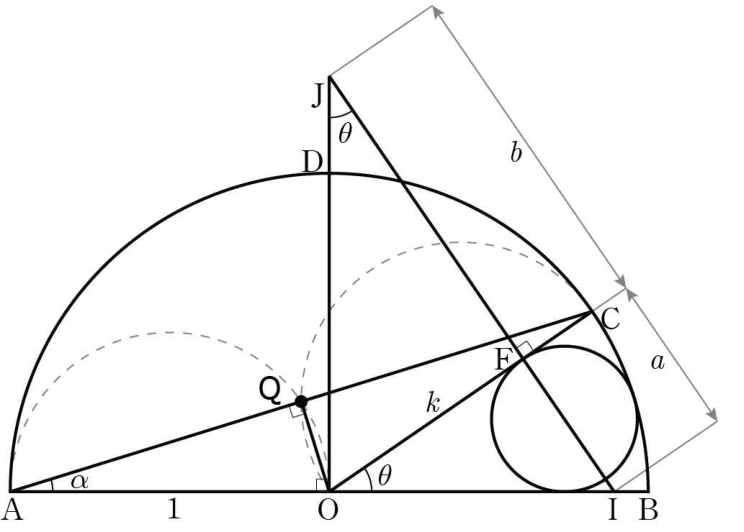
점 Q \displaystyle Q Q O Q → ⊥ A Q → \displaystyle \overrightarrow{OQ}\perp\overrightarrow{AQ} O Q ⊥ A Q A O \displaystyle AO A O Q \displaystyle Q Q O Q → ⊥ C Q → \displaystyle \overrightarrow{OQ}\perp\overrightarrow{CQ} O Q ⊥ C Q C O \displaystyle CO C O Q \displaystyle Q Q O \displaystyle O O A C \displaystyle AC A C
점 Q \displaystyle Q Q O \displaystyle O O A C \displaystyle AC A C O Q ‾ = sin α \displaystyle \overline{OQ}=\sin\alpha O Q = sin α
점 C \displaystyle C C B D \displaystyle BD B D α = θ / 2 \displaystyle \alpha=\theta/2 α = θ /2 O Q ‾ = sin α \displaystyle \overline{OQ}=\sin\alpha O Q = sin α α \displaystyle \alpha α
주어진 조건: J I → ⋅ J O → ≥ I J → ⋅ I F → ⇔ J I → ⋅ J O → ≥ − J I → ⋅ I F → ⇔ J I → ⋅ J O → + J I → ⋅ I F → ≥ 0 \displaystyle \begin{aligned}\overrightarrow{JI}\cdot\overrightarrow{JO}&\ge\overrightarrow{IJ}\cdot\overrightarrow{IF}\\\Leftrightarrow\quad\overrightarrow{JI}\cdot\overrightarrow{JO}&\ge-\overrightarrow{JI}\cdot\overrightarrow{IF}\\\Leftrightarrow\quad\overrightarrow{JI}\cdot\overrightarrow{JO}+\overrightarrow{JI}\cdot\overrightarrow{IF}&\ge0\end{aligned} J I ⋅ J O ⇔ J I ⋅ J O ⇔ J I ⋅ J O + J I ⋅ I F ≥ I J ⋅ I F ≥ − J I ⋅ I F ≥ 0
(J I → ⊥ F O → \displaystyle \overrightarrow{JI}\perp\overrightarrow{FO} J I ⊥ F O J I → ⋅ F O → = 0 \displaystyle \overrightarrow{JI}\cdot\overrightarrow{FO}=0 J I ⋅ F O = 0
J I → ⋅ J O → + J I → ⋅ I F → = J I → ⋅ J O → + J I → ⋅ F O → + J I → ⋅ I F → ≥ 0 ⇔ J I → ⋅ ( J O → + F O → + I F → ) ≥ 0 ⇔ J I → ⋅ ( J O → + I O → ) ≥ 0 ⇔ J O → ⋅ J I → ≥ I O → ⋅ I J → \displaystyle \begin{aligned}\overrightarrow{JI}\cdot\overrightarrow{JO}+\overrightarrow{JI}\cdot\overrightarrow{IF}&=\overrightarrow{JI}\cdot\overrightarrow{JO}+\overrightarrow{JI}\cdot\overrightarrow{FO}+\overrightarrow{JI}\cdot\overrightarrow{IF}\ge0\\\Leftrightarrow\quad\overrightarrow{JI}\cdot(\overrightarrow{JO}+\overrightarrow{FO}+\overrightarrow{IF})&\ge0\\\Leftrightarrow\quad\overrightarrow{JI}\cdot(\overrightarrow{JO}+\overrightarrow{IO})&\ge0\\\Leftrightarrow\quad\overrightarrow{JO}\cdot\overrightarrow{JI}&\ge\overrightarrow{IO}\cdot\overrightarrow{IJ}\end{aligned} J I ⋅ J O + J I ⋅ I F ⇔ J I ⋅ ( J O + F O + I F ) ⇔ J I ⋅ ( J O + I O ) ⇔ J O ⋅ J I = J I ⋅ J O + J I ⋅ F O + J I ⋅ I F ≥ 0 ≥ 0 ≥ 0 ≥ I O ⋅ I J
여기에서 J O → ⋅ J I → \displaystyle \overrightarrow{JO}\cdot\overrightarrow{JI} J O ⋅ J I I O → ⋅ I J → \displaystyle \overrightarrow{IO}\cdot\overrightarrow{IJ} I O ⋅ I J
J O → ⋅ J I → = J O ‾ × J I ‾ × cos ( ∠ O J I ) = J O ‾ × J I ‾ × J F ‾ J O ‾ = J I ‾ × J F ‾ \displaystyle \overrightarrow{JO}\cdot\overrightarrow{JI}=\overline{JO}\times\overline{JI}\times\cos(\angle OJI)=\overline{JO}\times\overline{JI}\times\frac{\overline{JF}}{\overline{JO}}=\overline{JI}\times\overline{JF} J O ⋅ J I = J O × J I × cos ( ∠ O J I ) = J O × J I × J O J F = J I × J F
I O → ⋅ I J → = I O ‾ × I J ‾ × cos ( ∠ O I J ) = I O ‾ × I J ‾ × I F ‾ I O ‾ = I J ‾ × I F ‾ \displaystyle \overrightarrow{IO}\cdot\overrightarrow{IJ}=\overline{IO}\times\overline{IJ}\times\cos(\angle OIJ)=\overline{IO}\times\overline{IJ}\times\frac{\overline{IF}}{\overline{IO}}=\overline{IJ}\times\overline{IF} I O ⋅ I J = I O × I J × cos ( ∠ O I J ) = I O × I J × I O I F = I J × I F
a = I F ‾ \displaystyle a=\overline{IF} a = I F b = J F ‾ \displaystyle b=\overline{JF} b = J F b × J I ‾ = J O → ⋅ J I → ≥ I O → ⋅ I J → = a × I J ‾ \displaystyle b\times\overline{JI}=\overrightarrow{JO}\cdot\overrightarrow{JI}\ge\overrightarrow{IO}\cdot\overrightarrow{IJ}=a\times\overline{IJ} b × J I = J O ⋅ J I ≥ I O ⋅ I J = a × I J a \displaystyle a a b \displaystyle b b b ≥ a \displaystyle b\ge a b ≥ a
직각삼각형 I O F \displaystyle IOF I O F tan θ = a / k \displaystyle \tan\theta=a/k tan θ = a / k O J F \displaystyle OJF O J F tan θ = k / b \displaystyle \tan\theta=k/b tan θ = k / b b = k / tan θ ≥ k tan θ = a \displaystyle b=k/\tan\theta\ge k\tan\theta=a b = k / tan θ ≥ k tan θ = a ⇒ tan 2 θ ≤ 1 \displaystyle \Rightarrow\quad\tan^2\theta\le1 ⇒ tan 2 θ ≤ 1 ⇒ θ ≤ π / 4 \displaystyle \Rightarrow\quad\theta\le\pi/4 ⇒ θ ≤ π /4
그러므로 ∣ O Q → ∣ 2 = sin 2 α \displaystyle |\overrightarrow{OQ}|^2=\sin^2\alpha ∣ O Q ∣ 2 = sin 2 α α = θ / 2 = π / 8 \displaystyle \alpha=\theta/2=\pi/8 α = θ /2 = π /8 sin 2 ( π / 8 ) = 1 − cos ( π / 4 ) 2 = 1 − 2 / 2 2 = 2 − 2 4 \displaystyle \sin^2(\pi/8)=\frac{1-\cos(\pi/4)}2=\frac{1-\sqrt2/2}2=\frac{2-\sqrt2}4 sin 2 ( π /8 ) = 2 1 − cos ( π /4 ) = 2 1 − 2 /2 = 4 2 − 2
(문제 3-3)
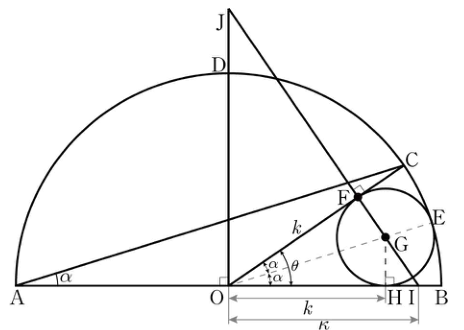
해설의 편의를 위해 O H ‾ = k \displaystyle \overline{OH}=k O H = k O I ‾ = ϰ \displaystyle \overline{OI}=\varkappa O I = ϰ I O F \displaystyle IOF I O F cos θ = k / ϰ \displaystyle \cos\theta=k/\varkappa cos θ = k / ϰ ⇒ ϰ = k cos θ = k cos ( 2 α ) = cos α cos ( 2 α ) ( 1 + sin α ) \displaystyle \Rightarrow\quad\varkappa=\frac k{\cos\theta}=\frac k{\cos(2\alpha)}=\frac{\cos\alpha}{\cos(2\alpha)(1+\sin\alpha)} ⇒ ϰ = cos θ k = cos ( 2 α ) k = cos ( 2 α ) ( 1 + sin α ) cos α 이다.
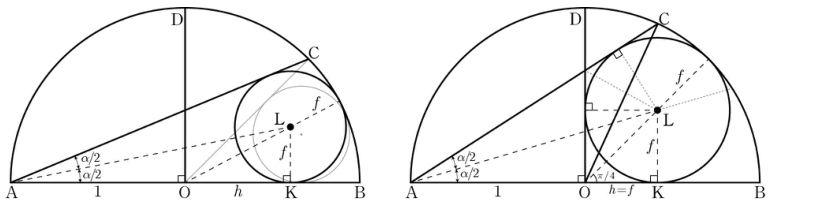
원 O 2 \displaystyle O_2 O 2 f \displaystyle f f O K \displaystyle OK O K h \displaystyle h h K O L \displaystyle KOL K O L ( 1 − f ) 2 = h 2 + f 2 \displaystyle (1-f)^2=h^2+f^2 ( 1 − f ) 2 = h 2 + f 2 K A L \displaystyle KAL K A L tan ( α / 2 ) = f 1 + h \displaystyle \tan(\alpha/2)=\frac f{1+h} tan ( α /2 ) = 1 + h f ⇒ h = f tan ( α / 2 ) − 1 \displaystyle \Rightarrow\quad h=\frac f{\tan(\alpha/2)}-1 ⇒ h = tan ( α /2 ) f − 1
그러므로 ( 1 − f ) 2 = ( f tan ( α / 2 ) − 1 ) 2 + f 2 \displaystyle (1-f)^2=\left(\frac f{\tan(\alpha/2)}-1\right)^2+f^2 ( 1 − f ) 2 = ( tan ( α /2 ) f − 1 ) 2 + f 2
⇒ 1 − 2 f + f 2 = ( f tan ( α / 2 ) ) 2 − 2 f tan ( α / 2 ) + 1 + f 2 ⇒ − 2 = f tan 2 ( α / 2 ) − 2 tan ( α / 2 ) ⇒ f = 2 tan ( α / 2 ) − 2 tan 2 ( α / 2 ) ⇒ h ( α ) = 1 − 2 tan ( α 2 ) \displaystyle \begin{aligned}\Rightarrow\quad1-2f+f^2&=\left(\frac f{\tan(\alpha/2)}\right)^2-\frac{2f}{\tan(\alpha/2)}+1+f^2\\\Rightarrow\quad-2&=\frac f{\tan^2(\alpha/2)}-\frac2{\tan(\alpha/2)}\\\Rightarrow\quad f&=2\tan(\alpha/2)-2\tan^2(\alpha/2)\\\Rightarrow\quad h(\alpha)&=1-2\tan\left(\frac\alpha2\right)\end{aligned} ⇒ 1 − 2 f + f 2 ⇒ − 2 ⇒ f ⇒ h ( α ) = ( tan ( α /2 ) f ) 2 − tan ( α /2 ) 2 f + 1 + f 2 = tan 2 ( α /2 ) f − tan ( α /2 ) 2 = 2 tan ( α /2 ) − 2 tan 2 ( α /2 ) = 1 − 2 tan ( 2 α )
원 O 2 \displaystyle O_2 O 2 O D \displaystyle OD O D h = f \displaystyle h=f h = f 2 tan ( α 2 ) − 2 tan 2 ( α 2 ) = 1 − 2 tan ( α 2 ) \displaystyle 2\tan\left(\frac\alpha2\right)-2\tan^2\left(\frac\alpha2\right)=1-2\tan\left(\frac\alpha2\right) 2 tan ( 2 α ) − 2 tan 2 ( 2 α ) = 1 − 2 tan ( 2 α ) ⇒ 2 tan 2 ( α 2 ) − 4 tan ( α 2 ) + 1 = 0 \displaystyle \Rightarrow\quad2\tan^2\left(\frac\alpha2\right)-4\tan\left(\frac\alpha2\right)+1=0 ⇒ 2 tan 2 ( 2 α ) − 4 tan ( 2 α ) + 1 = 0 ⇒ tan ( α 2 ) = 2 ± 2 2 \displaystyle \Rightarrow\quad\tan\left(\frac\alpha2\right)=\frac{2\pm\sqrt2}2 ⇒ tan ( 2 α ) = 2 2 ± 2
여기에서 tan ( α 2 ) = 2 + 2 2 > 1 \displaystyle \tan\left(\frac\alpha2\right)=\frac{2+\sqrt2}2>1 tan ( 2 α ) = 2 2 + 2 > 1 α / 2 > π / 4 \displaystyle \alpha/2>\pi/4 α /2 > π /4 ⇒ α > π / 2 \displaystyle \Rightarrow\quad\alpha>\pi/2 ⇒ α > π /2 ⇒ θ = 2 α > π \displaystyle \Rightarrow\quad\theta=2\alpha>\pi ⇒ θ = 2 α > π
그러므로 tan ( α 2 ) = 2 − 2 2 \displaystyle \tan\left(\frac\alpha2\right)=\frac{2-\sqrt2}2 tan ( 2 α ) = 2 2 − 2
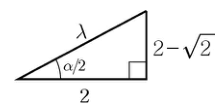
한 각이 α / 2 \displaystyle \alpha/2 α /2 2 \displaystyle 2 2 2 − 2 \displaystyle 2-\sqrt2 2 − 2 λ \displaystyle \lambda λ λ 2 = 2 2 + ( 2 − 2 ) 2 = 10 − 4 2 \displaystyle \lambda^2=2^2+(2-\sqrt2)^2=10-4\sqrt2 λ 2 = 2 2 + ( 2 − 2 ) 2 = 10 − 4 2
삼각함수의 덧셈정리에 의해서 다음과 같이 sin α \displaystyle \sin\alpha sin α cos α \displaystyle \cos\alpha cos α
sin α = sin ( 2 α / 2 ) = 2 sin ( α / 2 ) cos ( α / 2 ) = 2 2 − 2 λ 2 λ = 4 ( 2 − 2 ) λ 2 = 4 ( 2 − 2 ) 10 − 4 2 = 4 − 2 2 5 − 2 2 cos α = cos ( 2 α / 2 ) = 2 cos 2 ( α / 2 ) − 1 = 2 4 λ 2 − 1 = 8 − λ 2 λ 2 = 8 − ( 10 − 4 2 ) 10 − 4 2 = − 1 + 2 2 5 − 2 2 cos 2 α = ( − 1 + 2 2 5 − 2 2 ) 2 = 9 − 4 2 33 − 20 2 \displaystyle \begin{aligned}\sin\alpha&=\sin(2\alpha/2)=2\sin(\alpha/2)\cos(\alpha/2)\\&=2\frac{2-\sqrt2}{\lambda}\frac2\lambda=\frac{4(2-\sqrt2)}{\lambda^2}=\frac{4(2-\sqrt2)}{10-4\sqrt2}=\frac{4-2\sqrt2}{5-2\sqrt2}\\\cos\alpha&=\cos(2\alpha/2)=2\cos^2(\alpha/2)-1\\&=2\frac4{\lambda^2}-1=\frac{8-\lambda^2}{\lambda^2}=\frac{8-(10-4\sqrt2)}{10-4\sqrt2}=\frac{-1+2\sqrt2}{5-2\sqrt2}\\\cos^2\alpha&=\left(\frac{-1+2\sqrt2}{5-2\sqrt2}\right)^2=\frac{9-4\sqrt2}{33-20\sqrt2}\end{aligned} sin α cos α cos 2 α = sin ( 2 α /2 ) = 2 sin ( α /2 ) cos ( α /2 ) = 2 λ 2 − 2 λ 2 = λ 2 4 ( 2 − 2 ) = 10 − 4 2 4 ( 2 − 2 ) = 5 − 2 2 4 − 2 2 = cos ( 2 α /2 ) = 2 cos 2 ( α /2 ) − 1 = 2 λ 2 4 − 1 = λ 2 8 − λ 2 = 10 − 4 2 8 − ( 10 − 4 2 ) = 5 − 2 2 − 1 + 2 2 = ( 5 − 2 2 − 1 + 2 2 ) 2 = 33 − 20 2 9 − 4 2
그러므로 O I ‾ = ϰ = cos α ( 2 cos 2 α − 1 ) ( 1 + sin α ) = − 1 + 2 2 5 − 2 2 ( 2 9 − 4 2 33 − 20 2 − 1 ) ( 1 + 4 − 2 2 5 − 2 2 ) = − 1 + 2 2 ( 18 − 8 2 33 − 20 2 − 33 − 20 2 33 − 20 2 ) ( ( 5 − 2 2 ) + ( 4 − 2 2 ) ) = ( − 1 + 2 2 ) ( 33 − 20 2 ) ( − 15 + 12 2 ) ( 9 − 4 2 ) = − 113 + 86 2 − 231 + 168 2 = − 113 + 86 2 − 21 ( 11 − 8 2 ) = 113 − 86 2 21 ( 11 − 8 2 ) = ( 113 − 86 2 ) ( 11 + 8 2 ) 21 ( 11 − 8 2 ) ( 11 + 8 2 ) = ( 113 − 86 2 ) ( 11 + 8 2 ) 21 ( 121 − 128 ) = − 133 − 42 2 21 × ( − 7 ) = 19 + 6 2 21 \displaystyle \begin{aligned}\text{그러므로 }\overline{OI}=\varkappa&=\frac{\cos\alpha}{(2\cos^2\alpha-1)(1+\sin\alpha)}=\frac{\frac{-1+2\sqrt2}{5-2\sqrt2}}{\left(2\frac{9-4\sqrt2}{33-20\sqrt2}-1\right)\left(1+\frac{4-2\sqrt2}{5-2\sqrt2}\right)}\\&=\frac{-1+2\sqrt2}{\left(\frac{18-8\sqrt2}{33-20\sqrt2}-\frac{33-20\sqrt2}{33-20\sqrt2}\right)((5-2\sqrt2)+(4-2\sqrt2))}\\&=\frac{(-1+2\sqrt2)(33-20\sqrt2)}{(-15+12\sqrt2)(9-4\sqrt2)}\\&=\frac{-113+86\sqrt2}{-231+168\sqrt2}\\&=\frac{-113+86\sqrt2}{-21(11-8\sqrt2)}\\&=\frac{113-86\sqrt2}{21(11-8\sqrt2)}\\&=\frac{(113-86\sqrt2)(11+8\sqrt2)}{21(11-8\sqrt2)(11+8\sqrt2)}\\&=\frac{(113-86\sqrt2)(11+8\sqrt2)}{21(121-128)}\\&=\frac{-133-42\sqrt2}{21\times(-7)}\\&=\frac{19+6\sqrt2}{21}\end{aligned} 그러므로 O I = ϰ = ( 2 cos 2 α − 1 ) ( 1 + sin α ) cos α = ( 2 33 − 20 2 9 − 4 2 − 1 ) ( 1 + 5 − 2 2 4 − 2 2 ) 5 − 2 2 − 1 + 2 2 = ( 33 − 20 2 18 − 8 2 − 33 − 20 2 33 − 20 2 ) (( 5 − 2 2 ) + ( 4 − 2 2 )) − 1 + 2 2 = ( − 15 + 12 2 ) ( 9 − 4 2 ) ( − 1 + 2 2 ) ( 33 − 20 2 ) = − 231 + 168 2 − 113 + 86 2 = − 21 ( 11 − 8 2 ) − 113 + 86 2 = 21 ( 11 − 8 2 ) 113 − 86 2 = 21 ( 11 − 8 2 ) ( 11 + 8 2 ) ( 113 − 86 2 ) ( 11 + 8 2 ) = 21 ( 121 − 128 ) ( 113 − 86 2 ) ( 11 + 8 2 ) = 21 × ( − 7 ) − 133 − 42 2 = 21 19 + 6 2
그러므로 O I ‾ = u + v 2 w = 19 + 6 2 21 \displaystyle \overline{OI}=\frac{u+v\sqrt2}w=\frac{19+6\sqrt2}{21} O I = w u + v 2 = 21 19 + 6 2 u + v + w = 19 + 6 + 21 = 46 \displaystyle u+v+w=19+6+21=46 u + v + w = 19 + 6 + 21 = 46
[문제 3-1] (10점) (상) 문제해결 방향과 계산이 명확하고 옳게 답을 구한경우 (중상) 문제해결 방향을 맞게 설정했지만 계산에 사소한 실수가 있는 경우 (중하) 문제해결 방향을 맞게 설정했지만 계산에 중요한 실수가 있거나 계산을 끝까지 마치지 못한 경우 (하) 잘못된 방향설정으로 답을 구하지 못한 경우
[문제 3-2] (10점) (상) 문제해결 방향과 계산이 명확하고 옳게 답을 구한경우 (중상) 문제해결 방향을 맞게 설정했지만 계산에 사소한 실수가 있는 경우 (중하) 문제해결 방향을 맞게 설정했지만 계산에 중요한 실수가 있거나 계산을 끝까지 마치지 못한 경우 (하) 잘못된 방향설정으로 답을 구하지 못한 경우
[문제 3-2] (15점) Correction. 마지막 채점기준의 [3-2]는 [3-3]의 오기이다. 그러나 원칙에 따라 원문 표기를 그대로 실었다.(상) 문제해결 방향과 계산이 명확하고 옳게 답을 구한경우 (중상) 문제해결 방향을 맞게 설정했지만 계산에 사소한 실수가 있는 경우 (중하) 문제해결 방향을 맞게 설정했지만 계산에 중요한 실수가 있거나 계산을 끝까지 마치지 못한 경우 (하) 잘못된 방향설정으로 답을 구하지 못한 경우
 수리논술, 배움에서 논증의 완성까지.