[문제 1-1]
+4점 · 평균값정리에 의해 ln ( x + 1 ) − ln x = 1 c ( x + 1 − x ) \displaystyle \ln(x+1)-\ln x=\frac1c(x+1-x) ln ( x + 1 ) − ln x = c 1 ( x + 1 − x ) c \displaystyle c c x \displaystyle x x x + 1 \displaystyle x+1 x + 1 (1) [풀이] f ( x ) = ln p ( x ) \displaystyle f(x)=\ln p(x) f ( x ) = ln p ( x ) lim x → ∞ f ( x ) = 1 \displaystyle \lim_{x\to\infty}f(x)=1 x → ∞ lim f ( x ) = 1 a \displaystyle a a ln ( x + 1 ) − ln x = 1 c ( x + 1 − x ) \displaystyle \ln(x+1)-\ln x=\frac1c(x+1-x) ln ( x + 1 ) − ln x = c 1 ( x + 1 − x ) c \displaystyle c c x \displaystyle x x x + 1 \displaystyle x+1 x + 1
+2점 · 정리하면 ln ( 1 + 1 x ) = 1 c \displaystyle \ln(1+\frac1x)=\frac1c ln ( 1 + x 1 ) = c 1 c = x + α x ( 0 < α x < 1 ) \displaystyle c=x+\alpha_x(0<\alpha_x<1) c = x + α x ( 0 < α x < 1 ) 정리하면 ln ( 1 + 1 x ) = 1 c \displaystyle \ln(1+\frac1x)=\frac1c ln ( 1 + x 1 ) = c 1 c = x + α x ( 0 < α x < 1 ) \displaystyle c=x+\alpha_x(0<\alpha_x<1) c = x + α x ( 0 < α x < 1 )
+2점 · lim x → ∞ ( x + a ) ln ( 1 + 1 x ) = lim x → ∞ x + a x + α x \displaystyle \lim_{x\to\infty}(x+a)\ln(1+\frac1x)=\lim_{x\to\infty}\frac{x+a}{x+\alpha_x} x → ∞ lim ( x + a ) ln ( 1 + x 1 ) = x → ∞ lim x + α x x + a lim x → ∞ f ( x ) = 1 \displaystyle \lim_{x\to\infty}f(x)=1 x → ∞ lim f ( x ) = 1 lim x → ∞ ( x + a ) ln ( 1 + 1 x ) = lim x → ∞ x + a x + α x \displaystyle \lim_{x\to\infty}(x+a)\ln(1+\frac1x)=\lim_{x\to\infty}\frac{x+a}{x+\alpha_x} x → ∞ lim ( x + a ) ln ( 1 + x 1 ) = x → ∞ lim x + α x x + a lim x → ∞ f ( x ) = 1 \displaystyle \lim_{x\to\infty}f(x)=1 x → ∞ lim f ( x ) = 1 따라서 lim x → ∞ ln p ( x ) = e \displaystyle \lim_{x\to\infty}\ln p(x)=e x → ∞ lim ln p ( x ) = e Correction. 이 문장의 lim x → ∞ ln p ( x ) = e \displaystyle \lim_{x\to\infty}\ln p(x)=e x → ∞ lim ln p ( x ) = e lim x → ∞ ln p ( x ) = 1 \displaystyle \lim_{x\to\infty}\ln p(x)=1 x → ∞ lim ln p ( x ) = 1 lim x → ∞ p ( x ) = e \displaystyle \lim_{x\to\infty}p(x)=e x → ∞ lim p ( x ) = e
[참고1] lim x → ∞ ln p ( x ) = lim x → ∞ ( x + a x ) ln ( 1 + 1 x ) x = 1 × ln e = 1 \displaystyle \lim_{x\to\infty}\ln p(x)=\lim_{x\to\infty}(\frac{x+a}x)\ln(1+\frac1x)^x=1\times\ln e=1 x → ∞ lim ln p ( x ) = x → ∞ lim ( x x + a ) ln ( 1 + x 1 ) x = 1 × ln e = 1 [참고2] lim x → ∞ p ( x ) = lim x → ∞ ( 1 + 1 x ) x ( 1 + 1 x ) a = lim x → ∞ ( 1 + 1 x ) x lim x → ∞ ( 1 + 1 x ) a = e × 1 a = e \displaystyle \begin{aligned}\lim_{x\to\infty}p(x)&=\lim_{x\to\infty}(1+\frac1x)^x(1+\frac1x)^a\\&=\lim_{x\to\infty}(1+\frac1x)^x\lim_{x\to\infty}(1+\frac1x)^a=e\times1^a=e\end{aligned} x → ∞ lim p ( x ) = x → ∞ lim ( 1 + x 1 ) x ( 1 + x 1 ) a = x → ∞ lim ( 1 + x 1 ) x x → ∞ lim ( 1 + x 1 ) a = e × 1 a = e
+3점 · 결론을 부정하면 f ( x 0 ) ≥ 0 \displaystyle f(x_0)\ge0 f ( x 0 ) ≥ 0 x 0 > 0 \displaystyle x_0>0 x 0 > 0 (2) [풀이] 결론을 부정하면 f ( x 0 ) ≥ 0 \displaystyle f(x_0)\ge0 f ( x 0 ) ≥ 0 x 0 > 0 \displaystyle x_0>0 x 0 > 0
+3점 · 모든 x > 0 \displaystyle x>0 x > 0 f ′ ( x ) > 0 \displaystyle f^{\prime}(x)>0 f ′ ( x ) > 0 f ( x 0 + 1 ) > f ( x 0 ) ≥ 0 \displaystyle f(x_0+1)>f(x_0)\ge0 f ( x 0 + 1 ) > f ( x 0 ) ≥ 0 x > x 0 + 1 \displaystyle x>x_0+1 x > x 0 + 1 f ( x ) > f ( x 0 + 1 ) \displaystyle f(x)>f(x_0+1) f ( x ) > f ( x 0 + 1 ) 모든 x > 0 \displaystyle x>0 x > 0 f ′ ( x ) > 0 \displaystyle f^{\prime}(x)>0 f ′ ( x ) > 0 f ( x 0 + 1 ) > f ( x 0 ) ≥ 0 \displaystyle f(x_0+1)>f(x_0)\ge0 f ( x 0 + 1 ) > f ( x 0 ) ≥ 0 x > x 0 + 1 \displaystyle x>x_0+1 x > x 0 + 1 f ( x ) > f ( x 0 + 1 ) \displaystyle f(x)>f(x_0+1) f ( x ) > f ( x 0 + 1 )
+2점 · 이는 0 = lim x → ∞ f ( x ) ≥ f ( x 0 + 1 ) \displaystyle 0=\lim_{x\to\infty}f(x)\ge f(x_0+1) 0 = x → ∞ lim f ( x ) ≥ f ( x 0 + 1 ) 이는 0 = lim x → ∞ f ( x ) ≥ f ( x 0 + 1 ) \displaystyle 0=\lim_{x\to\infty}f(x)\ge f(x_0+1) 0 = x → ∞ lim f ( x ) ≥ f ( x 0 + 1 )
[문제 1-2]
+2점 · (1) f ′ ( x ) = ln ( 1 + 1 x ) − x + a x ( x + 1 ) \displaystyle f^{\prime}(x)=\ln(1+\frac1x)-\frac{x+a}{x(x+1)} f ′ ( x ) = ln ( 1 + x 1 ) − x ( x + 1 ) x + a lim x → ∞ f ′ ( x ) = 0 \displaystyle \lim_{x\to\infty}f^{\prime}(x)=0 x → ∞ lim f ′ ( x ) = 0 a \displaystyle a a [풀이] (1) f ( x ) = ( x + a ) ln ( 1 + 1 x ) \displaystyle f(x)=(x+a)\ln(1+\frac1x) f ( x ) = ( x + a ) ln ( 1 + x 1 ) f ′ ( x ) = ln ( 1 + 1 x ) + ( x + a ) ( 1 x + 1 − 1 x ) = ln ( 1 + 1 x ) − x + a x ( x + 1 ) \displaystyle f^{\prime}(x)=\ln(1+\frac1x)+(x+a)(\frac1{x+1}-\frac1x)=\ln(1+\frac1x)-\frac{x+a}{x(x+1)} f ′ ( x ) = ln ( 1 + x 1 ) + ( x + a ) ( x + 1 1 − x 1 ) = ln ( 1 + x 1 ) − x ( x + 1 ) x + a lim x → ∞ f ′ ( x ) = 0 \displaystyle \lim_{x\to\infty}f^{\prime}(x)=0 x → ∞ lim f ′ ( x ) = 0 a \displaystyle a a
+2점 · f ′ ′ ( x ) = ( 2 a − 1 ) x + a ( x ( x + 1 ) ) 2 \displaystyle f^{\prime\prime}(x)=\frac{(2a-1)x+a}{(x(x+1))^2} f ′′ ( x ) = ( x ( x + 1 ) ) 2 ( 2 a − 1 ) x + a f ′ ′ ( x ) = 1 x + 1 − 1 x − x ( x + 1 ) − ( x + a ) ( 2 x + 1 ) ( x ( x + 1 ) ) 2 = ( 2 a − 1 ) x + a ( x ( x + 1 ) ) 2 \displaystyle f^{\prime\prime}(x)=\frac1{x+1}-\frac1x-\frac{x(x+1)-(x+a)(2x+1)}{(x(x+1))^2}=\frac{(2a-1)x+a}{(x(x+1))^2} f ′′ ( x ) = x + 1 1 − x 1 − ( x ( x + 1 ) ) 2 x ( x + 1 ) − ( x + a ) ( 2 x + 1 ) = ( x ( x + 1 ) ) 2 ( 2 a − 1 ) x + a
+2점 · a ≥ 1 2 \displaystyle a\ge\frac12 a ≥ 2 1 f ′ ′ ( x ) > 0 \displaystyle f^{\prime\prime}(x)>0 f ′′ ( x ) > 0 lim x → ∞ f ′ ( x ) = 0 \displaystyle \lim_{x\to\infty}f^{\prime}(x)=0 x → ∞ lim f ′ ( x ) = 0 f ′ ( x ) < 0 \displaystyle f^{\prime}(x)<0 f ′ ( x ) < 0 a ≥ 1 2 \displaystyle a\ge\frac12 a ≥ 2 1 f ′ ′ ( x ) > 0 \displaystyle f^{\prime\prime}(x)>0 f ′′ ( x ) > 0 lim x → ∞ f ′ ( x ) = 0 \displaystyle \lim_{x\to\infty}f^{\prime}(x)=0 x → ∞ lim f ′ ( x ) = 0 f ′ ( x ) < 0 \displaystyle f^{\prime}(x)<0 f ′ ( x ) < 0
+2점 · [문제 1-1] (1)에서 lim x → ∞ f ( x ) = 1 \displaystyle \lim_{x\to\infty}f(x)=1 x → ∞ lim f ( x ) = 1 f ( x ) > 1 \displaystyle f(x)>1 f ( x ) > 1 [문제 1-1] (1)에서 lim x → ∞ f ( x ) = 1 \displaystyle \lim_{x\to\infty}f(x)=1 x → ∞ lim f ( x ) = 1 f ( x ) > 1 \displaystyle f(x)>1 f ( x ) > 1
+1점 · 따라서 p ( x ) = e f ( x ) > e 1 = e \displaystyle p(x)=e^{f(x)}>e^1=e p ( x ) = e f ( x ) > e 1 = e x > 0 \displaystyle x>0 x > 0 따라서 p ( x ) = e f ( x ) > e 1 = e \displaystyle p(x)=e^{f(x)}>e^1=e p ( x ) = e f ( x ) > e 1 = e x > 0 \displaystyle x>0 x > 0
+2점 · (2) f ′ ( x ) = ln ( 1 + 1 x ) − x + a x ( x + 1 ) \displaystyle f^{\prime}(x)=\ln(1+\frac1x)-\frac{x+a}{x(x+1)} f ′ ( x ) = ln ( 1 + x 1 ) − x ( x + 1 ) x + a lim x → ∞ f ′ ( x ) = 0 \displaystyle \lim_{x\to\infty}f^{\prime}(x)=0 x → ∞ lim f ′ ( x ) = 0 a \displaystyle a a [풀이] (2) f ( x ) = ( x + a ) ln ( 1 + 1 x ) \displaystyle f(x)=(x+a)\ln(1+\frac1x) f ( x ) = ( x + a ) ln ( 1 + x 1 ) f ′ ( x ) = ln ( 1 + 1 x ) + ( x + a ) ( 1 x + 1 − 1 x ) = ln ( 1 + 1 x ) − x + a x ( x + 1 ) \displaystyle f^{\prime}(x)=\ln(1+\frac1x)+(x+a)(\frac1{x+1}-\frac1x)=\ln(1+\frac1x)-\frac{x+a}{x(x+1)} f ′ ( x ) = ln ( 1 + x 1 ) + ( x + a ) ( x + 1 1 − x 1 ) = ln ( 1 + x 1 ) − x ( x + 1 ) x + a lim x → ∞ f ′ ( x ) = 0 \displaystyle \lim_{x\to\infty}f^{\prime}(x)=0 x → ∞ lim f ′ ( x ) = 0 a \displaystyle a a
+2점 · f ′ ′ ( x ) = ( 2 a − 1 ) x + a ( x ( x + 1 ) ) 2 \displaystyle f^{\prime\prime}(x)=\frac{(2a-1)x+a}{(x(x+1))^2} f ′′ ( x ) = ( x ( x + 1 ) ) 2 ( 2 a − 1 ) x + a f ′ ′ ( x ) = 1 x + 1 − 1 x − x ( x + 1 ) − ( x + a ) ( 2 x + 1 ) ( x ( x + 1 ) ) 2 = ( 2 a − 1 ) x + a ( x ( x + 1 ) ) 2 \displaystyle f^{\prime\prime}(x)=\frac1{x+1}-\frac1x-\frac{x(x+1)-(x+a)(2x+1)}{(x(x+1))^2}=\frac{(2a-1)x+a}{(x(x+1))^2} f ′′ ( x ) = x + 1 1 − x 1 − ( x ( x + 1 ) ) 2 x ( x + 1 ) − ( x + a ) ( 2 x + 1 ) = ( x ( x + 1 ) ) 2 ( 2 a − 1 ) x + a
+2점 · a ≤ 0 \displaystyle a\le0 a ≤ 0 f ′ ′ ( x ) < 0 \displaystyle f^{\prime\prime}(x)<0 f ′′ ( x ) < 0 lim x → ∞ f ′ ( x ) = 0 \displaystyle \lim_{x\to\infty}f^{\prime}(x)=0 x → ∞ lim f ′ ( x ) = 0 f ′ ( x ) > 0 \displaystyle f^{\prime}(x)>0 f ′ ( x ) > 0 a ≤ 0 \displaystyle a\le0 a ≤ 0 f ′ ′ ( x ) < 0 \displaystyle f^{\prime\prime}(x)<0 f ′′ ( x ) < 0 lim x → ∞ f ′ ( x ) = 0 \displaystyle \lim_{x\to\infty}f^{\prime}(x)=0 x → ∞ lim f ′ ( x ) = 0 f ′ ( x ) > 0 \displaystyle f^{\prime}(x)>0 f ′ ( x ) > 0
+2점 · [문제 1-1] (1)에서 lim x → ∞ f ( x ) = 1 \displaystyle \lim_{x\to\infty}f(x)=1 x → ∞ lim f ( x ) = 1 f ( x ) < 1 \displaystyle f(x)<1 f ( x ) < 1 [문제 1-1] (1)에서 lim x → ∞ f ( x ) = 1 \displaystyle \lim_{x\to\infty}f(x)=1 x → ∞ lim f ( x ) = 1 f ( x ) < 1 \displaystyle f(x)<1 f ( x ) < 1
+1점 · 따라서 p ( x ) = e f ( x ) < e 1 = e \displaystyle p(x)=e^{f(x)}<e^1=e p ( x ) = e f ( x ) < e 1 = e x > 0 \displaystyle x>0 x > 0 따라서 p ( x ) = e f ( x ) < e 1 = e \displaystyle p(x)=e^{f(x)}<e^1=e p ( x ) = e f ( x ) < e 1 = e x > 0 \displaystyle x>0 x > 0
[문제 1-3]
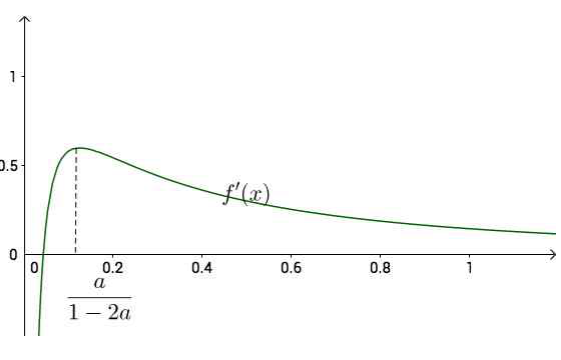
+4점 · f ′ ′ ( a 1 − 2 a ) = 0 \displaystyle f^{\prime\prime}(\frac a{1-2a})=0 f ′′ ( 1 − 2 a a ) = 0 + \displaystyle + + − \displaystyle - − f ′ ( a 1 − 2 a ) \displaystyle f^{\prime}(\frac a{1-2a}) f ′ ( 1 − 2 a a ) lim x → ∞ f ′ ( x ) = 0 \displaystyle \lim_{x\to\infty}f^{\prime}(x)=0 x → ∞ lim f ′ ( x ) = 0 f ′ ( a 1 − 2 a ) > 0 \displaystyle f^{\prime}(\frac a{1-2a})>0 f ′ ( 1 − 2 a a ) > 0 (1) [풀이] f ′ ′ ( a 1 − 2 a ) = 0 \displaystyle f^{\prime\prime}(\frac a{1-2a})=0 f ′′ ( 1 − 2 a a ) = 0 + \displaystyle + + − \displaystyle - − f ′ ( a 1 − 2 a ) = ln ( 1 − a a ) − 2 ( 1 − 2 a ) \displaystyle f^{\prime}(\frac a{1-2a})=\ln(\frac{1-a}a)-2(1-2a) f ′ ( 1 − 2 a a ) = ln ( a 1 − a ) − 2 ( 1 − 2 a ) lim x → ∞ f ′ ( x ) = 0 \displaystyle \lim_{x\to\infty}f^{\prime}(x)=0 x → ∞ lim f ′ ( x ) = 0 f ′ ( a 1 − 2 a ) = ln ( 1 − a a ) − 2 ( 1 − 2 a ) > 0 \displaystyle f^{\prime}(\frac a{1-2a})=\ln(\frac{1-a}a)-2(1-2a)>0 f ′ ( 1 − 2 a a ) = ln ( a 1 − a ) − 2 ( 1 − 2 a ) > 0
+4점 · g ( t ) = ln t − a t = t ( ln t t − a ) \displaystyle g(t)=\ln t-at=t(\frac{\ln t}t-a) g ( t ) = ln t − a t = t ( t ln t − a ) lim t → ∞ g ( t ) = − ∞ \displaystyle \lim_{t\to\infty}g(t)=-\infty t → ∞ lim g ( t ) = − ∞ lim x → 0 + f ′ ( x ) = − ∞ \displaystyle \lim_{x\to0+}f^{\prime}(x)=-\infty x → 0 + lim f ′ ( x ) = − ∞ Correction. 그림의 극댓점 아래에 표시된 a 2 1 − 2 a \displaystyle \frac{a^2}{1-2a} 1 − 2 a a 2 a 1 − 2 a \displaystyle \frac a{1-2a} 1 − 2 a a
f ′ ( x ) = ln ( x + 1 ) + x + a x + 1 − 1 − ln x − a x \displaystyle f^{\prime}(x)=\ln(x+1)+\frac{x+a}{x+1}-1-\ln x-\frac ax f ′ ( x ) = ln ( x + 1 ) + x + 1 x + a − 1 − ln x − x a g ( t ) = ln t − a t = t ( ln t t − a ) \displaystyle g(t)=\ln t-at=t(\frac{\ln t}t-a) g ( t ) = ln t − a t = t ( t ln t − a ) lim t → ∞ g ( t ) = − ∞ \displaystyle \lim_{t\to\infty}g(t)=-\infty t → ∞ lim g ( t ) = − ∞ lim x → 0 + f ′ ( x ) = − ∞ \displaystyle \lim_{x\to0+}f^{\prime}(x)=-\infty x → 0 + lim f ′ ( x ) = − ∞ 이므로 그래프 개형은 다음과 같다.
+2점 · 사이값 정리에 의해 구간 ( 0 , a 1 − 2 a ) \displaystyle (0,\frac a{1-2a}) ( 0 , 1 − 2 a a ) f ′ ( x 0 ) = 0 \displaystyle f^{\prime}(x_0)=0 f ′ ( x 0 ) = 0 x 0 \displaystyle x_0 x 0 f ′ ( x ) \displaystyle f^{\prime}(x) f ′ ( x ) − \displaystyle - − + \displaystyle + + x = x 0 \displaystyle x=x_0 x = x 0 따라서 사이값 정리에 의해 구간 ( 0 , a 1 − 2 a ) \displaystyle (0,\frac a{1-2a}) ( 0 , 1 − 2 a a ) f ′ ( x 0 ) = 0 \displaystyle f^{\prime}(x_0)=0 f ′ ( x 0 ) = 0 x 0 \displaystyle x_0 x 0 f ′ ( x ) \displaystyle f^{\prime}(x) f ′ ( x ) − \displaystyle - − + \displaystyle + + x = x 0 \displaystyle x=x_0 x = x 0 을 갖는다.
+3점 · f ′ ( a 2 1 − 2 a ) = 2 ln 1 − a a − ( 1 − 2 a ) 1 a ( 1 − a ) \displaystyle f^{\prime}(\frac{a^2}{1-2a})=2\ln\frac{1-a}a-(1-2a)\frac1{a(1-a)} f ′ ( 1 − 2 a a 2 ) = 2 ln a 1 − a − ( 1 − 2 a ) a ( 1 − a ) 1 (2) [풀이] f ′ ( a 2 1 − 2 a ) = ln ( 1 + 1 − 2 a a 2 ) − a 2 1 − 2 a + a a 2 1 − 2 a ( 1 + a 2 1 − 2 a ) = ln ( a − 1 ) 2 a 2 − ( 1 − 2 a ) a 2 + a ( 1 − 2 a ) a 2 ( a − 1 ) 2 = 2 ln 1 − a a − ( 1 − 2 a ) a ( 1 − a ) a 2 ( a − 1 ) 2 = 2 ln 1 − a a − ( 1 − 2 a ) 1 a ( 1 − a ) \displaystyle \begin{aligned}f^{\prime}(\frac{a^2}{1-2a})&=\ln(1+\frac{1-2a}{a^2})-\frac{\frac{a^2}{1-2a}+a}{\frac{a^2}{1-2a}(1+\frac{a^2}{1-2a})}\\&=\ln\frac{(a-1)^2}{a^2}-(1-2a)\frac{a^2+a(1-2a)}{a^2(a-1)^2}=2\ln\frac{1-a}a-(1-2a)\frac{a(1-a)}{a^2(a-1)^2}\\&=2\ln\frac{1-a}a-(1-2a)\frac1{a(1-a)}\end{aligned} f ′ ( 1 − 2 a a 2 ) = ln ( 1 + a 2 1 − 2 a ) − 1 − 2 a a 2 ( 1 + 1 − 2 a a 2 ) 1 − 2 a a 2 + a = ln a 2 ( a − 1 ) 2 − ( 1 − 2 a ) a 2 ( a − 1 ) 2 a 2 + a ( 1 − 2 a ) = 2 ln a 1 − a − ( 1 − 2 a ) a 2 ( a − 1 ) 2 a ( 1 − a ) = 2 ln a 1 − a − ( 1 − 2 a ) a ( 1 − a ) 1
+3점 · h ′ ( a ) = ( 2 a − 1 ) 2 ( a ( 1 − a ) ) 2 > 0 \displaystyle h^{\prime}(a)=\frac{(2a-1)^2}{(a(1-a))^2}>0 h ′ ( a ) = ( a ( 1 − a ) ) 2 ( 2 a − 1 ) 2 > 0 h ( 1 2 ) = 0 \displaystyle h(\frac12)=0 h ( 2 1 ) = 0 a \displaystyle a a 0 < a < 1 2 \displaystyle 0<a<\frac12 0 < a < 2 1 h ( a ) < 0 \displaystyle h(a)<0 h ( a ) < 0 f ′ ( a 2 1 − 2 a ) < 0 \displaystyle f^{\prime}(\frac{a^2}{1-2a})<0 f ′ ( 1 − 2 a a 2 ) < 0 이므로 h ( a ) = 2 ln 1 − a a − ( 1 − 2 a ) 1 a ( 1 − a ) \displaystyle h(a)=2\ln\frac{1-a}a-(1-2a)\frac1{a(1-a)} h ( a ) = 2 ln a 1 − a − ( 1 − 2 a ) a ( 1 − a ) 1 h ′ ( a ) = 2 ( − 1 1 − a − 1 a ) − − 2 a ( 1 − a ) − ( 1 − 2 a ) 2 ( a ( 1 − a ) ) 2 = 2 − a − 1 + a a ( 1 − a ) − − 2 a ( 1 − a ) − ( 1 − 2 a ) 2 ( a ( 1 − a ) ) 2 = − 2 a ( 1 − a ) − − 2 a 2 + 2 a − 1 ( a ( 1 − a ) ) 2 = − 2 a ( 1 − a ) + 2 a 2 − 2 a + 1 ( a ( 1 − a ) ) 2 = ( 2 a − 1 ) 2 ( a ( 1 − a ) ) 2 \displaystyle \begin{aligned}h^{\prime}(a)&=2(-\frac1{1-a}-\frac1a)-\frac{-2a(1-a)-(1-2a)^2}{(a(1-a))^2}=2\frac{-a-1+a}{a(1-a)}-\frac{-2a(1-a)-(1-2a)^2}{(a(1-a))^2}\\&=\frac{-2}{a(1-a)}-\frac{-2a^2+2a-1}{(a(1-a))^2}\\&=\frac{-2a(1-a)+2a^2-2a+1}{(a(1-a))^2}=\frac{(2a-1)^2}{(a(1-a))^2}\end{aligned} h ′ ( a ) = 2 ( − 1 − a 1 − a 1 ) − ( a ( 1 − a ) ) 2 − 2 a ( 1 − a ) − ( 1 − 2 a ) 2 = 2 a ( 1 − a ) − a − 1 + a − ( a ( 1 − a ) ) 2 − 2 a ( 1 − a ) − ( 1 − 2 a ) 2 = a ( 1 − a ) − 2 − ( a ( 1 − a ) ) 2 − 2 a 2 + 2 a − 1 = ( a ( 1 − a ) ) 2 − 2 a ( 1 − a ) + 2 a 2 − 2 a + 1 = ( a ( 1 − a ) ) 2 ( 2 a − 1 ) 2 > 0 \displaystyle >0 > 0 h ( 1 2 ) = 0 \displaystyle h(\frac12)=0 h ( 2 1 ) = 0 모든 a \displaystyle a a 0 < a < 1 2 \displaystyle 0<a<\frac12 0 < a < 2 1 h ( a ) < 0 \displaystyle h(a)<0 h ( a ) < 0 f ′ ( a 2 1 − 2 a ) < 0 \displaystyle f^{\prime}(\frac{a^2}{1-2a})<0 f ′ ( 1 − 2 a a 2 ) < 0 따라서 a 2 1 − 2 a < x 0 \displaystyle \frac{a^2}{1-2a}<x_0 1 − 2 a a 2 < x 0
 수리논술, 배움에서 논증의 완성까지.