+2점 · 적분구간의 하한 cos θ \displaystyle \cos\theta cos θ +2점 · 적분구간의 상한 cot θ \displaystyle \cot\theta cot θ +1점 · 정적분 계산 ∫ cos θ cot θ 1 x 3 d x = 1 2 ( sec 2 θ − tan 2 θ ) \displaystyle \int_{\cos\theta}^{\cot\theta}\frac{1}{x^3}\,dx=\frac12(\sec^2\theta-\tan^2\theta) ∫ c o s θ c o t θ x 3 1 d x = 2 1 ( sec 2 θ − tan 2 θ ) +2점 · 정답 1 / 2 \displaystyle 1/2 1/2 [문제 2-1] (1) S \displaystyle S S ∫ cos θ cot θ 1 x 3 d x = [ − 1 2 x 2 ] cos θ cot θ = − 1 2 cot 2 θ + 1 2 cos 2 θ = 1 2 ( sec 2 θ − tan 2 θ ) \displaystyle \int_{\cos\theta}^{\cot\theta}\frac{1}{x^3}\,dx=\Biggl[-\frac{1}{2x^2}\Biggr]_{\cos\theta}^{\cot\theta}=-\frac{1}{2\cot^2\theta}+\frac{1}{2\cos^2\theta}=\frac12(\sec^2\theta-\tan^2\theta) ∫ c o s θ c o t θ x 3 1 d x = [ − 2 x 2 1 ] c o s θ c o t θ = − 2 cot 2 θ 1 + 2 cos 2 θ 1 = 2 1 ( sec 2 θ − tan 2 θ ) 이다. 삼각함수 공식에 의해 이것은 1 2 \displaystyle \frac12 2 1 θ \displaystyle \theta θ
+2점 · cos π 3 = 1 2 \displaystyle \cos\frac{\pi}{3}=\frac12 cos 3 π = 2 1 +2점 · cot π 3 = 1 3 \displaystyle \cot\frac{\pi}{3}=\frac{1}{\sqrt3} cot 3 π = 3 1 +2점 · 부분적분 ∫ 1 / 2 1 / 3 ( 1 − x ) e − x d x = [ − ( 1 − x ) e − x ] 1 / 2 1 / 3 − ∫ 1 / 2 1 / 3 e − x d x \displaystyle \int_{1/2}^{1/\sqrt3}(1-x)e^{-x}\,dx=\Biggl[-(1-x)e^{-x}\Biggr]_{1/2}^{1/\sqrt3}-\int_{1/2}^{1/\sqrt3}e^{-x}\,dx ∫ 1/2 1/ 3 ( 1 − x ) e − x d x = [ − ( 1 − x ) e − x ] 1/2 1/ 3 − ∫ 1/2 1/ 3 e − x d x +2점 · 정답 1 3 e − 1 / 3 − 1 2 e − 1 / 2 \displaystyle \frac{1}{\sqrt3}e^{-1/\sqrt3}-\frac12e^{-1/2} 3 1 e − 1/ 3 − 2 1 e − 1/2 (2) cos π 3 = 1 2 , cot π 3 = 1 3 \displaystyle \cos\frac{\pi}{3}=\frac12,\ \cot\frac{\pi}{3}=\frac{1}{\sqrt3} cos 3 π = 2 1 , cot 3 π = 3 1 S \displaystyle S S ∫ 1 / 2 1 / 3 ( 1 − x ) e − x d x = [ − ( 1 − x ) e − x ] 1 / 2 1 / 3 − ∫ 1 / 2 1 / 3 e − x d x = 1 3 e − 1 / 3 − 1 2 e − 1 / 2 \displaystyle \int_{1/2}^{1/\sqrt3}(1-x)e^{-x}\,dx=\Biggl[-(1-x)e^{-x}\Biggr]_{1/2}^{1/\sqrt3}-\int_{1/2}^{1/\sqrt3}e^{-x}\,dx=\frac{1}{\sqrt3}e^{-1/\sqrt3}-\frac12e^{-1/2} ∫ 1/2 1/ 3 ( 1 − x ) e − x d x = [ − ( 1 − x ) e − x ] 1/2 1/ 3 − ∫ 1/2 1/ 3 e − x d x = 3 1 e − 1/ 3 − 2 1 e − 1/2
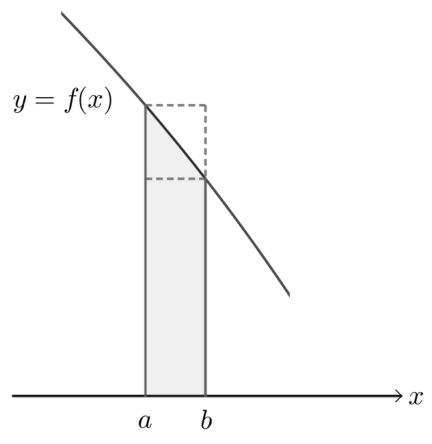
+7점 · 세 도형의 넓이를 그림이나 글로 비교하여 부등식이 성립함을 설명
※ 서술이나 그림이 부정확하면 부분점수 2~3점 [문제 2-2] (1) f ( x ) \displaystyle f(x) f ( x ) S \displaystyle S S L \displaystyle L L f ( a ) \displaystyle f(a) f ( a ) L \displaystyle L L f ( b ) \displaystyle f(b) f ( b ) ( ∗ ) \displaystyle (\ast) ( ∗ )
+4점 · 도함수 계산 f ′ ( x ) = 1 − x − 1 1 + x \displaystyle f^{\prime}(x)=1-x-\frac{1}{1+x} f ′ ( x ) = 1 − x − 1 + x 1 +4점 · 부등식 f ′ ( x ) = − x 2 1 + x < 0 \displaystyle f^{\prime}(x)=-\frac{x^2}{1+x}<0 f ′ ( x ) = − 1 + x x 2 < 0 f \displaystyle f f (2) 도함수 f ′ ( x ) = 1 − x − 1 1 + x = − x 2 1 + x < 0 \displaystyle f^{\prime}(x)=1-x-\frac{1}{1+x}=-\frac{x^2}{1+x}<0 f ′ ( x ) = 1 − x − 1 + x 1 = − 1 + x x 2 < 0 ( 0 , 1 ) \displaystyle (0,1) ( 0 , 1 )
+3점 · 부등식 f ( b ) ≤ T L ≤ f ( a ) \displaystyle f(b)\le\frac{T}{L}\le f(a) f ( b ) ≤ L T ≤ f ( a ) +3점 · lim θ → π 2 − T L = lim x → 0 + f ( x ) = lim x → 0 + ( 2 + x − x 2 2 − ln ( 1 + x ) ) \displaystyle \lim_{\theta\to\frac{\pi}{2}-}\frac{T}{L}=\lim_{x\to0+}f(x)=\lim_{x\to0+}\left(2+x-\frac{x^2}{2}-\ln(1+x)\right) θ → 2 π − lim L T = x → 0 + lim f ( x ) = x → 0 + lim ( 2 + x − 2 x 2 − ln ( 1 + x ) ) +2점 · 정답은 2 (3) 문제 (2)로부터 f ( x ) = 2 + x − x 2 2 − ln ( 1 + x ) \displaystyle f(x)=2+x-\frac{x^2}{2}-\ln(1+x) f ( x ) = 2 + x − 2 x 2 − ln ( 1 + x ) ( 0 , 1 ] \displaystyle (0,1] ( 0 , 1 ] ( ∗ ) \displaystyle (\ast) ( ∗ ) f ( b ) ≤ T L ≤ f ( a ) \displaystyle f(b)\le\frac{T}{L}\le f(a) f ( b ) ≤ L T ≤ f ( a ) 가 얻는다. θ → π 2 − \displaystyle \theta\to\frac{\pi}{2}- θ → 2 π − a → 0 + , b → 0 + \displaystyle a\to0+,\ b\to0+ a → 0 + , b → 0 + lim θ → π 2 − T L = lim x → 0 + f ( x ) = lim x → 0 + ( 2 + x − x 2 2 − ln ( 1 + x ) ) = 2 \displaystyle \lim_{\theta\to\frac{\pi}{2}-}\frac{T}{L}=\lim_{x\to0+}f(x)=\lim_{x\to0+}\left(2+x-\frac{x^2}{2}-\ln(1+x)\right)=2 θ → 2 π − lim L T = x → 0 + lim f ( x ) = x → 0 + lim ( 2 + x − 2 x 2 − ln ( 1 + x ) ) = 2 이므로, lim θ → π 2 − T L = 2 \displaystyle \lim_{\theta\to\frac{\pi}{2}-}\frac{T}{L}=2 θ → 2 π − lim L T = 2
+5점 · 함수 f \displaystyle f f M \displaystyle M M m \displaystyle m m m ≤ T L ≤ M \displaystyle m\le\frac{T}{L}\le M m ≤ L T ≤ M +5점 · lim θ → π 2 − m = lim θ → π 2 − M = lim x → 0 + f ( x ) = f ( 0 ) \displaystyle \lim_{\theta\to\frac{\pi}{2}-}m=\lim_{\theta\to\frac{\pi}{2}-}M=\lim_{x\to0+}f(x)=f(0) θ → 2 π − lim m = θ → 2 π − lim M = x → 0 + lim f ( x ) = f ( 0 ) +2점 · 정답 f ( 0 ) = 2 \displaystyle f(0)=2 f ( 0 ) = 2 [문제 2-3] 함수 f ( x ) \displaystyle f(x) f ( x ) [ cos θ , cot θ ] \displaystyle [\cos\theta,\cot\theta] [ cos θ , cot θ ] M \displaystyle M M m \displaystyle m m S \displaystyle S S m L ≤ T ≤ M L . \displaystyle mL\le T\le ML. m L ≤ T ≤ M L . 또는 m ≤ T L ≤ M \displaystyle m\le\frac{T}{L}\le M m ≤ L T ≤ M 이 성립한다. 한편 θ → π 2 − \displaystyle \theta\to\frac{\pi}{2}- θ → 2 π − x → 0 + \displaystyle x\to0+ x → 0 + lim θ → π 2 − m = lim θ → π 2 − M = lim x → 0 + f ( x ) = f ( 0 ) \displaystyle \lim_{\theta\to\frac{\pi}{2}-}m=\lim_{\theta\to\frac{\pi}{2}-}M=\lim_{x\to0+}f(x)=f(0) θ → 2 π − lim m = θ → 2 π − lim M = x → 0 + lim f ( x ) = f ( 0 ) lim θ → π 2 − T L = f ( 0 ) = 2 \displaystyle \lim_{\theta\to\frac{\pi}{2}-}\frac{T}{L}=f(0)=2 θ → 2 π − lim L T = f ( 0 ) = 2
 수리논술, 배움에서 논증의 완성까지.