[문제 4-1]
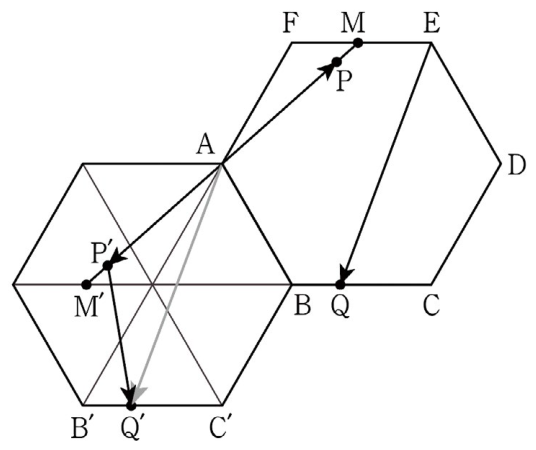
+5점 · ∣ A P → + E Q → ∣ = ∣ P ′ Q ′ → ∣ \displaystyle |\overrightarrow{\mathrm{AP}}+\overrightarrow{\mathrm{EQ}}|=|\overrightarrow{\mathrm{P}^{\prime}\mathrm{Q}^{\prime}}| ∣ AP + EQ ∣ = ∣ P ′ Q ′ ∣ 왼쪽의 그림과 같이 점 P \displaystyle \mathrm{P} P M \displaystyle \mathrm{M} M A \displaystyle \mathrm{A} A P ′ \displaystyle \mathrm{P}^{\prime} P ′ M ′ \displaystyle \mathrm{M}^{\prime} M ′ E Q → \displaystyle \overrightarrow{\mathrm{EQ}} EQ A \displaystyle \mathrm{A} A Q ′ \displaystyle \mathrm{Q}^{\prime} Q ′ A P ′ → = − A P → \displaystyle \overrightarrow{\mathrm{AP}^{\prime}}=-\overrightarrow{\mathrm{AP}} AP ′ = − AP A P → + E Q → = A P → + A Q ′ → = A P → + A P ′ → + P ′ Q ′ → = P ′ Q ′ → \displaystyle \overrightarrow{\mathrm{AP}}+\overrightarrow{\mathrm{EQ}}=\overrightarrow{\mathrm{AP}}+\overrightarrow{\mathrm{AQ}^{\prime}}=\overrightarrow{\mathrm{AP}}+\overrightarrow{\mathrm{AP}^{\prime}}+\overrightarrow{\mathrm{P}^{\prime}\mathrm{Q}^{\prime}}=\overrightarrow{\mathrm{P}^{\prime}\mathrm{Q}^{\prime}} AP + EQ = AP + AQ ′ = AP + AP ′ + P ′ Q ′ = P ′ Q ′ 따라서 ∣ A P → + E Q → ∣ = ∣ P ′ Q ′ → ∣ \displaystyle |\overrightarrow{\mathrm{AP}}+\overrightarrow{\mathrm{EQ}}|=|\overrightarrow{\mathrm{P}^{\prime}\mathrm{Q}^{\prime}}| ∣ AP + EQ ∣ = ∣ P ′ Q ′ ∣
+5점 · ∣ A P → + E Q → ∣ \displaystyle |\overrightarrow{\mathrm{AP}}+\overrightarrow{\mathrm{EQ}}| ∣ AP + EQ ∣ 3 \displaystyle \sqrt3 3 B ′ C ′ ‾ = 2 \displaystyle \overline{\mathrm{B}^{\prime}\mathrm{C}^{\prime}}=2 B ′ C ′ = 2 M ′ B ′ ‾ = 3 \displaystyle \overline{\mathrm{M}^{\prime}\mathrm{B}^{\prime}}=\sqrt3 M ′ B ′ = 3 A C ′ ‾ = 2 3 \displaystyle \overline{\mathrm{AC}^{\prime}}=2\sqrt3 AC ′ = 2 3 B ′ \displaystyle \mathrm{B}^{\prime} B ′ C ′ \displaystyle \mathrm{C}^{\prime} C ′ A \displaystyle \mathrm{A} A M ′ \displaystyle \mathrm{M}^{\prime} M ′ ( 0 , 0 ) \displaystyle (0,0) ( 0 , 0 ) ( 2 , 0 ) \displaystyle (2,0) ( 2 , 0 ) ( 2 , 2 3 ) \displaystyle (2,2\sqrt3) ( 2 , 2 3 ) ( 0 , 3 ) \displaystyle (0,\sqrt3) ( 0 , 3 ) P ′ \displaystyle \mathrm{P}^{\prime} P ′ Q ′ \displaystyle \mathrm{Q}^{\prime} Q ′ M ′ A \displaystyle \mathrm{M}^{\prime}\mathrm{A} M ′ A B ′ C ′ \displaystyle \mathrm{B}^{\prime}\mathrm{C}^{\prime} B ′ C ′ s : 1 − s ( 0 ≤ s ≤ 1 ) \displaystyle s:1-s\;(0\le s\le1) s : 1 − s ( 0 ≤ s ≤ 1 ) t : 1 − t ( 0 ≤ t ≤ 1 ) \displaystyle t:1-t\;(0\le t\le1) t : 1 − t ( 0 ≤ t ≤ 1 ) P ′ \displaystyle \mathrm{P}^{\prime} P ′ Q ′ \displaystyle \mathrm{Q}^{\prime} Q ′ ( 2 s , 3 ( 1 + s ) ) \displaystyle (2s,\sqrt3(1+s)) ( 2 s , 3 ( 1 + s )) ( 2 t , 0 ) \displaystyle (2t,0) ( 2 t , 0 ) ∣ P ′ Q ′ → ∣ = 4 ( s − t ) 2 + 3 ( 1 + s ) 2 \displaystyle |\overrightarrow{\mathrm{P}^{\prime}\mathrm{Q}^{\prime}}|=\sqrt{4(s-t)^2+3(1+s)^2} ∣ P ′ Q ′ ∣ = 4 ( s − t ) 2 + 3 ( 1 + s ) 2 0 ≤ s ≤ 1 \displaystyle 0\le s\le1 0 ≤ s ≤ 1 0 ≤ t ≤ 1 \displaystyle 0\le t\le1 0 ≤ t ≤ 1 ∣ P ′ Q ′ → ∣ \displaystyle |\overrightarrow{\mathrm{P}^{\prime}\mathrm{Q}^{\prime}}| ∣ P ′ Q ′ ∣ s = t = 0 \displaystyle s=t=0 s = t = 0 3 \displaystyle \sqrt3 3
+5점 · ∣ A P → + E Q → ∣ \displaystyle |\overrightarrow{\mathrm{AP}}+\overrightarrow{\mathrm{EQ}}| ∣ AP + EQ ∣ Correction. 채점기준의 “최솟값 4”에서 “최솟값”은 “최댓값”의 오기다. 그러나 원칙에 따라 원문 표기를 그대로 실었다.
최댓값은 s = 1 \displaystyle s=1 s = 1 t = 0 \displaystyle t=0 t = 0 ∣ A P → + E Q → ∣ \displaystyle |\overrightarrow{\mathrm{AP}}+\overrightarrow{\mathrm{EQ}}| ∣ AP + EQ ∣ 4 + 3 \displaystyle 4+\sqrt3 4 + 3
[문제 4-2]
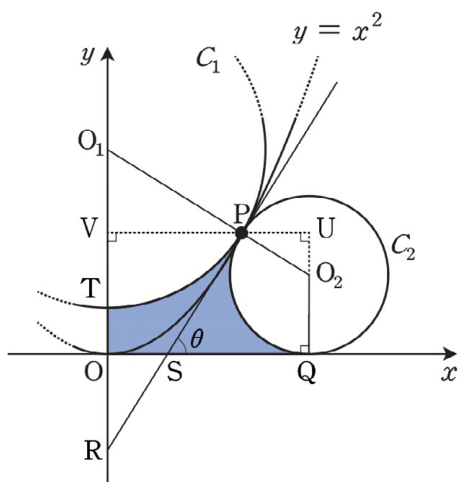
좌표평면의 원점을 O \displaystyle \mathrm{O} O C i ( i = 1 , 2 ) \displaystyle C_i\;(i=1,2) C i ( i = 1 , 2 ) O i \displaystyle \mathrm{O}_i O i O 2 \displaystyle \mathrm{O}_2 O 2 x \displaystyle x x Q \displaystyle \mathrm{Q} Q P \displaystyle \mathrm{P} P y = x 2 \displaystyle y=x^2 y = x 2 y = 2 t x − t 2 \displaystyle y=2tx-t^2 y = 2 t x − t 2 y \displaystyle y y x \displaystyle x x R \displaystyle \mathrm{R} R S \displaystyle \mathrm{S} S O O 1 \displaystyle \mathrm{OO}_1 OO 1 C 1 \displaystyle C_1 C 1 T \displaystyle \mathrm{T} T P \displaystyle \mathrm{P} P O 2 Q \displaystyle \mathrm{O}_2\mathrm{Q} O 2 Q y \displaystyle y y U \displaystyle \mathrm{U} U V \displaystyle \mathrm{V} V θ = ∠ P S Q \displaystyle \theta=\angle\mathrm{PSQ} θ = ∠ PSQ
+5점 · t = 3 2 \displaystyle t=\frac{\sqrt3}2 t = 2 3 직선 O 1 O 2 \displaystyle \mathrm{O}_1\mathrm{O}_2 O 1 O 2 y = − 1 2 t ( x − t ) + t 2 \displaystyle y=-\frac1{2t}(x-t)+t^2 y = − 2 t 1 ( x − t ) + t 2 y \displaystyle y y O 1 \displaystyle \mathrm{O}_1 O 1 ( 0 , t 2 + 1 2 ) \displaystyle \left(0,t^2+\frac12\right) ( 0 , t 2 + 2 1 ) P U ‾ = 1 2 × V P ‾ = t 2 \displaystyle \overline{\mathrm{PU}}=\frac12\times\overline{\mathrm{VP}}=\frac t2 PU = 2 1 × VP = 2 t O 2 U ‾ = 1 2 × O 1 V ‾ = 1 2 × ( O 1 O ‾ − V O ‾ ) = 1 4 \displaystyle \overline{\mathrm{O}_2\mathrm{U}}=\frac12\times\overline{\mathrm{O}_1\mathrm{V}}=\frac12\times(\overline{\mathrm{O}_1\mathrm{O}}-\overline{\mathrm{VO}})=\frac14 O 2 U = 2 1 × O 1 V = 2 1 × ( O 1 O − VO ) = 4 1 O 2 \displaystyle \mathrm{O}_2 O 2 ( 3 t 2 , t 2 − 1 4 ) \displaystyle \left(\frac{3t}2,t^2-\frac14\right) ( 2 3 t , t 2 − 4 1 ) t 2 − 1 4 = O 2 Q ‾ = O 2 P ‾ = ( 3 t 2 − t ) 2 + ( t 2 − 1 4 − t 2 ) 2 \displaystyle t^2-\frac14=\overline{\mathrm{O}_2\mathrm{Q}}=\overline{\mathrm{O}_2\mathrm{P}}=\sqrt{\left(\frac{3t}2-t\right)^2+\left(t^2-\frac14-t^2\right)^2} t 2 − 4 1 = O 2 Q = O 2 P = ( 2 3 t − t ) 2 + ( t 2 − 4 1 − t 2 ) 2 t = 3 2 \displaystyle t=\frac{\sqrt3}2 t = 2 3 tan θ = 2 t \displaystyle \tan\theta=2t tan θ = 2 t θ = π 3 \displaystyle \theta=\frac\pi3 θ = 3 π
+6점 · 부채꼴 O 2 P Q \displaystyle \mathrm{O}_2\mathrm{PQ} O 2 PQ π 12 \displaystyle \frac\pi{12} 12 π O 1 T P \displaystyle \mathrm{O}_1\mathrm{TP} O 1 TP π 6 \displaystyle \frac\pi6 6 π ∠ P O 2 Q = π − θ = 2 π 3 \displaystyle \angle\mathrm{PO}_2\mathrm{Q}=\pi-\theta=\frac{2\pi}3 ∠ PO 2 Q = π − θ = 3 2 π O 2 Q ‾ = 1 2 \displaystyle \overline{\mathrm{O}_2\mathrm{Q}}=\frac12 O 2 Q = 2 1 O 2 P Q \displaystyle \mathrm{O}_2\mathrm{PQ} O 2 PQ π 12 \displaystyle \frac\pi{12} 12 π ∠ R O 1 P = ∠ R S O = θ = π 3 \displaystyle \angle\mathrm{RO}_1\mathrm{P}=\angle\mathrm{RSO}=\theta=\frac\pi3 ∠ RO 1 P = ∠ RSO = θ = 3 π O 1 P ‾ = 2 O 2 Q ‾ = 1 \displaystyle \overline{\mathrm{O}_1\mathrm{P}}=2\overline{\mathrm{O}_2\mathrm{Q}}=1 O 1 P = 2 O 2 Q = 1 O 1 T P \displaystyle \mathrm{O}_1\mathrm{TP} O 1 TP π 6 \displaystyle \frac\pi6 6 π
+4점 · 영역의 넓이 21 32 3 − π 4 \displaystyle \frac{21}{32}\sqrt3-\frac\pi4 32 21 3 − 4 π 사다리꼴 O Q O 2 O 1 \displaystyle \mathrm{OQO}_2\mathrm{O}_1 OQO 2 O 1 1 2 × ( O O 1 ‾ + O 2 Q ‾ ) × O Q ‾ = 1 2 × ( 5 4 + 1 2 ) × 3 3 4 = 21 32 3 \displaystyle \frac12\times(\overline{\mathrm{OO}_1}+\overline{\mathrm{O}_2\mathrm{Q}})\times\overline{\mathrm{OQ}}=\frac12\times\left(\frac54+\frac12\right)\times\frac{3\sqrt3}4=\frac{21}{32}\sqrt3 2 1 × ( OO 1 + O 2 Q ) × OQ = 2 1 × ( 4 5 + 2 1 ) × 4 3 3 = 32 21 3 C 1 \displaystyle C_1 C 1 C 2 \displaystyle C_2 C 2 x \displaystyle x x y \displaystyle y y 21 32 3 − π 6 − π 12 = 21 32 3 − π 4 \displaystyle \frac{21}{32}\sqrt3-\frac\pi6-\frac\pi{12}=\frac{21}{32}\sqrt3-\frac\pi4 32 21 3 − 6 π − 12 π = 32 21 3 − 4 π
※ 논리 전개 과정이 맞으면 답이 틀리더라도 1~2점의 부분 점수를 부여함.
※ 채점자는 답안의 완성도에 따라 –0.5~+0.5점 부여 가능함.
 수리논술, 배움에서 논증의 완성까지.