수리논술, 이게 다다.

자연계열 (오후1) 2번

오류 제보

문제

[문제 2] 다음 제시문을 읽고 물음에 답하시오. (50점)

<가> n≥3\displaystyle n\ge3인 자연수 n\displaystyle n에 대하여 함수 f(x)\displaystyle f(x)를 다음과 같이 정의하자.f(x)=(1−xn)1n(0≤x≤1)\displaystyle f(x)=(1-x^n)^{\frac1n}\quad(0\le x\le1)

<나> 곡선 y=f(x)\displaystyle y=f(x) 위의 한 점 (x0,f(x0))\displaystyle (x_0,f(x_0)) (0<x0<1)\displaystyle (0<x_0<1)에서의 접선이 x\displaystyle x축과 만나는 점을 P, y\displaystyle y축과 만나는 점을 Q라 하자.

<다> 수열 {an}, {bn}, {cn}\displaystyle \{a_n\},\ \{b_n\},\ \{c_n\}에 대하여 lim⁡n→∞an=lim⁡n→∞bn=L\displaystyle \lim_{n\to\infty}a_n=\lim_{n\to\infty}b_n=L이고 모든 자연수 n\displaystyle n에 대하여 an≤cn≤bn\displaystyle a_n\le c_n\le b_n이면, lim⁡n→∞cn=L\displaystyle \lim_{n\to\infty}c_n=L이다.

1. 곡선 y=f(x)(0≤x≤1)\displaystyle y = f ( x ) ( 0 \le x \le 1 ) 위의 점 중에서 원점까지의 거리가 최대인 점을 A\displaystyle \mathrm{A}라 하자. 점 A\displaystyle \mathrm{A}의 좌표를 구하시오.

2. 선분 PQ\displaystyle \mathrm{PQ}의 길이의 최솟값을 구하시오.

3. 자연수 n\displaystyle n에 대하여 dn=∫01(1−xn)1ndx\displaystyle d_{n} = \int_{0}^{1} ( 1 - x^{n} )^{\frac{1}{n}} d x라 할 때, 극한값 lim⁡n→∞dn\displaystyle \lim_{n \to \infty} {d_{n}}을 구하시오.

해설강의 준비중

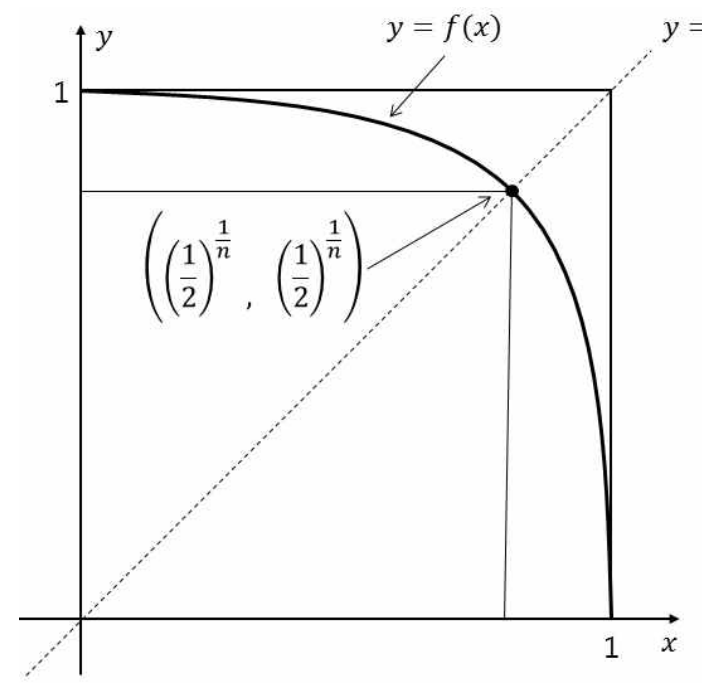
1. 원점 (0,0)\displaystyle (0,0)과 곡선 y=f(x)\displaystyle y=f(x) 위의 점 (x,f(x))\displaystyle (x,f(x)) 사이의 거리의 제곱을 g(x)\displaystyle g(x) (0≤x≤1)\displaystyle (0\le x\le1)라 하자.함수 g(x)\displaystyle g(x)의 정의에 의해 g(x)=x2+(1−xn)2n\displaystyle g(x)=x^2+(1-x^n)^{\frac2n}이다.g(0)=1, g(1)=1\displaystyle g(0)=1,\ g(1)=1이고, g′(x)=2x−2(1−xn)2n−1xn−1\displaystyle g^{\prime}(x)=2x-2(1-x^n)^{\frac2n-1}x^{n-1}이다. 0<x<1\displaystyle 0<x<1일 때g′(x)>0⇔x−(1−xn)2n−1xn−1>0⇔x2−n−(1−xn)2−nn>0⇔x2−n>(1−xn)2−nn⇔x<(1−xn)1n\displaystyle g^{\prime}(x)>0\Leftrightarrow x-(1-x^n)^{\frac2n-1}x^{n-1}>0\Leftrightarrow x^{2-n}-(1-x^n)^{\frac{2-n}n}>0\Leftrightarrow x^{2-n}>(1-x^n)^{\frac{2-n}n}\Leftrightarrow x<(1-x^n)^{\frac1n} (n≥3\displaystyle n\ge3이므로)⇔xn<1−xn⇔xn<12⇔x<(12)1n\displaystyle \Leftrightarrow x^n<1-x^n\Leftrightarrow x^n<\frac12\Leftrightarrow x<\left(\frac12\right)^{\frac1n}비슷한 방법으로 g′(x)=0⇔x=(12)1n\displaystyle g^{\prime}(x)=0\Leftrightarrow x=\left(\frac12\right)^{\frac1n}, 그리고 g′(x)<0⇔x>(12)1n\displaystyle g^{\prime}(x)<0\Leftrightarrow x>\left(\frac12\right)^{\frac1n}임을 확인할 수 있다.따라서 x=(12)1n\displaystyle x=\left(\frac12\right)^{\frac1n}에서 g(x)\displaystyle g(x)가 최대가 된다.f((12)1n)=(12)1n\displaystyle f\left(\left(\frac12\right)^{\frac1n}\right)=\left(\frac12\right)^{\frac1n}이므로 원하는 점 A의 좌표는 ((12)1n,(12)1n)\displaystyle \left(\left(\frac12\right)^{\frac1n},\left(\frac12\right)^{\frac1n}\right)이다.

2. 0<x<1\displaystyle 0<x<1일 때 f′(x)=−(1−xn)1−nnxn−1<0\displaystyle f^{\prime}(x)=-(1-x^n)^{\frac{1-n}n}x^{n-1}<0이다.곡선 y=f(x)\displaystyle y=f(x)의 한 점 (x0,f(x0))\displaystyle (x_0,f(x_0))의 접선의 방정식은 y=f′(x0)(x−x0)+f(x0)\displaystyle y=f^{\prime}(x_0)(x-x_0)+f(x_0)점 P의 좌표를 (p,0)\displaystyle (p,0), 점 Q의 좌표를 (0,q)\displaystyle (0,q)이라 하면 0=f′(x0)(p−x0)+f(x0), q=f′(x0)(0−x0)+f(x0)\displaystyle 0=f^{\prime}(x_0)(p-x_0)+f(x_0),\ q=f^{\prime}(x_0)(0-x_0)+f(x_0)따라서 p=f(x0)−x0f′(x0)−f′(x0),q=f(x0)−x0f′(x0)\displaystyle p=\frac{f(x_0)-x_0f^{\prime}(x_0)}{-f^{\prime}(x_0)},\quad q=f(x_0)-x_0f^{\prime}(x_0)즉, 점 P의 좌표는 (f(x0)−x0f′(x0)−f′(x0),0)\displaystyle \left(\frac{f(x_0)-x_0f^{\prime}(x_0)}{-f^{\prime}(x_0)},0\right), 점 Q의 좌표는 (0,f(x0)−x0f′(x0))\displaystyle (0,f(x_0)-x_0f^{\prime}(x_0))이다.이로부터 선분 PQ의 길이의 제곱을 h(x0)\displaystyle h(x_0)라 하면h(x0)=∣f(x0)−x0f′(x0)∣2∣f′(x0)∣2(1+(f′(x0))2)(0<x0<1)\displaystyle h(x_0)=\frac{|f(x_0)-x_0f^{\prime}(x_0)|^2}{|f^{\prime}(x_0)|^2}\left(1+(f^{\prime}(x_0))^2\right)\quad(0<x_0<1)을 얻는다.한편 ∣f(x0)−x0f′(x0)∣=∣(1−x0n)1n+x0n(1−x0n)1−nn∣=(1−x0n)1−nn,∣f′(x0)∣=(1−x0n)1−nnx0n−1\displaystyle |f(x_0)-x_0f^{\prime}(x_0)|=\left|(1-x_0^n)^{\frac1n}+x_0^n(1-x_0^n)^{\frac{1-n}n}\right|=(1-x_0^n)^{\frac{1-n}n},\quad |f^{\prime}(x_0)|=(1-x_0^n)^{\frac{1-n}n}x_0^{n-1}이므로 정리하면h(x0)=(1x0)2(n−1)+(1−x0n)2(1−n)n\displaystyle h(x_0)=\left(\frac1{x_0}\right)^{2(n-1)}+(1-x_0^n)^{\frac{2(1-n)}n}선분 PQ의 길이의 최솟값을 찾기 위해서는 구간 (0,1)\displaystyle (0,1)에서의 h(x)\displaystyle h(x)의 최솟값을 찾으면 충분하다.x\displaystyle x가 0또는 1로 수렴함에 따라 h(x)\displaystyle h(x)는 양의 무한대로 발산한다.또한 h′(x)=2(1−n)(x1−2n−(1−xn)2−3nnxn−1)\displaystyle h^{\prime}(x)=2(1-n)\left(x^{1-2n}-(1-x^n)^{\frac{2-3n}n}x^{n-1}\right)이므로, 0<x<1\displaystyle 0<x<1일 때h′(x)>0⇔x1−2n−(1−xn)2−3nnxn−1<0\displaystyle h^{\prime}(x)>0\Leftrightarrow x^{1-2n}-(1-x^n)^{\frac{2-3n}n}x^{n-1}<0 (n≥3\displaystyle n\ge3이므로) ⇔x2−3n−(1−xn)2−3nn<0⇔x2−3n<(1−xn)2−3nn\displaystyle \Leftrightarrow x^{2-3n}-(1-x^n)^{\frac{2-3n}n}<0\Leftrightarrow x^{2-3n}<(1-x^n)^{\frac{2-3n}n}⇔x>(1−xn)1n\displaystyle \Leftrightarrow x>(1-x^n)^{\frac1n} (n≥3\displaystyle n\ge3이므로) ⇔xn>1−xn⇔xn>12⇔x>(12)1n\displaystyle \Leftrightarrow x^n>1-x^n\Leftrightarrow x^n>\frac12\Leftrightarrow x>\left(\frac12\right)^{\frac1n}비슷한 방법으로 h′(x)=0⇔x=(12)1n\displaystyle h^{\prime}(x)=0\Leftrightarrow x=\left(\frac12\right)^{\frac1n}, 그리고 h′(x)<0⇔x<(12)1n\displaystyle h^{\prime}(x)<0\Leftrightarrow x<\left(\frac12\right)^{\frac1n}임을 확인할 수 있다.따라서 x=(12)1n\displaystyle x=\left(\frac12\right)^{\frac1n}에서 h(x)\displaystyle h(x)가 최소가 되고 h((12)1n)=2⋅4n−1n\displaystyle h\left(\left(\frac12\right)^{\frac1n}\right)=2\cdot4^{\frac{n-1}n}이다.선분 PQ의 길이의 최솟값은 h((12)1n)\displaystyle h\left(\left(\frac12\right)^{\frac1n}\right)의 양의 제곱근인 2⋅2n−1n\displaystyle \sqrt2\cdot2^{\frac{n-1}n}이다.

3.

곡선 y=f(x)와 두 정사각형 및 직선 y=x

0<x<1\displaystyle 0<x<1일 때 f(x)>0, f′(x)<0\displaystyle f(x)>0,\ f^{\prime}(x)<0이고, f((12)1n)=(12)1n\displaystyle f\left(\left(\frac12\right)^{\frac1n}\right)=\left(\frac12\right)^{\frac1n}따라서 0<x<(12)1n\displaystyle 0<x<\left(\frac12\right)^{\frac1n}이면 (12)1n<f(x)<1\displaystyle \left(\frac12\right)^{\frac1n}<f(x)<1이다. 이로부터(한 변의 길이가 (12)1n\displaystyle \left(\frac12\right)^{\frac1n}인 정사각형의 넓이) =∫0(12)1n(12)1n dx\displaystyle =\int_0^{\left(\frac12\right)^{\frac1n}}\left(\frac12\right)^{\frac1n}\,dx≤∫0(12)1nf(x) dx≤∫01f(x) dx=∫01(1−xn)1n dx≤∫011 dx\displaystyle \le\int_0^{\left(\frac12\right)^{\frac1n}}f(x)\,dx\le\int_0^1f(x)\,dx=\int_0^1(1-x^n)^{\frac1n}\,dx\le\int_0^1 1\,dx= (한 변의 길이가 1인 정사각형의 넓이)를 얻는다. 정리하면 (12)2n≤dn≤1\displaystyle \left(\frac12\right)^{\frac2n}\le d_n\le1이 때 lim⁡n→∞(12)2n=1\displaystyle \lim_{n\to\infty}\left(\frac12\right)^{\frac2n}=1이므로 제시문 <다>에 의해 lim⁡n→∞dn=1\displaystyle \lim_{n\to\infty}d_n=1

첨삭 사례

아직 등록된 첨삭 사례가 없습니다.

질문과 답변 · 0개질문과 답변 · 고정 0개

아직 등록된 질문이 없습니다. 질문 작성은 멤버십 회원만 가능합니다.