[논제I-1]
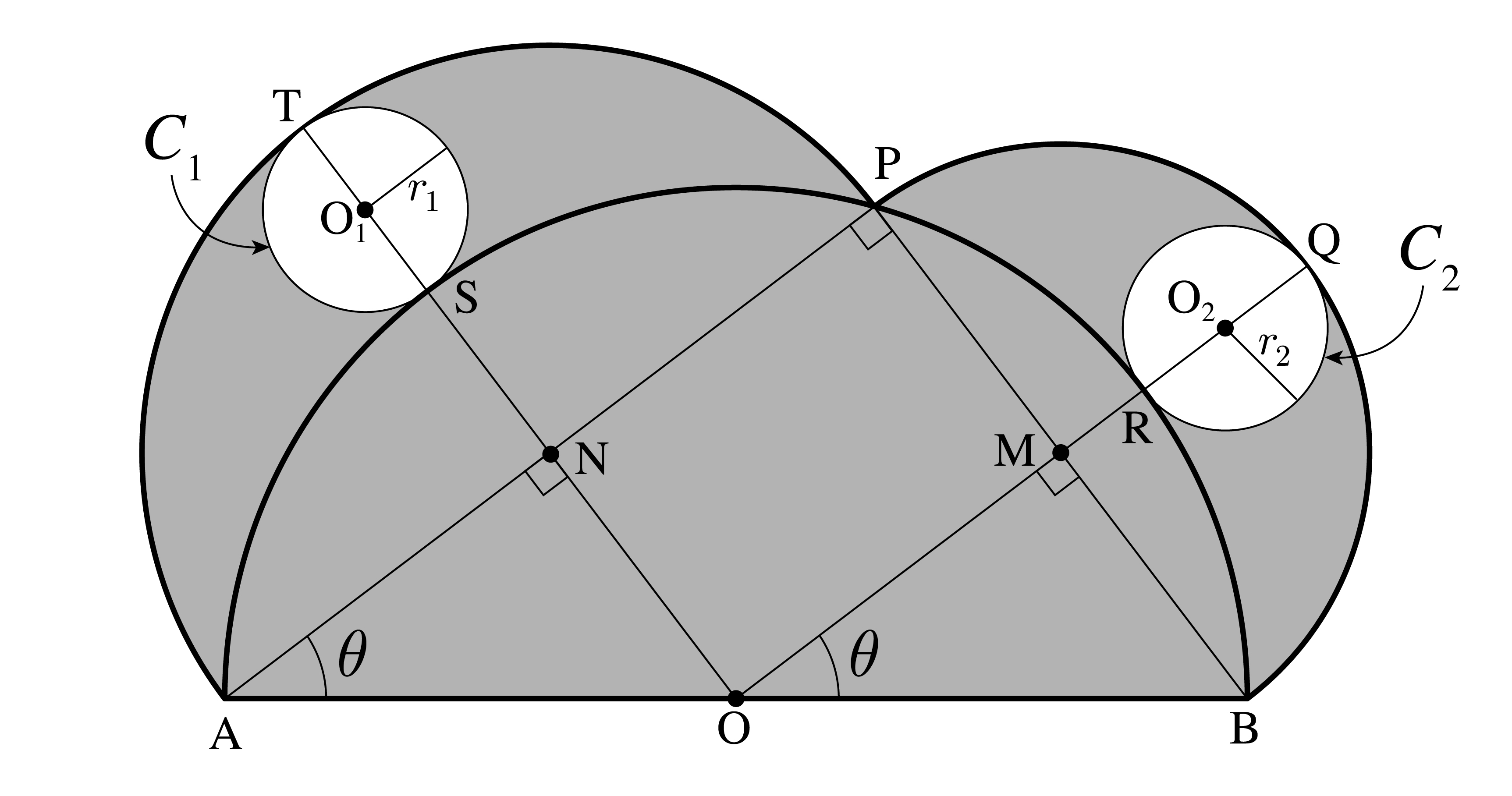
+4점 · ∠ R O B = ∠ P A B = θ \displaystyle \angle\mathrm{ROB}=\angle\mathrm{PAB}=\theta ∠ ROB = ∠ PAB = θ 원의 중심과 현의 중점을 이은 선분은 현을 수직 이등분하므로, O M ‾ ⊥ B P ‾ \displaystyle \overline{\mathrm{OM}} \perp \overline{\mathrm{BP}} OM ⊥ BP ∠ A P B \displaystyle \angle \mathrm{APB} ∠ APB ∠ A P B = ∠ O M B \displaystyle \angle \mathrm{APB} = \angle \mathrm{OMB} ∠ APB = ∠ OMB A P \displaystyle {\mathrm{AP}} AP O M \displaystyle \mathrm{OM} OM ∠ R O B = ∠ P A B = θ \displaystyle \angle \mathrm{ROB} = \angle \mathrm{PAB} = \theta ∠ ROB = ∠ PAB = θ
+5점 · 접점 R \displaystyle \mathrm R R Q \displaystyle \mathrm Q Q O \displaystyle \mathrm O O M \displaystyle \mathrm M M O 2 \displaystyle \mathrm O_2 O 2 원 C 2 \displaystyle C_2 C 2 O \displaystyle \mathrm O O R \displaystyle \mathrm R R C 2 \displaystyle C_2 C 2 P M \displaystyle \mathrm{PM} PM Q \displaystyle \mathrm Q Q Correction. 반원의 지름을 나타낸 선분 P M \displaystyle PM P M P B \displaystyle PB P B R \displaystyle \mathrm{R} R O 2 R \displaystyle \mathrm{O}_{2} \mathrm{R} O 2 R O R \displaystyle \mathrm{OR} OR 따라서 접점 R \displaystyle \mathrm{R} R O \displaystyle \mathrm{O} O O 2 \displaystyle \mathrm{O}_{2} O 2 마찬가지로 접점 Q \displaystyle \mathrm{Q} Q M \displaystyle \mathrm{M} M O 2 \displaystyle \mathrm{O}_{2} O 2 세 점 O \displaystyle \mathrm{O} O M \displaystyle \mathrm{M} M O 2 \displaystyle \mathrm{O}_{2} O 2 R \displaystyle \mathrm{R} R Q \displaystyle \mathrm{Q} Q O \displaystyle \mathrm{O} O M \displaystyle \mathrm{M} M O 2 \displaystyle \mathrm{O}_{2} O 2
+6점 · r 1 ( θ ) = r 2 ( θ ) = 1 2 ( cos θ + sin θ − 1 ) \displaystyle r_1(\theta)=r_2(\theta)=\frac12(\cos\theta+\sin\theta-1) r 1 ( θ ) = r 2 ( θ ) = 2 1 ( cos θ + sin θ − 1 ) 따라서 O R ‾ + 2 r 2 = O M ‾ + M Q ‾ = O M ‾ + B M ‾ \displaystyle {\overline{\mathrm{OR}}} + 2 r_{2} = {\overline{\mathrm{OM}} + \overline{\mathrm{MQ}}} = {\overline{\mathrm{OM}} + \overline{\mathrm{BM}}} OR + 2 r 2 = OM + MQ = OM + BM O S ‾ + 2 r 1 = O N ‾ + A N ‾ \displaystyle {\overline{\mathrm{OS}}} + 2 r_{1} = \overline{\mathrm{ON}} + \overline{\mathrm{AN}} OS + 2 r 1 = ON + AN 이때, A N ‾ = O M ‾ = cos θ , O N ‾ = B M ‾ = sin θ \displaystyle {\overline{\mathrm{AN}}} = {\overline{\mathrm{OM}}} = \cos \theta , {\overline{\mathrm{ON}} = {\overline{\mathrm{BM}}}} = \sin \theta AN = OM = cos θ , ON = BM = sin θ r 1 ( θ ) = r 2 ( θ ) = 1 2 ( cos θ + sin θ − 1 ) ( 0 < θ < π 2 ) \displaystyle r_{1} ( \theta ) = r_{2} ( \theta ) = \frac{{1}}{2} ( \cos \theta + \sin \theta - 1 ) \left( 0 < \theta < \frac{{\pi}}{2} \right) r 1 ( θ ) = r 2 ( θ ) = 2 1 ( cos θ + sin θ − 1 ) ( 0 < θ < 2 π )
+5점 · O 2 M ‾ = B M ‾ − r 2 \displaystyle \overline{\mathrm{O_2M}}=\overline{\mathrm{BM}}-r_2 O 2 M = BM − r 2 B M ‾ = sin θ \displaystyle \overline{\mathrm{BM}}=\sin\theta BM = sin θ [논제I-2] 그림에서 원 C 2 \displaystyle C_{2} C 2 O \displaystyle \mathrm{O} O R \displaystyle \mathrm{R} R O \displaystyle \mathrm{O} O R \displaystyle \mathrm{R} R O 2 \displaystyle \mathrm{O}_{2} O 2 O \displaystyle \mathrm{O} O M \displaystyle \mathrm{M} M O 2 \displaystyle \mathrm{O}_{2} O 2 M \displaystyle \mathrm{M} M R \displaystyle \mathrm{R} R O 2 \displaystyle \mathrm{O}_{2} O 2 O 2 M ‾ = Q M ‾ − r 2 = B M ‾ − r 2 \displaystyle \overline{\mathrm{O}_{2} \mathrm{M}} = \overline{\mathrm{QM}} - r_{2} = \overline{\mathrm{BM}} - r_{2} O 2 M = QM − r 2 = BM − r 2
+5점 · ℓ ( θ ) = O 2 M ‾ = 1 2 ( sin θ − cos θ + 1 ) \displaystyle \ell(\theta)=\overline{\mathrm{O_2M}}=\frac12(\sin\theta-\cos\theta+1) ℓ ( θ ) = O 2 M = 2 1 ( sin θ − cos θ + 1 ) B M ‾ = sin θ \displaystyle {\overline{\mathrm{BM}}} = \sin \theta BM = sin θ r 2 ( θ ) \displaystyle r_{2} ( \theta ) r 2 ( θ ) ℓ ( θ ) = O 2 M ‾ = 1 2 ( sin θ − cos θ + 1 ) \displaystyle \ell(\theta)=\overline{\mathrm{O_2M}}=\frac12(\sin\theta-\cos\theta+1) ℓ ( θ ) = O 2 M = 2 1 ( sin θ − cos θ + 1 )
+5점 · ∫ π / 6 π / 3 ℓ ( θ ) d θ = 1 2 ∫ π / 6 π / 3 ( sin θ − cos θ + 1 ) d θ = 1 2 [ − cos θ − sin θ + θ ] π / 6 π / 3 = π 12 \displaystyle \int_{\pi/6}^{\pi/3}\ell(\theta)\,d\theta=\frac12\int_{\pi/6}^{\pi/3}(\sin\theta-\cos\theta+1)\,d\theta=\frac12\Biggl[-\cos\theta-\sin\theta+\theta\Biggr]_{\pi/6}^{\pi/3}=\frac\pi{12} ∫ π /6 π /3 ℓ ( θ ) d θ = 2 1 ∫ π /6 π /3 ( sin θ − cos θ + 1 ) d θ = 2 1 [ − cos θ − sin θ + θ ] π /6 π /3 = 12 π 따라서, ∫ π 6 π 3 ℓ ( θ ) d θ = 1 2 ∫ π 6 π 3 ( sin θ − cos θ + 1 ) d θ = 1 2 [ − cos θ − sin θ + θ ] π 6 π 3 = π 12 \displaystyle \begin{aligned}\int_{\frac{{\pi}}{6}}^{\frac{{\pi}}{3}} {\ell ( \theta ) d \theta} &= \frac{{1}}{2} \int_{\frac{{\pi}}{6}}^{\frac{{\pi}}{3}} {( \sin \theta - \cos \theta + 1 ) d \theta} = \frac{{1}}{2} \Biggl[ - \cos \theta - \sin \theta + \theta \Biggr]_{\frac{{\pi}}{6}}^{\frac{{\pi}}{3}}\\&= \frac{{\pi}}{12}\end{aligned} ∫ 6 π 3 π ℓ ( θ ) d θ = 2 1 ∫ 6 π 3 π ( sin θ − cos θ + 1 ) d θ = 2 1 [ − cos θ − sin θ + θ ] 6 π 3 π = 12 π
+5점 · S ′ ( θ ) = π ( cos θ + sin θ − 1 ) ( cos θ − sin θ ) = 2 π r 1 ( θ ) ( cos θ − sin θ ) \displaystyle S^{\prime}(\theta)=\pi(\cos\theta+\sin\theta-1)(\cos\theta-\sin\theta)=2\pi r_1(\theta)(\cos\theta-\sin\theta) S ′ ( θ ) = π ( cos θ + sin θ − 1 ) ( cos θ − sin θ ) = 2 π r 1 ( θ ) ( cos θ − sin θ ) [논제I-3] [논제I-1]의 결과를 이용하면, r 1 ( θ ) = r 2 ( θ ) = 1 2 ( cos θ + sin θ − 1 ) ( 0 < θ < π 2 ) \displaystyle r_{1} ( \theta ) = r_{2} ( \theta ) = \frac{{1}}{2} \left( \cos \theta + \sin \theta - 1 \right) \left( 0 < \theta < \frac{{\pi}}{2} \right) r 1 ( θ ) = r 2 ( θ ) = 2 1 ( cos θ + sin θ − 1 ) ( 0 < θ < 2 π ) S ( θ ) = S 1 ( θ ) + S 2 ( θ ) = π 2 ( cos θ + sin θ − 1 ) 2 \displaystyle S ( \theta ) = S_{1} ( \theta ) + S_{2} ( \theta ) = \frac{{\pi}}{2} ( \cos \theta + \sin \theta - 1 )^{2} S ( θ ) = S 1 ( θ ) + S 2 ( θ ) = 2 π ( cos θ + sin θ − 1 ) 2 합성함수의 미분법을 적용하면, S ′ ( θ ) = π ( cos θ + sin θ − 1 ) ( cos θ − sin θ ) = 2 π r 1 ( θ ) ( cos θ − sin θ ) \displaystyle S^{\prime} ( \theta ) = \pi ( \cos \theta + \sin \theta - 1 ) ( \cos \theta - \sin \theta ) = 2 {\pi} r_{1} ( \theta ) ( \cos \theta - \sin \theta ) S ′ ( θ ) = π ( cos θ + sin θ − 1 ) ( cos θ − sin θ ) = 2 π r 1 ( θ ) ( cos θ − sin θ )
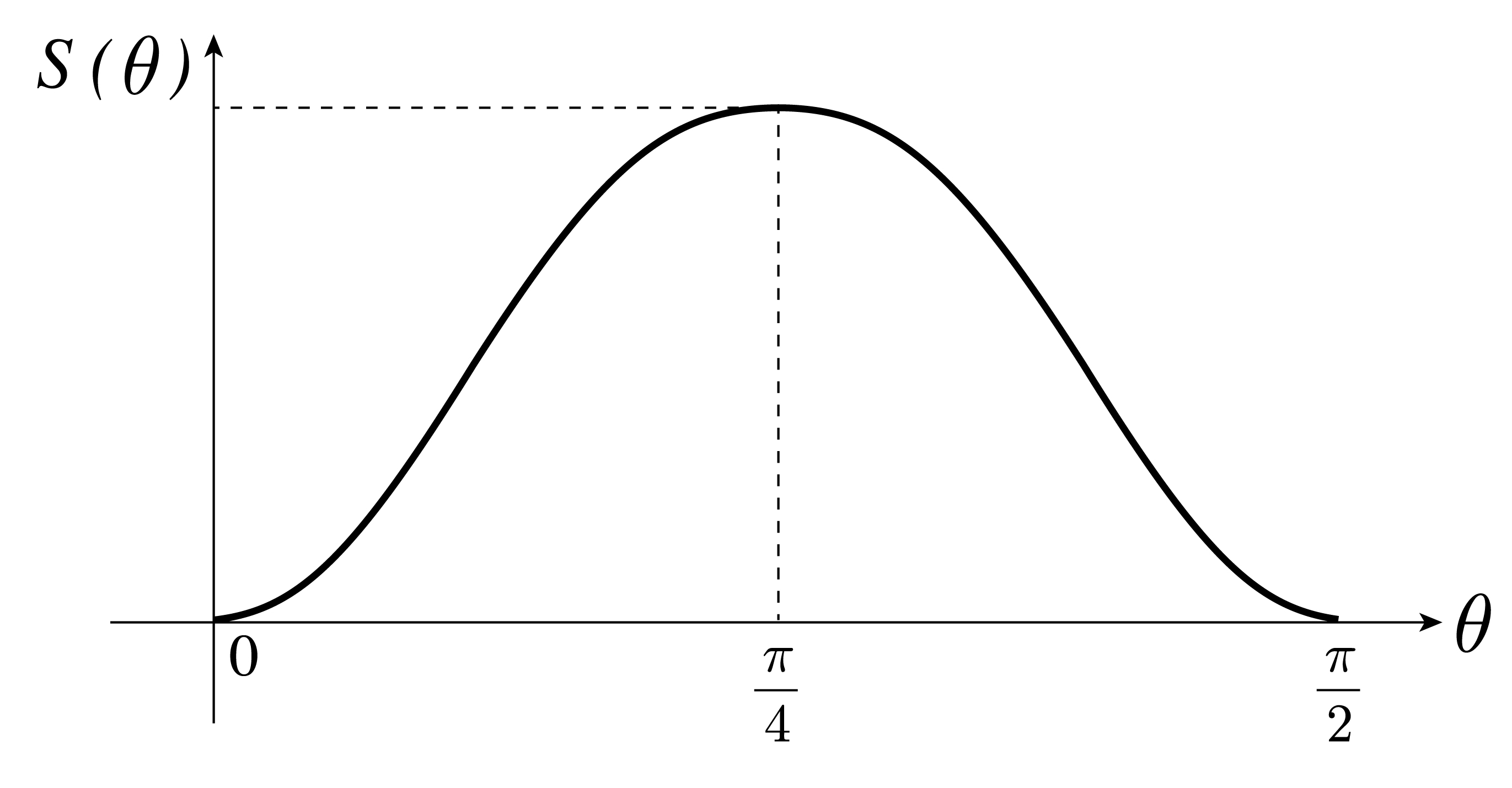
+7점 · r 1 ( θ ) > 0 \displaystyle r_1(\theta)>0 r 1 ( θ ) > 0 cos θ − sin θ > 0 ( 0 < θ < π 4 ) \displaystyle \cos\theta-\sin\theta>0\left(0<\theta<\frac\pi4\right) cos θ − sin θ > 0 ( 0 < θ < 4 π ) cos θ − sin θ < 0 ( π 4 < θ < π 2 ) \displaystyle \cos\theta-\sin\theta<0\left(\frac\pi4<\theta<\frac\pi2\right) cos θ − sin θ < 0 ( 4 π < θ < 2 π ) S ( θ ) \displaystyle S(\theta) S ( θ ) 이때, r 1 ( θ ) > 0 \displaystyle r_1(\theta)>0 r 1 ( θ ) > 0 cos θ − sin θ > 0 ( 0 < θ < π 4 ) \displaystyle \cos\theta-\sin\theta>0\left(0<\theta<\frac\pi4\right) cos θ − sin θ > 0 ( 0 < θ < 4 π ) cos θ − sin θ < 0 ( π 4 < θ < π 2 ) \displaystyle \cos\theta-\sin\theta<0\left(\frac\pi4<\theta<\frac\pi2\right) cos θ − sin θ < 0 ( 4 π < θ < 2 π ) 함수 S ( θ ) \displaystyle S ( \theta ) S ( θ )
θ \displaystyle \theta θ 0 ⋯ \displaystyle \cdots ⋯ π 4 \displaystyle \frac\pi4 4 π ⋯ \displaystyle \cdots ⋯ π 2 \displaystyle \frac\pi2 2 π S ′ ( θ ) \displaystyle S^{\prime}(\theta) S ′ ( θ ) + 0 − S ( θ ) \displaystyle S(\theta) S ( θ ) ↗ ( 2 − 1 ) 2 2 π \displaystyle \frac{(\sqrt2-1)^2}{2}\pi 2 ( 2 − 1 ) 2 π ↘
+3점 · θ = π 4 \displaystyle \theta=\frac\pi4 θ = 4 π S ( θ ) \displaystyle S(\theta) S ( θ ) 따라서 그래프의 개형은 오른쪽 그림과 같으며 θ = π 4 \displaystyle \theta = \frac{\pi}{4} θ = 4 π S ( θ ) \displaystyle S ( \theta ) S ( θ )
[논제1-4]
+4점 · Q = ( ( cos θ + sin θ ) cos θ , ( cos θ + sin θ ) sin θ ) \displaystyle \mathrm Q=((\cos\theta+\sin\theta)\cos\theta,(\cos\theta+\sin\theta)\sin\theta) Q = (( cos θ + sin θ ) cos θ , ( cos θ + sin θ ) sin θ ) 점 O \displaystyle \mathrm{O} O ( 0 , 0 ) \displaystyle ( 0 , 0 ) ( 0 , 0 ) 원 C 2 \displaystyle C_{2} C 2 P B \displaystyle \mathrm{PB} PB Q \displaystyle \mathrm{Q} Q Q = ( ( cos θ + sin θ ) cos θ , ( cos θ + sin θ ) sin θ ) \displaystyle {\mathrm{Q}} = ( ( \cos \theta + \sin \theta ) \cos \theta , ( \cos \theta + \sin \theta ) \sin \theta ) Q = (( cos θ + sin θ ) cos θ , ( cos θ + sin θ ) sin θ )
+8점 · ( x ′ ( θ ) ) 2 + ( y ′ ( θ ) ) 2 = 2 ( X 2 + Y 2 ) = 2 ( cos 2 θ + sin 2 θ ) 2 = 2 \displaystyle (x^{\prime}(\theta))^2+(y^{\prime}(\theta))^2=2(X^2+Y^2)=2(\cos^2\theta+\sin^2\theta)^2=2 ( x ′ ( θ ) ) 2 + ( y ′ ( θ ) ) 2 = 2 ( X 2 + Y 2 ) = 2 ( cos 2 θ + sin 2 θ ) 2 = 2 점 Q \displaystyle \mathrm{Q} Q Q \displaystyle \mathrm{Q} Q x \displaystyle x x x ( θ ) \displaystyle x ( \theta ) x ( θ ) y \displaystyle y y y ( θ ) \displaystyle y ( \theta ) y ( θ ) x ′ ( θ ) = cos 2 θ − sin 2 θ − 2 sin θ cos θ \displaystyle x^{\prime} ( \theta ) = \cos^{2} \theta - \sin^{2} \theta - 2 \sin \theta \cos \theta x ′ ( θ ) = cos 2 θ − sin 2 θ − 2 sin θ cos θ y ′ ( θ ) = cos 2 θ − sin 2 θ + 2 sin θ cos θ \displaystyle y^{\prime} ( \theta ) = \cos^{2} \theta - \sin^{2} \theta + 2 \sin \theta \cos \theta y ′ ( θ ) = cos 2 θ − sin 2 θ + 2 sin θ cos θ X = cos 2 θ − sin 2 θ , Y = 2 sin θ cos θ \displaystyle X = \cos^{2} \theta - \sin^{2} \theta , Y = 2 \sin \theta \cos \theta X = cos 2 θ − sin 2 θ , Y = 2 sin θ cos θ ( x ′ ( θ ) ) 2 + ( y ′ ( θ ) ) 2 = 2 ( X 2 + Y 2 ) = 2 ( cos 2 θ + sin 2 θ ) 2 = 2 \displaystyle ( x^{\prime} ( \theta ) )^{2} + ( y^{\prime} ( \theta ) )^{2} = 2 ( X^{2} + Y^{2} ) = 2 ( \cos^{2} \theta + \sin^{2} \theta )^{2} = 2 ( x ′ ( θ ) ) 2 + ( y ′ ( θ ) ) 2 = 2 ( X 2 + Y 2 ) = 2 ( cos 2 θ + sin 2 θ ) 2 = 2
+3점 · ∫ π / 6 π / 3 ( x ′ ( θ ) ) 2 + ( y ′ ( θ ) ) 2 d θ = ∫ π / 6 π / 3 2 d θ = [ 2 θ ] π / 6 π / 3 = 2 6 π \displaystyle \int_{\pi/6}^{\pi/3}\sqrt{(x^{\prime}(\theta))^2+(y^{\prime}(\theta))^2}\,d\theta=\int_{\pi/6}^{\pi/3}\sqrt2\,d\theta=\Biggl[\sqrt2\theta\Biggr]_{\pi/6}^{\pi/3}=\frac{\sqrt2}{6}\pi ∫ π /6 π /3 ( x ′ ( θ ) ) 2 + ( y ′ ( θ ) ) 2 d θ = ∫ π /6 π /3 2 d θ = [ 2 θ ] π /6 π /3 = 6 2 π 따라서, 곡선의 길이는 ∫ π 6 π 3 ( x ′ ( θ ) ) 2 + ( y ′ ( θ ) ) 2 d θ = ∫ π 6 π 3 2 d θ = [ 2 θ ] π 6 π 3 = 2 6 π \displaystyle \begin{aligned}\int_{\frac{{\pi}}{6}}^{\frac{{\pi}}{3}} {\sqrt{( x^{\prime} ( \theta ) )^{2} + ( y^{\prime} ( \theta ) )^{2}} d \theta} &= \int_{\frac{{\pi}}{6}}^{\frac{{\pi}}{3}} {\sqrt{2} d \theta} = \Biggl[ \sqrt{2} \theta \Biggr]_{\frac{{\pi}}{6}}^{\frac{{\pi}}{3}}\\&= \frac{{\sqrt{2}}}{6} \pi\end{aligned} ∫ 6 π 3 π ( x ′ ( θ ) ) 2 + ( y ′ ( θ ) ) 2 d θ = ∫ 6 π 3 π 2 d θ = [ 2 θ ] 6 π 3 π = 6 2 π
※ 아이디어는 맞지만 계산이 틀린 경우 적절하게 부분점수 부여
 수리논술, 배움에서 논증의 완성까지.