+6점 · f ′ ( t ) = 2 t + 4 t ( t 2 − a ) = 2 t ( 2 t 2 + 1 − 2 a ) = 0 \displaystyle f^{\prime}(t)=2t+4t(t^2-a)=2t(2t^2+1-2a)=0 f ′ ( t ) = 2 t + 4 t ( t 2 − a ) = 2 t ( 2 t 2 + 1 − 2 a ) = 0 [논제 I-1] A ( 0 , a ) \displaystyle {\mathrm{A}} ( 0 , a ) A ( 0 , a ) ( t , t 2 ) \displaystyle ( t , t^{2} ) ( t , t 2 ) t \displaystyle t t f ( t ) = t 2 + ( t 2 − a ) 2 \displaystyle f ( t ) = t^{2} + ( t^{2} - a )^{2} f ( t ) = t 2 + ( t 2 − a ) 2 f ′ ( t ) = 2 t + 4 t ( t 2 − a ) = 2 t ( 2 t 2 + 1 − 2 a ) = 0 \displaystyle f^{\prime} ( t ) = 2 t + 4 t ( t^{2} - a ) = 2 t ( 2 t^{2} + 1 - 2 a ) = 0 f ′ ( t ) = 2 t + 4 t ( t 2 − a ) = 2 t ( 2 t 2 + 1 − 2 a ) = 0 0 < a ≤ 1 2 \displaystyle 0 < a \leq \frac{1}{2} 0 < a ≤ 2 1 f ′ ( t ) \displaystyle f^{\prime} ( t ) f ′ ( t ) 0 \displaystyle 0 0 a > 1 2 \displaystyle a > \frac{1}{2} a > 2 1 0 \displaystyle 0 0 ± a − 1 2 \displaystyle \pm \sqrt{a - \frac{1}{2}} ± a − 2 1
+7점 · 0 < a ≤ 1 2 \displaystyle 0<a\le\frac12 0 < a ≤ 2 1 f ( t ) \displaystyle f(t) f ( t ) t = 0 \displaystyle t=0 t = 0 b = 0 \displaystyle b=0 b = 0 (1) 0 < a ≤ 1 2 \displaystyle 0 < a \le \frac{{1}}{2} 0 < a ≤ 2 1
t ⋯ 0 ⋯ f ′ ( t ) − 0 + f ( t ) ↘ a 2 ↗ \displaystyle \begin{array}{c|ccc}t&\cdots&0&\cdots\\\hline f^{\prime}(t)&-&0&+\\\hline f(t)&\searrow&a^2&\nearrow\end{array} t f ′ ( t ) f ( t ) ⋯ − ↘ 0 0 a 2 ⋯ + ↗
따라서 함수 f ( t ) \displaystyle f ( t ) f ( t ) t = 0 \displaystyle t = 0 t = 0 b = 0 \displaystyle b = 0 b = 0
+7점 · a > 1 2 \displaystyle a>\frac12 a > 2 1 f ( t ) \displaystyle f(t) f ( t ) t = a − 1 2 \displaystyle t=\sqrt{a-\frac12} t = a − 2 1 b = a − 1 2 \displaystyle b=\sqrt{a-\frac12} b = a − 2 1 (2) a > 1 2 \displaystyle a > \frac{1}{2} a > 2 1
t ⋯ − a − 1 2 ⋯ 0 ⋯ a − 1 2 ⋯ f ′ ( t ) − 0 + 0 − 0 + f ( t ) ↘ a − 1 4 ↗ a 2 ↘ a − 1 4 ↗ \displaystyle \begin{array}{c|ccccccc}t&\cdots&-\sqrt{a-\frac12}&\cdots&0&\cdots&\sqrt{a-\frac12}&\cdots\\\hline f^{\prime}(t)&-&0&+&0&-&0&+\\\hline f(t)&\searrow&a-\frac14&\nearrow&a^2&\searrow&a-\frac14&\nearrow\end{array} t f ′ ( t ) f ( t ) ⋯ − ↘ − a − 2 1 0 a − 4 1 ⋯ + ↗ 0 0 a 2 ⋯ − ↘ a − 2 1 0 a − 4 1 ⋯ + ↗
그러므로 f ( t ) \displaystyle f ( t ) f ( t ) t = ± a − 1 2 \displaystyle t = \pm \sqrt{a - \frac{1}{2}} t = ± a − 2 1 b = a − 1 2 \displaystyle b = \sqrt{a - \frac{1}{2}} b = a − 2 1 b ≥ 0 \displaystyle b \geq 0 b ≥ 0 따라서 b = { 0 ( 0 < a ≤ 1 2 ) , a − 1 2 ( a > 1 2 ) \displaystyle b = {\begin{cases}0 & \left( 0 < a \leq \frac{{1}}{2} \right) , \\ \sqrt{a - \frac{{1}}{2}} & \left( a > \frac{{1}}{2} \right)\end{cases}} b = { 0 a − 2 1 ( 0 < a ≤ 2 1 ) , ( a > 2 1 ) 이다.
+5점 · 거리의 제곱 함수 f ( t ) = t 2 + ( t 3 − a ) 2 \displaystyle f(t)=t^2+(t^3-a)^2 f ( t ) = t 2 + ( t 3 − a ) 2 f ′ ( t ) = 2 t ( 1 + 3 t ( t 3 − a ) ) = 0 \displaystyle f^{\prime}(t)=2t(1+3t(t^3-a))=0 f ′ ( t ) = 2 t ( 1 + 3 t ( t 3 − a )) = 0 [논제 I-2] 점 A ( 0 , a ) \displaystyle {\mathrm{A}} ( 0 , a ) A ( 0 , a ) C ( t , t 3 ) \displaystyle \mathrm{C} ( t , t^{3} ) C ( t , t 3 ) f ( t ) = t 2 + ( t 3 − a ) 2 \displaystyle f ( t ) = t^{2} + ( t^{3} - a )^{2} f ( t ) = t 2 + ( t 3 − a ) 2
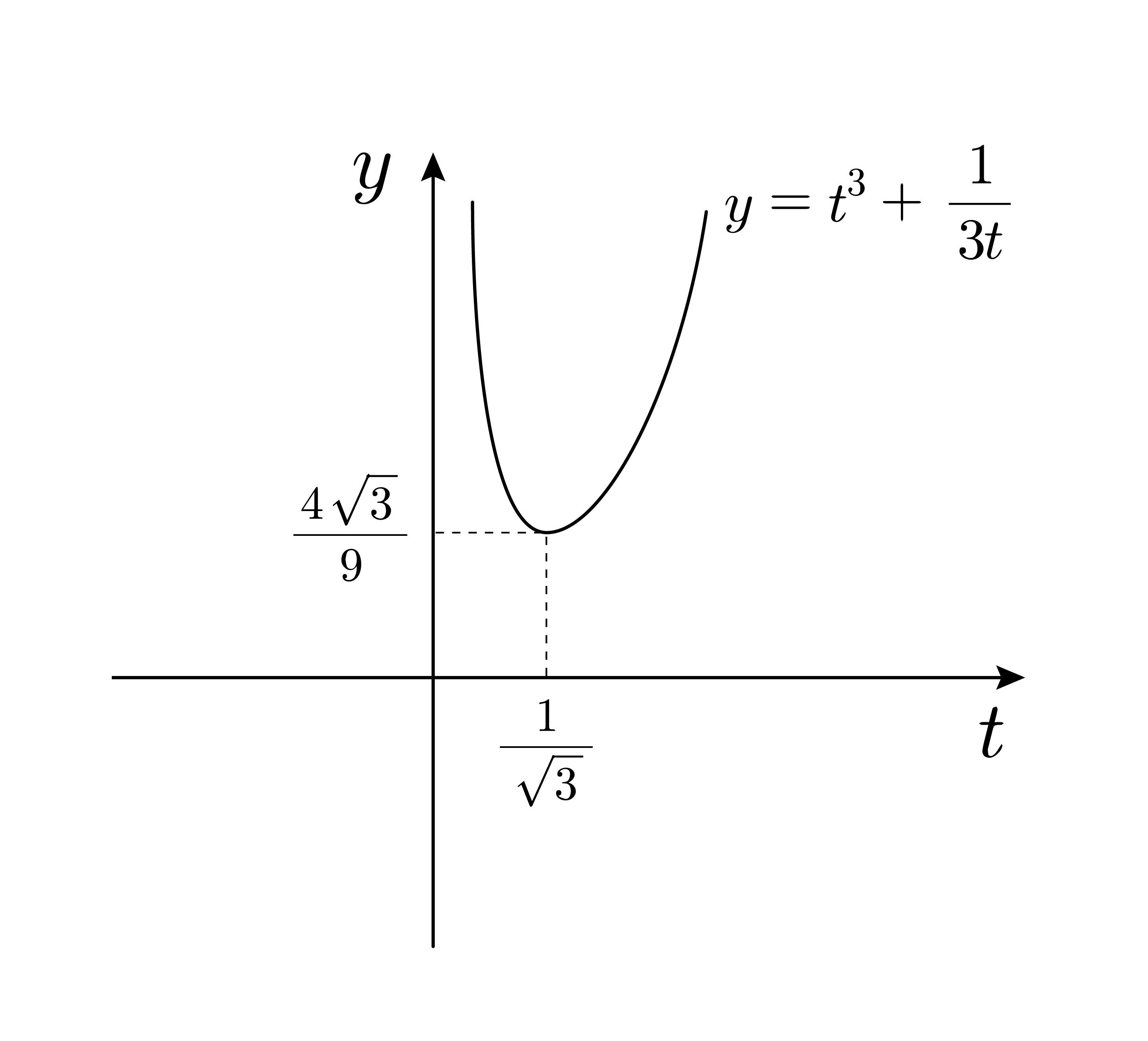
+5점 · t = 0 \displaystyle t=0 t = 0 f ′ ( t ) \displaystyle f^{\prime}(t) f ′ ( t ) t = 0 \displaystyle t=0 t = 0 f ( t ) \displaystyle f(t) f ( t ) 1 + 3 t ( t 3 − a ) \displaystyle 1+3t(t^3-a) 1 + 3 t ( t 3 − a ) y = t 3 + 1 3 t \displaystyle y=t^3+\frac1{3t} y = t 3 + 3 t 1 y = a \displaystyle y=a y = a y = 1 + 3 t 4 \displaystyle y=1+3t^4 y = 1 + 3 t 4 y = 3 a t \displaystyle y=3at y = 3 a t f ′ ( t ) = 2 t { 1 + 3 t ( t 3 − a ) } = 0 \displaystyle f^{\prime} ( t ) = 2 t \left\{ 1 + 3 t ( t^{3} - a ) \right\} = 0 f ′ ( t ) = 2 t { 1 + 3 t ( t 3 − a ) } = 0 f ′ ( t ) \displaystyle f^{\prime} ( t ) f ′ ( t ) t = 0 \displaystyle t = 0 t = 0 f ( t ) \displaystyle f ( t ) f ( t ) t = 0 \displaystyle t = 0 t = 0 나머지 극값을 찾기 위해 1 + 3 t ( t 3 − a ) = 0 \displaystyle 1 + 3 t ( t^{3} - a ) = 0 1 + 3 t ( t 3 − a ) = 0 1 + 3 t ( t 3 − a ) \displaystyle 1 + 3 t ( t^{3} - a ) 1 + 3 t ( t 3 − a ) 1 + 3 t ( t 3 − a ) = 0 \displaystyle 1 + 3 t ( t^{3} - a ) = 0 1 + 3 t ( t 3 − a ) = 0 1 3 t + t 3 − a = 0 \displaystyle \frac{{1}}{3 t} + t^{3} - a = 0 3 t 1 + t 3 − a = 0 두 곡선 y = g ( t ) = 1 3 t + t 3 \displaystyle y = g ( t ) = \frac{{1}}{3 t} + t^{3} y = g ( t ) = 3 t 1 + t 3 y = a \displaystyle y = a y = a 특히 a \displaystyle a a t > 0 \displaystyle t > 0 t > 0 g ( t ) = 1 3 t + t 3 \displaystyle g ( t ) = \frac{{1}}{3 t} + t^{3} g ( t ) = 3 t 1 + t 3 y = a \displaystyle y = a y = a g ′ ( t ) = 3 t 2 − 1 3 t 2 = 0 \displaystyle g^{\prime} ( t ) = 3 t^{2} - \frac{{1}}{3 t^{2}} = 0 g ′ ( t ) = 3 t 2 − 3 t 2 1 = 0 t = 1 3 \displaystyle t = \frac{1}{\sqrt{3}} t = 3 1 함수의 증가와 감소를 표로 나타내면 다음과 같다.
t ( 0 ) ⋯ 1 3 ⋯ g ′ ( t ) − 0 + g ( t ) ↘ 4 3 9 ↗ \displaystyle \begin{array}{c|cccc}t&(0)&\cdots&\frac1{\sqrt3}&\cdots\\\hline g^{\prime}(t)&&-&0&+\\\hline g(t)&&\searrow&\frac{4\sqrt3}{9}&\nearrow\end{array} t g ′ ( t ) g ( t ) ( 0 ) ⋯ − ↘ 3 1 0 9 4 3 ⋯ + ↗
t > 0 \displaystyle t > 0 t > 0 t \displaystyle t t f ′ ( t ) = 6 t 2 ( g ( t ) − a ) \displaystyle f^{\prime} ( t ) = 6 t^{2} ( g ( t ) - a ) f ′ ( t ) = 6 t 2 ( g ( t ) − a )
+5점 · 0 < a ≤ 4 3 9 \displaystyle 0<a\le\frac{4\sqrt3}{9} 0 < a ≤ 9 4 3 g ( t ) − a ≥ 0 \displaystyle g(t)-a\ge0 g ( t ) − a ≥ 0 f ( t ) \displaystyle f(t) f ( t ) (1) 0 < a ≤ 4 3 9 \displaystyle 0 < a \le \frac{{4 \sqrt{3}}}{9} 0 < a ≤ 9 4 3 g ( t ) \displaystyle g ( t ) g ( t ) 4 3 9 \displaystyle \frac{{4 \sqrt{3}}}{9} 9 4 3 g ( t ) − a ≥ 0 \displaystyle g ( t ) - a \ge 0 g ( t ) − a ≥ 0 f ′ ( t ) ≥ 0 \displaystyle f^{\prime} ( t ) \ge 0 f ′ ( t ) ≥ 0 따라서 f ( t ) \displaystyle f ( t ) f ( t ) t = 0 \displaystyle t = 0 t = 0
+5점 · a > 4 3 9 \displaystyle a>\frac{4\sqrt3}{9} a > 9 4 3 g ( t ) − a = 0 \displaystyle g(t)-a=0 g ( t ) − a = 0 f ( t ) \displaystyle f(t) f ( t ) (2) a > 4 3 9 \displaystyle a > \frac{{4 \sqrt{3}}}{9} a > 9 4 3 방정식 g ( t ) − a = 0 \displaystyle g ( t ) - a = 0 g ( t ) − a = 0 그 두 점의 좌우에서 g ( t ) − a \displaystyle g ( t ) - a g ( t ) − a 그러므로 f ( t ) \displaystyle f ( t ) f ( t )
+5점 · 0 < a ≤ 4 3 9 \displaystyle 0<a\le\frac{4\sqrt3}{9} 0 < a ≤ 9 4 3 g ( t ) − a ≥ 0 \displaystyle g(t)-a\ge0 g ( t ) − a ≥ 0 f ( t ) \displaystyle f(t) f ( t ) +5점 · a > 4 3 9 \displaystyle a>\frac{4\sqrt3}{9} a > 9 4 3 g ( t ) − a = 0 \displaystyle g(t)-a=0 g ( t ) − a = 0 f ( t ) \displaystyle f(t) f ( t ) 따라서 f ( t ) \displaystyle f ( t ) f ( t ) a \displaystyle a a 0 < a ≤ 4 3 9 \displaystyle 0 < a \leq \frac{{4 \sqrt{3}}}{9} 0 < a ≤ 9 4 3 f ( t ) \displaystyle f ( t ) f ( t ) a \displaystyle a a a > 4 3 9 \displaystyle a > \frac{{4 \sqrt{3}}}{9} a > 9 4 3
+3점 · f ( t ) \displaystyle f(t) f ( t ) t \displaystyle t t t = 0 \displaystyle t=0 t = 0 0 < t < 1 3 \displaystyle 0<t<\frac1{\sqrt3} 0 < t < 3 1 t > 1 3 \displaystyle t>\frac1{\sqrt3} t > 3 1 t = 0 \displaystyle t=0 t = 0 t > 1 3 \displaystyle t>\frac1{\sqrt3} t > 3 1 [논제 I-3] [논제 I-2]로부터 함수 f ( t ) \displaystyle f ( t ) f ( t ) 점 A ( 0 , a ) \displaystyle {\mathrm{A}} ( 0 , a ) A ( 0 , a ) f ( t ) \displaystyle f ( t ) f ( t ) 즉 a > 4 3 9 \displaystyle a > \frac{{4 \sqrt{3}}}{9} a > 9 4 3 이때, f ′ ( t ) = 2 t ( 1 + 3 t ( t 3 − a ) ) = 0 \displaystyle f^{\prime} ( t ) = 2 t ( 1 + 3 t ( t^{3} - a ) ) = 0 f ′ ( t ) = 2 t ( 1 + 3 t ( t 3 − a )) = 0 t = 0 \displaystyle t = 0 t = 0 그리고 1 + 3 t ( t 3 − a ) = 0 \displaystyle 1 + 3 t ( t^{3} - a ) = 0 1 + 3 t ( t 3 − a ) = 0 [논제 I-2]의 함수 g ( t ) \displaystyle g ( t ) g ( t ) f ′ ( t ) = 0 \displaystyle f^{\prime} ( t ) = 0 f ′ ( t ) = 0 0 \displaystyle 0 0 0 < t < 1 3 \displaystyle {0 < t < \frac{1}{\sqrt{3}}} 0 < t < 3 1 (이 때의 해를 t 1 \displaystyle t_{1} t 1 t > 1 3 \displaystyle t > \frac{1}{\sqrt{3}} t > 3 1 t 2 \displaystyle t_{2} t 2 이를 바탕으로 함수 f ( t ) \displaystyle f ( t ) f ( t )
t ⋯ 0 ⋯ t 1 ⋯ t 2 ⋯ f ′ ( t ) − 0 + 0 − 0 + f ( t ) ↘ f ( 0 ) ↗ f ( t 1 ) ↘ f ( t 2 ) ↗ \displaystyle \begin{array}{c|ccccccc}t&\cdots&0&\cdots&t_1&\cdots&t_2&\cdots\\\hline f^{\prime}(t)&-&0&+&0&-&0&+\\\hline f(t)&\searrow&f(0)&\nearrow&f(t_1)&\searrow&f(t_2)&\nearrow\end{array} t f ′ ( t ) f ( t ) ⋯ − ↘ 0 0 f ( 0 ) ⋯ + ↗ t 1 0 f ( t 1 ) ⋯ − ↘ t 2 0 f ( t 2 ) ⋯ + ↗
그러므로 함수 f ( t ) \displaystyle f ( t ) f ( t ) t = 0 \displaystyle t = 0 t = 0 t = t 2 \displaystyle t = t_{2} t = t 2 이때 f ( 0 ) = f ( t 2 ) \displaystyle f ( 0 ) = f ( t_{2} ) f ( 0 ) = f ( t 2 )
+3점 · t > 1 3 \displaystyle t>\frac1{\sqrt3} t > 3 1 f ( t ) \displaystyle f(t) f ( t ) t 2 \displaystyle t_2 t 2 a = t 2 3 + 1 3 t 2 \displaystyle a=t_2^3+\frac1{3t_2} a = t 2 3 + 3 t 2 1 Correction. 채점기준에서 “f ( t ) \displaystyle f(t) f ( t ) f ′ ( t ) = 0 \displaystyle f^{\prime}(t)=0 f ′ ( t ) = 0
또한, t 2 \displaystyle t_{2} t 2 g ( t ) = a \displaystyle g ( t ) = a g ( t ) = a a = t 2 3 + 1 3 t 2 \displaystyle a = t_{2}^{3} + \frac{{1}}{3 t_{2}} a = t 2 3 + 3 t 2 1
+3점 · 방정식 f ( 0 ) = f ( t 2 ) \displaystyle f(0)=f(t_2) f ( 0 ) = f ( t 2 ) t 2 = 1 3 4 \displaystyle t_2=\frac1{\sqrt[4]3} t 2 = 4 3 1 t 2 6 + 2 3 t 2 2 + 1 9 t 2 2 = f ( 0 ) = f ( t 2 ) = t 2 2 + 1 9 t 2 2 \displaystyle t_{2}^{6} + \frac{{2}}{3} t_{2}^{2} + \frac{{1}}{9 t_{2}^{2}} = f ( 0 ) = f ( t_{2} ) = t_{2}^{2} + \frac{{1}}{9 t_{2}^{2}} t 2 6 + 3 2 t 2 2 + 9 t 2 2 1 = f ( 0 ) = f ( t 2 ) = t 2 2 + 9 t 2 2 1 로부터 t 2 = 1 3 4 \displaystyle t_{2} {=} \frac{1}{\sqrt[4]{3}} t 2 = 4 3 1
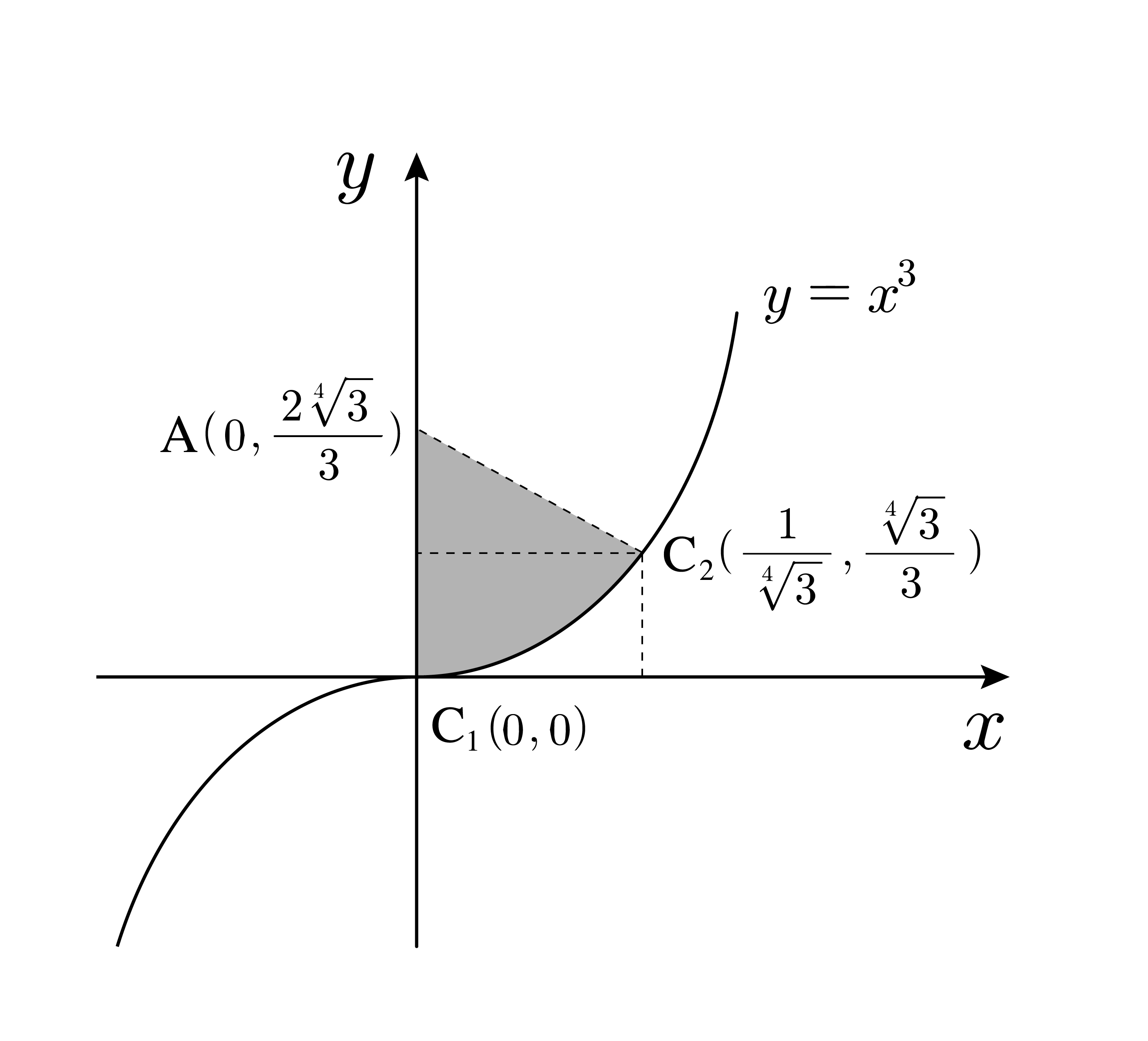
+1점 · a 0 = 2 3 4 3 \displaystyle a_0=\frac{2\sqrt[4]3}{3} a 0 = 3 2 4 3 c 1 = 0 \displaystyle c_1=0 c 1 = 0 c 2 = 1 3 4 \displaystyle c_2=\frac1{\sqrt[4]3} c 2 = 4 3 1 a 0 = ( 1 3 4 ) 3 + 3 4 3 = 2 3 4 3 \displaystyle a_{0} = \left( \frac{{1}}{\sqrt[4]{3}} \right)^{3} + \frac{{\sqrt[4]{3}}}{3} = \frac{{2 \sqrt[4]{3}}}{3} a 0 = ( 4 3 1 ) 3 + 3 4 3 = 3 2 4 3 c 1 = 0 , c 2 = 1 3 4 \displaystyle c_{1} = 0 , c_{2} = \frac{{1}}{\sqrt[4]{3}} c 1 = 0 , c 2 = 4 3 1
+4점 · 사다리꼴의 넓이 1 2 ( 2 3 4 3 + 3 4 3 ) 1 3 4 = 1 2 \displaystyle \frac12\left(\frac{2\sqrt[4]3}{3}+\frac{\sqrt[4]3}{3}\right)\frac1{\sqrt[4]3}=\frac12 2 1 ( 3 2 4 3 + 3 4 3 ) 4 3 1 = 2 1 +4점 · y = x 3 \displaystyle y=x^3 y = x 3 ∫ 0 1 / 3 4 x 3 d x = 1 12 \displaystyle \int_0^{1/\sqrt[4]3}x^3\,dx=\frac1{12} ∫ 0 1/ 4 3 x 3 d x = 12 1 +2점 · 넓이 1 2 ( 2 3 4 3 + 3 4 3 ) 1 3 4 − ∫ 0 1 / 3 4 x 3 d x = 1 2 − 1 12 = 5 12 \displaystyle \frac12\left(\frac{2\sqrt[4]3}{3}+\frac{\sqrt[4]3}{3}\right)\frac1{\sqrt[4]3}-\int_0^{1/\sqrt[4]3}x^3\,dx=\frac12-\frac1{12}=\frac5{12} 2 1 ( 3 2 4 3 + 3 4 3 ) 4 3 1 − ∫ 0 1/ 4 3 x 3 d x = 2 1 − 12 1 = 12 5 [논제 I-4] 영역의 넓이는 아래 그림처럼 사다리꼴의 넓이에서 곡선 y = x 3 \displaystyle y = x^{3} y = x 3 1 2 ( 2 3 4 3 + 3 4 3 ) 1 3 4 − ∫ 0 1 / 3 4 x 3 d x = 1 2 − 1 12 = 5 12 \displaystyle \frac{1}{2} \left( \frac{{2 \sqrt[4]{3}}}{3} + \frac{{\sqrt[4]{3}}}{3} \right) \frac{{1}}{\sqrt[4]{3}} - \int_{0}^{1 / \sqrt[4]{3}} {x^{3} d x = \frac{{1}}{2} - \frac{{1}}{12} = \frac{{5}}{12}} 2 1 ( 3 2 4 3 + 3 4 3 ) 4 3 1 − ∫ 0 1/ 4 3 x 3 d x = 2 1 − 12 1 = 12 5 이다.
※ [논제 I-1] 주의사항 〈7점〉 두 구간의 구분 없이 한 경우만 답했을 경우.
 수리논술, 배움에서 논증의 완성까지.