수리논술, 이게 다다.

의학계 1번

오류 제보

문제

[가] 중심이 C(a,b)\displaystyle \mathrm{C} ( a , b )이고 반지름의 길이가 r\displaystyle r인 원의 방정식은(x−a)2+(y−b)2=r2\displaystyle ( x - a )^{2} + ( y - b )^{2} = r^{2}[나] 함수 y=x\displaystyle y = \sqrt{x}의 정의역을 {x∣x≥0}\displaystyle \left\{ x | x \ge 0 \right\}, 공역을 {y∣y≥0}\displaystyle \left\{ y | y \ge 0 \right\}이라고 하면 이 함수는 일대일 대응이므로 역함수가 존재한다. 즉 y=x(x≥0)\displaystyle y = \sqrt{x} ( x \ge 0 )에서 x\displaystyle x를 y\displaystyle y의 식으로 나타내면 x=y2(y≥0)\displaystyle x = y^{2} \left( y \ge 0 \right)이고, 이 식에서 x\displaystyle x와 y\displaystyle y를 서로 바꾸면 역함수 y=x2(x≥0)\displaystyle y = x^{2} ( x \ge 0 )을 얻는다.[다] 수열 {an}\displaystyle \left\{ a_{n} \right\}, {bn}\displaystyle \left\{ b_{n} \right\}이 수렴하고, lim⁡n→∞an=α\displaystyle \lim_{n \to \infty} {a_{n}} = \alpha, lim⁡n→∞bn=β\displaystyle \lim_{n \to \infty} {b_{n}} = \beta일 때(1) 모든 자연수 n\displaystyle n에 대하여 an≤bn\displaystyle a_{n} \le b_{n}이면lim⁡n→∞an≤lim⁡n→∞bn\displaystyle \lim_{n \to \infty} {a_{n}} \le \lim_{n \to \infty} {b_{n}}, 즉 α≤β\displaystyle \alpha \le \beta(2) 수열 {cn}\displaystyle \left\{ c_{n} \right\}과 모든 자연수 n\displaystyle n에 대하여 an≤cn≤bn\displaystyle a_{n} \le c_{n} \le b_{n}이고 α=β\displaystyle \alpha = \beta이면 수열 {cn}\displaystyle \left\{ c_{n} \right\}도 수렴하고lim⁡n→∞cn=α\displaystyle \lim_{n \to \infty} {c_{n}} = \alpha[라] x\displaystyle x의 값이 a\displaystyle a보다 크면서 a\displaystyle a에 한없이 가까워지는 것을 기호로 x→a+\displaystyle x \to a +와 같이 나타내고, x\displaystyle x의 값이 a\displaystyle a보다 작으면서 a\displaystyle a에 한없이 가까워지는 것을 기호로 x→a−\displaystyle x \to a -와 같이 나타낸다. 일반적으로 함수 f(x)\displaystyle f ( x )에서 x→a+\displaystyle x \to a +일 때 f(x)\displaystyle f ( x )의 값이 일정한 값 L\displaystyle L에 한없이 가까워지면 L\displaystyle L을 f(x)\displaystyle f ( x )의 x=a\displaystyle x = a에서의 우극한이라고 하며, 이것을 기호로lim⁡x→a+f(x)=L\displaystyle \lim_{x \to a +} {f ( x )} = L 또는 x→a+\displaystyle x \to a +일 때 f(x)→L\displaystyle f ( x ) \to L과 같이 나타낸다. 또 x→a−\displaystyle x\to a-일 때 f(x)\displaystyle f(x)의 값이 일정한 값 M\displaystyle M에 한없이 가까워지면 M\displaystyle M을 f(x)\displaystyle f(x)의 x=a\displaystyle x=a에서의 좌극한이라고 하며, 이것을 기호로lim⁡x→a−f(x)=M\displaystyle \lim_{x\to a-}f(x)=M 또는 x→a−\displaystyle x\to a-일 때 f(x)→M\displaystyle f(x)\to M과 같이 나타낸다.[마] 닫힌 구간 [a,b]\displaystyle [a,b]의 임의의 점 x\displaystyle x에서 x\displaystyle x축에 수직인 평면으로 자를 때 생기는 단면의 넓이가 S(x)\displaystyle S(x)인 입체도형의 부피 V\displaystyle V는V=∫abS(x)dx\displaystyle V = \int_{a}^{b} {S ( x ) d x} (단, S(x)\displaystyle S ( x )는 닫힌 구간 [a,b]\displaystyle \left[ a , b \right]에서 연속)

[논제 Ⅰ] 제시문 [가]~[마]를 읽고 다음 질문에 답하시오.중심이 원점이고 반지름의 길이가 1\displaystyle 1인 원을 S\displaystyle S라 하고, 원 S\displaystyle S의 내부와 경계선으로 이루어진 영역을 R\displaystyle R이라 하자.

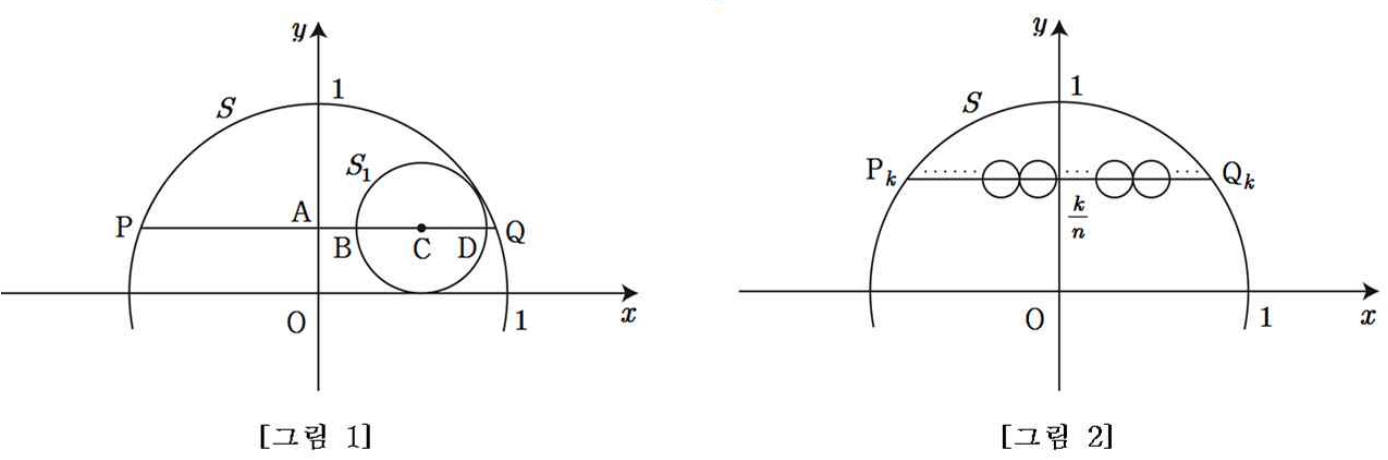
그림 1: 원 S에 내접하는 원, 그림 2: 수평선 위에 중심이 있는 원들

[논제 Ⅰ-1] [그림 1]과 같이 0<t<12\displaystyle 0 < t < \frac{{1}}{2}일 때, 점 A\displaystyle \mathrm{A}의 좌표는 (0,t)\displaystyle ( 0 , t )이고, 직선 y=t\displaystyle y = t와 원 S\displaystyle S가 만나는 두 점을 P\displaystyle \mathrm{P}와 Q\displaystyle \mathrm{Q}라 하자. (단, P\displaystyle \mathrm{P}의 x\displaystyle x좌표가 Q\displaystyle \mathrm{Q}의 x\displaystyle x좌표보다 작다.) 반지름의 길이가 t\displaystyle t이고 중심 C\displaystyle \mathrm{C}가 선분 AQ\displaystyle \mathrm{AQ}위에 있는 원 S1\displaystyle S_{1}이 원 S\displaystyle S와 접한다.

(1) 원작다.) S1\displaystyle S_{1}이 선분 AQ\displaystyle \mathrm{AQ}와 만나는 두 점을 B\displaystyle \mathrm{B}와 D\displaystyle \mathrm{D}라 하자.Correction. 문장 앞의 ‘작다.)’는 ‘B의 x좌표가 D의 x좌표보다’ 뒤에 와야 한다. 그러나 원칙에 따라 원문 표기를 그대로 실었다.Caution. 구하는 극한값에는 영향이 없지만, 원 S1\displaystyle S_1이 선분 AQ\displaystyle \mathrm{AQ}와 두 점에서 만나려면 0<t≤2−1\displaystyle 0<t\le\sqrt2-1이어야 한다. t\displaystyle t가 이보다 크면 점 B\displaystyle \mathrm B가 A\displaystyle \mathrm A의 왼쪽에 놓인다. 그러나 원칙에 따라 원문 표기를 그대로 실었다.(단, B\displaystyle \mathrm{B}의 x\displaystyle x좌표가 D\displaystyle \mathrm{D}의 x\displaystyle x좌표보다 선분 DQ\displaystyle \mathrm{DQ}의 길이를 f(t)\displaystyle f ( t )라 할 때, 극한값 lim⁡t→0+f(t)t3\displaystyle \lim_{t \to {0 +}} {\frac{{f ( t )}}{t^{3}}}를 구하고, 그 근거를 논술하시오. (10점)

(2) 선분 PQ\displaystyle \mathrm{PQ}위에 중심이 있고 반지름의 길이가 t\displaystyle t인 같은 크기의 원들을 서로 한 점에서 만나거나 만나지 않도록 영역 R\displaystyle R에 최대한 많이 그렸을 때, 양쪽 끝에 있는 두 개의 원들이 원 S\displaystyle S와 접하는 경우를 생각하자. 이때 작은 원들의 개수를 N\displaystyle N( N\displaystyle N은 2\displaystyle 2이상의 자연수)이라 할 때, t\displaystyle t의 최댓값을 N\displaystyle N을 이용하여 나타내고, 그 근거를 논술하시오. (10점)

[논제 Ⅰ-2] [그림 2]와 같이 n\displaystyle n이 3\displaystyle 3이상의 자연수이고, 0≤k≤n−1\displaystyle 0 \le k \le n - 1인 정수 k\displaystyle k일 때, 직선 y=kn\displaystyle y = \frac{{k}}{n}가 원 S\displaystyle S와 만나는 점을 각각 Pk\displaystyle \mathrm{P}_{k}와 Qk\displaystyle \mathrm{Q}_{k}라 하자. 선분 PkQk\displaystyle {\mathrm{P}_{k} Q_{k}} 위에 중심이 있고 반지름의 길이가 1n\displaystyle \frac{1}{n}인 같은 크기의 원들을 서로 한 점에서 만나거나 만나지 않도록 영역 R\displaystyle R에 최대한 많이 그리자. 이때, 그 원들의 개수를 ak\displaystyle a_{k}라 하자.

(1) n≥4\displaystyle n \ge 4일 때, an−4=8\displaystyle a_{n - 4} = 8이 되는 가장 큰 자연수 n\displaystyle n을 구하고, 그 근거를 논술하시오. (12점)

(2) n=11\displaystyle n = 11이고, k\displaystyle k는 0≤k≤10\displaystyle 0 \le k \le 10인 정수라 하자. 선분 PkQk\displaystyle \mathrm{P}_{k} Q_{k}위에 중심이 있는 원들 중, 이웃하는 원들은 한 점에서 만나고 양끝의 두 원은 S\displaystyle S에도 접하는 k\displaystyle k의 값을 모두 구하고, 그 근거를 논술하시오. (8점)

(3) 자연수 m\displaystyle m이 주어져 있을 때, k=n−m\displaystyle k = n - m이라 하자. (단, 2≤m<n\displaystyle 2 \le m < n) 반지름의 길이가 1n\displaystyle \frac{1}{n}인 원 하나를 선택하여 선분 Pn−mQn−m\displaystyle \mathrm{P}_{n - m} Q_{n - m}과 만나는 두 점의 x\displaystyle x좌표를 각각 p\displaystyle p, q\displaystyle q (p<q\displaystyle p < q)라 하자. p≤x≤q\displaystyle p \le x \le q인 점 (x,0)\displaystyle ( x , 0 )에서 y\displaystyle y축에 평행한 직선을 그렸을 때, 선택한 작은 원과 만나는 두 점 중에서 y\displaystyle y좌표가 더 큰 점부터 x\displaystyle x축까지의 거리를 한 변의 길이로 하는 정사각형의 넓이를 A(x)\displaystyle A ( x )라 하자. 닫힌 구간 [p,p+3q4]\displaystyle \left[ p , \frac{{p + 3 q}}{4} \right]의 임의의 점 x\displaystyle x에서 x\displaystyle x축에 수직인 평면으로 자른 단면의 넓이가 A(x)\displaystyle A ( x )인 입체도형의 부피를 Vn\displaystyle V_{n}이라 할 때, Vn\displaystyle V_{n}을 구한 후, 수열 {nan−mVn}\displaystyle \left\{ \sqrt{n} a_{n - m} V_{n} \right\}의 수렴, 발산을 조사하여 수렴하면 그 극한값을 구하고, 그 근거를 논술하시오. (20점)

해설강의 준비중
+3점 · DQ‾\displaystyle \overline{DQ}의 길이를 계산하여 함수 f(t)\displaystyle f(t)를 찾을 수 있다.

[논제 Ⅰ-1](1) 두 원이 접하는 점을 E\displaystyle \mathrm{E}라 하면, 원점 O\displaystyle \mathrm{O}, 점 C\displaystyle \mathrm{C}와 점 E\displaystyle \mathrm{E}가 한 직선 위에 있다.CE‾=t\displaystyle \overline{\mathrm{CE}} = t이므로 OC‾=1−t\displaystyle \overline{\mathrm{OC}} = 1 - t이다. 따라서 AC‾2=OC‾2−OA‾2=(1−t)2−t2=1−2t\displaystyle {\overline{\mathrm{AC}}}^{2} = {\overline{\mathrm{OC}}}^{2} - {\overline{\mathrm{OA}}}^{2} = ( 1 - t )^{2} - t^{2} = 1 - 2 t이다.DQ‾=AQ‾−AC‾−CD‾\displaystyle \overline{DQ}=\overline{AQ}-\overline{AC}-\overline{CD}이므로, f(t)=1−t2−1−2t−t\displaystyle f(t)=\sqrt{1-t^2}-\sqrt{1-2t}-t이다.

+7점 · t=0\displaystyle t=0에서의 f(t)t3\displaystyle \frac{f(t)}{t^3}의 우극한을 계산할 수 있다.

lim⁡t→0+f(t)t3=lim⁡t→0+1−t2−(1−2t+t)t3=lim⁡t→0+−2(t−1+1−2t)t2(1−t2+1−2t+t)=lim⁡t→0+−2(1−t2+1−2t+t)(t−1−1−2t)=12\displaystyle \begin{aligned}\lim_{t\to0+}\frac{f(t)}{t^3}&=\lim_{t\to0+}\frac{\sqrt{1-t^2}-(\sqrt{1-2t}+t)}{t^3}=\lim_{t\to0+}\frac{-2(t-1+\sqrt{1-2t})}{t^2(\sqrt{1-t^2}+\sqrt{1-2t}+t)}\\&=\lim_{t\to0+}\frac{-2}{(\sqrt{1-t^2}+\sqrt{1-2t}+t)(t-1-\sqrt{1-2t})}=\frac12\end{aligned}

+3점 · 최대가 되려면 이웃하는 원들끼리 접해야 함을 관찰한다.

(2) t\displaystyle t가 최대가 되려면 이웃하는 원들끼리 접해야 한다. 따라서 N\displaystyle N개의 원들의 지름의 합은 2Nt\displaystyle 2Nt가 되는데, 이는 PQ‾−2DQ‾\displaystyle \overline{PQ}-2\overline{DQ}와 같아야 한다. 즉, PQ‾−2DQ‾=2Nt\displaystyle \overline{PQ}-2\overline{DQ}=2Nt를 만족한다. PQ‾=21−t2\displaystyle \overline{PQ}=2\sqrt{1-t^2}이고, [논제 Ⅰ-1](1)번의 풀이에서 DQ‾=1−t2−1−2t−t\displaystyle \overline{DQ}=\sqrt{1-t^2}-\sqrt{1-2t}-t이므로, 1−2t+t=Nt\displaystyle \sqrt{1-2t}+t=Nt가 된다.

+7점 · t\displaystyle t와 N\displaystyle N의 관계를 방정식으로 만들어서 t\displaystyle t를 N\displaystyle N에 관해서 구할 수 있다.

1−2t=(N−1)t\displaystyle \sqrt{1-2t}=(N-1)t에서 양변을 제곱하여 정리하면, (N−1)2t2+2t−1=0\displaystyle (N-1)^2t^2+2t-1=0이고 t>0\displaystyle t>0이므로 t=−1+1+(N−1)2(N−1)2\displaystyle t=\frac{-1+\sqrt{1+(N-1)^2}}{(N-1)^2}이다.

+8점 · 선분 PkQk\displaystyle P_kQ_k에 중심이 있는 원들의 최대 개수 ak\displaystyle a_k를 설명할 수 있다.

[논제 Ⅰ-2](1) (0,kn)\displaystyle \left( 0 , \frac{k}{n} \right)를 점 Ak\displaystyle {\mathrm{A}}_{k}라 하자. 선분 PkQk\displaystyle {\mathrm{P}}_{k} {\mathrm{Q}}_{k}에 중심이 있고 반지름이 1n\displaystyle \frac{1}{n}인 원들 중에서 가장 오른쪽에 있는 원을 S2\displaystyle S_{2}라 하고, 원 S2\displaystyle S_{2}가 원 S\displaystyle S와 접한다고 하자. 원 S2\displaystyle S_{2}의 중심을 C\displaystyle \mathrm{C}라 하고, 선분 CQk\displaystyle {\mathrm{CQ}}_{k}와 만나는 점을 D\displaystyle \mathrm{D}라 하면,AkC‾ 2=OC‾ 2−OAk‾ 2=(1−1n)2−(kn)2=(n−1)2−k2n2\displaystyle \overline{A_kC}^{\,2}=\overline{OC}^{\,2}-\overline{OA_k}^{\,2}=\left(1-\frac1n\right)^2-\left(\frac kn\right)^2=\frac{(n-1)^2-k^2}{n^2}이므로, AkC‾=(n−1)2−k2n\displaystyle \overline{{\mathrm{A}}_{k} {\mathrm{C}}} = \frac{{\sqrt{( n - 1 )^{2} - k^{2}}}}{n}이다. 따라서 선분 PkQk\displaystyle {\mathrm{P}}_{k} {\mathrm{Q}}_{k}에 중심이 있는 원들이 움직일 수 있는 선분의 길이는 2AkD‾=2(AkC‾+1n)\displaystyle 2 \overline{{\mathrm{A}}_{k} {\mathrm{D}}} = 2 \left( \overline{{\mathrm{A}}_{k} {\mathrm{C}}} + \frac{1}{n} \right)이므로, 2n\displaystyle \frac{2}{n}로 나누면, (n−1)2−k2+1\displaystyle \sqrt{( n - 1 )^{2} - k^{2}} + 1이 되기 때문에, ak\displaystyle a_{k}는 (n−1)2−k2+1\displaystyle \sqrt{( n - 1 )^{2} - k^{2}} + 1보다 작거나 같고, (n−1)2−k2\displaystyle \sqrt{( n - 1 )^{2} - k^{2}}보다 큰 자연수이다.

+4점 · ak\displaystyle a_k의 크기를 이용하여 an−4=8\displaystyle a_{n-4}=8이 되는 n\displaystyle n의 최댓값을 구할 수 있다.

k=n−4\displaystyle k = n - 4이면, (n−1)2−(n−4)2=6n−15\displaystyle \sqrt{( n - 1 )^{2} - ( n - 4 )^{2}} = \sqrt{6 n - 15}이므로, 6n−15\displaystyle \sqrt{6 n - 15}가 8\displaystyle 8보다 작은 자연수 n\displaystyle n을 구하면 된다. g(x)=6x−15\displaystyle g ( x ) = \sqrt{6 x - 15}라 하면, g(x)\displaystyle g ( x )는 증가함수이고, g(796)=8\displaystyle g \left( \frac{79}{6} \right) = 8이므로, n<796\displaystyle n < \frac{79}{6}이다. n\displaystyle n은 자연수이기 때문에, 가장 큰 자연수 n\displaystyle n은 13\displaystyle 13이 된다.

+2점 · 이웃하는 모든 원들이 한 점에서 만나는 경우, ak\displaystyle a_k의 값을 계산할 수 있다.

(2) 이웃하는 모든 원들이 한 점에서 만나면, [논제 Ⅰ-2] (1)에서 얻은 (n−1)2−k2+1\displaystyle \sqrt{( n - 1 )^{2} - k^{2}} + 1이 자연수이다.

+6점 · n=11\displaystyle n=11인 경우, ak\displaystyle a_k가 자연수가 되는 k\displaystyle k를 구할 수 있다.

Comment. ak\displaystyle a_k는 원의 개수이므로 항상 자연수이다. 이 항목에서는 100−k2+1\displaystyle \sqrt{100-k^2}+1이 자연수가 되는 k\displaystyle k를 구한다. 그러나 원칙에 따라 원문 표기를 그대로 실었다.

즉, n=11\displaystyle n = 11이면, 102−k2+1\displaystyle \sqrt{10^{2} - k^{2}} + 1가 자연수가 되는 정수 k\displaystyle k는 0\displaystyle 0, 6\displaystyle 6 또는 8\displaystyle 8에서 자연수가 되고, 각각 그 때의 원들의 개수는 11\displaystyle 11개, 9\displaystyle 9개, 7\displaystyle 7개가 된다.

+4점 · 선택한 원을 중심이 y\displaystyle y축에 있도록 평행이동하여 A(x)\displaystyle A(x)를 구할 수 있다.

(3) 모든 원의 크기가 같기 때문에 선택한 원을 평행이동하여 x2+(y−n−mn)2=1n2\displaystyle x^2+\left(y-\frac{n-m}{n}\right)^2=\frac1{n^2}라 할 수 있다. (x,0)\displaystyle (x,0)으로부터 y\displaystyle y축에 평행한 직선을 그렸을 때, y\displaystyle y좌표가 더 큰 점까지의 거리는 n−mn+1n2−x2\displaystyle \frac{n-m}{n}+\sqrt{\frac1{n^2}-x^2}이므로, A(x)\displaystyle A(x)는 (n−mn+1n2−x2)2\displaystyle \left(\frac{n-m}{n}+\sqrt{\frac1{n^2}-x^2}\right)^2가 된다. 닫힌 구간 [p,p+3q4]\displaystyle \left[p,\frac{p+3q}{4}\right]를 위와 같이 평행이동하면 x\displaystyle x의 범위는 [−1n,12n]\displaystyle \left[-\frac1n,\frac1{2n}\right]가 된다. 따라서 입체도형의 부피 Vn\displaystyle V_n은

+8점 · A(x)\displaystyle A(x)를 이용하여 Vn\displaystyle V_n을 정확히 계산할 수 있다.

Vn=∫−1n12n(n−mn+1n2−x2)2 dx=∫−1n12n((n−m)2+1n2−x2+2(n−m)n1n2−x2)dx=12(n−m)2+98n3+2(n−m)n∫−1n12n1n2−x2 dx\displaystyle \begin{aligned}V_n&=\int_{-\frac1n}^{\frac1{2n}}\left(\frac{n-m}{n}+\sqrt{\frac1{n^2}-x^2}\right)^2\,dx=\int_{-\frac1n}^{\frac1{2n}}\left(\frac{(n-m)^2+1}{n^2}-x^2+\frac{2(n-m)}n\sqrt{\frac1{n^2}-x^2}\right)dx\\&=\frac{12(n-m)^2+9}{8n^3}+\frac{2(n-m)}n\int_{-\frac1n}^{\frac1{2n}}\sqrt{\frac1{n^2}-x^2}\,dx\end{aligned}이다.여기에서 적분값 ∫−1n12n1n2−x2 dx\displaystyle \int_{-\frac1n}^{\frac1{2n}}\sqrt{\frac1{n^2}-x^2}\,dx은 반원 y=1n2−x2\displaystyle y=\sqrt{\frac1{n^2}-x^2}과 x\displaystyle x축, x=12n\displaystyle x=\frac1{2n}로 둘러싸인 영역의 넓이와 같다. 이는 부채꼴과 직각삼각형의 넓이의 합으로 계산하면 된다.중심각이 2π3\displaystyle \frac{2\pi}3인 부채꼴의 넓이는 12×1n2×2π3=π3n2\displaystyle \frac12\times\frac1{n^2}\times\frac{2\pi}3=\frac\pi{3n^2}이고, 직각삼각형의 넓이는 12×12n×1n2−14n2=38n2\displaystyle \frac12\times\frac1{2n}\times\sqrt{\frac1{n^2}-\frac1{4n^2}}=\frac{\sqrt3}{8n^2}이므로 ∫−1n12n1n2−x2 dx=π3n2+38n2=8π+3324n2\displaystyle \int_{-\frac1n}^{\frac1{2n}}\sqrt{\frac1{n^2}-x^2}\,dx=\frac\pi{3n^2}+\frac{\sqrt3}{8n^2}=\frac{8\pi+3\sqrt3}{24n^2}이다.따라서 Vn=12(n−m)2+98n3+2(8π+33)(n−m)24n3=32n+αn2+βn3\displaystyle V_n=\frac{12(n-m)^2+9}{8n^3}+\frac{2(8\pi+3\sqrt3)(n-m)}{24n^3}=\frac3{2n}+\frac\alpha{n^2}+\frac\beta{n^3}로 놓으면 상수 α\displaystyle \alpha와 β\displaystyle \beta는 α=−36m+(8π+33)12\displaystyle \alpha=\frac{-36m+(8\pi+3\sqrt3)}{12}이고, β=36m2−2m(8π+33)+2724\displaystyle \beta=\frac{36m^2-2m(8\pi+3\sqrt3)+27}{24}이다.

+8점 · nan−mVn\displaystyle \sqrt n a_{n-m}V_n이 만족하는 부등식을 이용하여 수열 {nan−mVn}\displaystyle \{\sqrt n a_{n-m}V_n\}이 수렴함을 보이고, 수렴값을 계산할 수 있다.

[논제 Ⅰ-2](1)번에서 (m−1)(2n−m−1)<an−m≤(m−1)(2n−m−1)+1\displaystyle \sqrt{(m-1)(2n-m-1)}<a_{n-m}\le\sqrt{(m-1)(2n-m-1)}+1이므로,n(m−1)(2n−m−1)Vn<nan−mVn≤n((m−1)(2n−m−1)+1)Vn\displaystyle \sqrt n\sqrt{(m-1)(2n-m-1)}V_n<\sqrt n a_{n-m}V_n\le\sqrt n(\sqrt{(m-1)(2n-m-1)}+1)V_n이다.bn=n(m−1)(2n−m−1)Vn\displaystyle b_n=\sqrt n\sqrt{(m-1)(2n-m-1)}V_n이고, cn=n(m−1)(2n−m−1)Vn+nVn\displaystyle c_n=\sqrt n\sqrt{(m-1)(2n-m-1)}V_n+\sqrt nV_n이라 하면,bn<nan−mVn≤cn\displaystyle b_n<\sqrt n a_{n-m}V_n\le c_n …… ①bn=m−1n2n−m−1(32n+αn2+βn3)=m−12−m+1n(32+αn+βn2)\displaystyle b_n=\sqrt{m-1}\sqrt n\sqrt{2n-m-1}\left(\frac3{2n}+\frac\alpha{n^2}+\frac\beta{n^3}\right)=\sqrt{m-1}\sqrt{2-\frac{m+1}n}\left(\frac32+\frac\alpha n+\frac\beta{n^2}\right)가 되어,lim⁡n→∞bn=322(m−1)\displaystyle \lim_{n\to\infty}b_n=\frac32\sqrt{2(m-1)} …… ②cn=bn+nVn\displaystyle c_n=b_n+\sqrt nV_n이 되는데, nVn=n(32n+αn2+βn3)\displaystyle \sqrt nV_n=\sqrt n\left(\frac3{2n}+\frac\alpha{n^2}+\frac\beta{n^3}\right)이므로, lim⁡n→∞nVn=0\displaystyle \lim_{n\to\infty}\sqrt nV_n=0이다.따라서 lim⁡n→∞cn=322(m−1)\displaystyle \lim_{n\to\infty}c_n=\frac32\sqrt{2(m-1)} …… ③제시문 [다]와 ①, ②, ③으로부터 수열 {nan−mVn}\displaystyle \left\{\sqrt n a_{n-m}V_n\right\}은 수렴하고, 극한값은 322(m−1)\displaystyle \frac32\sqrt{2(m-1)}이다.

첨삭 사례

아직 등록된 첨삭 사례가 없습니다.

질문과 답변 · 0개질문과 답변 · 고정 0개

아직 등록된 질문이 없습니다. 질문 작성은 멤버십 회원만 가능합니다.