수리논술, 배움에서 논증의 완성까지.

자연계열 2번

문제

🔒
짧은 시간에 너무 많은 문제를 여셔서 열람을 잠시 제한했습니다. 잠시 후 다시 시도하시거나 로그인해 주세요.
해설강의 준비중
+3점 · 접점 P의 좌표를 a\displaystyle a로 표현하면 (예) P(x1,x1a)\displaystyle \left(x_1,\dfrac{x_1}a\right)

[1]

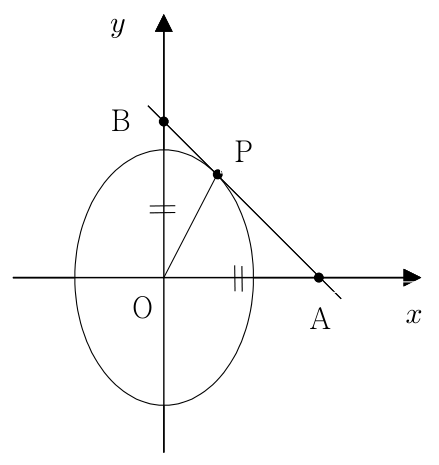
(1) 점 P(x1, y1)\displaystyle \mathrm{P} \left (x_{1},~ y_{1} \right )에서의 접선의 방정식은 x1xa+y1y=1\displaystyle \frac{x_{1} x}{a}+y_{1} y=1이므로 A(ax1, 0)\displaystyle \mathrm{A} \left (\frac{a}{x_{1}},~ 0 \right )이고 B(0, 1y1)\displaystyle \mathrm{B} \left (0,~ \frac{1}{y_{1}} \right )이다.

삼각형 OAB\displaystyle \mathrm{OAB}가 직각이등변삼각형이므로 OA=OB\displaystyle \overline{OA}=\overline{OB}이고

이에 따라 y1=x1a\displaystyle y_{1}=\frac{x_{1}}{a}이다.

+3점 · 직각이등변삼각형 조건을 이용하여 접점 P(aa+1,1a+1)\displaystyle \left(\dfrac a{\sqrt{a+1}},\dfrac1{\sqrt{a+1}}\right)를 얻으면

접점 P(x1, x1a)\displaystyle \mathrm{P} \left (x_{1},~ \frac{x_{1}}{a} \right )는 타원의 점이므로 x12a+y12=x12a+(x1a)2=a+1a2x12=1\displaystyle \frac{x_{1}^{2}}{a}+y_{1}^{2}=\frac{x_{1}^{2}}{a}+ \left (\frac{x_{1}}{a} \right )^{2}=\frac{a+1}{a^{2}} x_{1}^{2}=1이고

1\displaystyle 1사분면에 있으므로 x1=aa+1\displaystyle x_{1}=\frac{a}{\sqrt {a+1}}이고 y1=x1a=1a+1\displaystyle y_{1}=\frac{x_{1}}{a}=\frac{1}{\sqrt {a+1}}이다.

따라서 접점 P\displaystyle \mathrm{P}의 좌표는 (aa+1, 1a+1)\displaystyle \left (\frac{a}{\sqrt {a+1}},~ \frac{1}{\sqrt {a+1}} \right )이다.

타원에 접하는 직선과 직각이등변삼각형 원본 그림
+2점 · 두 삼각형의 넓이를 이용하여 방정식을 얻으면 (예) 1a+1=2×aa+1\displaystyle \dfrac1{\sqrt{a+1}}=2\times\dfrac a{\sqrt{a+1}}

(2) 삼각형 OAP\displaystyle \mathrm{OAP}의 넓이는 S1=12×OA×1a+1\displaystyle S_{1}=\frac{1}{2} \times \overline{OA} \times \frac{1}{\sqrt {a+1}}이고

삼각형 OBP\displaystyle \mathrm{OBP}의 넓이는 S2=12×OB×aa+1\displaystyle S_{2}=\frac{1}{2} \times \overline{OB} \times \frac{a}{\sqrt {a+1}}이다.

OA=OB\displaystyle \overline{OA}=\overline{OB}이고 S1=2×S2\displaystyle S_{1}=2 \times S_{2}이므로 1a+1=2×aa+1\displaystyle \frac{1}{\sqrt {a+1}}=2 \times \frac{a}{\sqrt {a+1}}이고, a=12\displaystyle a=\frac{1}{2}이다.

+2점 · 타원의 방정식 2x2+y2=1\displaystyle 2x^2+y^2=1을 얻으면

따라서 타원의 방정식은 2x2+y2=1\displaystyle 2 x^{2}+y^{2}=1이다.

+3점 · FQF=90\displaystyle \angle FQF^{\prime}=90^\circ을 이용하여 원의 방정식 x2+y2=12\displaystyle x^2+y^2=\dfrac12을 얻으면

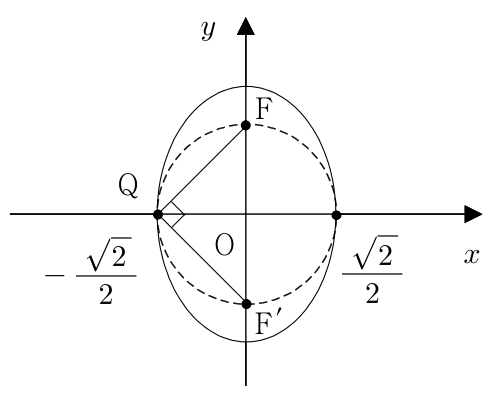
(3) 타원의 두 초점을 F(0,c)\displaystyle (0,c)와 F′(0,c)\displaystyle (0,-c)라고 하면

c2=1a=12\displaystyle c^2=1-a=\dfrac12이므로 F(0,22)\displaystyle \left(0,\dfrac{\sqrt2}2\right)와 F′(0,22)\displaystyle \left(0,-\dfrac{\sqrt2}2\right)이다.

타원의 점 Q에 대하여 FQFQ=0\displaystyle \overrightarrow{FQ}\cdot\overrightarrow{F^{\prime}Q}=0이므로

FQF=90\displaystyle \angle FQF^{\prime}=90^\circ이다.

따라서 점 Q\displaystyle \mathrm{Q}는 타원의 두 초점을 지름의 양 끝점으로 하는 원 x2+y2=12\displaystyle x^{2}+y^{2}=\frac{1}{2}과 타원의 교점이 된다.

+3점 · 점 Q의 좌표 (22,0)\displaystyle \left(\dfrac{\sqrt2}2,0\right)(22,0)\displaystyle \left(-\dfrac{\sqrt2}2,0\right)을 모두 얻으면

타원의 식과 원의 식을 연립하여 풀면 찾는 점 Q\displaystyle \mathrm{Q}의 좌표는 (22, 0)\displaystyle \left (\frac{\sqrt {2}}{2},~ 0 \right )(22, 0)\displaystyle \left (-\frac{\sqrt {2}}{2},~ 0 \right )이다.

타원과 초점을 지름으로 하는 원의 교점 원본 그림
+5점 · A에서 B까지 가는 경우의 수 92를 얻으면 (세부기준) 일부 구간의 경우의 수만 계산하는 경우에는 비례하여 부분 점수를 부여

[2]

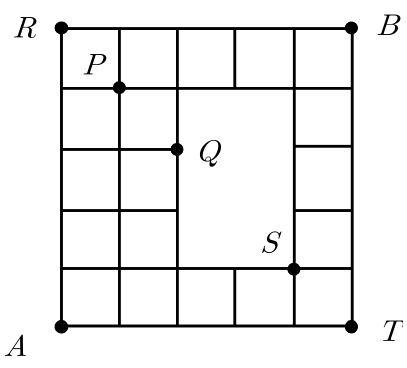
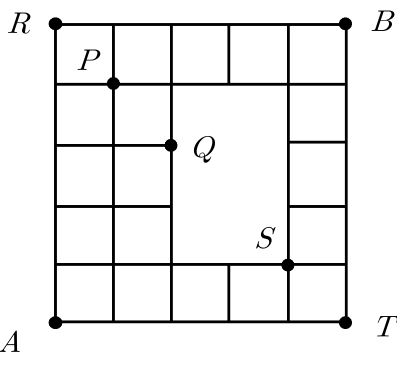
(1) A\displaystyle A에서 B\displaystyle B까지 가는 경우의 수는 오른쪽과 같은 5\displaystyle 5개의 지점 P, Q, R, S, T\displaystyle P,~ Q,~ R,~ S,~ T을 통과하는 경우의 수의 합과 같다.

대학 원본의 도로망과 중간 지점 다섯 곳

- R\displaystyle R지점 : 1×1=1\displaystyle 1 \times 1=1,

- P\displaystyle P지점 : 5C1×5C4=5!1!×4!×5!4!×1!=25\displaystyle { }_{5} \mathrm{C}_{1} \times { }_{5} \mathrm{C}_{4}=\frac{5 !}{1 ! \times 4 !} \times \frac{5 !}{4 ! \times 1 !}=25,

- Q\displaystyle Q지점: 5C2×4C3=5!2!×3!×4!3!×1!=40\displaystyle { }_{5} \mathrm{C}_{2} \times { }_{4} \mathrm{C}_{3}=\frac{5 !}{2 ! \times 3 !} \times \frac{4 !}{3 ! \times 1 !}=40,

- S\displaystyle S지점 : 5C4×5C1=5!4!×1!×5!1!×4!=25\displaystyle { }_{5} \mathrm{C}_{4} \times { }_{5} \mathrm{C}_{1}=\frac{5 !}{4 ! \times 1 !} \times \frac{5 !}{1 ! \times 4 !}=25,

- T\displaystyle T지점 : 1×1=1\displaystyle 1 \times 1=1

따라서 A\displaystyle A에서 B\displaystyle B까지 가는 경우의 수는 1+25+40+25+1=92\displaystyle 1+25+40+25+1=92이다.

+2점 · P 지점에서 만나는 경우의 수 625를 얻으면

(2) 두 사람이 자신의 출발지에서 목적지까지 가는 모든 경우의 수는 각 사람이 한 방향으로 가는 경로의 수의 곱과 같으므로 92×92=8464\displaystyle 92 \times 92=8464이다.

또한 두 사람은 서로 반대방향에서 동시에 출발하여 같은 속력으로 이동하므로, 서로 같은 거리에 있는 P, Q, R, S, T\displaystyle P,~ Q,~ R,~ S,~ T지점에서만 만날 수 있다.

두 사람이 어느 한 지점에서만나는 경우의 수는 수철이가 해당 지점을 지나서 목적지까지 가는 경우의 수에 대하여 연수가 같은 지점을 지나서 목적지까지 가는 경우의 수를 곱한 것과 같으므로 다음과 같다.
대학 원본의 서로 마주 오는 두 사람의 도로망

- P\displaystyle P지점에서만나는 경우의 수: (5C1×5C4)×(5C4×5C1)=25×25=625\displaystyle \left ({ }_{5} \mathrm{C}_{1} \times { }_{5} \mathrm{C}_{4} \right ) \times \left ({ }_{5} \mathrm{C}_{4} \times { }_{5} \mathrm{C}_{1} \right )=25 \times 25=625

+2점 · Q 지점에서 만나는 경우의 수 1600을 얻으면

- Q\displaystyle Q지점에서만나는 경우의 수: (5C2×4C3)×(4C3×5C2)=40×40=1600\displaystyle \left ({ }_{5} \mathrm{C}_{2} \times { }_{4} \mathrm{C}_{3} \right ) \times \left ({ }_{4} \mathrm{C}_{3} \times { }_{5} \mathrm{C}_{2} \right )=40 \times 40=1600

+3점 · P와 Q 지점에서 만나는 확률 6258464\displaystyle \dfrac{625}{8464}100529\displaystyle \dfrac{100}{529}을 얻으면

따라서 두 사람이 각 지점에서만나고 목적지까지 가는 확률은 다음과 같다.

- P\displaystyle P지점에서만나는 확률 : 62592×92=6258464\displaystyle \frac{625}{92 \times 92}=\frac{625}{8464}

- Q\displaystyle Q지점에서만나는 확률: 160092×92=16008464=100529\displaystyle \frac{1600}{92 \times 92}=\frac{1600}{8464}=\frac{100}{529}

+2점 · 임의의 두 항을 이용하여 관계식을 얻으면 (예) a+b=2, 2a+b=3\displaystyle a+b=2,~2a+b=3

[3]

(1) g(n)=an2+bn\displaystyle g(n)=a n^{2}+b n이라고 하면 다음의 식을 얻는다.

{a1=(a+b)×1!=2a+b=2a2=(4a+2b)×2!=122a+b=3\displaystyle \begin{cases}a_1=(a+b)\times1!=2\quad\to a+b=2\\a_2=(4a+2b)\times2!=12\quad\to2a+b=3\end{cases} 또는 {a2=(4a+2b)×2!=122a+b=3a3=(9a+3b)×3!=729a+3b=12\displaystyle \begin{cases}a_2=(4a+2b)\times2!=12\quad\to2a+b=3\\a_3=(9a+3b)\times3!=72\quad\to9a+3b=12\end{cases}

+2점 · 연립 방정식을 풀어 g(n)=n2+n\displaystyle g(n)=n^2+n을 얻으면

두 식을 연립하여 풀면 a=1, b=1\displaystyle a=1,~ b=1이고, 따라서 g(n)=n2+n\displaystyle g(n)=n^{2}+n이다.

+2점 · 제시문 (i)에 따라 n=1\displaystyle n=1일 때 성립함을 보이면

(2) 모든 자연수 n\displaystyle n에서 다음이 성립함을 밝히자.

an=(n2+n)×n!\displaystyle a_n=(n^2+n)\times n! ……①

n=1\displaystyle n=1일 때, a1=(12+1)×1!=2\displaystyle a_1=(1^2+1)\times1!=2이므로 ①이 성립한다.

+4점 · 제시문 (ii)에 따라 n=k+1\displaystyle n=k+1일 때 성립함을 보이면

n=k\displaystyle n=k일 때, 식 ①이 성립한다고 하자. 곧 ak=(k2+k)×k!\displaystyle a_{k}= \left (k^{2}+k \right ) \times k!이라고 하자.

그러면 n=k+1\displaystyle n=k+1일 때 다음을 얻는다.

ak+1=ak+(k2+2k+2)×(k+1)!=(k2+k)×k!+(k2+2k+2)×(k+1)!=k×(k+1)!+(k2+2k+2)×(k+1)!=(k2+3k+2)×(k+1)!={(k+1)2+(k+1)}×(k+1)!\displaystyle \begin{aligned}a_{k+1}&=a_k+(k^2+2k+2)\times(k+1)!\\&=(k^2+k)\times k!+(k^2+2k+2)\times(k+1)!\\&=k\times(k+1)!+(k^2+2k+2)\times(k+1)!\\&=(k^2+3k+2)\times(k+1)!\\&=\{(k+1)^2+(k+1)\}\times(k+1)!\end{aligned}

+1점 · (i)과 (ii)에 따라 모든 자연수에 대하여 성립한다고 결론 지으면

그러므로 식 ①은 n=k+1\displaystyle n=k+1일 때 성립한다.

따라서 식 ①은 모든 자연수 n\displaystyle n에서 성립한다.

+1점 · 귀류법으로 증명하기 위해 결론을 부정하여 AC2\displaystyle \overline{AC}\ne2라고 가정하면

[4]

(1) 귀류법으로 증명하기 위하여 AC2\displaystyle \overline{AC} \ne 2라고 가정한다.

+4점 · 삼각형에서 내각의 크기가 크면(작으면) 대변의 길이가 길다(작다)를 이용하여 증명하면 (세부기준) AC>2\displaystyle \overline{AC}>2AC<2\displaystyle \overline{AC}<2로 나누어 각각의 경우를 증명해야 하며 증명의 일부만 설명하는 경우 비례하여 부분 점수 부여

(i) AC>2\displaystyle \overline{AC}>2라고 하자.

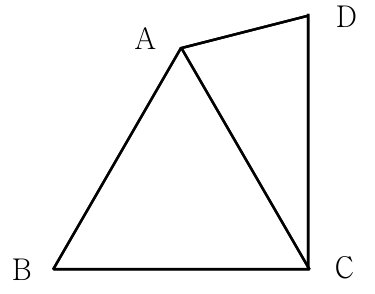
그러면 이등변삼각형 ABC\displaystyle \mathrm{ABC}의 세 변 중에서 AC\displaystyle \overline{AC}의 길이가 가장 길기 때문에 세 내각 중에서 ABC\displaystyle \angle \mathrm{ABC}의 크기가 가장 크다. 이에 따라 BAC<60\displaystyle \angle \mathrm{BAC}<60^{\circ }이다.

그리고 삼각형 ACD\displaystyle \mathrm{ACD}에서 AC>CD\displaystyle \overline{AC}>\overline{CD}이므로, CAD<75\displaystyle \angle \mathrm{CAD}<75^{\circ }이다.

그러면 DAB=BAC+CAD<135\displaystyle \angle \mathrm{DAB}=\angle \mathrm{BAC}+\angle \mathrm{CAD}<135^{\circ }이므로, 주어진 조건에 모순된다.

사각형 ABCD의 대각선 AC를 그은 대학 원본 그림

(ii) AC<2\displaystyle \overline{AC}<2라고 하자.

그러면 이등변삼각형 ABC\displaystyle \mathrm{ABC}의 세 변 중에서 AC\displaystyle \overline{AC}의 길이가 가장 짧기 때문에 세 내각 중에서 ABC\displaystyle \angle \mathrm{ABC}의 크기가 가장 작다. 이에 따라 BAC>60\displaystyle \angle \mathrm{BAC}>60^{\circ }이다.

그리고 삼각형 ACD\displaystyle \mathrm{ACD}에서 AC<CD\displaystyle \overline{AC}<\overline{CD}이므로, CAD>75\displaystyle \angle \mathrm{CAD}>75^{\circ }이다.

그러면 DAB=BAC+CAD>135\displaystyle \angle \mathrm{DAB}=\angle \mathrm{BAC}+\angle \mathrm{CAD}>135^{\circ }이므로, 주어진 조건에 모순된다.

+1점 · 결론을 부정한 것이 모순임을 언급하며 AC=2\displaystyle \overline{AC}=2라고 결론 지으면

따라서 (i)과 (ii)에 의해 AC=2\displaystyle \overline{AC}=2이다.

+2점 · 삼각형 ACD가 이등변삼각형임을 언급하면

(2) (1)의 결과에 의하여 삼각형 ACD\displaystyle \mathrm{ACD}AC=CD=2\displaystyle \overline{AC}=\overline{CD}=2인 이등변삼각형이고 CDA=CAD=75\displaystyle \angle \mathrm{CDA}=\angle \mathrm{CAD}=75^{\circ }이다. 따라서 삼각함수의 덧셈정리에 따라 다음을 얻는다.

+3점 · 삼각함수의 성질을 이용하여 AD=62 (=843)\displaystyle \overline{AD}=\sqrt6-\sqrt2~(=\sqrt{8-4\sqrt3})을 얻으면

AD=2×2cos75=4cos(45+30)=4cos45cos304sin45sin30=4×22×324×22×12=62\displaystyle \begin{aligned}\overline{AD}&=2\times2\cos75^\circ=4\cos(45^\circ+30^\circ)=4\cos45^\circ\cos30^\circ-4\sin45^\circ\sin30^\circ\\&=4\times\dfrac{\sqrt2}2\times\dfrac{\sqrt3}2-4\times\dfrac{\sqrt2}2\times\dfrac12=\sqrt6-\sqrt2\end{aligned}

첨삭 사례

아직 등록된 첨삭 사례가 없습니다.

질문과 답변 · 0개질문과 답변 · 고정 0개

아직 등록된 질문이 없습니다. 질문 작성은 멤버십 회원만 가능합니다.