+13점 · 도함수를 구하고 이차방정식의 판별식과 근과 계수의 관계를 이용하여 도함수의 부호를 조사할 수 있다. [2-1] f ( x ) \displaystyle f(x) f ( x ) f ′ ( x ) \displaystyle f^{\prime}(x) f ′ ( x ) x > 0 \displaystyle x>0 x > 0 f ′ ( x ) = − 1 2 ( 1 + x ) 3 2 + p 2 2 x ( x + p 2 ) 3 2 = − x ( x + p 2 ) 3 2 + p 2 ( 1 + x ) 3 2 2 x ( 1 + x ) 3 2 ( x + p 2 ) 3 2 \displaystyle f^{\prime}(x)=-\frac{1}{2(1+x)^{\frac{3}{2}}}+\frac{p^{2}}{2\sqrt{x}\,(x+p^{2})^{\frac{3}{2}}}=\frac{-\sqrt{x}\,(x+p^{2})^{\frac{3}{2}}+p^{2}(1+x)^{\frac{3}{2}}}{2\sqrt{x}\,(1+x)^{\frac{3}{2}}(x+p^{2})^{\frac{3}{2}}} f ′ ( x ) = − 2 ( 1 + x ) 2 3 1 + 2 x ( x + p 2 ) 2 3 p 2 = 2 x ( 1 + x ) 2 3 ( x + p 2 ) 2 3 − x ( x + p 2 ) 2 3 + p 2 ( 1 + x ) 2 3 f ′ ( x ) = 0 \displaystyle f^{\prime}(x)=0 f ′ ( x ) = 0 f ′ ( x ) = 0 ⟺ p 2 ( 1 + x ) 3 2 = x ( x + p 2 ) 3 2 ⟺ p 4 ( 1 + x ) 3 − x ( x + p 2 ) 3 = 0 \displaystyle f^{\prime}(x)=0\iff p^{2}(1+x)^{\frac{3}{2}}=\sqrt{x}\,(x+p^{2})^{\frac{3}{2}}\iff p^{4}(1+x)^{3}-x(x+p^{2})^{3}=0 f ′ ( x ) = 0 ⟺ p 2 ( 1 + x ) 2 3 = x ( x + p 2 ) 2 3 ⟺ p 4 ( 1 + x ) 3 − x ( x + p 2 ) 3 = 0 0 = p 4 ( 1 + x ) 3 − x ( x + p 2 ) 3 = ( p 2 − x 2 ) { x 2 − p 2 ( p 2 − 3 ) x + p 2 } \displaystyle 0=p^{4}(1+x)^{3}-x(x+p^{2})^{3}=(p^{2}-x^{2})\left\{x^{2}-p^{2}(p^{2}-3)x+p^{2}\right\} 0 = p 4 ( 1 + x ) 3 − x ( x + p 2 ) 3 = ( p 2 − x 2 ) { x 2 − p 2 ( p 2 − 3 ) x + p 2 } x 2 − p 2 ( p 2 − 3 ) x + p 2 = 0 \displaystyle x^{2}-p^{2}(p^{2}-3)x+p^{2}=0 x 2 − p 2 ( p 2 − 3 ) x + p 2 = 0 D = p 4 ( p 2 − 3 ) 2 − 4 p 2 = p 2 { p 2 ( p 2 − 3 ) 2 − 4 } = p 2 ( p 2 − 1 ) 2 ( p 2 − 4 ) \displaystyle D=p^{4}(p^{2}-3)^{2}-4p^{2}=p^{2}\left\{p^{2}(p^{2}-3)^{2}-4\right\}=p^{2}(p^{2}-1)^{2}(p^{2}-4) D = p 4 ( p 2 − 3 ) 2 − 4 p 2 = p 2 { p 2 ( p 2 − 3 ) 2 − 4 } = p 2 ( p 2 − 1 ) 2 ( p 2 − 4 )
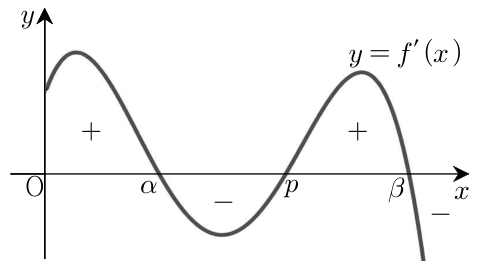
(i) p > 2 \displaystyle p>2 p > 2 D > 0 \displaystyle D>0 D > 0 x 2 − p 2 ( p 2 − 3 ) x + p 2 = 0 \displaystyle x^{2}-p^{2}(p^{2}-3)x+p^{2}=0 x 2 − p 2 ( p 2 − 3 ) x + p 2 = 0 α \displaystyle \alpha α β ( α < β ) \displaystyle \beta\ (\alpha<\beta) β ( α < β ) 제시문 (가)에 의하여 α + β = p 2 ( p 2 − 3 ) > 0 \displaystyle \alpha+\beta=p^{2}(p^{2}-3)>0 α + β = p 2 ( p 2 − 3 ) > 0 α β = p 2 > 0 \displaystyle \alpha\beta=p^{2}>0 α β = p 2 > 0 0 < α < p < β \displaystyle 0<\alpha<p<\beta 0 < α < p < β f ′ ( x ) ≥ 0 ⟺ p 2 ( 1 + x ) 3 2 ≥ x ( x + p 2 ) 3 2 ⟺ p 4 ( 1 + x ) 3 − x ( x + p 2 ) 3 ≥ 0 \displaystyle f^{\prime}(x)\ge 0\iff p^{2}(1+x)^{\frac{3}{2}}\ge\sqrt{x}\,(x+p^{2})^{\frac{3}{2}}\iff p^{4}(1+x)^{3}-x(x+p^{2})^{3}\ge 0 f ′ ( x ) ≥ 0 ⟺ p 2 ( 1 + x ) 2 3 ≥ x ( x + p 2 ) 2 3 ⟺ p 4 ( 1 + x ) 3 − x ( x + p 2 ) 3 ≥ 0 f ′ ( x ) \displaystyle f^{\prime}(x) f ′ ( x ) p 4 ( 1 + x ) 3 − x ( x + p 2 ) 3 \displaystyle p^{4}(1+x)^{3}-x(x+p^{2})^{3} p 4 ( 1 + x ) 3 − x ( x + p 2 ) 3 p 4 ( 1 + x ) 3 − x ( x + p 2 ) 3 = ( p 2 − x 2 ) { x 2 − p 2 ( p 2 − 3 ) x + p 2 } = − ( x + p ) ( x − p ) ( x − α ) ( x − β ) \displaystyle p^{4}(1+x)^{3}-x(x+p^{2})^{3}=(p^{2}-x^{2})\left\{x^{2}-p^{2}(p^{2}-3)x+p^{2}\right\}=-(x+p)(x-p)(x-\alpha)(x-\beta) p 4 ( 1 + x ) 3 − x ( x + p 2 ) 3 = ( p 2 − x 2 ) { x 2 − p 2 ( p 2 − 3 ) x + p 2 } = − ( x + p ) ( x − p ) ( x − α ) ( x − β ) x > 0 \displaystyle x>0 x > 0
+7점 · 함수의 증가, 감소 하는 구간을 구하고 극값과 양 끝에서의 함숫값과 극한값을 구할 수 있다. 이므로, 제시문 (나)에 의해 x > 0 \displaystyle x>0 x > 0 f ( x ) \displaystyle f(x) f ( x ) x 0 ⋯ α ⋯ p ⋯ β ⋯ f ′ ( x ) + − + − f ( x ) 1 ↗ ↘ ↗ ↘ \displaystyle \begin{array}{c|c|c|c|c|c|c|c|c} x & 0 & \cdots & \alpha & \cdots & p & \cdots & \beta & \cdots \\\\ \hline f^{\prime}(x) & & + & & - & & + & & - \\\\ \hline f(x) & 1 & \nearrow & & \searrow & & \nearrow & & \searrow \end{array} x f ′ ( x ) f ( x ) 0 1 ⋯ + ↗ α ⋯ − ↘ p ⋯ + ↗ β ⋯ − ↘ 최솟값이 될 수 있는 값은 lim x → ∞ f ( x ) = 1 = f ( 0 ) \displaystyle \lim_{x\to\infty}f(x)=1=f(0) x → ∞ lim f ( x ) = 1 = f ( 0 ) f ( p ) = 2 1 + p \displaystyle f(p)=\frac{2}{\sqrt{1+p}} f ( p ) = 1 + p 2
+5점 · 함수의 최솟값을 구할 수 있다. p ≥ 3 \displaystyle p\ge 3 p ≥ 3 f ( p ) = 2 1 + p ≤ 1 \displaystyle f(p)=\frac{2}{\sqrt{1+p}}\le 1 f ( p ) = 1 + p 2 ≤ 1 f ( x ) \displaystyle f(x) f ( x ) 2 1 + p \displaystyle \frac{2}{\sqrt{1+p}} 1 + p 2 2 < p < 3 \displaystyle 2<p<3 2 < p < 3 f ( p ) = 2 1 + p > 1 \displaystyle f(p)=\frac{2}{\sqrt{1+p}}>1 f ( p ) = 1 + p 2 > 1 f ( x ) \displaystyle f(x) f ( x )
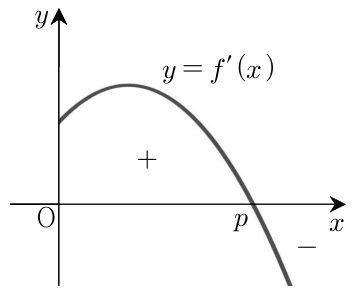
(ii) 0 < p ≤ 2 \displaystyle 0<p\le 2 0 < p ≤ 2 • p ≠ 1 \displaystyle p\ne 1 p = 1 p ≠ 2 \displaystyle p\ne 2 p = 2 D < 0 \displaystyle D<0 D < 0 0 < x < p \displaystyle 0<x<p 0 < x < p ( p 2 − x 2 ) { x 2 − p 2 ( p 2 − 3 ) x + p 2 } > 0 \displaystyle (p^{2}-x^{2})\left\{x^{2}-p^{2}(p^{2}-3)x+p^{2}\right\}>0 ( p 2 − x 2 ) { x 2 − p 2 ( p 2 − 3 ) x + p 2 } > 0 x > p \displaystyle x>p x > p ( p 2 − x 2 ) { x 2 − p 2 ( p 2 − 3 ) x + p 2 } < 0 \displaystyle (p^{2}-x^{2})\left\{x^{2}-p^{2}(p^{2}-3)x+p^{2}\right\}<0 ( p 2 − x 2 ) { x 2 − p 2 ( p 2 − 3 ) x + p 2 } < 0 • p = 1 \displaystyle p=1 p = 1 p = 2 \displaystyle p=2 p = 2 D = 0 \displaystyle D=0 D = 0 0 < x < p \displaystyle 0<x<p 0 < x < p ( p 2 − x 2 ) { x 2 − p 2 ( p 2 − 3 ) x + p 2 } > 0 \displaystyle (p^{2}-x^{2})\left\{x^{2}-p^{2}(p^{2}-3)x+p^{2}\right\}>0 ( p 2 − x 2 ) { x 2 − p 2 ( p 2 − 3 ) x + p 2 } > 0 x > p \displaystyle x>p x > p ( p 2 − x 2 ) { x 2 − p 2 ( p 2 − 3 ) x + p 2 } < 0 \displaystyle (p^{2}-x^{2})\left\{x^{2}-p^{2}(p^{2}-3)x+p^{2}\right\}<0 ( p 2 − x 2 ) { x 2 − p 2 ( p 2 − 3 ) x + p 2 } < 0 f ′ ( x ) \displaystyle f^{\prime}(x) f ′ ( x )
제시문 (나)를 이용하여 f ( x ) \displaystyle f(x) f ( x ) x 0 ⋯ p ⋯ f ′ ( x ) + − f ( x ) 1 ↗ ↘ \displaystyle \begin{array}{c|c|c|c|c} x & 0 & \cdots & p & \cdots \\\\ \hline f^{\prime}(x) & & + & & - \\\\ \hline f(x) & 1 & \nearrow & & \searrow \end{array} x f ′ ( x ) f ( x ) 0 1 ⋯ + ↗ p ⋯ − ↘ lim x → ∞ f ( x ) = 1 = f ( 0 ) \displaystyle \lim_{x\to\infty}f(x)=1=f(0) x → ∞ lim f ( x ) = 1 = f ( 0 ) f ( x ) \displaystyle f(x) f ( x )
그러므로 (i)과 (ii)의 결과를 종합해 보면 p ≥ 3 \displaystyle p\ge 3 p ≥ 3 f ( x ) \displaystyle f(x) f ( x ) 2 1 + p \displaystyle \frac{2}{\sqrt{1+p}} 1 + p 2 0 < p < 3 \displaystyle 0<p<3 0 < p < 3 f ( x ) \displaystyle f(x) f ( x )
+3점 · 원하는 부등식을 보이기 위해 [2-1]의 결과를 이용한다. [2-2] [2-1]의 결과에 의하면 a b ≥ 3 \displaystyle ab\ge 3 ab ≥ 3 f ( x ) = 1 1 + x + x x + a 2 b 2 \displaystyle f(x)=\frac{1}{\sqrt{1+x}}+\frac{\sqrt{x}}{\sqrt{x+a^{2}b^{2}}} f ( x ) = 1 + x 1 + x + a 2 b 2 x 2 1 + a b \displaystyle \frac{2}{\sqrt{1+ab}} 1 + ab 2 모든 x ≥ 0 \displaystyle x\ge 0 x ≥ 0 1 1 + x + x x + a 2 b 2 ≥ 2 1 + a b \displaystyle \frac{1}{\sqrt{1+x}}+\frac{\sqrt{x}}{\sqrt{x+a^{2}b^{2}}}\ge\frac{2}{\sqrt{1+ab}} 1 + x 1 + x + a 2 b 2 x ≥ 1 + ab 2
+7점 · 함숫값의 최솟값을 이용하여 원하는 부등식이 성립함을 보일 수 있다. 그러므로 x = a 2 \displaystyle x=a^{2} x = a 2 1 1 + a 2 + a 2 a 2 + a 2 b 2 ≥ 2 1 + a b \displaystyle \frac{1}{\sqrt{1+a^{2}}}+\frac{\sqrt{a^{2}}}{\sqrt{a^{2}+a^{2}b^{2}}}\ge\frac{2}{\sqrt{1+ab}} 1 + a 2 1 + a 2 + a 2 b 2 a 2 ≥ 1 + ab 2 즉, 1 1 + a 2 + 1 1 + b 2 ≥ 2 1 + a b \displaystyle \frac{1}{\sqrt{1+a^{2}}}+\frac{1}{\sqrt{1+b^{2}}}\ge\frac{2}{\sqrt{1+ab}} 1 + a 2 1 + 1 + b 2 1 ≥ 1 + ab 2
 수리논술, 배움에서 논증의 완성까지.