수리논술, 배움에서 논증의 완성까지.

자연계열 3번

문제

[문항 3] 다음 제시문을 이용하여 아래 논제의 풀이 과정과 답을 논리적으로 서술하시오.

(가) n\displaystyle n개 중에서 같은 것이 각각 p\displaystyle p개, q\displaystyle q개, \displaystyle \cdots, r\displaystyle r개 있을 때, n\displaystyle n개를 모두 일렬로 배열하는 순열의 수는n!p!q!r!\displaystyle \frac{n!}{p!q!\cdots r!} (단, p+q++r=n\displaystyle p+q+\cdots+r=n)

(나) 사건 A\displaystyle A가 일어났을 때 사건 B\displaystyle B의 조건부확률은P(BA)=P(AB)P(A)\displaystyle {\mathrm{P}} ( B | A ) = \frac{{{\mathrm{P}} ( A \cap B )}}{{\mathrm{P}} ( A )} (단, P(A)>0\displaystyle {\mathrm{P}} ( A ) > 0)

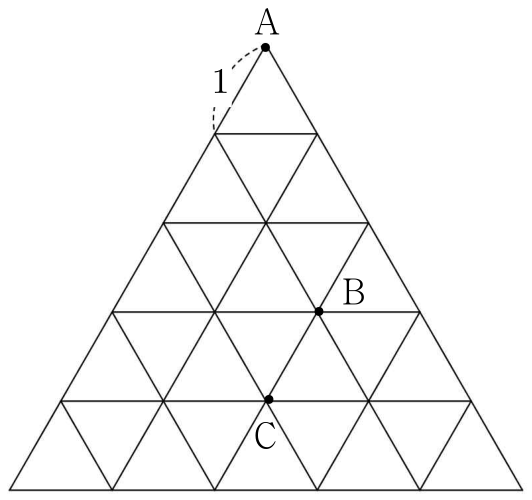
그림과 같이 인접한 두 지점 사이의 거리가 1\displaystyle 1인 정삼각형 모양의 도로망이 있다. 이 도로망을 따라서 이동하려고 할 때, 다음 물음에 답하시오.

정삼각형 도로망의 세 지점 A B C

[3-1] A\displaystyle \mathrm{A}지점에서 출발하여 C\displaystyle \mathrm{C}지점으로 이동하려고 할 때, 이동거리가 5\displaystyle 5인 경로는 몇 가지인지 구하시오. (10점)

[3-2] 주머니 안에 1\displaystyle 1, 2\displaystyle 2, 3\displaystyle 3의 숫자가 각각 하나씩 적혀 있는 세 장의 카드가 있다. 다음과 같은 방법으로 도로망을 따라서 1\displaystyle 1만큼 이동하는 것을 시행이라고 하자.

[단계 1] 주머니에서 임의로 한 장의 카드를 뽑았을 때 1\displaystyle 1이 적힌 카드이면 ↙방향으로, 2\displaystyle 2가 적힌 카드이면 ↘방향으로, 3\displaystyle 3이 적힌 카드이면 →방향으로 도로망을 따라서 1\displaystyle 1만큼 이동한다. 만약 3\displaystyle 3이 적힌 카드를 뽑아서 이동을 할 수 없을 때에는 남은 두 장의 카드 중에서 한 장의 카드를 다시 뽑아서 1\displaystyle 1이 적힌 카드를 뽑으면 ↙방향으로, 2\displaystyle 2가 적힌 카드를 뽑으면 ↘방향으로 도로망을 따라서 1\displaystyle 1만큼 이동한다.

[단계 2] 1\displaystyle 1만큼 이동을 하고 나면 모든 카드를 주머니에 다시 넣는다.

이와 같은 시행을 반복하여 A\displaystyle \mathrm{A}지점에서 출발하여 B\displaystyle \mathrm{B}지점으로 이동하였다고 할 때, A\displaystyle \mathrm{A}지점에서 B\displaystyle \mathrm{B}지점까지 이동한 거리를 확률변수 X\displaystyle X라 하자. 이때, P(X=3)P(X=4)\displaystyle \frac{{{\mathrm{P}} ( X = 3 )}}{{\mathrm{P}} ( X = 4 )}의 값을 구하시오. (20점)

(단, 시행은 최대 5\displaystyle 5번까지 할 수 있다.)

해설강의 준비중
+10점 · 3-1

[3-1]

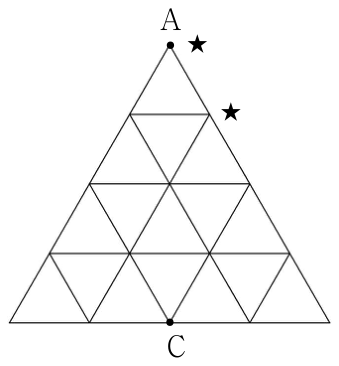
이동거리가 5인 경로와 오른쪽으로 이동할 수 없는 두 지점

↙방향으로 1\displaystyle 1만큼 이동하는 것을 a\displaystyle a,↘방향으로 1\displaystyle 1만큼 이동하는 것을 b\displaystyle b,→방향으로 1\displaystyle 1만큼 이동하는 것을 c\displaystyle c,←방향으로 1\displaystyle 1만큼 이동하는 것을 d\displaystyle d라 하면

이동거리가 5\displaystyle 5인 경로는 다음과 같은 두 가지 경우가 있다.

(ⅰ) a\displaystyle a, a\displaystyle a, a\displaystyle a, b\displaystyle b, c\displaystyle c를 일렬로 나열하는 경우

a\displaystyle a, a\displaystyle a, a\displaystyle a, b\displaystyle b, c\displaystyle c를 일렬로 나열하는 전체 경우의 수는 5!3!=20\displaystyle \frac{5!}{3!} = 20(가지)이다.

이 중에서 그림의 표시된 지점(★)에서는 →방향으로는 이동할 수 없으므로

1) c\displaystyle c를 먼저 선택하고 나머지 a\displaystyle a, a\displaystyle a, a\displaystyle a, b\displaystyle b를 일렬로 나열하는 경우의 수 4!3!=4\displaystyle \frac{4!}{3!} = 4(가지)

2) b\displaystyle b, c\displaystyle c순으로 선택하고 나머지 a\displaystyle a, a\displaystyle a, a\displaystyle a를 일렬로 나열하는 경우의 수 3!3!=1\displaystyle \frac{3!}{3!} = 1(가지)

5\displaystyle 5가지의 경우는 위 도로망에서 불가능하다.

따라서 구하는 경우의 수는 205=15\displaystyle 20 - 5 = 15(가지)이다.

(ⅱ) a\displaystyle a, b\displaystyle b, b\displaystyle b, b\displaystyle b, d\displaystyle d를 일렬로 나열하는 경우

(ⅰ)과 같은 방법으로 구하면 15\displaystyle 15(가지)이다.

그러므로 (ⅰ), (ⅱ)에 의해서 이동거리가 5\displaystyle 5인 경로는 15+15=30\displaystyle 15 + 15 = 30(가지)이다.

※ 참고

좌표평면 위에 A\displaystyle \mathrm{A}지점을 (0,0)\displaystyle \left( 0 , 0 \right)으로 두고, 각 방향으로 1\displaystyle 1만큼 이동하는 것을

↙방향 : a=(1,0)\displaystyle \overrightarrow{a} = \left( 1 , 0 \right),↘방향 : b=(0,1)\displaystyle \overrightarrow{b} = \left( 0 , 1 \right)

→방향 : c=(1,1)\displaystyle \overrightarrow{c} = \left( - 1 , 1 \right)←방향 : d=(1,1)\displaystyle \overrightarrow{d} = \left( 1 , - 1 \right)

이라 하자. C\displaystyle \mathrm{C}지점은 (2,2)\displaystyle \left( 2 , 2 \right)이므로 위 네 방향으로 이동하는 횟수를 각각 x\displaystyle x, y\displaystyle y, z\displaystyle z, w\displaystyle w라 두면

{x+y+z+w=5xz+w=2y+zw=2\displaystyle \begin{cases}x + y + z + w = 5 \\ x - z + w = 2 \\ y + z - w = 2\end{cases}

이 성립하고, 연립방정식을 풀면

x=3\displaystyle x = 3, y=1\displaystyle y = 1, z=1\displaystyle z = 1, w=0\displaystyle w = 0 혹은 x=1\displaystyle x = 1, y=3\displaystyle y = 3, z=0\displaystyle z = 0, w=1\displaystyle w = 1

의 두 가지의 경우만 존재한다.

+20점 · 3-2

[3-2]

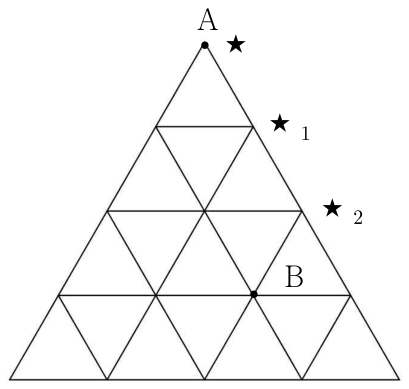
오른쪽으로 이동할 수 없는 세 지점

그림의 표시된 세 지점(★)에서는 →방향으로는 이동할 수 없다.즉, 뽑은 카드가 3\displaystyle 3이면 남은 두 장의 카드 중에서 한 장의 카드를 다시 뽑아야 하므로★지점에서 각 방향으로 이동할 수 있는 확률은13+13×12=12\displaystyle \frac{1}{3} + \frac{1}{3} \times \frac{1}{2} = \frac{1}{2}

★지점 이외에서는 B\displaystyle \mathrm{B}지점까지 이동할 때 지나는 모든 점에서 각 방향으로 이동할 수 있는 확률은 13\displaystyle \frac{1}{3}이다.

위 시행을 반복하였을 때A\displaystyle \mathrm{A}지점을 출발하여 B\displaystyle \mathrm{B}지점에 도착하는 사건을 L\displaystyle L이라 하고,이동한 거리가 3\displaystyle 3인 사건을 D3\displaystyle D_{3}, 이동한 거리가 4\displaystyle 4인 사건을 D4\displaystyle D_{4}라 하자.

P(X=3)=P(D3L)=P(D3L)P(L)\displaystyle {\mathrm{P}} ( X = 3 ) = {\mathrm{P}} ( D_{3} | L ) = \frac{{{\mathrm{P}} ( D_{3} \cap L )}}{{\mathrm{P}} ( L )}이고

P(D3L)\displaystyle {\mathrm{P}} ( D_{3} \cap L )은 다음의 네 가지 경우로 나누어서 구할 수 있다.

(ⅰ) 1\displaystyle \star_{1}, 2\displaystyle \star_{2} 두 지점을 모두 지나지 않는 경우 : 12×13×13=118\displaystyle \frac{1}{2} \times \frac{1}{3} \times \frac{1}{3} = \frac{1}{18}

(ⅱ) 1\displaystyle \star_{1}지점은 지나고, 2\displaystyle \star_{2}지점을 지나지 않는 경우 : 12×12×13=112\displaystyle \frac{1}{2} \times \frac{1}{2} \times \frac{1}{3} = \frac{1}{12}

(ⅲ) 1\displaystyle \star_{1}지점은 지나지 않고, 2\displaystyle \star_{2}지점을 지나는 경우 : 0\displaystyle 0

(ⅳ) 1\displaystyle \star_{1}, 2\displaystyle \star_{2} 두 지점을 모두 지나는 경우 : 12×12×12=18\displaystyle \frac{1}{2} \times \frac{1}{2} \times \frac{1}{2} = \frac{1}{8}

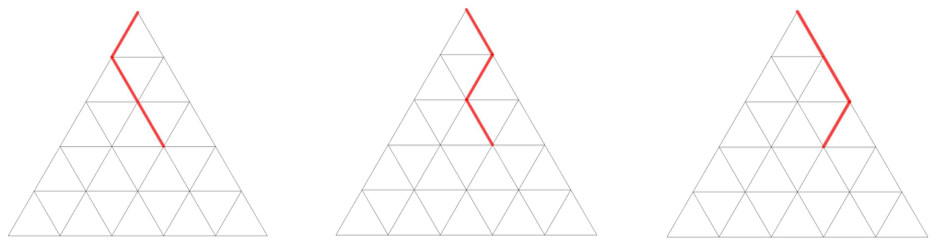
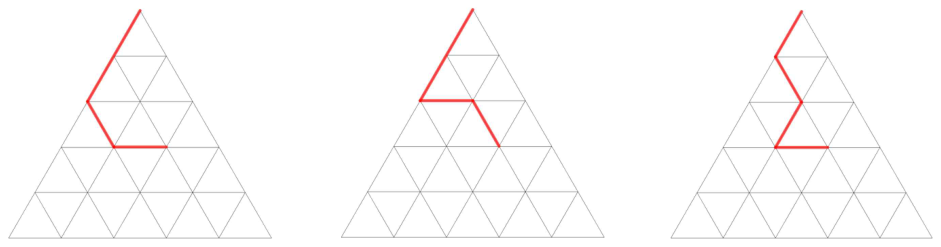
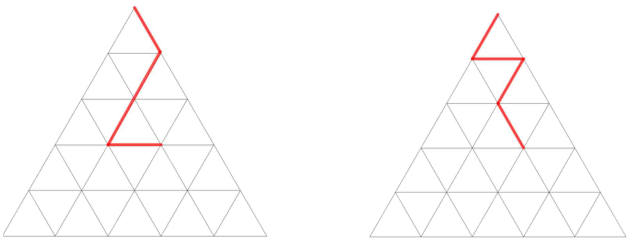
이동거리가 3인 세 경로

따라서 P(D3L)=118+112+18=1972\displaystyle {\mathrm{P}} ( D_{3} \cap L ) = \frac{1}{18} + \frac{1}{12} + \frac{1}{8} = \frac{19}{72}이다.

P(X=4)=P(D4L)=P(D4L)P(L)\displaystyle {\mathrm{P}} ( X = 4 ) = {\mathrm{P}} ( D_{4} | L ) = \frac{{{\mathrm{P}} ( D_{4} \cap L )}}{{\mathrm{P}} ( L )}이고

P(D4L)\displaystyle {\mathrm{P}} ( D_{4} \cap L )은 다음의 네 가지 경우로 나누어서 구할 수 있다.

(ⅰ) 1\displaystyle \star_{1}, 2\displaystyle \star_{2} 두 지점을 모두 지나지 않는 경우 : 12×13×13×13×3=118\displaystyle \frac{1}{2} \times \frac{1}{3} \times \frac{1}{3} \times \frac{1}{3} \times 3 = \frac{1}{18}

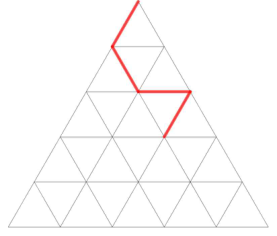
표시된 두 지점을 모두 지나지 않는 경로

(ⅱ) 1\displaystyle \star_{1}지점은 지나고, 2\displaystyle \star_{2}지점을 지나지 않는 경우 : 12×12×13×13×2=118\displaystyle \frac{1}{2} \times \frac{1}{2} \times \frac{1}{3} \times \frac{1}{3} \times 2 = \frac{1}{18}

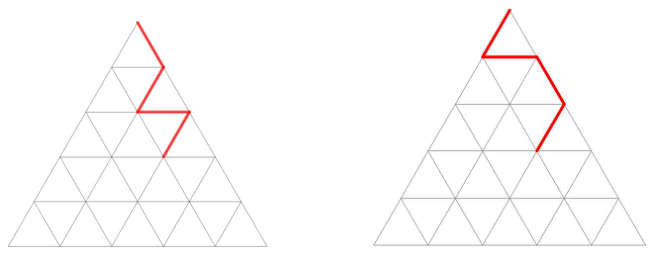
첫째 지점만 지나는 경로

(ⅲ) 1\displaystyle \star_{1}지점은 지나지 않고, 2\displaystyle \star_{2}지점을 지나는 경우 : 12×12×13×13×1=136\displaystyle \frac{1}{2} \times \frac{1}{2} \times \frac{1}{3} \times \frac{1}{3} \times 1 = \frac{1}{36}

둘째 지점만 지나는 경로

(ⅳ) 1\displaystyle \star_{1}, 2\displaystyle \star_{2} 두 지점을 모두 지나는 경우 : 12×12×12×13×2=112\displaystyle \frac{1}{2} \times \frac{1}{2} \times \frac{1}{2} \times \frac{1}{3} \times 2 = \frac{1}{12}

두 지점을 모두 지나는 경로

따라서 P(D4L)=118+118+136+112=29\displaystyle {\mathrm{P}} ( D_{4} \cap L ) = \frac{1}{18} + \frac{1}{18} + \frac{1}{36} + \frac{1}{12} = \frac{2}{9}이다.

그러므로 P(X=3)P(X=4)=P(D3L)P(D4L)=197229=1916\displaystyle \frac{{{\mathrm{P}} ( X = 3 )}}{{\mathrm{P}} ( X = 4 )} = \frac{{{\mathrm{P}} ( D_{3} \cap L )}}{{\mathrm{P}} ( D_{4} \cap L )} = \frac{{\frac{19}{72}}}{\frac{2}{9}}= \frac{19}{16}

첨삭 사례

아직 등록된 첨삭 사례가 없습니다.

질문과 답변 · 0개질문과 답변 · 고정 0개

아직 등록된 질문이 없습니다. 질문 작성은 멤버십 회원만 가능합니다.