수리논술, 이게 다다.

자연계열 3번

오류 제보

문제

【문항 3】다음 제시문을 이용하여 아래 논제의 풀이 과정과 답을 논리적으로 서술하시오.

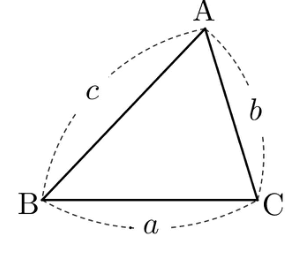
(가) 삼각형 ABC의 세 변의 길이가 a,b,c\displaystyle a,b,c일 때 다음이 성립한다.a2=b2+c2−2bccos⁡A\displaystyle a^2=b^2+c^2-2bc\cos Ab2=c2+a2−2cacos⁡B\displaystyle b^2=c^2+a^2-2ca\cos Bc2=a2+b2−2abcos⁡C\displaystyle c^2=a^2+b^2-2ab\cos C

삼각형 ABC와 세 변의 길이

(나) 평면 β\displaystyle \beta 위의 도형의 넓이를 S\displaystyle S, 이 도형의 평면 α\displaystyle \alpha 위로의 정사영의 넓이를 S′\displaystyle S^{\prime}이라 할 때, 두 평면 α,β\displaystyle \alpha,\beta가 이루는 각의 크기를 θ  (0∘≤θ≤90∘)\displaystyle \theta\;(0^\circ\le\theta\le90^\circ)라 하면 S′=Scos⁡θ\displaystyle S^{\prime}=S\cos\theta이다.

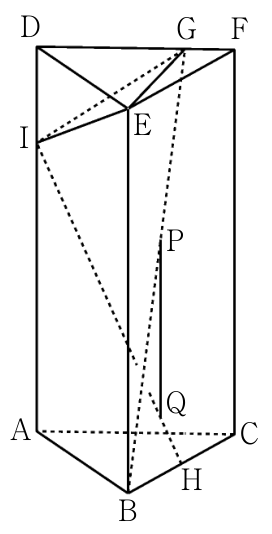
두 밑면은 한 변의 길이가 4인 정삼각형이고 옆면은 모두 직사각형인 삼각기둥 DEF-ABC가 있다.이 삼각기둥의 높이는 8이다. 선분 DF 위에 점 G를 FG‾=1\displaystyle \overline{\mathrm{FG}}=1이 되도록 잡고, 선분 BC의 중점을 H, 선분 AD 위의 한 점을 I라 하자. 선분 BG 위의 한 점 P와 선분 HI 위의 한 점 Q에 대하여직선 PQ는 밑면과 수직이고, PQ‾=267\displaystyle \overline{\mathrm{PQ}}=\frac{26}7이다. 다음 물음에 답하시오.

삼각기둥 DEF-ABC와 점 P, Q

[3-1] 점 G에서 평면 ABC에 내린 수선의 발을 G′이라 할 때, 직선 AH와 직선 BG′의 교점을 P′이라 하자. AP′‾:P′H‾=t:1\displaystyle \overline{\mathrm{AP}^{\prime}}:\overline{\mathrm P^{\prime}\mathrm H}=t:1일 때, 양수 t\displaystyle t의 값을 구하시오. (10점)

[3-2] 삼각형 EGI 내부의 점 R에 대하여 삼각형 PQR의 넓이가 137\displaystyle \frac{13}7이 되도록 하는 모든 점 R이 나타내는 도형과 선분 EG로 둘러싸인 부분의 넓이를 구하시오. (25점)

해설강의 준비중
+2점 · 점 G에서 평면 ABC에 내린 수선의 발은 선분 AC 위에 있음을 서술할 수 있다.

[3-1]점 G에서 평면 ABC에 내린 수선의 발 G′는 선분 AC 위의 점이다.
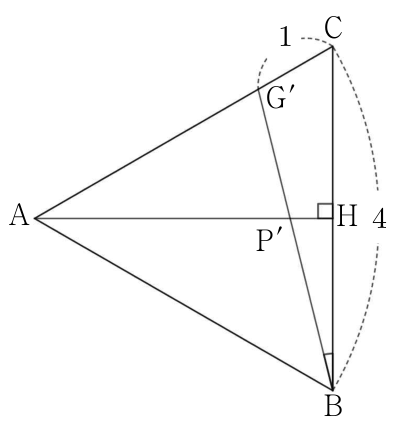
삼각형 ABC에서 선분 AH와 BG′의 교점
+6점 · 삼각형 ABC에서 AP′‾\displaystyle \overline{\mathrm{AP}^{\prime}} 또는 P′H‾\displaystyle \overline{\mathrm P^{\prime}\mathrm H}의 길이를 구할 수 있다.

삼각형 BCG′에서 코사인법칙에 의해 BG′‾\displaystyle \overline{\mathrm{BG}^{\prime}}는BG′‾2=42+12−2×4×1×cos⁡60∘=16+1−4=13\displaystyle \overline{\mathrm{BG}^{\prime}}^2=4^2+1^2-2\times4\times1\times\cos60^\circ=16+1-4=13이므로 BG′‾=13\displaystyle \overline{\mathrm{BG}^{\prime}}=\sqrt{13}이다.AP′‾:P′H‾=t:1  (t>0),  G′P′‾:P′B‾=m:1  (m>0)\displaystyle \overline{\mathrm{AP}^{\prime}}:\overline{\mathrm P^{\prime}\mathrm H}=t:1\;(t>0),\;\overline{\mathrm G^{\prime}\mathrm P^{\prime}}:\overline{\mathrm P^{\prime}\mathrm B}=m:1\;(m>0)이라 하자.BG′‾=13,  AH‾=32×4=23\displaystyle \overline{\mathrm{BG}^{\prime}}=\sqrt{13},\;\overline{\mathrm{AH}}=\frac{\sqrt3}2\times4=2\sqrt3이므로P′H‾=23t+1,  P′B‾=13m+1\displaystyle \overline{\mathrm P^{\prime}\mathrm H}=\frac{2\sqrt3}{t+1},\;\overline{\mathrm P^{\prime}\mathrm B}=\frac{\sqrt{13}}{m+1}삼각형 BHP′은 ∠BHP′=90∘\displaystyle \angle\mathrm{BHP}^{\prime}=90^\circ인 직각삼각형이므로 cos⁡(∠P′BH)=2P′B‾=213m+1=213(m+1)13\displaystyle \cos(\angle\mathrm P^{\prime}\mathrm{BH})=\frac2{\overline{\mathrm P^{\prime}\mathrm B}}=\frac2{\dfrac{\sqrt{13}}{m+1}}=\frac{2\sqrt{13}(m+1)}{13}삼각형 BCG′에서 BG′‾=13,  BC‾=4,  CG′‾=1\displaystyle \overline{\mathrm{BG}^{\prime}}=\sqrt{13},\;\overline{\mathrm{BC}}=4,\;\overline{\mathrm{CG}^{\prime}}=1이므로 코사인법칙에 의해cos⁡(∠G′BC)=(13)2+42−122×13×4=71326\displaystyle \cos(\angle\mathrm G^{\prime}\mathrm{BC})=\frac{(\sqrt{13})^2+4^2-1^2}{2\times\sqrt{13}\times4}=\frac{7\sqrt{13}}{26}이다.cos⁡(∠P′BH)=cos⁡(∠G′BC)\displaystyle \cos(\angle\mathrm P^{\prime}\mathrm{BH})=\cos(\angle\mathrm G^{\prime}\mathrm{BC})이므로 213(m+1)13=71326\displaystyle \frac{2\sqrt{13}(m+1)}{13}=\frac{7\sqrt{13}}{26}에서m=34\displaystyle m=\frac34이고 cos⁡(∠P′BH)=71326\displaystyle \cos(\angle\mathrm P^{\prime}\mathrm{BH})=\frac{7\sqrt{13}}{26}이다.sin⁡(∠P′BH)=1−cos⁡2(∠P′BH)=1−(71326)2=3926\displaystyle \sin(\angle\mathrm P^{\prime}\mathrm{BH})=\sqrt{1-\cos^2(\angle\mathrm P^{\prime}\mathrm{BH})}=\sqrt{1-\left(\frac{7\sqrt{13}}{26}\right)^2}=\frac{\sqrt{39}}{26}삼각형 BHP′은 ∠BHP′=90∘\displaystyle \angle\mathrm{BHP}^{\prime}=90^\circ인 직각삼각형이므로 sin⁡(∠P′BH)=P′H‾P′B‾=23t+14137=73926(t+1)\displaystyle \sin(\angle\mathrm P^{\prime}\mathrm{BH})=\frac{\overline{\mathrm P^{\prime}\mathrm H}}{\overline{\mathrm P^{\prime}\mathrm B}}=\frac{\dfrac{2\sqrt3}{t+1}}{\dfrac{4\sqrt{13}}7}=\frac{7\sqrt{39}}{26(t+1)}

+2점 · AP′‾:P′H‾\displaystyle \overline{\mathrm{AP}^{\prime}}:\overline{\mathrm P^{\prime}\mathrm H}의 비율을 구할 수 있다.

이므로 3926=73926(t+1)\displaystyle \frac{\sqrt{39}}{26}=\frac{7\sqrt{39}}{26(t+1)}에서 t=6\displaystyle t=6이다.

+6점 · 넓이 조건으로부터 점 R은 직선 PQ를 축으로 하고 축과의 거리가 1인 원기둥 위에 있어야 함을 서술할 수 있다.

[3-2]두 점 P, Q는 각각 선분 BG, 선분 HI 위의 점이므로 두 점 P, Q에서 평면 ABC에 내린 수선의 발은 점 P′이다.즉, 직선 PQ와 평면 EGI의 교점은 선분 EG 위에 있으므로 삼각형 EGI 내부의 점 R은 직선 PQ 위의 점이 아니다.삼각형 EGI 내부의 점 R에서 직선 PQ까지의 거리를 r  (r>0)\displaystyle r\;(r>0)라 하면 삼각형 PQR은 밑변의 길이가 PQ‾=267\displaystyle \overline{\mathrm{PQ}}=\frac{26}7이고높이가 r\displaystyle r인 삼각형이다. 즉, 삼각형 PQR의 넓이는 267×r×12=137r\displaystyle \frac{26}7\times r\times\frac12=\frac{13}7r이고 137r=137\displaystyle \frac{13}7r=\frac{13}7에서 r=1\displaystyle r=1점 R이 나타내는 도형은 삼각형 EGI 내부의 점 중에서 직선 PQ까지의 거리가 1인 점들이 나타내는 도형이다.
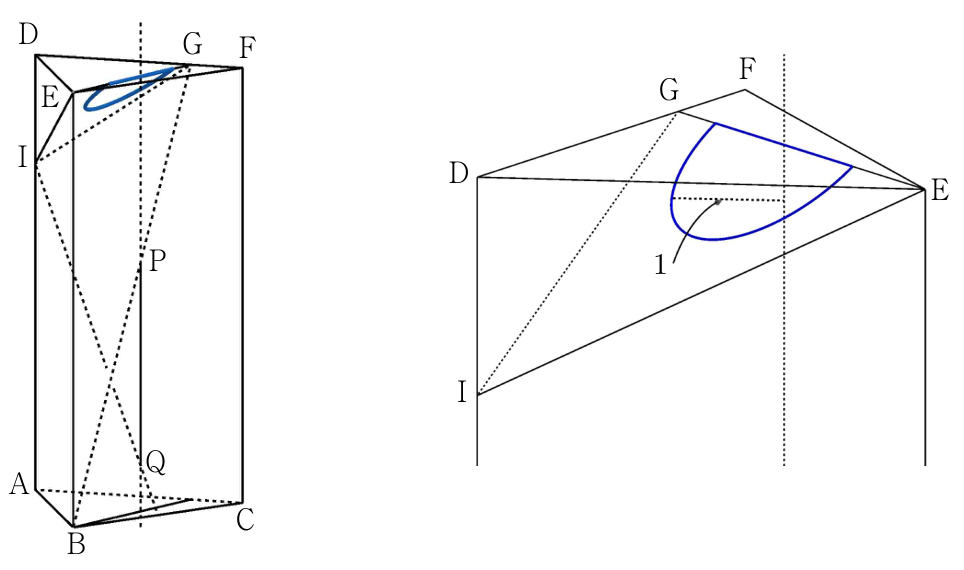
직선 PQ까지 거리가 1인 점들이 이루는 도형
+6점 · 점 R이 나타내는 도형의 평면 ABC 위로의 정사영은 중심이 점 P′이고 삼각형 ABG′ 내부에 있는 반지름의 길이가 1인 반원임을 서술할 수 있다.

한편 AP′‾:P′H‾=6:1\displaystyle \overline{\mathrm{AP}^{\prime}}:\overline{\mathrm P^{\prime}\mathrm H}=6:1이므로 AP′‾=67×23=1237\displaystyle \overline{\mathrm{AP}^{\prime}}=\frac67\times2\sqrt3=\frac{12\sqrt3}7이다.점 P′에서 직선 AC에 내린 수선의 발을 J라 하면 ∠P′AJ=30∘\displaystyle \angle\mathrm P^{\prime}\mathrm{AJ}=30^\circ이고 직선 AP′는 ∠CAB\displaystyle \angle\mathrm{CAB}의 이등분선이므로 점 P′에서 두 직선 AB, AC까지의 거리는 모두 선분 P′J의 길이와 같다.P′J‾=AP′‾×sin⁡30∘=1237×12=637\displaystyle \overline{\mathrm P^{\prime}\mathrm J}=\overline{\mathrm{AP}^{\prime}}\times\sin30^\circ=\frac{12\sqrt3}7\times\frac12=\frac{6\sqrt3}7이고 637=1087>497=1\displaystyle \frac{6\sqrt3}7=\frac{\sqrt{108}}7>\frac{\sqrt{49}}7=1이므로 삼각형 EGI내부의 점 R에 대하여 삼각형 PQR의 넓이가 137\displaystyle \frac{13}7이 되도록 하는 모든 점 R이 나타내는 도형을 D\displaystyle D라 하면 도형 D\displaystyle D의 평면 ABC 위로의 정사영은 중심이 P′이고 반지름의 길이가 1이며 삼각형 ABG′ 내부에 있는 반원이다.
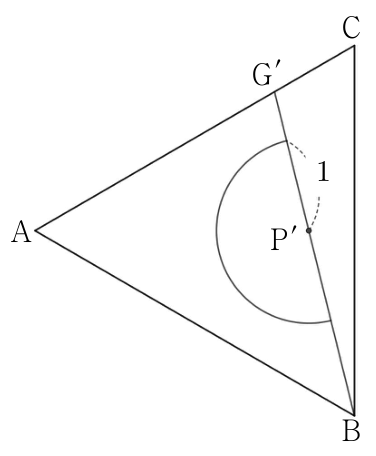
도형 D의 평면 ABC 위로의 정사영인 반원
+8점 · 평면 ABC와 평면 EGI가 이루는 이면각 θ\displaystyle \theta에 대한 cos⁡θ\displaystyle \cos\theta의 값을 구할 수 있다.

도형 D\displaystyle D와 선분 EG로 둘러싸인 부분의 넓이를 S\displaystyle S라 하고, 평면 EGI와 평면 ABC가 이루는 각의 크기를θ  (0∘≤θ≤90∘)\displaystyle \theta\;(0^\circ\le\theta\le90^\circ)라 하면 S×cos⁡θ=π2\displaystyle S\times\cos\theta=\frac\pi2이다.한편 삼각형 PBP′와 삼각형 GBG′는 서로 닮음이고 닮음비는 4:7\displaystyle 4:7이므로 PP′‾=8×47=327\displaystyle \overline{\mathrm{PP}^{\prime}}=8\times\frac47=\frac{32}7이고삼각형 QHP′와 삼각형 IHA는 서로 닮음이고 닮음비는 1:7\displaystyle 1:7이므로 QP′‾=17AI‾\displaystyle \overline{\mathrm{QP}^{\prime}}=\frac17\overline{\mathrm{AI}}이다.PQ‾=PP′‾−QP′‾=17(32−AI‾)=267\displaystyle \overline{\mathrm{PQ}}=\overline{\mathrm{PP}^{\prime}}-\overline{\mathrm{QP}^{\prime}}=\frac17(32-\overline{\mathrm{AI}})=\frac{26}7이므로 AI‾=6\displaystyle \overline{\mathrm{AI}}=6이다.삼각형 EGI에서 GI‾=DG‾2+DI‾2=32+22=13,  EI‾=DE‾2+DI‾2=42+22=25\displaystyle \overline{\mathrm{GI}}=\sqrt{\overline{\mathrm{DG}}^2+\overline{\mathrm{DI}}^2}=\sqrt{3^2+2^2}=\sqrt{13},\;\overline{\mathrm{EI}}=\sqrt{\overline{\mathrm{DE}}^2+\overline{\mathrm{DI}}^2}=\sqrt{4^2+2^2}=2\sqrt5,GE‾=13\displaystyle \overline{\mathrm{GE}}=\sqrt{13}이므로 삼각형 EGI는 GI‾=GE‾=13\displaystyle \overline{\mathrm{GI}}=\overline{\mathrm{GE}}=\sqrt{13}인 이등변삼각형이고 선분 EI를 밑변이라 하면높이는 (13)2−(5)2=22\displaystyle \sqrt{(\sqrt{13})^2-(\sqrt5)^2}=2\sqrt2이므로 삼각형 EGI의 넓이는 25×22×12=210\displaystyle 2\sqrt5\times2\sqrt2\times\frac12=2\sqrt{10}이다.삼각형 EGI의 평면 ABC 위로의 정사영은 삼각형 BG′A이고 그 넓이는 34×42×34=33\displaystyle \frac{\sqrt3}4\times4^2\times\frac34=3\sqrt3이므로210×cos⁡θ=33\displaystyle 2\sqrt{10}\times\cos\theta=3\sqrt3에서 cos⁡θ=33020\displaystyle \cos\theta=\frac{3\sqrt{30}}{20}

+5점 · 정사영을 이용하여 도형의 넓이를 구할 수 있다.

따라서 S×33020=π2\displaystyle S\times\frac{3\sqrt{30}}{20}=\frac\pi2에서 S=30π9\displaystyle S=\frac{\sqrt{30}\pi}9이다.

첨삭 사례

아직 등록된 첨삭 사례가 없습니다.

질문과 답변 · 0개질문과 답변 · 고정 0개

아직 등록된 질문이 없습니다. 질문 작성은 멤버십 회원만 가능합니다.