1단계 · <2-1>에서 정적분을 계산할 수 있다. ■ 2-1 함수 f ( x ) \displaystyle f(x) f ( x ) a 1 \displaystyle a_1 a 1 a n \displaystyle a_n a n ∫ a 1 a n 2 x e 2 − 1 e x 2 d x = ∫ a 1 a 2 2 x e 2 − 1 e x 2 d x + ∫ a 2 a 3 2 x e 2 − 1 e x 2 d x + ⋯ + ∫ a n − 1 a n 2 x e 2 − 1 e x 2 d x = e + e 3 + ⋯ + e 2 n − 3 \displaystyle \int_{a_1}^{a_n}\frac{2x}{e^2-1}e^{x^2}\,dx=\int_{a_1}^{a_2}\frac{2x}{e^2-1}e^{x^2}\,dx+\int_{a_2}^{a_3}\frac{2x}{e^2-1}e^{x^2}\,dx+\cdots+\int_{a_{n-1}}^{a_n}\frac{2x}{e^2-1}e^{x^2}\,dx=e+e^3+\cdots+e^{2n-3} ∫ a 1 a n e 2 − 1 2 x e x 2 d x = ∫ a 1 a 2 e 2 − 1 2 x e x 2 d x + ∫ a 2 a 3 e 2 − 1 2 x e x 2 d x + ⋯ + ∫ a n − 1 a n e 2 − 1 2 x e x 2 d x = e + e 3 + ⋯ + e 2 n − 3
1단계 · <2-1>에서 정적분을 계산할 수 있다. 2단계 · <2-1>에서 등비수열의 합을 구할 수 있다. 1 e 2 − 1 ( e a n 2 − e ) = ∑ k = 1 n − 1 e 2 k − 1 = 1 e 2 − 1 ( e 2 n − 1 − e ) \displaystyle \frac1{e^2-1}(e^{a_n^2}-e)=\sum_{k=1}^{n-1}e^{2k-1}=\frac1{e^2-1}(e^{2n-1}-e) e 2 − 1 1 ( e a n 2 − e ) = k = 1 ∑ n − 1 e 2 k − 1 = e 2 − 1 1 ( e 2 n − 1 − e )
3단계 · <2-1>에서 정적분의 성질을 이용하여 a n \displaystyle a_n a n 따라서 a n 2 = 2 n − 1 \displaystyle a_n^2=2n-1 a n 2 = 2 n − 1 a n = 2 n − 1 \displaystyle a_n=\sqrt{2n-1} a n = 2 n − 1
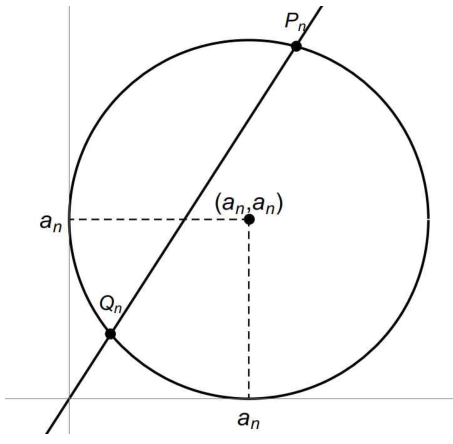
4단계 · <2-2>에서 점과 직선 사이의 거리를 구할 수 있다. ■ 2-2 점 ( a n , a n ) \displaystyle (a_n,a_n) ( a n , a n ) ( tan 1 n ) x − y = 0 \displaystyle \left(\tan\frac1n\right)x-y=0 ( tan n 1 ) x − y = 0 d n \displaystyle d_n d n d n = ∣ ( tan 1 n ) a n − a n ∣ tan 2 1 n + 1 \displaystyle d_n=\frac{\left|\left(\tan\frac1n\right)a_n-a_n\right|}{\sqrt{\tan^2\frac1n+1}} d n = tan 2 n 1 + 1 ( tan n 1 ) a n − a n 이다.
5단계 · <2-2>에서 선분의 길이 l n \displaystyle l_n l n 한편 l n = 2 a n 2 − d n 2 \displaystyle l_n=2\sqrt{a_n^2-d_n^2} l n = 2 a n 2 − d n 2 l n 2 = 4 ( a n 2 − d n 2 ) = 4 ( a n 2 − a n 2 ( tan 1 n − 1 ) 2 1 + tan 2 1 n ) \displaystyle \begin{aligned}l_n^2&=4(a_n^2-d_n^2)\\&=4\left(a_n^2-\frac{a_n^2\left(\tan\frac1n-1\right)^2}{1+\tan^2\frac1n}\right)\end{aligned} l n 2 = 4 ( a n 2 − d n 2 ) = 4 ( a n 2 − 1 + tan 2 n 1 a n 2 ( tan n 1 − 1 ) 2 ) 이다. 이때 삼각함수의 성질에 의하여 1 + tan 2 1 n = sec 2 1 n \displaystyle 1+\tan^2\frac1n=\sec^2\frac1n 1 + tan 2 n 1 = sec 2 n 1 4 ( a n 2 − a n 2 ( tan 1 n − 1 ) 2 1 + tan 2 1 n ) = 4 a n 2 ( 1 − ( tan 1 n − 1 ) 2 sec 2 1 n ) = 8 a n 2 ( tan 1 n sec 2 1 n ) = 8 a n 2 ( sin 1 n cos 1 n ) \displaystyle 4\left(a_n^2-\frac{a_n^2\left(\tan\frac1n-1\right)^2}{1+\tan^2\frac1n}\right)=4a_n^2\left(1-\frac{\left(\tan\frac1n-1\right)^2}{\sec^2\frac1n}\right)=8a_n^2\left(\frac{\tan\frac1n}{\sec^2\frac1n}\right)=8a_n^2\left(\sin\frac1n\cos\frac1n\right) 4 ( a n 2 − 1 + tan 2 n 1 a n 2 ( tan n 1 − 1 ) 2 ) = 4 a n 2 ( 1 − sec 2 n 1 ( tan n 1 − 1 ) 2 ) = 8 a n 2 ( sec 2 n 1 tan n 1 ) = 8 a n 2 ( sin n 1 cos n 1 ) 이다.
6단계 · <2-2>에서 삼각함수의 극한을 이용하여 극한값을 구할 수 있다. 또한 a n = 2 n − 1 \displaystyle a_n=\sqrt{2n-1} a n = 2 n − 1 l n 2 = 8 ( 2 n − 1 ) ( sin 1 n cos 1 n ) \displaystyle l_n^2=8(2n-1)\left(\sin\frac1n\cos\frac1n\right) l n 2 = 8 ( 2 n − 1 ) ( sin n 1 cos n 1 ) 이다. 이때, t = 1 n \displaystyle t=\frac1n t = n 1 n → ∞ \displaystyle n\to\infty n → ∞ t → 0 \displaystyle t\to0 t → 0 lim n → ∞ l n 2 = lim n → ∞ 8 ( 2 n − 1 ) ( sin 1 n cos 1 n ) = lim t → 0 8 ( 2 t − 1 ) ( sin t cos t ) = lim t → 0 8 ( 2 − t ) sin t t cos t = 16 \displaystyle \begin{aligned}\lim_{n\to\infty}l_n^2&=\lim_{n\to\infty}8(2n-1)\left(\sin\frac1n\cos\frac1n\right)=\lim_{t\to0}8\left(\frac2t-1\right)(\sin t\cos t)\\&=\lim_{t\to0}8(2-t)\frac{\sin t}{t}\cos t=16\end{aligned} n → ∞ lim l n 2 = n → ∞ lim 8 ( 2 n − 1 ) ( sin n 1 cos n 1 ) = t → 0 lim 8 ( t 2 − 1 ) ( sin t cos t ) = t → 0 lim 8 ( 2 − t ) t sin t cos t = 16 이다.
채점 기준 배점 위의 6가지 기준을 모두 충족시키고 논리 전개가 완벽한 경우 1등급 위의 6가지 기준을 모두 충족하나 논리 전개나 표현력이 다소 떨어지는 경우 2등급 위의 6가지 기준 중 5가지 요건을 만족하는 경우 3등급 위의 6가지 기준 중 ③과 ⑥ 요건을 충족시키고 나머지 요건 중 2가지를 만족시키는 경우 4등급 위의 6가지 기준 중 4가지 요건을 만족하는 경우(4등급 기준 제외) 5등급 위의 6가지 기준 중 3가지 요건을 만족하는 경우 6등급 위의 6가지 기준 중 2가지 요건을 만족하는 경우 7등급 위의 6가지 기준 중 1가지 요건을 만족하는 경우 8등급 위의 6가지 기준을 전혀 충족시키지 못한 경우 9등급
 수리논술, 배움에서 논증의 완성까지.