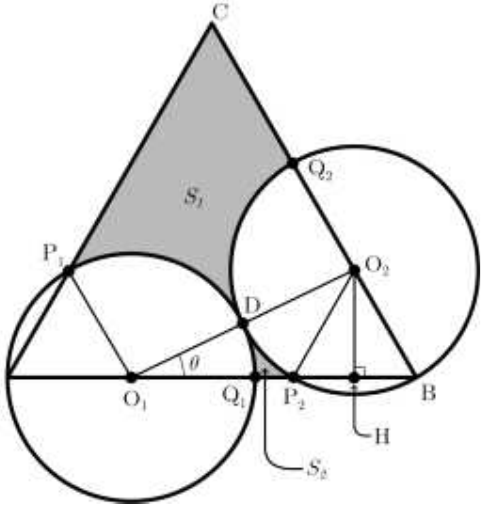
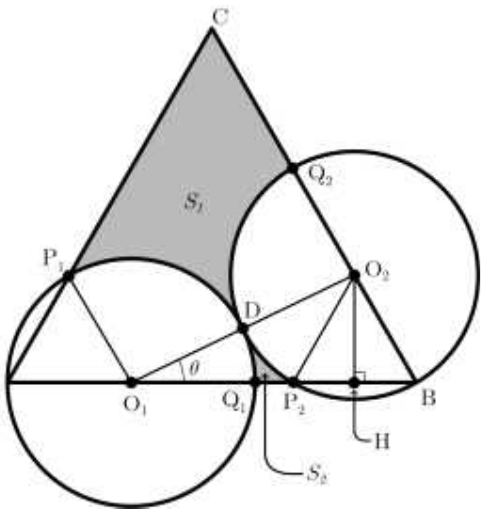
(문제 2-1) 우선 S 1 + S 2 \displaystyle S_{1}+S_{2} S 1 + S 2 S 2 \displaystyle S_{2} S 2 S 1 \displaystyle S_{1} S 1
< 1 > S 1 + S 2 \displaystyle S_{1}+S_{2} S 1 + S 2 영역 S 1 + S 2 \displaystyle S_{1}+S_{2} S 1 + S 2 A O 1 P 1 \displaystyle \mathrm{AO}_{1}\mathrm{P}_{1} AO 1 P 1 B O 2 P 2 \displaystyle \mathrm{BO}_{2}\mathrm{P}_{2} BO 2 P 2 O 1 P 1 Q 1 \displaystyle \mathrm{O}_{1}\mathrm{P}_{1}\mathrm{Q}_{1} O 1 P 1 Q 1 O 2 P 2 Q 2 \displaystyle \mathrm{O}_{2}\mathrm{P}_{2}\mathrm{Q}_{2} O 2 P 2 Q 2 O 1 B O 2 \displaystyle \mathrm{O}_{1}\mathrm{BO}_{2} O 1 BO 2 O 1 B ‾ = x \displaystyle \overline{\mathrm{O}_{1}\mathrm{B}}=x O 1 B = x O 1 O 2 ‾ = 4 \displaystyle \overline{\mathrm{O}_{1}\mathrm{O}_{2}}=4 O 1 O 2 = 4 O 2 B ‾ = 2 \displaystyle \overline{\mathrm{O}_{2}\mathrm{B}}=2 O 2 B = 2 ∠ B = π 3 \displaystyle \angle B=\frac{\pi}{3} ∠ B = 3 π 4 2 = x 2 + 2 2 − 4 x cos π 3 \displaystyle 4^{2}=x^{2}+2^{2}-4x\cos\frac{\pi}{3} 4 2 = x 2 + 2 2 − 4 x cos 3 π 0 < x = 13 + 1 \displaystyle 0<x=\sqrt{13}+1 0 < x = 13 + 1 13 + 3 \displaystyle \sqrt{13}+3 13 + 3 A O 1 P 1 \displaystyle \mathrm{AO}_{1}\mathrm{P}_{1} AO 1 P 1 B O 2 P 2 \displaystyle \mathrm{BO}_{2}\mathrm{P}_{2} BO 2 P 2 O 1 P 1 Q 1 \displaystyle \mathrm{O}_{1}\mathrm{P}_{1}\mathrm{Q}_{1} O 1 P 1 Q 1 O 2 P 2 Q 2 \displaystyle \mathrm{O}_{2}\mathrm{P}_{2}\mathrm{Q}_{2} O 2 P 2 Q 2 2 π 3 \displaystyle \frac{2\pi}{3} 3 2 π S 1 + S 2 \displaystyle S_{1}+S_{2} S 1 + S 2 Correction. 여기서 부채꼴의 ‘원주각’은 ‘중심각’의 오기다. 그러나 원칙에 따라 원문 표기를 그대로 실었다.( 13 + 3 ) 2 3 4 − 2 × ( 2 2 3 4 ) − 2 × ( 1 2 × 2 2 × 2 π 3 ) = ( 22 + 6 13 ) 3 4 − 2 3 − 8 π 3 = 7 3 2 + 3 39 2 − 8 π 3 \displaystyle \begin{aligned} & \frac{(\sqrt{13}+3)^{2}\sqrt{3}}{4}-2\times\left(\frac{2^{2}\sqrt{3}}{4}\right)-2\times\left(\frac{1}{2}\times2^{2}\times\frac{2\pi}{3}\right) \\ &= \frac{(22+6\sqrt{13})\sqrt{3}}{4}-2\sqrt{3}-\frac{8\pi}{3}=\frac{7\sqrt{3}}{2}+\frac{3\sqrt{39}}{2}-\frac{8\pi}{3} \end{aligned} 4 ( 13 + 3 ) 2 3 − 2 × ( 4 2 2 3 ) − 2 × ( 2 1 × 2 2 × 3 2 π ) = 4 ( 22 + 6 13 ) 3 − 2 3 − 3 8 π = 2 7 3 + 2 3 39 − 3 8 π
< 2 > S 2 \displaystyle S_{2} S 2 영역 S 2 \displaystyle S_{2} S 2 H O 1 O 2 \displaystyle \mathrm{HO}_{1}\mathrm{O}_{2} HO 1 O 2 H O 2 P 2 \displaystyle \mathrm{HO}_{2}\mathrm{P}_{2} HO 2 P 2 O 1 Q 1 D \displaystyle \mathrm{O}_{1}\mathrm{Q}_{1}\mathrm{D} O 1 Q 1 D O 2 P 2 D \displaystyle \mathrm{O}_{2}\mathrm{P}_{2}\mathrm{D} O 2 P 2 D H O 1 O 2 \displaystyle \mathrm{HO}_{1}\mathrm{O}_{2} HO 1 O 2 O 1 B ‾ − H B ‾ = x − 1 = 13 \displaystyle \overline{\mathrm{O}_{1}\mathrm{B}}-\overline{\mathrm{HB}}=x-1=\sqrt{13} O 1 B − HB = x − 1 = 13 O 2 H ‾ = 3 \displaystyle \overline{\mathrm{O}_{2}\mathrm{H}}=\sqrt{3} O 2 H = 3 H O 2 P 2 \displaystyle \mathrm{HO}_{2}\mathrm{P}_{2} HO 2 P 2 H P 2 ‾ = 1 \displaystyle \overline{\mathrm{HP}_{2}}=1 HP 2 = 1 O 2 H ‾ = 3 \displaystyle \overline{\mathrm{O}_{2}\mathrm{H}}=\sqrt{3} O 2 H = 3 O 1 Q 1 D \displaystyle \mathrm{O}_{1}\mathrm{Q}_{1}\mathrm{D} O 1 Q 1 D θ \displaystyle \theta θ O 2 P 2 D \displaystyle \mathrm{O}_{2}\mathrm{P}_{2}\mathrm{D} O 2 P 2 D π 3 − θ \displaystyle \frac{\pi}{3}-\theta 3 π − θ S 2 \displaystyle S_{2} S 2 Correction. 여기서 부채꼴의 ‘원주각’은 ‘중심각’의 오기다. 그러나 원칙에 따라 원문 표기를 그대로 실었다.1 2 × 13 × 3 − 1 2 × 1 × 3 − 1 2 × 2 2 × θ − 1 2 × 2 2 × ( π 3 − θ ) = 39 2 − 3 2 − 2 π 3 \displaystyle \begin{aligned} & \frac{1}{2}\times\sqrt{13}\times\sqrt{3}-\frac{1}{2}\times1\times\sqrt{3}-\frac{1}{2}\times2^{2}\times\theta-\frac{1}{2}\times2^{2}\times\left(\frac{\pi}{3}-\theta\right) \\ &= \frac{\sqrt{39}}{2}-\frac{\sqrt{3}}{2}-\frac{2\pi}{3} \end{aligned} 2 1 × 13 × 3 − 2 1 × 1 × 3 − 2 1 × 2 2 × θ − 2 1 × 2 2 × ( 3 π − θ ) = 2 39 − 2 3 − 3 2 π
< 3 > S 1 \displaystyle S_{1} S 1 S 1 + S 2 \displaystyle S_{1}+S_{2} S 1 + S 2 7 3 2 + 3 39 2 − 8 π 3 \displaystyle \frac{7\sqrt{3}}{2}+\frac{3\sqrt{39}}{2}-\frac{8\pi}{3} 2 7 3 + 2 3 39 − 3 8 π S 2 \displaystyle S_{2} S 2 39 2 − 3 2 − 2 π 3 \displaystyle \frac{\sqrt{39}}{2}-\frac{\sqrt{3}}{2}-\frac{2\pi}{3} 2 39 − 2 3 − 3 2 π S 1 \displaystyle S_{1} S 1 ( 7 3 2 + 3 39 2 − 8 π 3 ) − ( 39 2 − 3 2 − 2 π 3 ) = 4 3 + 39 − 2 π \displaystyle \left(\frac{7\sqrt{3}}{2}+\frac{3\sqrt{39}}{2}-\frac{8\pi}{3}\right)-\left(\frac{\sqrt{39}}{2}-\frac{\sqrt{3}}{2}-\frac{2\pi}{3}\right)=4\sqrt{3}+\sqrt{39}-2\pi ( 2 7 3 + 2 3 39 − 3 8 π ) − ( 2 39 − 2 3 − 3 2 π ) = 4 3 + 39 − 2 π
(문제 2-2) 살수반경의 최솟값 r \displaystyle r r C P 1 ‾ \displaystyle \overline{\mathrm{CP}_{1}} CP 1 C D ‾ \displaystyle \overline{\mathrm{CD}} CD C P 1 ‾ 2 \displaystyle \overline{\mathrm{CP}_{1}}^{2} CP 1 2 C D ‾ 2 \displaystyle \overline{\mathrm{CD}}^{2} CD 2
< 1 > C P 1 ‾ 2 \displaystyle \overline{\mathrm{CP}_{1}}^{2} CP 1 2 C P 1 ‾ \displaystyle \overline{\mathrm{CP}_{1}} CP 1 O 1 \displaystyle \mathrm{O}_{1} O 1 C P 1 ‾ 2 = ( 13 + 1 ) 2 = 14 + 2 13 \displaystyle \overline{\mathrm{CP}_{1}}^{2}=(\sqrt{13}+1)^{2}=14+2\sqrt{13} CP 1 2 = ( 13 + 1 ) 2 = 14 + 2 13
< 2 > C D ‾ 2 \displaystyle \overline{\mathrm{CD}}^{2} CD 2 삼각형 O 2 C D \displaystyle \mathrm{O}_{2}\mathrm{CD} O 2 CD O 2 C ‾ = 13 + 1 \displaystyle \overline{\mathrm{O}_{2}\mathrm{C}}=\sqrt{13}+1 O 2 C = 13 + 1 O 2 D ‾ = 2 \displaystyle \overline{\mathrm{O}_{2}\mathrm{D}}=2 O 2 D = 2 ∠ C O 2 D = θ + π 3 \displaystyle \angle CO_{2}D=\theta+\frac{\pi}{3} ∠ C O 2 D = θ + 3 π C D ‾ 2 = ( 13 + 1 ) 2 + 2 2 − 2 × ( 13 + 1 ) × 2 × cos ( θ + π 3 ) = ( 14 + 2 13 ) + 4 − 4 ( 13 + 1 ) cos ( θ + π 3 ) \displaystyle \begin{aligned} \overline{\mathrm{CD}}^{2} &= (\sqrt{13}+1)^{2}+2^{2}-2\times(\sqrt{13}+1)\times2\times\cos\left(\theta+\frac{\pi}{3}\right) \\ &= (14+2\sqrt{13})+4-4(\sqrt{13}+1)\cos\left(\theta+\frac{\pi}{3}\right) \end{aligned} CD 2 = ( 13 + 1 ) 2 + 2 2 − 2 × ( 13 + 1 ) × 2 × cos ( θ + 3 π ) = ( 14 + 2 13 ) + 4 − 4 ( 13 + 1 ) cos ( θ + 3 π ) 삼각함수의 덧셈정리에 의해서 cos ( θ + π 3 ) = cos θ cos π 3 − sin θ sin π 3 = cos θ − 3 sin θ 2 \displaystyle \cos\left(\theta+\frac{\pi}{3}\right)=\cos\theta\cos\frac{\pi}{3}-\sin\theta\sin\frac{\pi}{3}=\frac{\cos\theta-\sqrt{3}\sin\theta}{2} cos ( θ + 3 π ) = cos θ cos 3 π − sin θ sin 3 π = 2 cos θ − 3 sin θ 직각삼각형 H O 1 O 2 \displaystyle \mathrm{HO}_{1}\mathrm{O}_{2} HO 1 O 2 sin θ = 3 4 \displaystyle \sin\theta=\frac{\sqrt{3}}{4} sin θ = 4 3 cos θ = 13 4 \displaystyle \cos\theta=\frac{\sqrt{13}}{4} cos θ = 4 13 cos ( θ + π 3 ) = 1 2 × ( 13 4 − 3 × 3 4 ) = 13 − 3 8 \displaystyle \cos\left(\theta+\frac{\pi}{3}\right)=\frac{1}{2}\times\left(\frac{\sqrt{13}}{4}-\sqrt{3}\times\frac{\sqrt{3}}{4}\right)=\frac{\sqrt{13}-3}{8} cos ( θ + 3 π ) = 2 1 × ( 4 13 − 3 × 4 3 ) = 8 13 − 3 따라서 C D ‾ 2 = ( 18 + 2 13 ) − 4 ( 13 + 1 ) cos ( θ + π 3 ) = ( 18 + 2 13 ) − 4 ( 13 + 1 ) × 13 − 3 8 = 13 + 3 13 \displaystyle \begin{aligned} \overline{\mathrm{CD}}^{2} &= (18+2\sqrt{13})-4(\sqrt{13}+1)\cos\left(\theta+\frac{\pi}{3}\right) \\ &= (18+2\sqrt{13})-4(\sqrt{13}+1)\times\frac{\sqrt{13}-3}{8} \\ &= 13+3\sqrt{13} \end{aligned} CD 2 = ( 18 + 2 13 ) − 4 ( 13 + 1 ) cos ( θ + 3 π ) = ( 18 + 2 13 ) − 4 ( 13 + 1 ) × 8 13 − 3 = 13 + 3 13
< 3 > C D ‾ 2 \displaystyle \overline{\mathrm{CD}}^{2} CD 2 C P 1 ‾ 2 \displaystyle \overline{\mathrm{CP}_{1}}^{2} CP 1 2 ( C D ‾ 2 − C P 1 ‾ 2 ) = ( 13 + 3 13 ) − ( 14 + 2 13 ) = 13 − 1 > 0 \displaystyle \left(\overline{\mathrm{CD}}^{2}-\overline{\mathrm{CP}_{1}}^{2}\right)=(13+3\sqrt{13})-(14+2\sqrt{13})=\sqrt{13}-1>0 ( CD 2 − CP 1 2 ) = ( 13 + 3 13 ) − ( 14 + 2 13 ) = 13 − 1 > 0 따라서 C D ‾ 2 > C P 1 ‾ 2 \displaystyle \overline{\mathrm{CD}}^{2}>\overline{\mathrm{CP}_{1}}^{2} CD 2 > CP 1 2 r 2 = C D ‾ 2 = 13 + 3 13 \displaystyle r^{2}=\overline{\mathrm{CD}}^{2}=13+3\sqrt{13} r 2 = CD 2 = 13 + 3 13
[문제 2-1] (15점) (상) 문제해결 방향과 계산이 명확하고 옳게 답을 구한경우 (중상) 문제해결 방향을 맞게 설정했지만 계산에 사소한 실수가 있는 경우 (중하) 문제해결 방향을 맞게 설정했지만 계산에 중요한 실수가 있거나 계산을 끝까지 마치지 못한 경우 (하) 잘못된 방향설정으로 답을 구하지 못한 경우
[문제 2-2] (15점) (상) 문제해결 방향과 계산이 명확하고 옳게 답을 구한경우 (중상) 문제해결 방향을 맞게 설정했지만 계산에 사소한 실수가 있는 경우 (중하) 문제해결 방향을 맞게 설정했지만 계산에 중요한 실수가 있거나 계산을 끝까지 마치지 못한 경우 (하) 잘못된 방향설정으로 답을 구하지 못한 경우
 수리논술, 배움에서 논증의 완성까지.