수리논술, 이게 다다.

자연계열 1번

오류 제보

문제

[문제1] 다음 제시문을 읽고 질문에 답하시오. (30점)

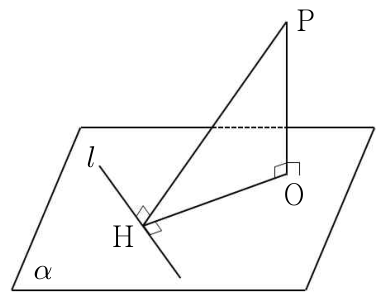
(가) 평면 α\displaystyle \alpha 위에 있지 않은 한 점 P\displaystyle \mathrm P와 평면 α\displaystyle \alpha 위의 직선 l\displaystyle l, 직선 l\displaystyle l 위의 한 점 H\displaystyle \mathrm H, 평면 α\displaystyle \alpha 위에있으면서 직선 l\displaystyle l 위에 있지 않은 점 O\displaystyle \mathrm O에 대하여 다음이 성립한다.1) PO‾⊥α\displaystyle \overline{\mathrm{PO}}\perp\alpha, OH‾⊥l\displaystyle \overline{\mathrm{OH}}\perp l이면 PH‾⊥l\displaystyle \overline{\mathrm{PH}}\perp l2) PO‾⊥α\displaystyle \overline{\mathrm{PO}}\perp\alpha, PH‾⊥l\displaystyle \overline{\mathrm{PH}}\perp l이면 OH‾⊥l\displaystyle \overline{\mathrm{OH}}\perp l3) PH‾⊥l\displaystyle \overline{\mathrm{PH}}\perp l, OH‾⊥l\displaystyle \overline{\mathrm{OH}}\perp l, PO‾⊥OH‾\displaystyle \overline{\mathrm{PO}}\perp\overline{\mathrm{OH}}이면 PO‾⊥α\displaystyle \overline{\mathrm{PO}}\perp\alpha

삼수선의 정리

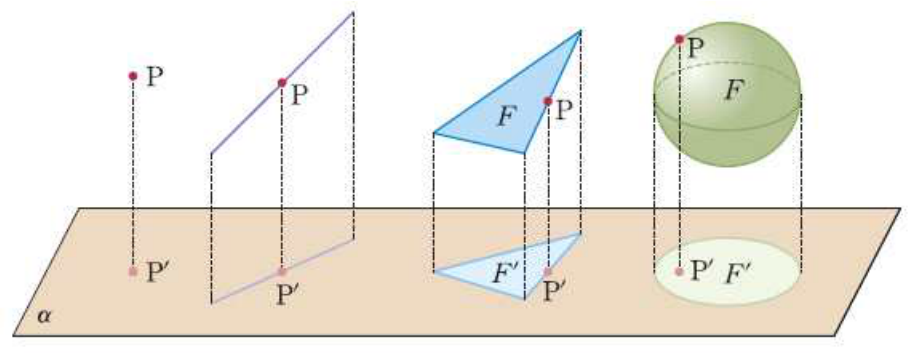
(나) 평면 α\displaystyle \alpha 위에 있지 않은 한 점 P\displaystyle \mathrm P에서 평면 α\displaystyle \alpha에 내린 수선의 발을 P′\displaystyle \mathrm P^{\prime}이라고 할 때, 점 P′\displaystyle \mathrm P^{\prime}을점 P\displaystyle \mathrm P의 평면 α\displaystyle \alpha 위로의 정사영이라고 한다. 일반적으로 도형 F\displaystyle F에 속하는 각 점의 평면 α\displaystyle \alpha 위로의 정사영으로 이루어진 도형 F′\displaystyle F^{\prime}을 도형 F\displaystyle F의 평면 α\displaystyle \alpha 위로의 정사영이라고 한다.

점과 도형의 평면 위로의 정사영

(다) 영벡터가 아닌 두 공간벡터 a⃗=(a1,a2,a3)\displaystyle \vec a=(a_1,a_2,a_3), b⃗=(b1,b2,b3)\displaystyle \vec b=(b_1,b_2,b_3)가 이루는 각의 크기가 θ\displaystyle \theta일 때cos⁡θ=a⃗⋅b⃗∣a⃗∣ ∣b⃗∣=a1b1+a2b2+a3b3a12+a22+a32b12+b22+b32\displaystyle \cos\theta=\frac{\vec a\cdot\vec b}{|\vec a|\,|\vec b|}=\frac{a_1b_1+a_2b_2+a_3b_3}{\sqrt{a_1^2+a_2^2+a_3^2}\sqrt{b_1^2+b_2^2+b_3^2}}

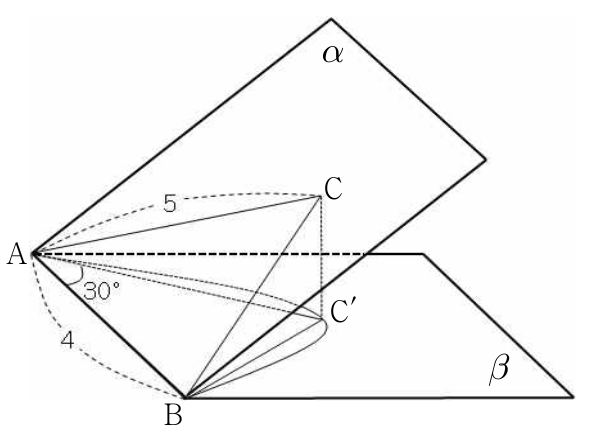
[논제 1] 그림과 같이 평면 α\displaystyle \alpha 위의 삼각형 ABC\displaystyle \mathrm{ABC}의 두꼭짓점 A\displaystyle \mathrm A, B\displaystyle \mathrm B는 두 평면 α\displaystyle \alpha와 β\displaystyle \beta의 교선 위에있고, 꼭짓점 C\displaystyle \mathrm C의 평면 β\displaystyle \beta 위로의 정사영 C′\displaystyle \mathrm C^{\prime}은 선분 AB\displaystyle \mathrm{AB}를 지름으로 하는 반원 위에 있다.AB‾=4\displaystyle \overline{\mathrm{AB}}=4, AC‾=5\displaystyle \overline{\mathrm{AC}}=5, ∠C′AB=30∘\displaystyle \angle\mathrm C^{\prime}\mathrm{AB}=30^\circ일 때, 두평면 α\displaystyle \alpha와 β\displaystyle \beta가 이루는 각의 크기가 θ\displaystyle \theta이다.cos⁡θ\displaystyle \cos\theta의 값을 구하시오. (10점)

두 평면 위의 삼각형과 정사영

[논제 2] 두 점 A(0,0,0)\displaystyle \mathrm A(0,0,0)과 B(1,1,1)\displaystyle \mathrm B(1,1,1)를 지나는 직선에 평행하고 점 (0,1,2)\displaystyle (0,1,2)를 지나는 직선 위의 점C\displaystyle \mathrm C가 있다. 점 C\displaystyle \mathrm C의 x\displaystyle x좌표는 −5\displaystyle -5보다 크고, 삼각형 ABC\displaystyle \mathrm{ABC}의 평면 2x−y+z+9=0\displaystyle 2x-y+z+9=0 위로의정사영을 삼각형 A′B′C′\displaystyle \mathrm A^{\prime}\mathrm B^{\prime}\mathrm C^{\prime}이라 할 때 사면체 A′B′C′C\displaystyle \mathrm A^{\prime}\mathrm B^{\prime}\mathrm C^{\prime}\mathrm C의 부피가 5\displaystyle 5이다. 점 C\displaystyle \mathrm C의 좌표를구하시오. (20점)

해설강의 준비중
+5점 · C′\displaystyle \mathrm C^{\prime}에서 AB‾\displaystyle \overline{\mathrm{AB}}에 내린 수선의 길이 HC′‾=3\displaystyle \overline{\mathrm{HC}^{\prime}}=\sqrt3을 제시

[논제1] 평면 β\displaystyle \beta 위의 점 C′\displaystyle \mathrm C^{\prime}가 반원 위에 있으므로 ∠AC′B\displaystyle \angle\mathrm{AC}^{\prime}\mathrm B는 직각이다. ∠BAC′\displaystyle \angle\mathrm{BAC}^{\prime}는 30∘\displaystyle 30^\circ이므로BC′‾=2\displaystyle \overline{\mathrm{BC}^{\prime}}=2, AC′‾=23\displaystyle \overline{\mathrm{AC}^{\prime}}=2\sqrt3이다. C′\displaystyle \mathrm C^{\prime}에서 AB‾\displaystyle \overline{\mathrm{AB}}에 내린 수선의 발을 H\displaystyle \mathrm H라고 하면,삼각형 ABC′\displaystyle \mathrm{ABC}^{\prime}의 넓이=23=12×4×HC′‾\displaystyle =2\sqrt3=\frac12\times4\times\overline{\mathrm{HC}^{\prime}}이므로, HC′‾=3\displaystyle \overline{\mathrm{HC}^{\prime}}=\sqrt3이다.

+5점 · cos⁡θ=HC′‾HC‾=34\displaystyle \cos\theta=\frac{\overline{\mathrm{HC}^{\prime}}}{\overline{\mathrm{HC}}}=\frac{\sqrt3}4을 제시

AC‾=5\displaystyle \overline{\mathrm{AC}}=5, AC′‾=23\displaystyle \overline{\mathrm{AC}^{\prime}}=2\sqrt3이므로 CC′‾=13\displaystyle \overline{\mathrm{CC}^{\prime}}=\sqrt{13}이고, HC‾=4\displaystyle \overline{\mathrm{HC}}=4이다.따라서 cos⁡θ=HC′‾HC‾=34\displaystyle \cos\theta=\frac{\overline{\mathrm{HC}^{\prime}}}{\overline{\mathrm{HC}}}=\frac{\sqrt3}4이다.

+5점 · cos⁡θ=∣n⃗1⋅n⃗2∣∣n⃗1∣ ∣n⃗2∣=∣2+2+1∣66=56\displaystyle \cos\theta=\frac{|\vec n_1\cdot\vec n_2|}{|\vec n_1|\,|\vec n_2|}=\frac{|2+2+1|}{\sqrt6\sqrt6}=\frac56를 제시

[논제2] 두 점 A\displaystyle \mathrm A와 B\displaystyle \mathrm B를 지나는 직선에 평행하고 점 (0,1,2)\displaystyle (0,1,2)를 지나는 직선 위의 임의의 점을C(t,t+1,t+2)\displaystyle \mathrm C(t,t+1,t+2)라고 하자.세 점 A\displaystyle \mathrm A, B\displaystyle \mathrm B, C\displaystyle \mathrm C를 지나는 평면의 방정식을 ax+by+cz+d=0\displaystyle ax+by+cz+d=0이라고 하면 d=0\displaystyle d=0이므로at+b(t+1)+c(t+2)=0\displaystyle at+b(t+1)+c(t+2)=0, 즉 (a+b+c)t+b+2c=0\displaystyle (a+b+c)t+b+2c=0이다. 그런데 a+b+c=0\displaystyle a+b+c=0이므로 b=−2c\displaystyle b=-2c, a=c\displaystyle a=c이다. 그러므로 세 점을 지나는 평면의 방정식은 x−2y+z=0\displaystyle x-2y+z=0이다. 따라서 두 평면이 이루는 각의 크기를 θ\displaystyle \theta (단, 0≤θ≤π2\displaystyle 0\le\theta\le\frac\pi2)라 하면,cos⁡θ=∣n⃗1⋅n⃗2∣∣n⃗1∣ ∣n⃗2∣=∣2+2+1∣66=56\displaystyle \cos\theta=\frac{|\vec n_1\cdot\vec n_2|}{|\vec n_1|\,|\vec n_2|}=\frac{|2+2+1|}{\sqrt6\sqrt6}=\frac56이다.(단, n⃗1\displaystyle \vec n_1, n⃗2\displaystyle \vec n_2는 각각 두 평면의 법선벡터이다.)

+5점 · 정사영 A′B′C′\displaystyle \mathrm A^{\prime}\mathrm B^{\prime}\mathrm C^{\prime}의 넓이 62cos⁡θ=5126\displaystyle \frac{\sqrt6}2\cos\theta=\frac5{12}\sqrt6을 제시

두 점 A\displaystyle \mathrm A, B\displaystyle \mathrm B를 지나는 직선과 점 (t,t+1,t+2)\displaystyle (t,t+1,t+2)를 지나는 직선은 평행하므로, 두 직선 사이의 거리를 구하기 위하여 먼저 두 직선 위의 점 (0,0,0)\displaystyle (0,0,0)과 점 (t,t+1,t+2)\displaystyle (t,t+1,t+2) 사이의 거리를 구하면(t−0)2+(t+1−0)2+(t+2−0)2=3(t+1)2+2\displaystyle \sqrt{(t-0)^2+(t+1-0)^2+(t+2-0)^2}=\sqrt{3(t+1)^2+2}이다. 따라서 t=−1\displaystyle t=-1일 때 최솟값을 가지므로 (0,0,0)\displaystyle (0,0,0)과 (−1,0,1)\displaystyle (-1,0,1) 사이의 거리를 구하면 2\displaystyle \sqrt2이다.그러므로 삼각형 ABC\displaystyle \mathrm{ABC}의 넓이는 62\displaystyle \frac{\sqrt6}2이며, 정사영 A′B′C′\displaystyle \mathrm A^{\prime}\mathrm B^{\prime}\mathrm C^{\prime}의 넓이는 62cos⁡θ=5126\displaystyle \frac{\sqrt6}2\cos\theta=\frac5{12}\sqrt6이다.

+5점 · 사면체 A′B′C′C\displaystyle \mathrm A^{\prime}\mathrm B^{\prime}\mathrm C^{\prime}\mathrm C의 높이 h=∣2t+10∣6\displaystyle h=\frac{|2t+10|}{\sqrt6}을 제시

정사영 A′B′C′\displaystyle \mathrm A^{\prime}\mathrm B^{\prime}\mathrm C^{\prime}을 밑면으로 하는 사면체 A′B′C′C\displaystyle \mathrm A^{\prime}\mathrm B^{\prime}\mathrm C^{\prime}\mathrm C의 높이는h=∣2t−(t+1)+(t+2)+9∣22+(−1)2+12=∣2t+10∣6\displaystyle h=\frac{|2t-(t+1)+(t+2)+9|}{\sqrt{2^2+(-1)^2+1^2}}=\frac{|2t+10|}{\sqrt6}

+5점 · 점 C(13,14,15)\displaystyle \mathrm C(13,14,15)를 제시

이다. 문제의 조건에서 사면체의 부피가 5이므로,V=13Ah=13×5126×∣2t+10∣6=5\displaystyle \begin{aligned}V&=\frac13Ah\\&=\frac13\times\frac5{12}\sqrt6\times\frac{|2t+10|}{\sqrt6}\\&=5\end{aligned}36=∣2t+10∣\displaystyle 36=|2t+10|이므로 t=13\displaystyle t=13 또는 t=−23\displaystyle t=-23이고, 이 중에 점 C\displaystyle \mathrm C의 x\displaystyle x좌표가 −5\displaystyle -5보다 크다는 조건을 만족시키는 t\displaystyle t의 값은 13\displaystyle 13이다. 그러므로 점 C\displaystyle \mathrm C의 좌표는 (13,14,15)\displaystyle (13,14,15)이다.

예시 답안의 내용 및 평가 기준의 내용과는 일치하지 않더라도 기술한 내용이 논리적으로 타당한 경우에는 평가위원의 판단에 따라 부분 점수를 부여할 수 있음.

첨삭 사례

아직 등록된 첨삭 사례가 없습니다.

질문과 답변 · 0개질문과 답변 · 고정 0개

아직 등록된 질문이 없습니다. 질문 작성은 멤버십 회원만 가능합니다.