+5점 · g ( x ) = t \displaystyle g(x)=t g ( x ) = t +5점 · ∫ 0 f ( 1 ) e g ( x ) d x = ∫ 0 1 ( e t + 1 ) d t = e \displaystyle \int_0^{f(1)}e^{g(x)}\,dx=\int_0^1(e^t+1)\,dt=e ∫ 0 f ( 1 ) e g ( x ) d x = ∫ 0 1 ( e t + 1 ) d t = e [논제 1] g ( x ) = t \displaystyle g(x)=t g ( x ) = t f \displaystyle f f g \displaystyle g g x = f ( t ) \displaystyle x=f(t) x = f ( t ) d x = f ′ ( t ) d t = ( 1 + e − t ) d t \displaystyle dx=f^{\prime}(t)\,dt=(1+e^{-t})\,dt d x = f ′ ( t ) d t = ( 1 + e − t ) d t f ( 0 ) = 0 \displaystyle f(0)=0 f ( 0 ) = 0 g ( 0 ) = 0 \displaystyle g(0)=0 g ( 0 ) = 0 g ( f ( 1 ) ) = 1 \displaystyle g(f(1))=1 g ( f ( 1 )) = 1 ∫ 0 f ( 1 ) e g ( x ) d x = ∫ 0 1 e t ( 1 + e − t ) d t = ∫ 0 1 ( e t + 1 ) d t = e \displaystyle \int_0^{f(1)}e^{g(x)}\,dx=\int_0^1e^t(1+e^{-t})\,dt=\int_0^1(e^t+1)\,dt=e ∫ 0 f ( 1 ) e g ( x ) d x = ∫ 0 1 e t ( 1 + e − t ) d t = ∫ 0 1 ( e t + 1 ) d t = e 이다.
+5점 · g ′ ( 0 ) = 1 f ′ ( g ( 0 ) ) = 1 2 \displaystyle g^{\prime}(0)=\frac1{f^{\prime}(g(0))}=\frac12 g ′ ( 0 ) = f ′ ( g ( 0 )) 1 = 2 1 [논제 2] 먼저, g ( 0 ) = 0 \displaystyle g(0)=0 g ( 0 ) = 0 f ′ ( x ) = 1 + e − x \displaystyle f^{\prime}(x)=1+e^{-x} f ′ ( x ) = 1 + e − x lim t → 0 g ( t ) t = lim t → 0 g ( t ) − g ( 0 ) t = g ′ ( 0 ) = 1 f ′ ( g ( 0 ) ) = 1 2 \displaystyle \lim_{t\to0}\frac{g(t)}t=\lim_{t\to0}\frac{g(t)-g(0)}t=g^{\prime}(0)=\frac1{f^{\prime}(g(0))}=\frac12 t → 0 lim t g ( t ) = t → 0 lim t g ( t ) − g ( 0 ) = g ′ ( 0 ) = f ′ ( g ( 0 )) 1 = 2 1
+5점 · lim t → 0 h ( g ( a ) + g ( t ) ) − h ( g ( a ) ) t = g ( a ) 2 e g ( a ) 2 \displaystyle \lim_{t\to0}\frac{h(g(a)+g(t))-h(g(a))}t=\frac{g(a)^2e^{g(a)}}2 t → 0 lim t h ( g ( a ) + g ( t )) − h ( g ( a )) = 2 g ( a ) 2 e g ( a ) 이다. 또, h ′ ( x ) = x 2 e x \displaystyle h^{\prime}(x)=x^2e^x h ′ ( x ) = x 2 e x lim t → 0 h ( g ( a ) + g ( t ) ) − h ( g ( a ) ) t = lim t → 0 h ( g ( a ) + g ( t ) ) − h ( g ( a ) ) g ( t ) g ( t ) t = lim s → 0 h ( g ( a ) + s ) − h ( g ( a ) ) s lim t → 0 g ( t ) t = h ′ ( g ( a ) ) g ′ ( 0 ) = g ( a ) 2 e g ( a ) 2 \displaystyle \begin{aligned}\lim_{t\to0}\frac{h(g(a)+g(t))-h(g(a))}t&=\lim_{t\to0}\frac{h(g(a)+g(t))-h(g(a))}{g(t)}\frac{g(t)}t\\&=\lim_{s\to0}\frac{h(g(a)+s)-h(g(a))}s\lim_{t\to0}\frac{g(t)}t\\&=h^{\prime}(g(a))g^{\prime}(0)\\&=\frac{g(a)^2e^{g(a)}}2\end{aligned} t → 0 lim t h ( g ( a ) + g ( t )) − h ( g ( a )) = t → 0 lim g ( t ) h ( g ( a ) + g ( t )) − h ( g ( a )) t g ( t ) = s → 0 lim s h ( g ( a ) + s ) − h ( g ( a )) t → 0 lim t g ( t ) = h ′ ( g ( a )) g ′ ( 0 ) = 2 g ( a ) 2 e g ( a )
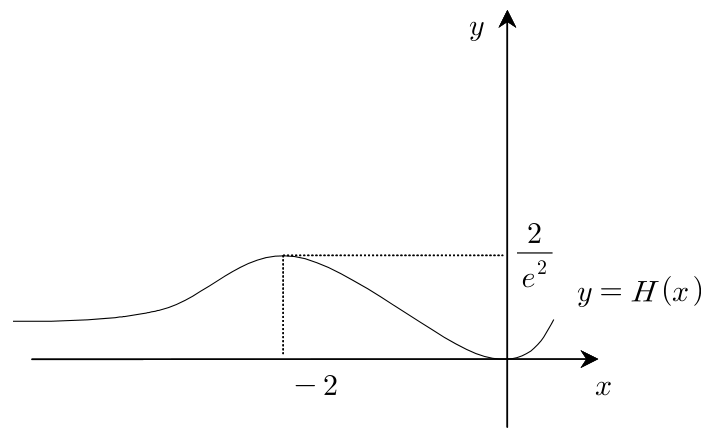
+10점 · a = − 1 − e 2 \displaystyle a=-1-e^2 a = − 1 − e 2 2 e 2 \displaystyle \frac2{e^2} e 2 2 이다. 따라서 a ≤ 0 \displaystyle a\le0 a ≤ 0 K ( a ) = 1 2 g ( a ) 2 e g ( a ) \displaystyle K(a)=\frac12g(a)^2e^{g(a)} K ( a ) = 2 1 g ( a ) 2 e g ( a ) a \displaystyle a a g ( x ) \displaystyle g(x) g ( x ) 합에서 일대일대응인 증가함수이고 g ( 0 ) = 0 \displaystyle g(0)=0 g ( 0 ) = 0 g ( a ) = x \displaystyle g(a)=x g ( a ) = x x ≤ 0 \displaystyle x\le0 x ≤ 0 H ( x ) = 1 2 x 2 e x \displaystyle H(x)=\frac12x^2e^x H ( x ) = 2 1 x 2 e x 최댓값을 구하면 된다. H ′ ( x ) = 1 2 x ( x + 2 ) e x \displaystyle H^{\prime}(x)=\frac12x(x+2)e^x H ′ ( x ) = 2 1 x ( x + 2 ) e x H ′ ( x ) = 0 \displaystyle H^{\prime}(x)=0 H ′ ( x ) = 0 x = − 2 \displaystyle x=-2 x = − 2 x = 0 \displaystyle x=0 x = 0 H ′ ( x ) \displaystyle H^{\prime}(x) H ′ ( x )
x \displaystyle x x ⋯ \displaystyle \cdots ⋯ − 2 \displaystyle -2 − 2 ⋯ \displaystyle \cdots ⋯ 0 \displaystyle 0 0 ⋯ \displaystyle \cdots ⋯ H ′ \displaystyle H^{\prime} H ′ + \displaystyle + + 0 \displaystyle 0 0 − \displaystyle - − 0 \displaystyle 0 0 + \displaystyle + + H \displaystyle H H ↗ \displaystyle \nearrow ↗ 2 e 2 \displaystyle \frac2{e^2} e 2 2 ↘ \displaystyle \searrow ↘ 0 \displaystyle 0 0 ↗ \displaystyle \nearrow ↗
따라서 x = − 2 \displaystyle x=-2 x = − 2 2 e 2 \displaystyle \frac2{e^2} e 2 2 한편, g ( a ) = x = − 2 \displaystyle g(a)=x=-2 g ( a ) = x = − 2 a = f ( − 2 ) = − 1 − e 2 \displaystyle a=f(-2)=-1-e^2 a = f ( − 2 ) = − 1 − e 2 a = − 1 − e 2 \displaystyle a=-1-e^2 a = − 1 − e 2 K ( a ) \displaystyle K(a) K ( a ) 2 e 2 \displaystyle \frac2{e^2} e 2 2 다.
(참조) 함수 H ( x ) \displaystyle H(x) H ( x )
예시 답안의 내용 및 평가 기준의 내용과는 일치하지 않더라도 기술한 내용이 논리적으로 타당한 경우에는 평가위원의 판단에 따라 부분 점수를 부여할 수 있음.
 수리논술, 배움에서 논증의 완성까지.