수리논술, 배움에서 논증의 완성까지.

자연계열 II 3번

문제

🔒
짧은 시간에 너무 많은 문제를 여셔서 열람을 잠시 제한했습니다. 잠시 후 다시 시도하시거나 로그인해 주세요.
해설강의 준비중

(1) 선분 밖의 점 P\displaystyle \mathrm{P}y\displaystyle y축의 점이고 θ=π6\displaystyle \theta=\frac\pi6가 되도록 선분 I\displaystyle I의 두 점 A,B\displaystyle \mathrm{A},\mathrm{B}를 선택할 수 있을 때 점 P\displaystyle \mathrm{P}의 집합을 J\displaystyle J라 하자. 집합 J{(0,0,0)}\displaystyle J\cup\{(0,0,0)\}이 나타내는 그림의 길이를 구하여라.

먼저 y\displaystyle y축의 점이고 선분 I\displaystyle I의 양 끝점을 선택하여 θ=π6\displaystyle \theta=\frac\pi6가 되도록 하는 점 (0,±m,0)(m>0)\displaystyle (0,\pm m,0)(m>0)을 찾으면 m\displaystyle m이 밑변의 길이가 10\displaystyle 10이고 두 밑각이 5π12\displaystyle \frac{5\pi}{12}인 이등변 삼각형의 높이이다. 꼭지점 (0,m,0)\displaystyle (0,m,0)tan5π12=m5\displaystyle \tan\frac{5\pi}{12}=\frac m5을 만족한다. 탄젠트함수의 덧셈공식에 따라m=5tan5π12=5tan(π4+π6)=5(tanπ4+tanπ61tanπ4tanπ6)=5(3+131)\displaystyle m=5\tan\frac{5\pi}{12}=5\tan\left(\frac\pi4+\frac\pi6\right)=5\left(\frac{\tan\frac\pi4+\tan\frac\pi6}{1-\tan\frac\pi4\tan\frac\pi6}\right)=5\left(\frac{\sqrt3+1}{\sqrt3-1}\right)이다.y\displaystyle y축의 점 (0,a,0)(a>5(3+131))\displaystyle (0,a,0)\left(|a|>5\left(\frac{\sqrt3+1}{\sqrt3-1}\right)\right)을 선택하면 선분 I\displaystyle I의 양 끝점을 선택하였을 때 θ\displaystyle \theta가 가장 큰 각이 되고 점 (0,a,0)\displaystyle (0,a,0)과 선분 I\displaystyle I의 양 끝점이 두 밑각이 5π12\displaystyle \frac{5\pi}{12}보다 큰 이등변 삼각형이 되므로 집합 J\displaystyle J의 원소가 아니다.y\displaystyle y축의 점 (0,a,0)(0<a<5(3+131))\displaystyle (0,a,0)\left(0<|a|<5\left(\frac{\sqrt3+1}{\sqrt3-1}\right)\right)을 선택하면 닮음꼴의 성질을 활용하여 높이가 a\displaystyle |a|이고 두 밑각이 5π12\displaystyle \frac{5\pi}{12}인 이등변 삼각형이 되는 선분의 두 점 (a(31)3+1,0,0)\displaystyle \left(\frac{-|a|(\sqrt3-1)}{\sqrt3+1},0,0\right), (a(31)3+1,0,0)\displaystyle \left(\frac{|a|(\sqrt3-1)}{\sqrt3+1},0,0\right)을 선분 I\displaystyle I에서 선택할 수 있다.따라서 구하는 집합 J\displaystyle JJ={(0,y,0)0<y5(3+131)}\displaystyle J=\left\{(0,y,0)\mid0<|y|\le5\left(\frac{\sqrt3+1}{\sqrt3-1}\right)\right\}이고J{(0,0,0)}\displaystyle J\cup\{(0,0,0)\}의 나타내는 그림의 길이는 10(3+131)\displaystyle 10\left(\frac{\sqrt3+1}{\sqrt3-1}\right)이다.

(2) 선분 밖의 점 P\displaystyle \mathrm{P}yz\displaystyle yz평면에 있고 θ=π6\displaystyle \theta=\frac\pi6가 되도록 선분 I\displaystyle I위의 두 점 A,B\displaystyle \mathrm{A},\mathrm{B}를 선택할 수 있을 때 점 P\displaystyle \mathrm{P}의 집합을 S\displaystyle S라 하자. 집합 S{(0,0,0)}\displaystyle S\cup\{(0,0,0)\}이 나타내는 그림의 넓이를 구하여라.

yz\displaystyle yz평면과 선분I\displaystyle I를 포함하는 x\displaystyle x축이 수직이므로 yz\displaystyle yz평면의 한점 (0,a,b)\displaystyle (0,a,b)x\displaystyle x축의 선분 I\displaystyle I의 두점에 대한 θ=π6\displaystyle \theta=\frac\pi6에 관한 문제는 (0,a,b)\displaystyle (0,a,b)x\displaystyle x축을 중심으로 회전하여 y\displaystyle y축의 점으로 옮겨서 문제 (1)과 같이 풀 수 있다. 따라서 집합 S\displaystyle SS={(0,a,b)0<a2+b225(3+131)2}\displaystyle S=\left\{(0,a,b)\mid0<a^2+b^2\le25\left(\frac{\sqrt3+1}{\sqrt3-1}\right)^2\right\}이다.그러므로 S{(0,0,0)}\displaystyle S\cup\{(0,0,0)\}의 넓이는 25(3+131)2π\displaystyle 25\left(\frac{\sqrt3+1}{\sqrt3-1}\right)^2\pi이다.

(3) 선분 밖의 점 P\displaystyle \mathrm{P}xy\displaystyle xy평면에 있고 θ=π6\displaystyle \theta=\frac\pi6가 되도록 선분 I\displaystyle I위의 두 점 A,B\displaystyle \mathrm{A},\mathrm{B}를 선택할 수 있을 때 점 P\displaystyle \mathrm{P}의 집합을 U\displaystyle U라 하자. 집합 UI\displaystyle U\cup I이 나타내는 그림의 넓이를 구하여라.

먼저 선분 I\displaystyle I의 양 끝점을 선택하여 θ=π6\displaystyle \theta=\frac\pi6가 되도록 하는 xy\displaystyle xy평면의 점들을 찾으면 원주각의 성질에 의하여 선분 I\displaystyle I를 현으로 하고 원주각이 π6\displaystyle \frac\pi6이 되는 원위의 점들이다. 중심각이 π3\displaystyle \frac\pi3이므로 구하는 원은 반지름이 10\displaystyle 10이고 중심이 (0,±53,0)\displaystyle (0,\pm5\sqrt3,0)이다. 따라서 대응되는 점들의 집합은B={(x,y,0)x2+(y53)2=102,y>0}{(x,y,0)x2+(y+53)2=102,y<0}\displaystyle B=\{(x,y,0)\mid x^2+(y-5\sqrt3)^2=10^2,y>0\}\cup\{(x,y,0)\mid x^2+(y+5\sqrt3)^2=10^2,y<0\}이고 집합 B\displaystyle B의 모든 원소가 U\displaystyle U에 속한다.xy\displaystyle xy-평면의 점 중에서 B{(5,0,0),(5,0,0)}\displaystyle B\cup\{(-5,0,0),(5,0,0)\}외부의 한 점을 잡으면 선분 I\displaystyle I의 양 끝점을 잡을 때 θ\displaystyle \theta가 가장 크고 집합 B{(5,0,0),(5,0,0)}\displaystyle B\cup\{(-5,0,0),(5,0,0)\}의 밖에 있으므로 원주각의 성질에 따라 θ<π6\displaystyle \theta<\frac\pi6이다.따라서 이들 점은 집합 U\displaystyle U의 원소가 아니다.xy\displaystyle xy-평면의 점 중에서 B{(5,0,0),(5,0,0)}\displaystyle B\cup\{(-5,0,0),(5,0,0)\}의 내부에 있고 선분밖에 있는 점의 집합C={(x,y,0)x2+(y53)2<102,y>0}{(x,y,0)x2+(y+53)2<102,y<0}\displaystyle C=\{(x,y,0)\mid x^2+(y-5\sqrt3)^2<10^2,y>0\}\cup\{(x,y,0)\mid x^2+(y+5\sqrt3)^2<10^2,y<0\}이다.

이제 집합 C\displaystyle C의 임의의 한 점 (α,β,0) β>0\displaystyle (\alpha,\beta,0)\ \beta>0이 집합 U\displaystyle U의 원소인 것을 다음과 같이 보인다. 닮음꼴을 활용하면 이 점이 반지름이 10l\displaystyle 10l이고 중심이 (0,53l,0)\displaystyle (0,5\sqrt3l,0)xy\displaystyle xy평면의 원의 점이고 선분 I\displaystyle I의 두 점 (5l,0,0),(5l,0,0)\displaystyle (-5l,0,0),(5l,0,0)을 현의 끝점으로 할 때 원주각 π6\displaystyle \frac\pi6이 됨을 알 수 있다. 주어진 조건의 l\displaystyle l0<l<1\displaystyle 0<l<1인 것을 확인하기 위하여 원의 방정식 α2+(β53l)2=(10l)2\displaystyle \alpha^2+(\beta-5\sqrt3l)^2=(10l)^2를 풀어서f(l)=25l2+103βl(α2+β2)\displaystyle f(l)=25l^2+10\sqrt3\beta l-(\alpha^2+\beta^2)0<l<1\displaystyle 0<l<1인 근을 가지는 것을 보이기로 한다. f(0)=(α2+β2)<0\displaystyle f(0)=-(\alpha^2+\beta^2)<0이고 점 (α,β,0) β>0\displaystyle (\alpha,\beta,0)\ \beta>0가 집합 C\displaystyle C의 원소이므로 f(1)=25+103β(α2+β2)=102α2(β53)2>0\displaystyle f(1)=25+10\sqrt3\beta-(\alpha^2+\beta^2)=10^2-\alpha^2-(\beta-5\sqrt3)^2>0이다.따라서 0<l<1\displaystyle 0<l<1인 근이 존재한다. 같은 이유로 C\displaystyle C의 한점 (α,β,0) β<0\displaystyle (\alpha,\beta,0)\ \beta<0U\displaystyle U의 원소이다.

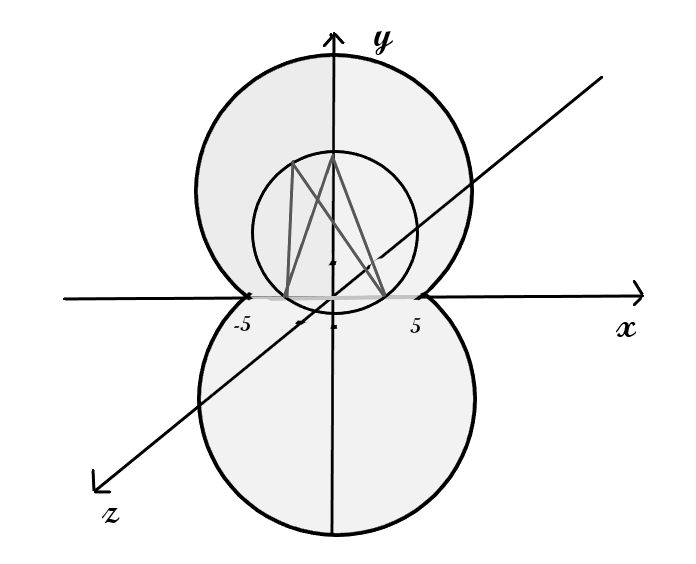
좌표공간의 xy평면 위에 있는 두 원과 집합 U

따라서 구하는 집합 U\displaystyle U는 집합 BC\displaystyle B\cup C이다. 집합 UI\displaystyle U\cup I은 위 그림처럼 나타나며 반지름 10이고 원주각 5π3\displaystyle \frac{5\pi}3인 부채꼴 두 개와 한 변의 길이가 10인 정삼각형이 두 개 있는 모양으로 분해 할 수 있다. 따라서Correction. 부채꼴을 설명하는 “원주각”은 “중심각”의 오기이다. 그러나 원칙에 따라 원문 표기를 그대로 실었다.2(121025π3+1232102)=100(5π3+32)\displaystyle 2\left(\frac1210^2\frac{5\pi}3+\frac12\frac{\sqrt3}210^2\right)=100\left(\frac{5\pi}3+\frac{\sqrt3}2\right)이다.

첨삭 사례

아직 등록된 첨삭 사례가 없습니다.

질문과 답변 · 0개질문과 답변 · 고정 0개

아직 등록된 질문이 없습니다. 질문 작성은 멤버십 회원만 가능합니다.