수리논술, 이게 다다.

자연계열 1번

오류 제보
해설강의 바로가기 ↓

문제

문제 1 (20점)

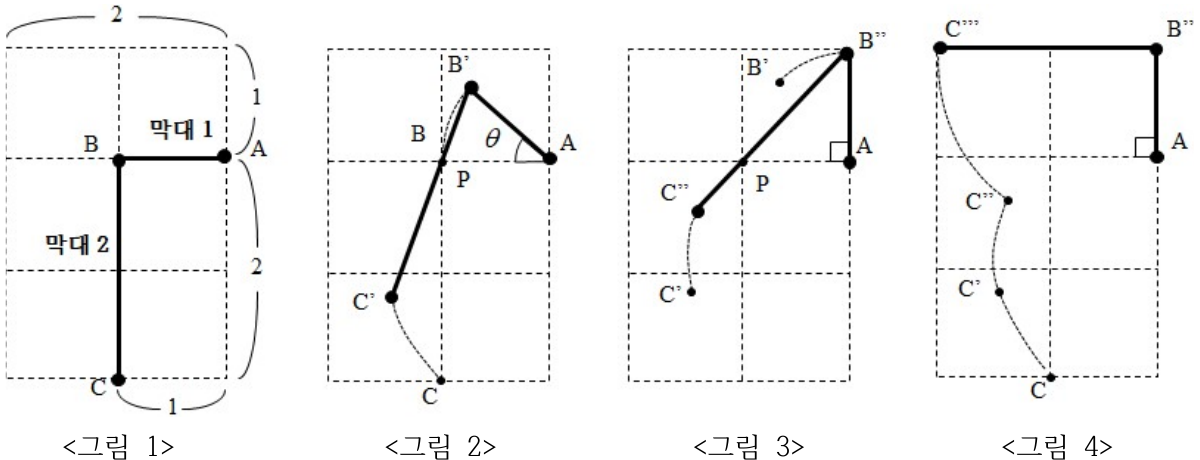
막대 1과 막대 2가 <그림 1>과 같이 B에서 연결되어 있다. 막대 1은 A를 중심으로 시곗바늘이 도는 방향으로 회전하고, 막대 1과 막대 2 사이의 각도는 자유롭게 변할 수 있다. 막대 1이 회전할 때 막대 2는 <그림 2>와 같이 항상 P 점을 지나면서 움직인다. 이때, 막대 1과 막대 2가 연결된 점의 속력은 항상 1이다. 막대 1이 <그림 3>과 같은 위치로 가면, 그다음에는 막대 2가 <그림 4>와 같은 모양이 될 때까지 B”을 중심으로 회전한다.

막대 1(길이 1)과 막대 2(길이 2)가 B에서 연결된 모습을 네 장면으로 보인 그림. <그림 1>은 처음 위치, <그림 2>는 막대 2가 점 P를 지나며 끝점 C가 C′으로 움직인 모습, <그림 3>은 막대 1이 A에서 수직이 된 위치, <그림 4>는 막대 2가 B″을 중심으로 회전을 마친 모습이다.

(1) <그림 2>에서 θ=π3\displaystyle \theta=\frac{\pi}{3}일 때 A와 C' 사이의 거리를 구하시오.

(2) <그림 2>에서 θ=π3\displaystyle \theta=\frac{\pi}{3}일 때 C'을 지나는 막대 2의 끝의 속력을 구하시오.

(3) <그림 2>에서 θ=π3\displaystyle \theta=\frac{\pi}{3}일 때 C'을 지나는 막대 2의 끝의 가속도 크기를 구하시오.

4점 만점 · 거리를 구함 (4점)

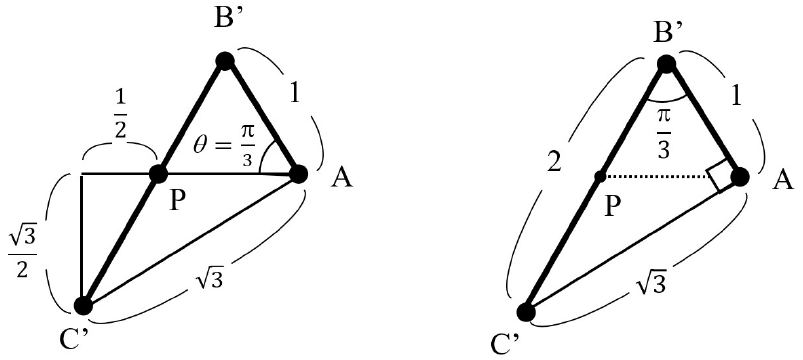
(1) θ=π3\displaystyle \theta=\frac{\pi}{3}이면 △AB′P\displaystyle \triangle\mathrm{AB'P}는 정삼각형이므로 아래 오른쪽 그림과 같이 △AB′C′\displaystyle \triangle\mathrm{AB'C'}은 한 각이 π3\displaystyle \frac{\pi}{3}인 직각삼각형이 된다. 따라서 A와 C'사이의 거리는 3\displaystyle \sqrt{3} 이다.

(별해) △AB′P\displaystyle \triangle\mathrm{AB'P}는 한변의 길이가 1인 정삼각형이므로 아래 왼쪽 그림에서 PB′→=(12,32)\displaystyle \overrightarrow{\mathrm{PB'}}=\left(\frac{1}{2},\frac{\sqrt{3}}{2}\right), PC′→=(−12,−32)\displaystyle \overrightarrow{\mathrm{PC'}}=\left(-\frac{1}{2},-\frac{\sqrt{3}}{2}\right) 이다. PA→=(1,0)\displaystyle \overrightarrow{\mathrm{PA}}=(1,0) 이므로 A와 C'사이의 거리는 3\displaystyle \sqrt{3} 이다.

왼쪽은 정삼각형 AB′P의 각 변에 1/2, √3/2, 1, √3을 적은 그림, 오른쪽은 ∠AB′C′ = π/3이고 B′A = 1, B′C′ = 2, AC′ = √3인 직각삼각형 그림.
12점 만점 · 막대 1과 막대 2가 연결된 점의 좌표 (−cos⁡θ,sin⁡θ)\displaystyle (-\cos\theta,\sin\theta)를 구함 (2점) θ=t\displaystyle \theta=t로 치환을 함 (1점) 벡터의 합을 이용하여 막대 2 끝의 좌표를 구함 (5점) 위치 벡터의 좌표를 미분하여 속도와 속력을 구함 (4점)

(2) <그림 2>에서 AB′→=(−cos⁡θ,sin⁡θ)\displaystyle \overrightarrow{\mathrm{AB'}}=(-\cos\theta,\sin\theta)이다. 두 막대가 연결된 점 B'은 점 A를 중심으로 원운동을 하는데 속력이 1이므로 θ=t\displaystyle \theta=t 이다.

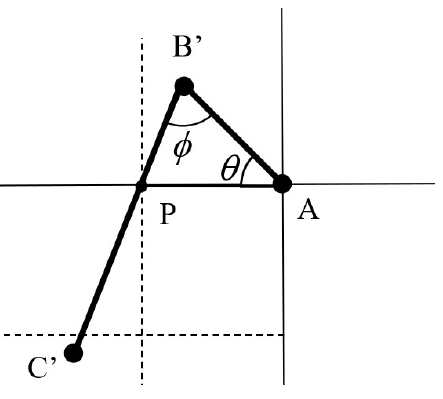
△AB′P\displaystyle \triangle\mathrm{AB'P}는 이등변 삼각형이므로 ϕ=12(π−θ)\displaystyle \phi=\frac{1}{2}(\pi-\theta)이다. 따라서 점 B'을 지나고 선분 PA와 수직인 직선과 선분 B'C'사이의 각도는 ϕ−(π2−θ)=θ2\displaystyle \phi-\left(\frac{\pi}{2}-\theta\right)=\frac{\theta}{2}이고 선분 B'C'의 길이는 2이므로B′C′→=(−2sin⁡θ2, −2cos⁡θ2)\displaystyle \overrightarrow{\mathrm{B'C'}}=\left(-2\sin\frac{\theta}{2},\,-2\cos\frac{\theta}{2}\right) 이다.

점 A를 원점으로 하고 직선 PA를 x축으로 하는 좌표에서, 막대 1이 이루는 각 θ와 삼각형 AB′P의 밑각 φ를 표시한 그림. 막대 2의 끝 C′이 왼쪽 아래에 있다.

A점을 원점으로 하고 직선 PA를 x\displaystyle x축으로 하는 좌표에 대하여 막대 2의 끝 C'의 좌표를 (x,y)\displaystyle (x,y)라 하면AC′→=AB′→+B′C′→=(−cos⁡θ−2sin⁡θ2, sin⁡θ−2cos⁡θ2)\displaystyle \overrightarrow{\mathrm{AC'}}=\overrightarrow{\mathrm{AB'}}+\overrightarrow{\mathrm{B'C'}}=\left(-\cos\theta-2\sin\frac{\theta}{2},\,\sin\theta-2\cos\frac{\theta}{2}\right) 이므로x=−cos⁡t−2sin⁡t2,y=sin⁡t−2cos⁡t2\displaystyle x=-\cos t-2\sin\frac{t}{2},\quad y=\sin t-2\cos\frac{t}{2} 이다.

dxdt=sin⁡t−cos⁡t2\displaystyle \frac{dx}{dt}=\sin t-\cos\frac{t}{2}, dydt=cos⁡t+sin⁡t2\displaystyle \frac{dy}{dt}=\cos t+\sin\frac{t}{2} 이므로 막대 2의 끝 C'의 속력은 다음과 같다.(dxdt)2+(dydt)2=(sin⁡t−cos⁡t2)2+(cos⁡t+sin⁡t2)2=sin⁡2t+cos⁡2t+sin⁡2t2+cos⁡2t2−2(sin⁡tcos⁡t2−cos⁡tsin⁡t2)=2−2sin⁡t2\displaystyle \begin{aligned} \sqrt{\left(\frac{dx}{dt}\right)^{2}+\left(\frac{dy}{dt}\right)^{2}} &=\sqrt{\left(\sin t-\cos\frac{t}{2}\right)^{2}+\left(\cos t+\sin\frac{t}{2}\right)^{2}} \\ &=\sqrt{\sin^{2}t+\cos^{2}t+\sin^{2}\frac{t}{2}+\cos^{2}\frac{t}{2}-2\left(\sin t\cos\frac{t}{2}-\cos t\sin\frac{t}{2}\right)} \\ &=\sqrt{2-2\sin\frac{t}{2}} \end{aligned}θ=π3\displaystyle \theta=\frac{\pi}{3} (즉, t=π3\displaystyle t=\frac{\pi}{3})일 때 속력을 구하면 2−2sin⁡π6=1\displaystyle \sqrt{2-2\sin\frac{\pi}{6}}=1 이다.

4점 만점 · 위치 벡터의 좌표를 두 번 미분하여 가속도와 그 크기를 구함 (4점)

(3) 막대 2의 끝 C'의 가속도는 (2)의 결과로부터(d2xdt2,d2ydt2)=(cos⁡t+12sin⁡t2, −sin⁡t+12cos⁡t2)\displaystyle \left(\frac{d^{2}x}{dt^{2}},\frac{d^{2}y}{dt^{2}}\right)=\left(\cos t+\frac{1}{2}\sin\frac{t}{2},\,-\sin t+\frac{1}{2}\cos\frac{t}{2}\right) 이고, 가속도의 크기는 다음과 같다.(d2xdt2)2+(d2ydt2)2=(cos⁡t+12sin⁡t2)2+(sin⁡t−12cos⁡t2)2=sin⁡2t+cos⁡2t+14(sin⁡2t2+cos⁡2t2)−(sin⁡tcos⁡t2−cos⁡tsin⁡t2)=54−sin⁡t2\displaystyle \begin{aligned} \sqrt{\left(\frac{d^{2}x}{dt^{2}}\right)^{2}+\left(\frac{d^{2}y}{dt^{2}}\right)^{2}} &=\sqrt{\left(\cos t+\frac{1}{2}\sin\frac{t}{2}\right)^{2}+\left(\sin t-\frac{1}{2}\cos\frac{t}{2}\right)^{2}} \\ &=\sqrt{\sin^{2}t+\cos^{2}t+\frac{1}{4}\left(\sin^{2}\frac{t}{2}+\cos^{2}\frac{t}{2}\right)-\left(\sin t\cos\frac{t}{2}-\cos t\sin\frac{t}{2}\right)} \\ &=\sqrt{\frac{5}{4}-\sin\frac{t}{2}} \end{aligned}θ=π3\displaystyle \theta=\frac{\pi}{3} (즉, t=π3\displaystyle t=\frac{\pi}{3})일 때 가속도의 크기를 구하면 54−sin⁡π6=32\displaystyle \sqrt{\frac{5}{4}-\sin\frac{\pi}{6}}=\frac{\sqrt{3}}{2}이다.

첨삭 사례

아직 등록된 첨삭 사례가 없습니다.

질문과 답변 · 0개질문과 답변 · 고정 0개

아직 등록된 질문이 없습니다. 질문 작성은 멤버십 회원만 가능합니다.