수리논술, 배움에서 논증의 완성까지.

자연계열 2번

문제

🔒
짧은 시간에 너무 많은 문제를 여셔서 열람을 잠시 제한했습니다. 잠시 후 다시 시도하시거나 로그인해 주세요.
해설강의 준비중
+2점 · 항등함수

2-1. (10점) 합성함수 (ff)(x)=x\displaystyle ( f \circ f ) ( x ) = x인 경우는(ⅰ) 항등함수 1개,

+3점 · 어느 한 쌍의 두 수가 서로 다른 수에 대응하는 경우

(ⅱ) 어느 한 쌍의 두 수가 서로 다른 수에 대응하는 경우 4C2\displaystyle {}_{4}\mathrm{C}_{2}개,

+4점 · 두 쌍인 경우

(ⅲ) (ⅱ)이 두 쌍인 경우 4C2×2C2×12!\displaystyle {}_{4}\mathrm C_2 \times{}_{2}\mathrm{C}_{2} \times \frac{{1}}{2 !}로 나누어진다.

+1점 · 10(개)

따라서, (ⅰ), (ⅱ), (ⅲ)에 의하여 1 +4C2+4C2×2C2×12!\displaystyle {}_{4}\mathrm{C}_{2} +{}_{4}\mathrm C_2 \times{}_{2}\mathrm{C}_{2} \times \frac{{1}}{2 !} = 1 + 6 + 3 = 10(개)이다.

+5점 · 세수씩 두 조로 편성

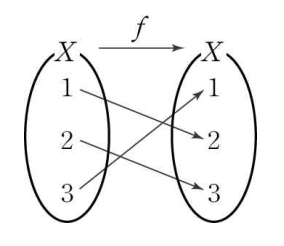
2-2. (10점) I(f)\displaystyle I ( f )가 공집합이므로 모든 xX\displaystyle x \in X에 대하여 f(x)x\displaystyle f ( x ) \ne x이다.그리고 (fff)(x)=x\displaystyle ( f \circ f \circ f ) ( x ) = x를 만족해야 f\displaystyle f는 일대일 대응이고 6개의 수가 세수씩 두 조로 편성하여각조는 예를 들어[예]

세 원소를 순환시키는 함수의 대응도

와 같이 대응되어야 한다.

+2점 · 세수씩 두 조로 편성하는 방법의 수

6개의 수를 세수씩 두 조로 편성하는 방법의 수 6C3×3C3×12!\displaystyle {}_{6}\mathrm{C}_{3} \times{}_{3}\mathrm{C}_{3} \times \frac{{1}}{2 !}

+3점 · 전체 경우의 수

각 조에서 [예]의 1이 3에 대응되는 경우로 나누어 곱의 법칙을 적용하면, 전체 경우의 수는6C3×3C3×12!×22\displaystyle {}_{6}\mathrm{C}_{3} \times{}_{3}\mathrm{C}_{3} \times \frac{{1}}{2 !} \times 2^{2} = 40(개)이다.

+3점 · a1=0\displaystyle a_1=0, a2=1\displaystyle a_2=1, a3=2\displaystyle a_3=2

2-3. (10점) X\displaystyle Xn\displaystyle n개의 원소를 가질 때, 모든 xX\displaystyle x \in X에 대하여 f(x)x\displaystyle f ( x ) \ne x인 함수의 개수를 an\displaystyle a_{n} 이라고 하자.a1=0\displaystyle a_{1} = 0 (∵ 원소가 1개일 때는 없다.)a2=1\displaystyle a_{2} = 1 (∵ 원소가 2개일 때는 서로 다른 수에 대응.)a3=2\displaystyle a_{3} = 2 (∵ 원소가 3개일 때는 2가지 경우이다.)

+3점 · a4=3(a2+a3)=9\displaystyle a_4=3(a_2+a_3)=9

a4=3(a2+a3)\displaystyle a_{4} = 3 ( a_{2} + a_{3} )= 9(∵) 1과 2k4\displaystyle 2 \leq k \leq 4인 수 k\displaystyle k를 잡고 점화식을 구하면ⅰ) 1에 k\displaystyle k, k\displaystyle k에 1이 대응할 때: 남은 2개를 대응하는 것으로 a2\displaystyle a_{2}ⅱ) 1에 k\displaystyle k, k\displaystyle k에 1이 아닐 때: 1자리를 제외한 3개를 대응하는 것으로 a3\displaystyle a_{3}따라서 4개를 완전순열로 대응하는 가짓수는 3개의 k\displaystyle k에 대해 a4=3(a2+a3)\displaystyle a_{4} = 3 ( a_{2} + a_{3} )이다.

+3점 · a5=4(a3+a4)\displaystyle a_5=4(a_3+a_4)

같은 방법으로, a5=4(a3+a4)\displaystyle a_{5} = 4 ( a_{3} + a_{4} )이고,

+1점 · 44(개)

따라서 a5=4(2+9)\displaystyle a_{5} = 4 ( 2 + 9 ) = 44(개)이다.

첨삭 사례

아직 등록된 첨삭 사례가 없습니다.

질문과 답변 · 0개질문과 답변 · 고정 0개

아직 등록된 질문이 없습니다. 질문 작성은 멤버십 회원만 가능합니다.