수리논술, 이게 다다.

의학계 2번

오류 제보

문제

【문항 2】다음 제시문을 근거로 하여 논제에 답하시오. (40점)

[가] 곡선 C:f(x,y)=0\displaystyle C : f ( x , y ) = 0 의 매개변수 방정식 x=p(t),y=q(t)\displaystyle x = p ( t ) , y = q ( t ) (t\displaystyle t는 매개변수)에 대하여,x=p(t)\displaystyle x = p ( t )와 y=q(t)\displaystyle y = q ( t )가 모두 매개변수 t\displaystyle t에 관하여 미분가능 할 때, 곡선 위의 점(x,y)\displaystyle ( x , y )에서접선의 기울기 dydx\displaystyle \frac{{d y}}{d x}는 dydx=dydtdxdt\displaystyle \frac{{d y}}{d x} = \frac{{\frac{{d y}}{d t}}}{\frac{{d x}}{d t}} 로 주어진다.

[나] 탄젠트함수에 대하여 다음의 덧셈정리가 성립한다.tan⁡(α+β)=tan⁡α+tan⁡β1−tan⁡αtan⁡β\displaystyle \tan ( \alpha + \beta ) = \frac{{\tan \alpha + \tan \beta}}{1 - \tan \alpha \tan \beta}, tan⁡(α−β)=tan⁡α−tan⁡β1+tan⁡αtan⁡β\displaystyle \tan ( \alpha - \beta ) = \frac{{\tan \alpha - \tan \beta}}{1 + \tan \alpha \tan \beta}

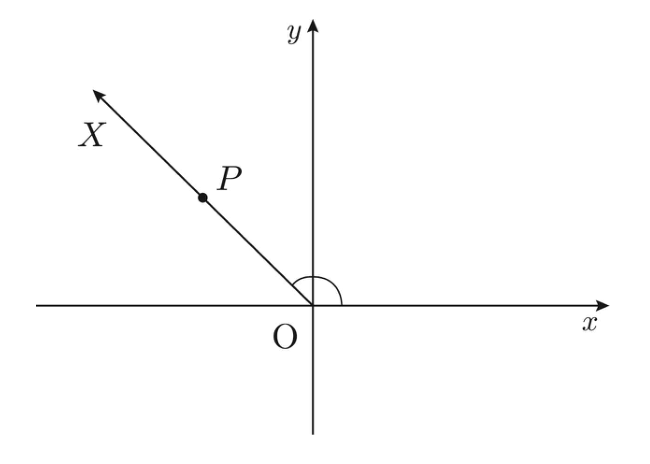
좌표평면 위에 반직선 OX→\displaystyle {\overrightarrow{OX}}가 x\displaystyle x축과 나란히 놓여 있고, 이 반직선 위에 한 점 P\displaystyle P가 원점으로부터 거리가 1\displaystyle 1인 위치에 놓여 있다. 시각이 t=0\displaystyle t = 0일 때 출발하여 반직선 OX→\displaystyle {\overrightarrow{OX}}는 원점을 중심으로 하여 1\displaystyle 1라디안의 각속도로 시계반대방향으로 회전하고, 점 P\displaystyle P는 이 반직선 OX→\displaystyle {\overrightarrow{OX}} 위를 f(t)\displaystyle f ( t )의 속도로 원점에서 멀어져간다고 하자. 여기서, f(t)\displaystyle f ( t )는 시각 t\displaystyle t에 관한 미분가능인 함수로서 모든 t\displaystyle t에 대하여 f(t)≥0\displaystyle f ( t ) \geq 0이라고 한다.

점 P\displaystyle P의 자취를 곡선 C\displaystyle C라 하고, 시각이 t\displaystyle t일 때의 점 P\displaystyle P에서 곡선 C\displaystyle C의 접선과 반직선 OX→\displaystyle {\overrightarrow{OX}} 가 이루는 각의 크기를 θt\displaystyle \theta_{t}라고 하자.

회전하는 반직선 OX와 그 위의 점 P

2-1. 모든 t\displaystyle t에 대하여 f(t)=2\displaystyle f ( t ) = 2 일 때, 점 P\displaystyle P의 자취인 곡선 C\displaystyle C를 t\displaystyle t에 관한 매개변수 방정식으로 나타내시오. (10점)

2-2. 모든 t\displaystyle t에 대하여 f(t)=2\displaystyle f ( t ) = 2 일 때, lim⁡t→∞θt\displaystyle \lim_{t \to \infty} {\theta_{t}}의 수렴, 발산을 판별하고, 수렴하는 경우에 극한값을 구하시오. (10점)

2-3. t>0\displaystyle t > 0 일 때, 시각 t\displaystyle t에 관계없이 θt\displaystyle \theta_{t}가 일정하게 되는 함수 f(t)\displaystyle f ( t )를 구하시오. (20점)

해설강의 준비중

시간 t\displaystyle t에 원점으로 부터의 거리는 F(t)=1+∫0tf(x)dx\displaystyle F ( t ) = 1 + \int_{0}^{t} {f ( x ) d x}이다.

+4점 · 원점으로부터의 거리

2-1. (10점) 점 P\displaystyle P의 속도가 2 이므로 시간 t\displaystyle t에 원점으로 부터의 거리는 F(t)=1+∫0t2dx=1+2t\displaystyle F ( t ) = 1 + \int_{0}^{t} {2 d x} = 1 + 2 t이다.

+6점 · 매개변수 방정식

반직선 OX→\displaystyle {\overrightarrow{OX}} 와 x\displaystyle x축의 양의 방향과 이루는 각이 t\displaystyle t(라디안)이므로 (x,y)=((1+2t)cos⁡t,(1+2t)sin⁡t)\displaystyle ( x , y ) = ( ( 1 + 2 t ) \cos t , ( 1 + 2 t ) \sin t ) 이다.따라서 점 P\displaystyle \mathrm{P}의 자취 C\displaystyle C의 매개변수 방정식은x=(1+2t)cos⁡t,y=(1+2t)sin⁡t\displaystyle x = ( 1 + 2 t ) \cos t , y = ( 1 + 2 t ) \sin t이다.

+3점 · 접선의 기울기

2-2. (10점) 2-1에 의하여 시각 t\displaystyle t에 점 Pt\displaystyle P_{t}의 좌표는 ((1+2t)cos⁡t,(1+2t)sin⁡t)\displaystyle ( ( 1 + 2 t ) \cos t , ( 1 + 2 t ) \sin t )이다.접선 l\displaystyle l이 x\displaystyle x축의 양의 방향과 이루는 각을 β\displaystyle \beta, 직선 OPt\displaystyle OP_{t}가 x\displaystyle x축의 양의 방향과 이루는 각을 α\displaystyle \alpha라고 하면, 접선 l\displaystyle l과 직선 OPt\displaystyle OP_{t}가 이루는 각은 θt=β−α\displaystyle \theta_{t} = \beta - \alpha 이다. 한편tan⁡β=dydx=dy/dtdx/dt=2sin⁡t+2tcos⁡t2cos⁡t−2tsin⁡t=sin⁡t+tcos⁡tcos⁡t−tsin⁡t=tan⁡t+t1−ttan⁡t\displaystyle \tan \beta = \frac{{d y}}{d x} = \frac{{d y / d t}}{d x / d t} = \frac{{2 \sin t + 2 t \cos t}}{2 \cos t - 2 t \sin t} = \frac{{\sin t + t \cos t}}{\cos t - t \sin t} = \frac{{\tan t + t}}{1 - t \tan t} 이고, tan⁡α=tan⁡t\displaystyle \tan \alpha = \tan t 이므로Comment. 대학 예시답안의 미분 계산에서 dy/dt\displaystyle dy/dt의 cos⁡t\displaystyle \cos t와 dx/dt\displaystyle dx/dt의 −sin⁡t\displaystyle -\sin t가 빠졌다. 이를 바로잡으면 tan⁡θt=t+12\displaystyle \tan\theta_t=t+\frac12이다. 대학이 구한 lim⁡t→∞θt=π2\displaystyle \lim_{t\to\infty}\theta_t=\frac\pi2라는 결론은 옳다. 원칙에 따라 원문 표기를 그대로 실었다.

+4점 · 탄젠트 덧셈정리

tan⁡(β−α)=tan⁡t+t1−ttan⁡t−tan⁡t1+tan⁡t+t1−ttan⁡ttan⁡t=tan⁡t+t−tan⁡t+ttan⁡2t1−ttan⁡t+tan⁡2t+ttan⁡t=t(1+tan⁡2t)1+tan⁡2t=t\displaystyle \tan ( \beta - \alpha ) = \frac{{\frac{{\tan t + t}}{1 - t \tan t} - \tan t}}{1 + \frac{{\tan t + t}}{1 - t \tan t} \tan t} = \frac{{\tan t + t - \tan t + t \tan^{2} t}}{1 - t \tan t + \tan^{2} t + t \tan t} = \frac{{t ( 1 + \tan^{2} t )}}{1 + \tan^{2} t} = t

+3점 · 각의 극한

이다. 따라서 tan⁡θt=tan⁡(β−α)=t\displaystyle \tan \theta_{t} = \tan ( \beta - \alpha ) = t 이고 lim⁡t→∞tan⁡θt=lim⁡t→∞t=∞\displaystyle \lim_{t \to \infty} {\tan \theta_{t} = \lim_{t \to \infty} {t = \infty}} 이다.그러므로 lim⁡t→∞θt=π2\displaystyle \lim_{t \to \infty} {\theta_{t}} = \frac{{\pi}}{2}이고 수렴한다.

+20점 · 각이 일정하게 되는 함수

2-3. (20점) 시각 t\displaystyle t에서 점 P\displaystyle P의 좌표를 P(t)\displaystyle P ( t )라 하자. P(t)\displaystyle P ( t )의 좌표는 (F(t)cos⁡t,F(t)sin⁡t)\displaystyle ( F ( t ) \cos t , F ( t ) \sin t )이며제시문 (가)로부터 tan⁡β=dydx=dydtdxdt=F′(t)sin⁡t+F(t)cos⁡tF′(t)cos⁡t−F(t)sin⁡t=tan⁡t+F(t)F′(t)1−F(t)F′(t)tan⁡t\displaystyle \tan \beta = \frac{{d y}}{d x} = \frac{{\frac{{d y}}{d t}}}{\frac{{d x}}{d t}} = \frac{{F^{\prime} ( t ) \sin t + F ( t ) \cos t}}{F^{\prime} ( t ) \cos t - F ( t ) \sin t} = \frac{{\tan t + \frac{{F ( t )}}{F^{\prime} ( t )}}}{1 - \frac{{F ( t )}}{F^{\prime} ( t )} \tan t}이다.또한 θt=β−α\displaystyle \theta_{t} = \beta - \alpha이므로 tan⁡t+F(t)F′(t)1−F(t)F′(t)tan⁡t=tan⁡β=tan⁡(θt+α)=tan⁡(θt+t)=tan⁡t+tan⁡θt1−tan⁡θttan⁡t\displaystyle \frac{{\tan t + \frac{{F ( t )}}{F^{\prime} ( t )}}}{1 - \frac{{F ( t )}}{F^{\prime} ( t )} \tan t} = \tan \beta = \tan ( \theta_{t} + \alpha ) = \tan ( \theta_{t} + t ) = \frac{{\tan t + \tan \theta_{t}}}{1 - \tan \theta_{t} \tan t}이다.이를 정리하면 tan⁡(θt)(1+tan⁡2t)=F(t)F′(t)(1+tan⁡2t)\displaystyle \tan ( \theta_{t} ) ( 1 + \tan^{2} t ) = \frac{{F ( t )}}{F^{\prime} ( t )} ( 1 + \tan^{2} t )가 된다. 그러므로 tan⁡(θt)=F(t)F′(t)\displaystyle \tan ( \theta_{t} ) = \frac{{F ( t )}}{F^{\prime} ( t )}(단, F′(t)=f(t)=0\displaystyle F^{\prime} ( t ) = f ( t ) = 0 이면 θt=π2\displaystyle \theta_{t} = \frac{{\pi}}{2})이다.여기서, F′(t)=f(t)≥0\displaystyle F^{\prime} ( t ) = f ( t ) \geq 0 이고 따라서 F(t)≥0\displaystyle F ( t ) \geq 0 이므로 tan⁡(θt)=F(t)F′(t)\displaystyle \tan ( \theta_{t} ) = \frac{{F ( t )}}{F^{\prime} ( t )}가 음이 아닌 상수이면 1tan⁡θt=F′(t)F(t)\displaystyle \frac{{1}}{\tan \theta_{t}} = \frac{{F^{\prime} ( t )}}{F ( t )}도 음이 아닌 상수이다.F′(t)F(t)=k\displaystyle \frac{{F^{\prime} ( t )}}{F ( t )} = k (k\displaystyle k는 음이 아닌 상수) 로 두고 양변을 적분하면 ln⁡∣F(t)∣=kt+C\displaystyle \ln \left| F ( t ) \right| = k t + C (C\displaystyle C는 적분상수)이고,F(t)≥0\displaystyle F ( t ) \geq 0이므로 F(t)=ekt+C\displaystyle F ( t ) = e^{k t + C} (단, k\displaystyle k는 음이 아닌 상수이고 C\displaystyle C는 상수) 이다.F(0)=1\displaystyle F ( 0 ) = 1 이므로 eC=1\displaystyle e^{C} = 1 이고 따라서 C=0\displaystyle C = 0 이다. 그러므로 F(t)=ekt\displaystyle F ( t ) = e^{k t} 이고f(t)=F′(t)=kekt\displaystyle f ( t ) = F^{\prime} ( t ) = k e^{k t} (k\displaystyle k 는 음이 아닌 상수) 이다.

(모범답안과 다른 방법으로 논술한 합당한 답안도 모두 인정한다)

첨삭 사례

아직 등록된 첨삭 사례가 없습니다.

질문과 답변 · 0개질문과 답변 · 고정 0개

아직 등록된 질문이 없습니다. 질문 작성은 멤버십 회원만 가능합니다.