수리논술, 이게 다다.

자연계열 1번

오류 제보

문제

※ 각 【문항】의 제시문을 이용하여 문제에 답하시오.※ 모든 서술과정의 각 단계에서 근거와 이유를 명확히 밝히시오.

【문항 1】

[제시문]

(가) 열린 구간 (a,b)\displaystyle ( a , b )에서 정의된 함수 f(x)\displaystyle f ( x )의 그래프 위에 있는 임의의 두 점 P,Q\displaystyle \mathrm{P} , \mathrm{Q}에 대하여 P,Q\displaystyle \mathrm{P} , \mathrm{Q}사이에 있는 그래프 부분이 선분 PQ\displaystyle \mathrm{PQ}보다 아래쪽에 있으면 함수 f(x)\displaystyle f ( x )의 그래프는 구간 (a,b)\displaystyle ( a , b )에서 아래로 볼록하다고 한다.

(나) 좌표평면 위의 두 점 P(x1,y1)\displaystyle \mathrm{P} ( x_{1} , y_{1} ), Q(x2,y2)\displaystyle \mathrm{Q} ( x_{2} , y_{2} )를 잇는 선분 PQ\displaystyle \mathrm{PQ}를 m:n(m>0,n>0)\displaystyle m : n ( m > 0 , n > 0 )으로 내분하는 점의 좌표는(mx2+nx1m+n,my2+ny1m+n)\displaystyle \left( \frac{{m x_{2} + n x_{1}}}{m + n} , \frac{{m y_{2} + n y_{1}}}{m + n} \right)이다.

(다) 두 함수 f(x),g(x)\displaystyle f ( x ) , g ( x )에 대하여 lim⁡x→af(x)=α\displaystyle \lim_{x \to a} {f ( x )} = \alpha, lim⁡x→ag(x)=β\displaystyle \lim_{x \to a} {g ( x )} = \beta (α,β\displaystyle \alpha , \beta는 실수)이고, a\displaystyle a를 포함하는 열린구간 내의 모든 x\displaystyle x에서 f(x)≤g(x)\displaystyle f ( x ) \le g ( x )이면 α≤β\displaystyle \alpha \le \beta이다.

[문제] 열린 구간 (a,b)\displaystyle ( a , b )에서 정의된 함수 f(x)\displaystyle f ( x )의 그래프가 아래로 볼록하다고 할 때, 다음 물음에 답하시오.

1-1. 구간 (a,b)\displaystyle ( a , b )에 속하는 임의의 p,q\displaystyle p , q와 0≤t≤1\displaystyle 0 \leq t \leq 1인 임의의 t\displaystyle t에 대하여 부등식f((1−t)p+tq)≤(1−t)f(p)+tf(q)\displaystyle f ( ( 1 - t ) p + t q ) \leq ( 1 - t ) f ( p ) + t f ( q )가 성립함을 보이시오. (10점)

1-2. 함수 f(x)\displaystyle f ( x )가 구간 (a,b)\displaystyle ( a , b )에서 미분가능하다고 할 때, 이 구간에 속하는 임의의 p,q\displaystyle p , q에 대하여 부등식f(q)≥f(p)+f′(p)(q−p)\displaystyle f ( q ) \geq f ( p ) + f^{\prime} ( p ) ( q - p )가 성립함을 보이시오. (20점)

해설강의 준비중
+10점 · 1-1

1-1.(i) t=0,1\displaystyle t = 0,1 일 때, f(p)≤f(p)\displaystyle f ( p ) \le f ( p ), f(q)≤f(q)\displaystyle f ( q ) \le f ( q )이므로 성립한다.(ii) 0<t<1\displaystyle 0 < t < 1 일 때, 편의상 임의의 두 점 p,q\displaystyle p , q 가 p<q\displaystyle p < q 라고 하자.제시문(나) (좌표평면에서의 내분점의 관계)에 의하여 좌표평면 위의 두 점 (p,f(p))\displaystyle ( p , f ( p ) ), (q,f(q))\displaystyle ( q , f ( q ) )를 잇는 선분을 t:1−t\displaystyle t : 1 - t 로 내분하는 점의 좌표는 ((1−t)p+tq,(1−t)f(p)+tf(q))\displaystyle ( ( 1 - t ) p + t q , ( 1 - t ) f ( p ) + t f ( q ) ) 이다.따라서 제시문(가) (또는 아래로 볼록하다는 정의 또는 개념)에 의하여f((1−t)p+tq)≤(1−t)f(p)+tf(q)\displaystyle f ( ( 1 - t ) p + t q ) \le ( 1 - t ) f ( p ) + t f ( q )가 성립한다.

+20점 · 1-2

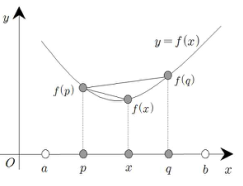
1-2.p,q\displaystyle p , q가 임의의 두 점이므로 p<q\displaystyle p < q라고 가정하자. 그리고 g(x)=f(x)−f(p)x−p\displaystyle g ( x ) = \frac{{f ( x ) - f ( p )}}{x - p} 라 하자.먼저 x≠p\displaystyle x \ne p인 임의의 x∈(a,q)\displaystyle x \in ( a , q )에 대하여g(x)=f(x)−f(p)x−p≤f(q)−f(p)q−p\displaystyle g ( x ) = \frac{{f ( x ) - f ( p )}}{x - p} \le \frac{{f ( q ) - f ( p )}}{q - p} (식1)임을 보이자.(i) p<x<q\displaystyle p < x < q 일 때, g(x)≤f(q)−f(p)q−p\displaystyle g ( x ) \le \frac{{f ( q ) - f ( p )}}{q - p} 가 성립함을 보이자.t=x−pq−p\displaystyle t = \frac{{x - p}}{q - p} 라 하면 0<t=x−pq−p<1\displaystyle 0 < t = \frac{{x - p}}{q - p} < 1, 0<1−x−pq−p<1\displaystyle 0 < 1 - \frac{{x - p}}{q - p} < 1이고 문제1.1의 부등식에 의하여f(x)≤(1−x−pq−p)f(p)+(x−pq−p)f(q)=f(p)+(x−p)f(q)−f(p)q−p\displaystyle f ( x ) \leq \left( 1 - \frac{{x - p}}{q - p} \right) f ( p ) + \left( \frac{{x - p}}{q - p} \right) f ( q ) = f ( p ) + ( x - p ) \frac{{f ( q ) - f ( p )}}{q - p}이다. 따라서 x−p>0\displaystyle x - p > 0 이므로 g(x)≤f(q)−f(p)q−p\displaystyle g ( x ) \le \frac{{f ( q ) - f ( p )}}{q - p} 이다.

아래로 볼록한 함수의 그래프와 세 점 p, x, q에서의 함수값

(ii) a<x<p\displaystyle a < x < p 일 때, g(x)≤f(q)−f(p)q−p\displaystyle g ( x ) \le \frac{{f ( q ) - f ( p )}}{q - p} 또한 성립함을 보이자.x<p<q\displaystyle x < p < q에 대하여 t=p−xq−x\displaystyle t = \frac{{p - x}}{q - x} 라 하면 0<t<1\displaystyle 0 < t < 1이고 (i)과 같은 계산과정을 반복하면,f(p)−f(x)p−x≤f(q)−f(p)q−p\displaystyle \frac{{f ( p ) - f ( x )}}{p - x} \le \frac{{f ( q ) - f ( p )}}{q - p} 이 성립되어 g(x)≤f(q)−f(p)q−p\displaystyle g ( x ) \le \frac{{f ( q ) - f ( p )}}{q - p} 이다.(i) (ii)에 의해 (식1)이 성립한다.함수 f(x)\displaystyle f ( x )가 열린구간 (a,b)\displaystyle ( a , b )에서 미분가능함으로 제시문(다)와 (식1)에 의하여 극한값lim⁡x→pg(x)=f′(p)≤f(q)−f(p)q−p\displaystyle \lim_{x \to p} {g ( x )} = f^{\prime} ( p ) \le \frac{{f ( q ) - f ( p )}}{q - p} 이다.그러므로 f(q)≥f(p)+f′(p)(q−p)\displaystyle f ( q ) \ge f ( p ) + f^{\prime} ( p ) ( q - p ) 가 성립한다.Comment. 대학 예시답안은 p<q\displaystyle p<q인 경우만 증명하였다. q<p\displaystyle q<p인 경우에도 같은 방법으로 f(q)≥f(p)+f′(p)(q−p)\displaystyle f(q)\ge f(p)+f^{\prime}(p)(q-p)를 보일 수 있으며, p=q\displaystyle p=q일 때에는 등호가 성립한다.

첨삭 사례

아직 등록된 첨삭 사례가 없습니다.

질문과 답변 · 0개질문과 답변 · 고정 0개

아직 등록된 질문이 없습니다. 질문 작성은 멤버십 회원만 가능합니다.