수리논술, 배움에서 논증의 완성까지.

의학계 1번

문제

🔒
짧은 시간에 너무 많은 문제를 여셔서 열람을 잠시 제한했습니다. 잠시 후 다시 시도하시거나 로그인해 주세요.
해설강의 준비중
+5점 · 평면과 구가 점 P(x0,y0,z0)\displaystyle P(x_0,y_0,z_0)에서 접하는 성질로부터 평면의 수직인 벡터를 구할 수 있다.

[1-1](다)에 의해 길이가 1\displaystyle 1인 단위벡터 n=(n1,n2,n3)\displaystyle \overrightarrow{n} = ( n_{1} , n_{2} , n_{3} )에 수직이고 구 위의 점 P(x0,y0,z0)\displaystyle {\mathrm{P}} ( x_{0} , y_{0} , z_{0} )를 지나는 평면의 방정식은 n1(xx0)+n2(yy0)+n3(zz0)=0\displaystyle n_{1} ( x - x_{0} ) + n_{2} ( y - y_{0} ) + n_{3} ( z - z_{0} ) = 0이다.평면 위의 점 (x,y,z)\displaystyle ( x , y , z )의 위치벡터를 X\displaystyle \overrightarrow{X}, 점 P(x0,y0,z0)\displaystyle {\mathrm{P}} ( x_{0} , y_{0} , z_{0} )의 위치벡터를 P\displaystyle \overrightarrow{P}라 하면 평면의 방정식은 n(XP)=0\displaystyle \overrightarrow{n} \cdot ( \overrightarrow{X} - \overrightarrow{P} ) = 0로 쓸 수 있다.평면과 구가 점 P(x0,y0,z0)\displaystyle {\mathrm{P}} ( x_{0} , y_{0} , z_{0} )에서 접하므로, 원점 O\displaystyle \mathrm{O}에서 평면 n(XP)=0\displaystyle \overrightarrow{n} \cdot ( \overrightarrow{X} - \overrightarrow{P} ) = 0까지 거리는 1\displaystyle 1임과 n=1\displaystyle | \overrightarrow{n} | = 1임을 알고, (라)를 적용하면 n(P)=1\displaystyle | \overrightarrow{n} \cdot ( - \overrightarrow{P} ) | = 1이고, (가)에 의해 nPcosθ=±1\displaystyle | \overrightarrow{n} | | \overrightarrow{P} | \cos \theta = \pm 1이고 n=1\displaystyle | \overrightarrow{n} | = 1, P=1\displaystyle | \overrightarrow{P} | = 1이므로 cosθ=±1\displaystyle \cos \theta = \pm 1를 얻을 수 있다.

+5점 · 점과 평면에 수직인 벡터를 이용하여 평면의 방정식을 구할 수 있다.

그러므로 n=±P\displaystyle \overrightarrow{n} = \pm \overrightarrow{P}이고 구하고자 하는 평면의 방정식은 P(XP)=0\displaystyle \overrightarrow{P} \cdot ( \overrightarrow{X} - \overrightarrow{P} ) = 0 또는 x0x+y0y+z0z1=0\displaystyle x_{0} x + y_{0} y + z_{0} z - 1 = 0이다.

+10점 · 문제조건을 통해 평면이 반지름의 길이가 1인 구와 접하는 문제임을 알 수 있다.

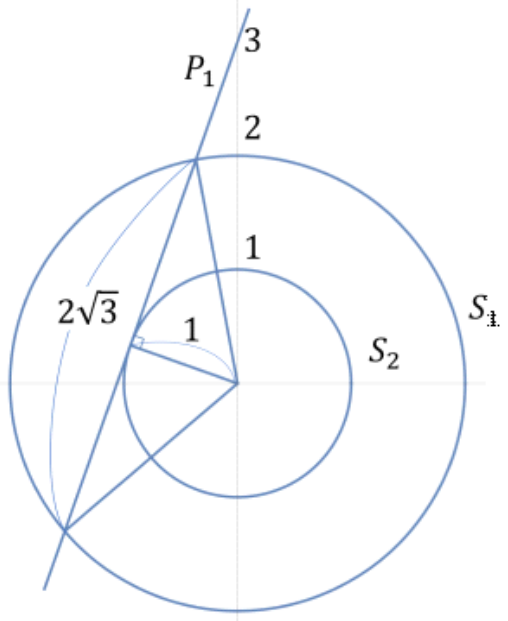
[1-2]평행이동에 의해 문제에서 주어진 구와 평면을 반지름이 2\displaystyle 2이고 중심이 원점인 구 S1\displaystyle S_{1}(0,0,3)\displaystyle ( 0 , 0 , 3 )을 지나고 S1\displaystyle S_{1}과의 교선의 길이가 23π\displaystyle 2 \sqrt{3} \pi인 평면 P1\displaystyle P_{1}으로 가정할 수 있다.평면 P1\displaystyle P_{1}은 원점으로부터 거리가 1\displaystyle 1인 평면이므로 원점이 중심이고 반지름이 1\displaystyle 1인 구 S2\displaystyle S_{2}와 접하는 것을 알 수 있다.

평행이동한 두 구 S1과 S2 및 평면 P1의 단면
+5점 · 이면각의 크기를 통해 조건에 맞는 평면의 수직인 벡터를 구할 수 있다.

S2\displaystyle S_{2} 위의 점 (x,y,z)\displaystyle ( x , y , z )에서 접평면에 수직인 벡터는 (x,y,z)\displaystyle ( x , y , z )이므로 다음이 성립한다.{(x,y,z)(x,y,z3)=0x2+y2+z2=1\displaystyle \begin{cases}( x , y , z ) \cdot ( x , y , z - 3 ) = 0 \\ x^{2} + y^{2} + z^{2} = 1\end{cases}위의 연립방정식을 풀면 z=13\displaystyle z = \frac{1}{3}을 얻고 접평면에 수직인 벡터는 매개변수 t\displaystyle t를 이용하여(x,y,z)=(223cost,223sint,13)\displaystyle ( x , y , z ) = \left( \frac{{2 \sqrt{2}}}{3} \cos t , \frac{{2 \sqrt{2}}}{3} \sin t , \frac{1}{3} \right)로 쓸 수 있다. 이면각의 크기가 60\displaystyle 60 ^\circ이므로 이면각의 면을 포함하는 두 평면의 수직인 벡터 사이의 각은 60\displaystyle 60 ^\circ120\displaystyle 120 ^\circ이므로(x,y,z)(0,1,0)=223sint=±12\displaystyle ( x , y , z ) \cdot ( 0 , 1 , 0 ) = \frac{{2 \sqrt{2}}}{3} \sin t = \pm \frac{1}{2}이고 sint=±342\displaystyle \sin t = \pm \frac{3}{4 \sqrt{2}}, cost=±2342\displaystyle \cos t = \pm \frac{\sqrt{23}}{4 \sqrt{2}}를 얻을 수 있다.

+5점 · 조건을 통해 평면의 방정식을 구할 수 있다.

그러므로 접평면에 수직인 네 개의 벡터는 (x,y,z)=(±236,±12,13)\displaystyle ( x , y , z ) = \left( \pm \frac{\sqrt{23}}{6} , \pm \frac{1}{2} , \frac{1}{3} \right)이고 접평면의 방정식은 ±236x±12y+13(z3)=0\displaystyle \pm \frac{\sqrt{23}}{6} x \pm \frac{1}{2} y + \frac{1}{3} ( z - 3 ) = 0이다. z\displaystyle z축으로 3\displaystyle 3만큼 평행이동하면 ±236x±12y+13z=0\displaystyle \pm \frac{\sqrt{23}}{6} x \pm \frac{1}{2} y + \frac{1}{3} z = 0(복호동순 아님)이다.

첨삭 사례

아직 등록된 첨삭 사례가 없습니다.

질문과 답변 · 0개질문과 답변 · 고정 0개

아직 등록된 질문이 없습니다. 질문 작성은 멤버십 회원만 가능합니다.