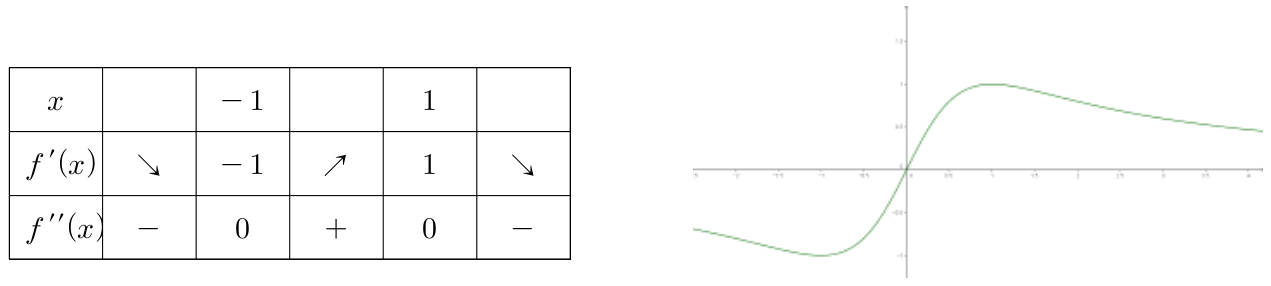
+1점 · 제시문 (나)에 근거하여 최솟값과 최댓값이 존재함을 서술한다. [2-1] f ( x ) = ln ( x 2 + 1 ) \displaystyle f(x)=\ln(x^2+1) f ( x ) = ln ( x 2 + 1 ) f ′ ( x ) = 2 x x 2 + 1 \displaystyle f^{\prime}(x)=\frac{2x}{x^2+1} f ′ ( x ) = x 2 + 1 2 x f ′ ( x ) \displaystyle f^{\prime}(x) f ′ ( x ) [ − 2 , 2 ] \displaystyle [-2,2] [ − 2 , 2 ]
+2점 · f ′ ′ ( x ) = 0 \displaystyle f^{\prime\prime}(x)=0 f ′′ ( x ) = 0 x \displaystyle x x f ′ ′ ( x ) = 2 ( x 2 + 1 ) − 2 x ( 2 x ) ( x 2 + 1 ) 2 = 2 − 2 x 2 ( x 2 + 1 ) 2 = 0 \displaystyle f^{\prime\prime}(x)=\frac{2(x^2+1)-2x(2x)}{(x^2+1)^2}=\frac{2-2x^2}{(x^2+1)^2}=0 f ′′ ( x ) = ( x 2 + 1 ) 2 2 ( x 2 + 1 ) − 2 x ( 2 x ) = ( x 2 + 1 ) 2 2 − 2 x 2 = 0 x = ± 1 \displaystyle x=\pm1 x = ± 1 f ′ ( x ) \displaystyle f^{\prime}(x) f ′ ( x ) x = ± 1 \displaystyle x=\pm1 x = ± 1 f ′ ( x ) \displaystyle f^{\prime}(x) f ′ ( x ) y = f ′ ( x ) \displaystyle y=f^{\prime}(x) y = f ′ ( x )
따라서 f ′ ( − 2 ) = − 4 5 \displaystyle f^{\prime} ( - 2 ) = - \frac{4}{5} f ′ ( − 2 ) = − 5 4 f ′ ( 2 ) = 4 5 \displaystyle f^{\prime} ( 2 ) = \frac{4}{5} f ′ ( 2 ) = 5 4 f ′ ( − 1 ) = − 1 \displaystyle f^{\prime} ( - 1 ) = - 1 f ′ ( − 1 ) = − 1 f ′ ( 1 ) = 1 \displaystyle f^{\prime} ( 1 ) = 1 f ′ ( 1 ) = 1 f ′ ( x ) \displaystyle f^{\prime} ( x ) f ′ ( x ) f ′ ( − 1 ) = − 1 \displaystyle f^{\prime} ( - 1 ) = - 1 f ′ ( − 1 ) = − 1 f ′ ( 1 ) = 1 \displaystyle f^{\prime} ( 1 ) = 1 f ′ ( 1 ) = 1
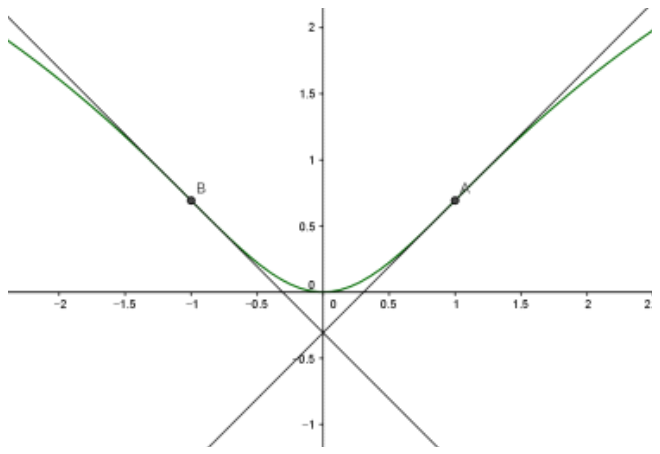
+2점 · 두 함수 g 1 ( x ) \displaystyle g_1(x) g 1 ( x ) g − 1 ( x ) \displaystyle g_{-1}(x) g − 1 ( x ) [2-2] g 1 ( x ) = f ′ ( 1 ) ( x − 1 ) + f ( 1 ) = x − 1 + ln 2 \displaystyle g_{1} ( x ) = f^{\prime} ( 1 ) ( x - 1 ) + f ( 1 ) = x - 1 + \ln 2 g 1 ( x ) = f ′ ( 1 ) ( x − 1 ) + f ( 1 ) = x − 1 + ln 2 g − 1 ( x ) = f ′ ( − 1 ) ( x + 1 ) + f ( − 1 ) = − x − 1 + ln 2 \displaystyle g_{-1} ( x ) = f^{\prime} ( -1 ) ( x + 1 ) + f ( - 1 ) = - x - 1 + \ln 2 g − 1 ( x ) = f ′ ( − 1 ) ( x + 1 ) + f ( − 1 ) = − x − 1 + ln 2
+2점 · 방정식 f ( x ) − g 1 ( x ) = 0 \displaystyle f(x)-g_1(x)=0 f ( x ) − g 1 ( x ) = 0 먼저 직선 y = g 1 ( x ) \displaystyle y = g_{1} ( x ) y = g 1 ( x ) ( 1 , ln 2 ) \displaystyle ( 1 , \ln 2 ) ( 1 , ln 2 ) y = f ( x ) \displaystyle y = f ( x ) y = f ( x ) p ( x ) = f ( x ) − g 1 ( x ) \displaystyle p ( x ) = f ( x ) - g_{1} ( x ) p ( x ) = f ( x ) − g 1 ( x ) p ′ ( x ) = f ′ ( x ) − g 1 ′ ( x ) = 2 x x 2 + 1 − 1 = − ( x − 1 ) 2 x 2 + 1 \displaystyle p^{\prime} ( x ) = f^{\prime} ( x ) - g_{1}^{\prime} ( x ) = \frac{2x}{x^2+1}-1=-\frac{(x-1)^2}{x^2+1} p ′ ( x ) = f ′ ( x ) − g 1 ′ ( x ) = x 2 + 1 2 x − 1 = − x 2 + 1 ( x − 1 ) 2 p ( x ) \displaystyle p ( x ) p ( x ) x ≠ 1 \displaystyle x \ne 1 x = 1 p ′ ( x ) < 0 \displaystyle p^{\prime} ( x ) < 0 p ′ ( x ) < 0 p ( x ) \displaystyle p ( x ) p ( x ) f ( x ) − g 1 ( x ) = 0 \displaystyle f ( x ) - g_{1} ( x ) = 0 f ( x ) − g 1 ( x ) = 0 ( x = 1 ) \displaystyle ( x = 1 ) ( x = 1 )
+2점 · 방정식 f ( x ) − g − 1 ( x ) = 0 \displaystyle f(x)-g_{-1}(x)=0 f ( x ) − g − 1 ( x ) = 0 마찬가지로 직선 y = g − 1 ( x ) \displaystyle y = g_{-1} ( x ) y = g − 1 ( x ) ( − 1 , ln 2 ) \displaystyle ( - 1 , \ln 2 ) ( − 1 , ln 2 ) y = f ( x ) \displaystyle y = f ( x ) y = f ( x ) q ( x ) = f ( x ) − g − 1 ( x ) \displaystyle q ( x ) = f ( x ) - g_{-1} ( x ) q ( x ) = f ( x ) − g − 1 ( x ) q ′ ( x ) = f ′ ( x ) − g − 1 ′ ( x ) = 2 x x 2 + 1 + 1 = ( x + 1 ) 2 x 2 + 1 \displaystyle q^{\prime} ( x ) = f^{\prime} ( x ) - g_{-1}^{\prime} ( x ) = \frac{{2 x}}{x^{2} + 1} + 1 = \frac{{( x + 1 )^{2}}}{x^{2} + 1} q ′ ( x ) = f ′ ( x ) − g − 1 ′ ( x ) = x 2 + 1 2 x + 1 = x 2 + 1 ( x + 1 ) 2 q ( x ) \displaystyle q ( x ) q ( x ) x ≠ − 1 \displaystyle x \ne - 1 x = − 1 q ′ ( x ) > 0 \displaystyle q^{\prime} ( x ) > 0 q ′ ( x ) > 0 q ( x ) \displaystyle q ( x ) q ( x ) f ( x ) − g − 1 ( x ) = 0 \displaystyle f ( x ) - g_{-1} ( x ) = 0 f ( x ) − g − 1 ( x ) = 0 ( x = − 1 ) \displaystyle ( x = - 1 ) ( x = − 1 )
그러므로 곡선 y = f ( x ) \displaystyle y = f ( x ) y = f ( x ) y = g 1 ( x ) \displaystyle y = g_{1} ( x ) y = g 1 ( x ) y = g − 1 ( x ) \displaystyle y = g_{-1} ( x ) y = g − 1 ( x )
+2점 · 곡선과 두 직선으로 둘러싸인 도형의 넓이를 적분기호로 나타낸다. 따라서 곡선 y = f ( x ) \displaystyle y = f ( x ) y = f ( x ) y = g 1 ( x ) \displaystyle y = g_{1} ( x ) y = g 1 ( x ) y = g − 1 ( x ) \displaystyle y = g_{-1} ( x ) y = g − 1 ( x ) S \displaystyle S S S = ∫ − 1 0 f ( x ) − g − 1 ( x ) d x + ∫ 0 1 f ( x ) − g 1 ( x ) d x = 2 ∫ 0 1 f ( x ) − g 1 ( x ) d x = 2 ∫ 0 1 f ( x ) d x − 2 ∫ 0 1 g 1 ( x ) d x \displaystyle \begin{aligned}S&=\int_{-1}^0 f(x)-g_{-1}(x)dx+\int_0^1f(x)-g_1(x)dx\\&=2\int_0^1f(x)-g_1(x)dx\\&=2\int_0^1f(x)dx-2\int_0^1g_1(x)dx\end{aligned} S = ∫ − 1 0 f ( x ) − g − 1 ( x ) d x + ∫ 0 1 f ( x ) − g 1 ( x ) d x = 2 ∫ 0 1 f ( x ) − g 1 ( x ) d x = 2 ∫ 0 1 f ( x ) d x − 2 ∫ 0 1 g 1 ( x ) d x
+2점 · 함수 f ( x ) \displaystyle f(x) f ( x ) 한편 ∫ 0 1 f ( x ) d x = ∫ 0 1 ln ( x 2 + 1 ) d x = ∫ 0 1 ( x ) ′ ln ( x 2 + 1 ) d x = [ x ln ( x 2 + 1 ) ] 0 1 − ∫ 0 1 2 x 2 x 2 + 1 d x = ln 2 − ∫ 0 1 2 x 2 x 2 + 1 d x \displaystyle \begin{aligned}\int_0^1f(x)dx&=\int_0^1\ln(x^2+1)dx=\int_0^1(x)^{\prime}\ln(x^2+1)dx=\Biggl[x\ln(x^2+1)\Biggr]_0^1-\int_0^1\frac{2x^2}{x^2+1}dx\\&=\ln2-\int_0^1\frac{2x^2}{x^2+1}dx\end{aligned} ∫ 0 1 f ( x ) d x = ∫ 0 1 ln ( x 2 + 1 ) d x = ∫ 0 1 ( x ) ′ ln ( x 2 + 1 ) d x = [ x ln ( x 2 + 1 ) ] 0 1 − ∫ 0 1 x 2 + 1 2 x 2 d x = ln 2 − ∫ 0 1 x 2 + 1 2 x 2 d x
+2점 · 치환적분법을 이용하여 계산한다. 여기서 x = tan θ \displaystyle x = \tan \theta x = tan θ d x = sec 2 θ d θ \displaystyle d x = \sec^{2} \theta d \theta d x = sec 2 θ d θ = ln 2 − ∫ 0 π 4 2 tan 2 θ tan 2 θ + 1 × sec 2 θ d θ = ln 2 − 2 ∫ 0 π 4 tan 2 θ d θ = ln 2 − 2 ∫ 0 π 4 sec 2 θ − 1 d θ = ln 2 − 2 [ tan θ − θ ] 0 π 4 = ln 2 − 2 + π 2 \displaystyle \begin{aligned}&=\ln2-\int_0^{\frac\pi4}\frac{2\tan^2\theta}{\tan^2\theta+1}\times\sec^2\theta d\theta=\ln2-2\int_0^{\frac\pi4}\tan^2\theta d\theta\\&=\ln2-2\int_0^{\frac\pi4}\sec^2\theta-1\,d\theta=\ln2-2\Biggl[\tan\theta-\theta\Biggr]_0^{\frac\pi4}=\ln2-2+\frac\pi2\end{aligned} = ln 2 − ∫ 0 4 π tan 2 θ + 1 2 tan 2 θ × sec 2 θ d θ = ln 2 − 2 ∫ 0 4 π tan 2 θ d θ = ln 2 − 2 ∫ 0 4 π sec 2 θ − 1 d θ = ln 2 − 2 [ tan θ − θ ] 0 4 π = ln 2 − 2 + 2 π 이고,
+2점 · 함수 g 1 ( x ) \displaystyle g_1(x) g 1 ( x ) ∫ 0 1 g 1 ( x ) d x = ∫ 0 1 ( x − 1 + ln 2 ) d x = [ 1 2 x 2 − x + x ln 2 ] 0 1 = 1 2 − 1 + ln 2 = ln 2 − 1 2 \displaystyle \int_{0}^{1} g_{1} ( x ) d x = \int_{0}^{1} ( x - 1 + \ln 2 ) d x = \Biggl[ \frac{1}{2} x^{2} - x + x \ln 2 \Biggr]_{0}^{1} = \frac{1}{2} - 1 + \ln 2 = \ln 2 - \frac{1}{2} ∫ 0 1 g 1 ( x ) d x = ∫ 0 1 ( x − 1 + ln 2 ) d x = [ 2 1 x 2 − x + x ln 2 ] 0 1 = 2 1 − 1 + ln 2 = ln 2 − 2 1 이다. 그러므로
+1점 · 곡선과 두 직선으로 둘러싸인 도형의 넓이를 구한다. S = 2 ( ln 2 − 2 + π 2 ) − 2 ( ln 2 − 1 2 ) = π − 3 \displaystyle S = 2 \left( \ln 2 - 2 + \frac{\pi}{2} \right) - 2 \left( \ln 2 - \frac{1}{2} \right) = \pi - 3 S = 2 ( ln 2 − 2 + 2 π ) − 2 ( ln 2 − 2 1 ) = π − 3
+4점 · 함수 f ( x ) − g t ( x ) \displaystyle f(x)-g_t(x) f ( x ) − g t ( x ) x \displaystyle x x t \displaystyle t t 1 t \displaystyle \frac1t t 1 [2-3] 함수 k ( x ) = f ( x ) − g t ( x ) = f ( x ) − f ′ ( t ) ( x − t ) − f ( t ) \displaystyle k ( x ) = f ( x ) - g_{t} ( x ) = f ( x ) - f^{\prime} ( t ) ( x - t ) - f ( t ) k ( x ) = f ( x ) − g t ( x ) = f ( x ) − f ′ ( t ) ( x − t ) − f ( t ) k ′ ( x ) = f ′ ( x ) − g t ′ ( x ) = f ′ ( x ) − f ′ ( t ) = 2 x x 2 + 1 − 2 t t 2 + 1 = 2 x ( t 2 + 1 ) − 2 t ( x 2 + 1 ) ( x 2 + 1 ) ( t 2 + 1 ) = − 2 t x 2 + 2 ( t 2 + 1 ) x − 2 t 2 ( x 2 + 1 ) ( t 2 + 1 ) = − 2 ( x − t ) ( t x − 1 ) ( x 2 + 1 ) ( t 2 + 1 ) = 0 \displaystyle \begin{aligned}k^{\prime}(x)&=f^{\prime}(x)-g_t^{\prime}(x)=f^{\prime}(x)-f^{\prime}(t)=\frac{2x}{x^2+1}-\frac{2t}{t^2+1}\\&=\frac{2x(t^2+1)-2t(x^2+1)}{(x^2+1)(t^2+1)}=\frac{-2tx^2+2(t^2+1)x-2t^2}{(x^2+1)(t^2+1)}=\frac{-2(x-t)(tx-1)}{(x^2+1)(t^2+1)}=0\end{aligned} k ′ ( x ) = f ′ ( x ) − g t ′ ( x ) = f ′ ( x ) − f ′ ( t ) = x 2 + 1 2 x − t 2 + 1 2 t = ( x 2 + 1 ) ( t 2 + 1 ) 2 x ( t 2 + 1 ) − 2 t ( x 2 + 1 ) = ( x 2 + 1 ) ( t 2 + 1 ) − 2 t x 2 + 2 ( t 2 + 1 ) x − 2 t 2 = ( x 2 + 1 ) ( t 2 + 1 ) − 2 ( x − t ) ( t x − 1 ) = 0 x = t \displaystyle x=t x = t x = 1 t \displaystyle x=\frac1t x = t 1 한편, k ′ ′ ( x ) = f ′ ′ ( x ) = 2 − 2 x 2 ( x 2 + 1 ) 2 \displaystyle k^{\prime \prime} ( x ) = f^{\prime \prime} ( x ) = \frac{{2 - 2 x^{2}}}{( x^{2} + 1 )^{2}} k ′′ ( x ) = f ′′ ( x ) = ( x 2 + 1 ) 2 2 − 2 x 2
+5점 · ∣ t ∣ < 1 \displaystyle |t|<1 ∣ t ∣ < 1 1) ∣ t ∣ < 1 \displaystyle | t | < 1 ∣ t ∣ < 1 제시문 (나)와 (다)에 의해 k ′ ( t ) = 0 \displaystyle k^{\prime} ( t ) = 0 k ′ ( t ) = 0 k ′ ′ ( t ) = 2 − 2 t 2 ( t 2 + 1 ) 2 > 0 \displaystyle k^{\prime \prime} ( t ) = \frac{{2 - 2 t^{2}}}{( t^{2} + 1 )^{2}} > 0 k ′′ ( t ) = ( t 2 + 1 ) 2 2 − 2 t 2 > 0 x = t \displaystyle x = t x = t k ′ ( 1 t ) = 0 \displaystyle k^{\prime} \left( \frac{1}{t} \right) = 0 k ′ ( t 1 ) = 0 k ′ ′ ( 1 t ) = 2 − 2 t 2 ( 1 t 2 + 1 ) 2 < 0 \displaystyle k^{\prime \prime} \left( \frac{1}{t} \right) = \frac{{2 - \frac{2}{t^{2}}}}{\left( \frac{1}{t^{2}} + 1 \right)^{2}} < 0 k ′′ ( t 1 ) = ( t 2 1 + 1 ) 2 2 − t 2 2 < 0 x = 1 t \displaystyle x = \frac{1}{t} x = t 1 h ( t ) = k ( t ) = 0 \displaystyle h ( t ) = k ( t ) = 0 h ( t ) = k ( t ) = 0
+5점 · ∣ t ∣ > 1 \displaystyle |t|>1 ∣ t ∣ > 1 2) ∣ t ∣ > 1 \displaystyle | t | > 1 ∣ t ∣ > 1 제시문 (나)와 (다)에 의해 k ′ ( t ) = 0 \displaystyle k^{\prime} ( t ) = 0 k ′ ( t ) = 0 k ′ ′ ( t ) = 2 − 2 t 2 ( t 2 + 1 ) 2 < 0 \displaystyle k^{\prime \prime} ( t ) = \frac{{2 - 2 t^{2}}}{( t^{2} + 1 )^{2}} < 0 k ′′ ( t ) = ( t 2 + 1 ) 2 2 − 2 t 2 < 0 x = t \displaystyle x = t x = t k ′ ( 1 t ) = 0 \displaystyle k^{\prime} \left( \frac{1}{t} \right) = 0 k ′ ( t 1 ) = 0 k ′ ′ ( 1 t ) = 2 − 2 t 2 ( 1 t 2 + 1 ) 2 > 0 \displaystyle k^{\prime \prime} \left( \frac{1}{t} \right) = \frac{{2 - \frac{2}{t^{2}}}}{\left( \frac{1}{t^{2}} + 1 \right)^{2}} > 0 k ′′ ( t 1 ) = ( t 2 1 + 1 ) 2 2 − t 2 2 > 0 x = 1 t \displaystyle x = \frac{1}{t} x = t 1 h ( t ) = k ( 1 t ) = ln ( 1 t 2 + 1 ) − 2 t 1 t 2 + 1 ( 1 t − t ) − ln ( t 2 + 1 ) = ln ( 1 t 2 ) + 2 ( t 2 − 1 ) t 2 + 1 \displaystyle h ( t ) = k \left( \frac{1}{t} \right) = \ln \left( \frac{1}{t^{2}} + 1 \right) - \frac{{\frac{2}{t}}}{\frac{1}{t^{2}} + 1} \left( \frac{1}{t} - t \right) - \ln ( t^{2} + 1 )= \ln \left( \frac{1}{t^{2}} \right) + \frac{{2 ( t^{2} - 1 )}}{t^{2} + 1} h ( t ) = k ( t 1 ) = ln ( t 2 1 + 1 ) − t 2 1 + 1 t 2 ( t 1 − t ) − ln ( t 2 + 1 ) = ln ( t 2 1 ) + t 2 + 1 2 ( t 2 − 1 )
+1점 · 함수 h ( t ) \displaystyle h(t) h ( t ) 1), 2)에 의해 h ( t ) = { 0 ( ∣ t ∣ < 1 ) ln ( 1 t 2 ) + 2 ( t 2 − 1 ) t 2 + 1 ( ∣ t ∣ > 1 ) \displaystyle h ( t ) = \begin{cases}0 & & ( | t | < 1 ) \\ \ln \left( \frac{1}{t^{2}} \right) + \frac{{2 ( t^{2} - 1 )}}{t^{2} + 1} & & ( | t | > 1 )\end{cases} h ( t ) = { 0 ln ( t 2 1 ) + t 2 + 1 2 ( t 2 − 1 ) ( ∣ t ∣ < 1 ) ( ∣ t ∣ > 1 ) 이다.
 수리논술, 배움에서 논증의 완성까지.