수리논술, 배움에서 논증의 완성까지.

자연계열 2번

문제

[문항 2] 다음 제시문을 이용하여 아래 논제의 풀이 과정과 답을 논리적으로 서술하시오.

(가) A(x1,y1,z1)\displaystyle \mathrm{A} ( x_{1} , y_{1} , z_{1} )을 지나고 영벡터가 아닌 벡터 n=(a,b,c)\displaystyle {\overrightarrow{n}} = ( a , b , c )에 수직인 평면의 방정식은a(xx1)+b(yy1)+c(zz1)=0\displaystyle a ( x - x_{1} ) + b ( y - y_{1} ) + c ( z - z_{1} ) = 0

(나) A(x0,y0,z0)\displaystyle \mathrm{A} \left( x_{0} , y_{0} , z_{0} \right)과 평면 ax+by+cz+d=0\displaystyle a x + b y + c z + d = 0 사이의 거리는ax0+by0+cz0+da2+b2+c2\displaystyle \frac{{\left| a x_{0} + b y_{0} + c z_{0} + d \right|}}{\sqrt{a^{2} + b^{2} + c^{2}}}

(다) 영벡터가 아닌 두 벡터 a\displaystyle {\overrightarrow{a}}, b\displaystyle {\overrightarrow{b}}가 이루는 각의 크기가 θ\displaystyle \theta일 때, ab=abcosθ\displaystyle {\overrightarrow{a}} \cdot {\overrightarrow{b}} = \left| {\overrightarrow{a}} \right| \left| {\overrightarrow{b}} \right| \cos \theta이다.

좌표공간의 세 점 O(0,0,0)\displaystyle \mathrm{O} ( 0 , 0 , 0 ), A(4,0,0)\displaystyle \mathrm{A} ( - 4 , 0 , 0 ), B(3,1,6)\displaystyle \mathrm{B} ( 3 , - 1 , \sqrt{6} )에 대하여AOB=AOC=BOD,OC=OD=2\displaystyle \angle\mathrm{AOB}=\angle\mathrm{AOC}=\angle\mathrm{BOD},\quad|\overrightarrow{\mathrm{OC}}|=|\overrightarrow{\mathrm{OD}}|=2를 만족하는 점 C\displaystyle \mathrm{C}, D\displaystyle \mathrm{D}가 존재할 때, 다음 물음에 답하시오.

[2-1] 사면체 OABC\displaystyle \mathrm{OABC}의 부피가 최대가 될 때, 점 C\displaystyle \mathrm{C}의 좌표를 모두 구하시오. (20점)

[2-2] BDAC\displaystyle {\overrightarrow{\mathrm{BD}}} \cdot {\overrightarrow{\mathrm{AC}}}가 최대가 될 때, OBOC\displaystyle \overrightarrow{\mathrm{OB}} \cdot \overrightarrow{\mathrm{OC}}의 값을 구하시오. (20점)

해설강의 준비중

[2-1]

+6점 · 세 점을 지나는 평면의 방정식을 세울 수 있다.

세 점 O(0,0,0)\displaystyle \mathrm{O} ( 0 , 0 , 0 ), A(4,0,0)\displaystyle \mathrm{A} ( - 4 , 0 , 0 ), B(3,1,6)\displaystyle \mathrm{B} \left( 3 , - 1 , \sqrt{6} \right)을 지나는 평면의 방정식을 ax+by+cz=0\displaystyle a x + b y + c z = 0이라 두면4a=0\displaystyle - 4 a = 0, 3ab+6c=0\displaystyle 3 a - b + \sqrt{6} c = 0에서 a=0\displaystyle a = 0, b=6c\displaystyle b = \sqrt{6} c이고 평면의 방정식은6y+z=0\displaystyle \sqrt{6} y + z = 0이다.

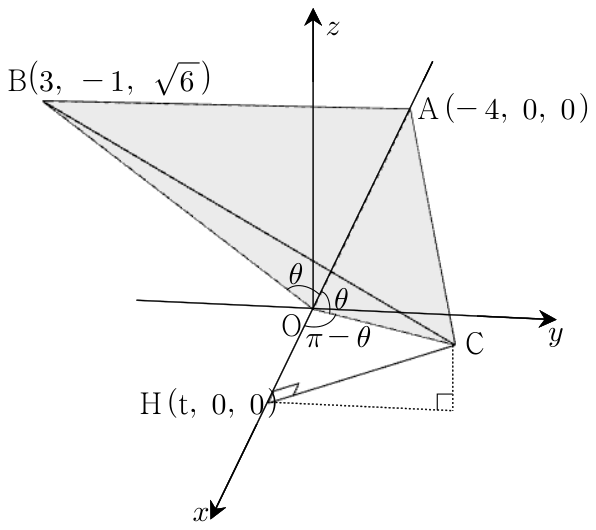
사면체 OABC와 점 C의 평면 OAB 위 정사영 H
+6점 · 점 H\displaystyle \mathrm{H}H(t,0,0)\displaystyle \mathrm{H}(t,0,0)라 두고 t\displaystyle t의 값을 구할 수 있다.

사면체 OABC\displaystyle \mathrm{OABC}의 부피가 최대가 될 때, 점 C\displaystyle \mathrm{C}의 평면 OAB\displaystyle \mathrm{OAB} 위로의 정사영 한 점 H\displaystyle \mathrm{H}는 두 점 O\displaystyle \mathrm{O}, A\displaystyle \mathrm{A}를 지나는 직선 위에 있다. 따라서 두 점 O\displaystyle \mathrm{O}, A\displaystyle \mathrm{A}를 지나는 직선의 방정식은 x\displaystyle x축이고, 점 H\displaystyle \mathrm{H}H(t,0,0)\displaystyle \mathrm{H} ( t , 0 , 0 )라 둘 수 있다.AOB=AOC=BOD=θ\displaystyle \angle \mathrm{AOB} = \angle \mathrm{AOC} = \angle \mathrm{BOD} = \theta라 두면cosθ=1244=34\displaystyle \cos \theta = \frac{{- 12}}{4 \cdot 4} = - \frac{{3}}{4}이므로t2=cos(πθ)=34\displaystyle \frac{{t}}{2} = \cos ( \pi - \theta ) = \frac{{3}}{4}이다. 따라서 점 H\displaystyle \mathrm{H}H(32,0,0)\displaystyle \mathrm{H} \left( \frac{{3}}{2} , 0 , 0 \right)이다.

+8점 · CH=(0,6t,t)\displaystyle \overrightarrow{\mathrm{CH}}=(0,\sqrt6t,t)를 이용 점 C\displaystyle \mathrm{C}의 좌표를 구할 수 있다.

한편, C(32,m,n)\displaystyle \mathrm{C}\left(\frac32,m,n\right)라 두면, CH=(0,m,n)\displaystyle \overrightarrow{\mathrm{CH}}=(0,m,n)이고CH=(0,6t,t)\displaystyle \overrightarrow{\mathrm{CH}}=(0,\sqrt6t,t)로 둘 수 있다. CH=72=7t2\displaystyle |\overrightarrow{\mathrm{CH}}|=\frac{\sqrt7}2=\sqrt{7t^2}이므로 t=±12\displaystyle t=\pm\frac12이므로 점 C\displaystyle \mathrm{C}의 좌표는(32,62,12)\displaystyle \left( \frac{{3}}{2} , \frac{{\sqrt{6}}}{2} , \frac{{1}}{2} \right), (32,62,12)\displaystyle \left( \frac{{3}}{2} , - \frac{{\sqrt{6}}}{2} , - \frac{{1}}{2} \right)이다.

[2-2]

+6점 · 두 벡터의 내적이 최댓값을 가질 때 조건을 구할 수 있다.

BDAC=(BO+OD)(AO+OC)=BOAO+BOOC+ODAO+ODOC=OBOAOBOCODOA+ODOC\displaystyle \begin{aligned}\overrightarrow{\mathrm{BD}}\cdot\overrightarrow{\mathrm{AC}}&=(\overrightarrow{\mathrm{BO}}+\overrightarrow{\mathrm{OD}})\cdot(\overrightarrow{\mathrm{AO}}+\overrightarrow{\mathrm{OC}})\\&=\overrightarrow{\mathrm{BO}}\cdot\overrightarrow{\mathrm{AO}}+\overrightarrow{\mathrm{BO}}\cdot\overrightarrow{\mathrm{OC}}+\overrightarrow{\mathrm{OD}}\cdot\overrightarrow{\mathrm{AO}}+\overrightarrow{\mathrm{OD}}\cdot\overrightarrow{\mathrm{OC}}\\&=\overrightarrow{\mathrm{OB}}\cdot\overrightarrow{\mathrm{OA}}-\overrightarrow{\mathrm{OB}}\cdot\overrightarrow{\mathrm{OC}}-\overrightarrow{\mathrm{OD}}\cdot\overrightarrow{\mathrm{OA}}+\overrightarrow{\mathrm{OD}}\cdot\overrightarrow{\mathrm{OC}}\end{aligned}이므로 BDAC\displaystyle {\overrightarrow{\mathrm{BD}}} \cdot {\overrightarrow{\mathrm{AC}}}의 최댓값은, OBOC\displaystyle {\overrightarrow{\mathrm{OB}}} \cdot {\overrightarrow{\mathrm{OC}}}가 최소이고 ODOA\displaystyle {\overrightarrow{\mathrm{OD}}} \cdot {\overrightarrow{\mathrm{OA}}}가 최소이고 ODOC\displaystyle {\overrightarrow{\mathrm{OD}}} \cdot {\overrightarrow{\mathrm{OC}}}가 최대이면 된다.

+6점 · ODOC\displaystyle \overrightarrow{\mathrm{OD}}\cdot\overrightarrow{\mathrm{OC}}가 최대가 되는 조건을 구할수 있다.

여기서 OBOA=(4,0,0)(1,3,6)=4\displaystyle {\overrightarrow{\mathrm{OB}}} \cdot {\overrightarrow{\mathrm{OA}}} = ( - 4 , 0 , 0 ) \cdot ( 1 , - 3 , \sqrt{6} ) = - 4이고, OBOC\displaystyle {\overrightarrow{\mathrm{OB}}} \cdot {\overrightarrow{\mathrm{OC}}}가 최소이고 ODOA\displaystyle {\overrightarrow{\mathrm{OD}}} \cdot {\overrightarrow{\mathrm{OA}}}가 최소이고 ODOC\displaystyle {\overrightarrow{\mathrm{OD}}} \cdot {\overrightarrow{\mathrm{OC}}}가 최대가 되기 위해서는 점 C,D\displaystyle \mathrm{C} , \mathrm{D}가 평면 OAB\displaystyle \mathrm{OAB} 위에 있을 때, 즉,BOC=DOA=2π2θ\displaystyle \angle \mathrm{BOC} = \angle \mathrm{DOA} = 2 \pi - 2 \theta

+8점 · 내적의 최댓값을 구할 수 있다.

이다. 그러므로OBOC=4×2×cos(2π2θ)=8cos2θ\displaystyle {\overrightarrow{\mathrm{OB}}} \cdot {\overrightarrow{\mathrm{OC}}} = 4 \times 2 \times \cos ( 2 \pi - 2 \theta ) = 8 \cos 2 \theta인데 cos2θ=2cos2θ1=18\displaystyle \cos 2 \theta = 2 \cos^{2} \theta - 1 = \frac{{1}}{8} 이므로 OBOC=1\displaystyle {\overrightarrow{\mathrm{OB}}} \cdot {\overrightarrow{\mathrm{OC}}} = 1이다.

첨삭 사례

아직 등록된 첨삭 사례가 없습니다.

질문과 답변 · 0개질문과 답변 · 고정 0개

아직 등록된 질문이 없습니다. 질문 작성은 멤버십 회원만 가능합니다.