수리논술, 배움에서 논증의 완성까지.

의학계 1번

문제

【문항 1】다음 제시문을 이용하여 아래 논제의 풀이 과정과 답을 논리적으로 서술하시오.

(가) 평면 위의 세 점 A,B,C\displaystyle \mathrm{A} , \mathrm{B} , \mathrm{C}에 대하여 다음이 성립한다.AB+BC=AC\displaystyle \overrightarrow{\mathrm{AB}} + \overrightarrow{\mathrm{BC}} = \overrightarrow{\mathrm{AC}}ABAC=CB\displaystyle {\overrightarrow{\mathrm{AB}}} - {\overrightarrow{\mathrm{AC}}} = {\overrightarrow{\mathrm{CB}}}

(나) 영벡터가 아닌 두 벡터 a,b\displaystyle {\overrightarrow{a}} , {\overrightarrow{b}}에 대하여 a+b2=a2+2ab+b2\displaystyle \left| {\overrightarrow{a}} + {\overrightarrow{b}} \right|^{2} = \left| {\overrightarrow{a}} \right|^{2} + 2 {\overrightarrow{a}} \cdot {\overrightarrow{b}} + \left| {\overrightarrow{b}} \right|^{2}이 성립한다.

중심이 O(0,0)\displaystyle \mathrm{O} ( 0 , 0 )이고 점 A(2,0)\displaystyle \mathrm{A} ( 2 , 0 )을 지나는 원 C\displaystyle C가 있다. OA\displaystyle \overline{\mathrm{OA}} 위에 OP=t(0t2)\displaystyle {\overline{\mathrm{OP}}} = t ( 0 \le t \le 2 )인 점 P\displaystyle \mathrm{P}와 원 C\displaystyle C 위의 임의의 점 Q\displaystyle \mathrm{Q}에 대하여 QR=PR\displaystyle {\overline{\mathrm{QR}}} = {\overline{\mathrm{PR}}}를 만족하는 OQ\displaystyle {\overline{\mathrm{OQ}}} 위의 점 R\displaystyle \mathrm{R}가 존재한다. 다음 물음에 답하시오.

[1-1] 점 R\displaystyle \mathrm{R}가 나타내는 도형의 방정식을 t\displaystyle t에 관한 식으로 나타내시오. (10점)

[1-2] 0<t<2\displaystyle 0 < t < 2일 때, ORPQ\displaystyle {\overrightarrow{\mathrm{OR}}} \cdot {\overrightarrow{\mathrm{PQ}}}t\displaystyle t에 관한 식으로 나타내시오. (10점)

[1-3] t=1\displaystyle t = 1일 때, PQ\displaystyle \overline{\mathrm{PQ}}의 중점 M\displaystyle \mathrm{M}에 대하여 RM=TR\displaystyle {\overrightarrow{\mathrm{RM}}} = {\overrightarrow{\mathrm{TR}}}를 만족하는 y\displaystyle y축 위의 점 T\displaystyle \mathrm{T}가 존재한다. 이 때, ORPR\displaystyle {\overrightarrow{\mathrm{OR}}} \cdot \overrightarrow{\mathrm{PR}}의 값을 구하시오. (10점)

해설강의 준비중

[1-1]

+2점 · 주어진 조건을 이용해서 점 R\displaystyle \mathrm{R}이 두 점 O,P\displaystyle \mathrm{O} , \mathrm{P}로부터 거리의 합이 2\displaystyle 2로 일정한 점임을 밝힌다.

OQ=2\displaystyle \overline{\mathrm{OQ}} = 2이고, OQ=OR+RQ=OR+PR\displaystyle {\overline{\mathrm{OQ}}} = \overline{\mathrm{OR}} + \overline{\mathrm{RQ}} = \overline{\mathrm{OR}} + \overline{\mathrm{PR}}이므로 OR+PR=2\displaystyle {\overline{\mathrm{OR}}} + {\overline{\mathrm{PR}}} = 2이다. 따라서 점 R\displaystyle \mathrm{R}은 두 점 O,P\displaystyle \mathrm{O} , \mathrm{P}로부터 거리의 합이 2\displaystyle 2로 일정한 점이다.

+2점 · t=0\displaystyle t = 0일 때 도형의 방정식을 구한다.

ⅰ) t=0\displaystyle t = 0이면 점 P\displaystyle \mathrm{P}가 원점이 되므로 점 R\displaystyle \mathrm{R}이 나타내는 도형은 중심이 원점이고 반지름의 길이가 1\displaystyle 1인 원과 같다. 따라서 x2+y2=1\displaystyle x^{2} + y^{2} = 1이다.

+3점 · t=2\displaystyle t = 2일 때 도형의 방정식을 구한다.

ⅱ) t=2\displaystyle t = 2이면 점 P\displaystyle \mathrm{P}가 점 A\displaystyle \mathrm{A}가 되고 2=OAOR+AROR+PR=2\displaystyle 2 = {\overline{\mathrm{OA}}} \leq {\overline{\mathrm{OR}}} + {\overline{\mathrm{AR}}} \leq {\overline{\mathrm{OR}}} + {\overline{\mathrm{PR}}} = 2이므로 점 Q\displaystyle \mathrm{Q}가 점 A\displaystyle \mathrm{A}가 아닌 위치에 있을 때, 점 R\displaystyle \mathrm{R}이 나타내는 도형은 (0,0)\displaystyle ( 0 , 0 )이고, 점 Q\displaystyle \mathrm{Q}가 점 A\displaystyle \mathrm{A}의 위치에 있을 때, 점 R\displaystyle \mathrm{R}이 나타내는 도형은 y=0(0x2)\displaystyle y = 0 ( 0 \le x \le 2 )이다.

+3점 · 0<t<2\displaystyle 0 < t < 2일 때 도형의 방정식을 구한다.

ⅲ) 0<t<2\displaystyle 0 < t < 2이면 점 R\displaystyle \mathrm{R}은 서로 다른 두 점 O,P\displaystyle \mathrm{O} , \mathrm{P}로부터 거리의 합이 2\displaystyle 2로 일정한 점이 되어 타원 위의 점이 된다. 즉, O(0,0)\displaystyle \mathrm{O} ( 0 , 0 )P(t,0)\displaystyle {\mathrm{P}} ( t , 0 )을 초점으로 하고 장축의 길이가 2\displaystyle 2인 타원의 방정식은, 두 점 O(t2,0)\displaystyle \mathrm{O}^{\prime} \left( - \frac{{t}}{2} , 0 \right)P(t2,0)\displaystyle {\mathrm{P}^{\prime}} \left( \frac{{t}}{2} , 0 \right)을 초점으로 하고 장축의 길이가 2\displaystyle 2인 타원을, x\displaystyle x축 방향으로 t2\displaystyle \frac{{t}}{2}만큼 평행이동한 방정식과 같다. 따라서(xt2)2+y21t24=1\displaystyle {\left( x - \frac{{t}}{2} \right)^{2}} + \frac{{y^{2}}}{1 - \frac{{t^{2}}}{4}} = 1이다.

[1-2]

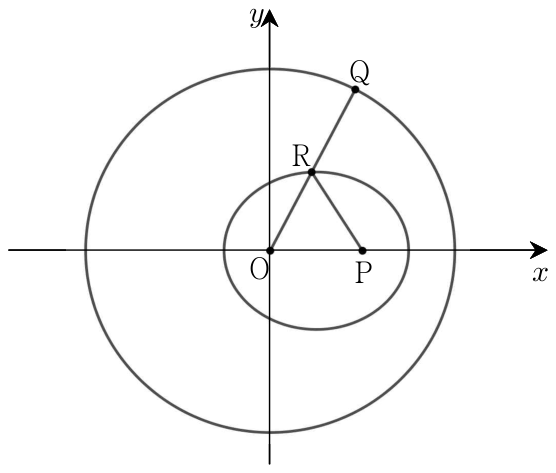
원 C 위의 점 Q와 타원 위의 점 R
+3점 · 주어진 벡터를 적절하게 합으로 분할하여 나타낸다.

ORPQ=OR(PR+RQ)=ORRQ+ORPR\displaystyle {\overrightarrow{\mathrm{OR}}} \cdot {\overrightarrow{\mathrm{PQ}}} = {\overrightarrow{\mathrm{OR}}} \cdot ( {\overrightarrow{\mathrm{PR}}} + {\overrightarrow{\mathrm{RQ}}} ) = {\overrightarrow{\mathrm{OR}}} \cdot {\overrightarrow{\mathrm{RQ}}} + {\overrightarrow{\mathrm{OR}}} \cdot {\overrightarrow{\mathrm{PR}}}과 같다. … ①

+3점 · ORPR\displaystyle {\overrightarrow{\mathrm{OR}}} \cdot {\overrightarrow{\mathrm{PR}}}t\displaystyle tOR=k(0<k<2)\displaystyle \left| {\overrightarrow{\mathrm{OR}}} \right| = k ( 0 < k < 2 )를 이용하여 구한다.

한편 OR=k(0<k<2)\displaystyle \left| {\overrightarrow{\mathrm{OR}}} \right| = k ( 0 < k < 2 )라 두면, RQ=PR=2k\displaystyle \left| {\overrightarrow{\mathrm{RQ}}} \right| = \left| {\overrightarrow{\mathrm{PR}}} \right| = 2 - k이다.또한, OP=RPRO=ORPR\displaystyle \overrightarrow{\mathrm{OP}}=\overrightarrow{\mathrm{RP}}-\overrightarrow{\mathrm{RO}}=\overrightarrow{\mathrm{OR}}-\overrightarrow{\mathrm{PR}}이므로 OP2=ORPR2\displaystyle |\overrightarrow{\mathrm{OP}}|^2=|\overrightarrow{\mathrm{OR}}-\overrightarrow{\mathrm{PR}}|^2이다.t2=k2+(2k)22ORPR\displaystyle t^{2} = k^{2} + ( 2 - k )^{2} - 2 {\overrightarrow{\mathrm{OR}}} \cdot {\overrightarrow{\mathrm{PR}}}이므로 ORPR=k22k+2t22\displaystyle {\overrightarrow{\mathrm{OR}}} \cdot {\overrightarrow{\mathrm{PR}}} = k^{2} - 2 k + 2 - \frac{{t^{2}}}{2}이다.

+4점 · ORPQ\displaystyle {\overrightarrow{\mathrm{OR}}} \cdot {\overrightarrow{\mathrm{PQ}}}을 구한다.

따라서 ①에ORPQ=OR(PR+RQ)=k(2k)+ORPR=2t22\displaystyle {\overrightarrow{\mathrm{OR}}} \cdot {\overrightarrow{\mathrm{PQ}}} = {\overrightarrow{\mathrm{OR}}} \cdot ( {\overrightarrow{\mathrm{PR}}} + {\overrightarrow{\mathrm{RQ}}} ) = k ( 2 - k ) + {\overrightarrow{\mathrm{OR}}} \cdot {\overrightarrow{\mathrm{PR}}} = 2 - \frac{{t^{2}}}{2}이다.

[1-3]

t=1\displaystyle t = 1이면 점 R\displaystyle \mathrm{R}은 타원 (x12)2+y234=1\displaystyle \left( x - \frac{{1}}{2} \right)^{2} + \frac{{y^{2}}}{\frac{{3}}{4}} = 1 위에 있다.

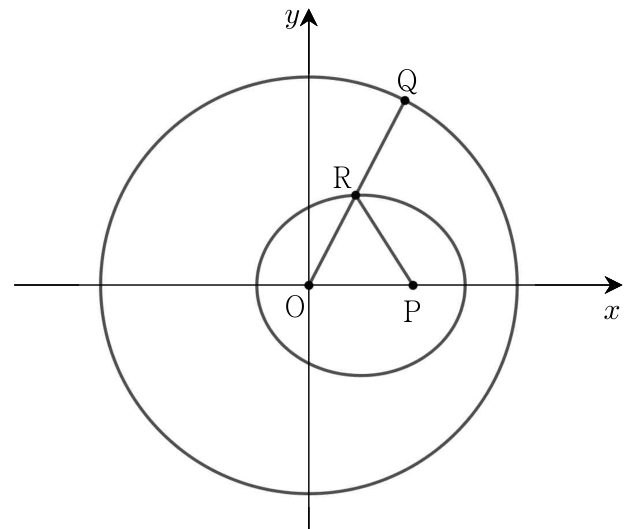
t=1일 때 타원의 단축 위 점 R
+2점 · 점 R\displaystyle \mathrm{R}이 두 점 M,T\displaystyle \mathrm{M} , \mathrm{T}의 중점임을 밝힌다.

RM=TR\displaystyle {\overrightarrow{\mathrm{RM}}} = {\overrightarrow{\mathrm{TR}}}에서 RM+RT=0\displaystyle {\overrightarrow{\mathrm{RM}}} + {\overrightarrow{\mathrm{RT}}} = {\overrightarrow{0}}이므로 점 R\displaystyle \mathrm{R}은 두 점 M,T\displaystyle \mathrm{M} , \mathrm{T}의 중점이어야 한다. … ①

+4점 · 점 Q\displaystyle \mathrm{Q}의 좌표를 구하기 위한 관계식을 2가지 이상 찾아낸다.

ⅰ) 점 Q\displaystyle \mathrm{Q}의 좌표를 (a,b)\displaystyle ( a , b )라 하자. 그러면 a2+b2=4\displaystyle a^{2} + b^{2} = 4이다.ⅱ) 점 M\displaystyle \mathrm{M}PQ\displaystyle \overline{\mathrm{PQ}}의 중점이므로 M(1+a2,b2)\displaystyle \mathrm{M} \left( \frac{{1 + a}}{2} , \frac{{b}}{2} \right)이다. 한편, 점 R\displaystyle \mathrm{R}은 두 직선 OQ\displaystyle \mathrm{OQ}MR\displaystyle \mathrm{MR}의 교점이다.직선 OQ\displaystyle \mathrm{OQ}의 방정식은y=bax\displaystyle y = \frac{{b}}{a} x … ②이고, 직선 MR\displaystyle \mathrm{MR}은 점 M\displaystyle \mathrm{M}을 지나고 직선 PQ\displaystyle \mathrm{PQ}에 수직이다. 직선 PQ\displaystyle \mathrm{PQ}의 기울기는 ba1\displaystyle \frac{{b}}{a - 1}이므로 직선 MR\displaystyle \mathrm{MR}의 방정식은y=1ab(xa+12)+b2\displaystyle y = \frac{{1 - a}}{b} \left( x - \frac{{a + 1}}{2} \right) + \frac{{b}}{2} 즉, y=1abx+32b\displaystyle y = \frac{{1 - a}}{b} x + \frac{{3}}{2 b} … ③이다. 따라서 ②, ③에 의해서 bax=1abx+32b\displaystyle \frac{{b}}{a} x = \frac{{1 - a}}{b} x + \frac{{3}}{2 b}가 되어 x=3a2(4a)\displaystyle x = \frac{{3 a}}{2 ( 4 - a )} 즉, 점 R\displaystyle \mathrm{R}x\displaystyle x좌표는 3a2(4a)\displaystyle \frac{{3 a}}{2 ( 4 - a )}이다.

+2점 · 점 Q\displaystyle \mathrm{Q}의 좌표를 구한다.

ⅲ) ①에 의해서 점 R\displaystyle \mathrm{R}x\displaystyle x좌표의 2\displaystyle 2배가 점 M\displaystyle \mathrm{M}x\displaystyle x좌표가 된다.따라서 2×3a2(4a)=a+12\displaystyle 2 \times \frac{{3 a}}{2 ( 4 - a )} = \frac{{a + 1}}{2}을 만족하는 a=1\displaystyle a = 1이다(2a2)\displaystyle ( - 2 \le a \le 2 ).이를 만족하는 점 Q\displaystyle \mathrm{Q}의 좌표는 (1,3)\displaystyle ( 1 , \sqrt{3} )이 된다.

+2점 · ORPR\displaystyle {\overrightarrow{\mathrm{OR}}} \cdot \overrightarrow{\mathrm{PR}}을 구한다.

따라서 점 R\displaystyle \mathrm{R}은 타원의 단축 위의 꼭짓점이 되어ORPR=1×1×cosπ3=12\displaystyle {\overrightarrow{\mathrm{OR}}} \cdot {\overrightarrow{\mathrm{PR}}} = 1 \times 1 \times \cos \frac{{\pi}}{3} = \frac{{1}}{2}이다.

첨삭 사례

아직 등록된 첨삭 사례가 없습니다.

질문과 답변 · 0개질문과 답변 · 고정 0개

아직 등록된 질문이 없습니다. 질문 작성은 멤버십 회원만 가능합니다.