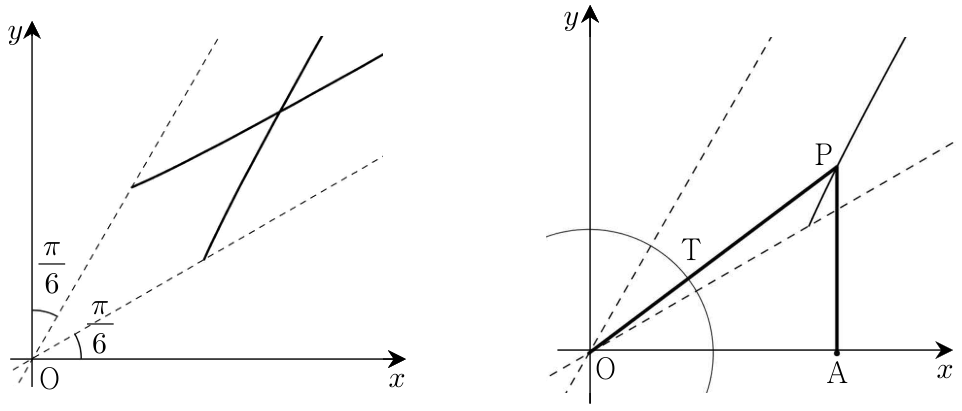
[2-1]
+2점 · P T ‾ = P A ‾ \displaystyle \overline{\mathrm{PT}} = \overline{\mathrm{PA}} PT = PA P \displaystyle \mathrm{P} P 점 T \displaystyle \mathrm{T} T P O ‾ − P A ‾ = ( P T ‾ + O T ‾ ) − P A ‾ = O T ‾ = 2 \displaystyle \overline{\mathrm{PO}} - \overline{\mathrm{PA}} = ( \overline{\mathrm{PT}} + \overline{\mathrm{OT}} ) - \overline{\mathrm{PA}} = \overline{\mathrm{OT}} = 2 PO − PA = ( PT + OT ) − PA = OT = 2 이므로 점 P \displaystyle \mathrm{P} P O \displaystyle \mathrm{O} O A \displaystyle \mathrm{A} A 2 \displaystyle 2 2 ( x − 2 ) 2 − y 2 3 = 1 \displaystyle ( x - 2 )^{2} - \frac{y^{2}}{3} = 1 ( x − 2 ) 2 − 3 y 2 = 1 ( x > 2 ) \displaystyle \left( x > 2 \right) ( x > 2 )
이 곡선의 점근선의 방정식이 y = ± 3 ( x − 2 ) \displaystyle y = \pm \sqrt{3} ( x - 2 ) y = ± 3 ( x − 2 ) 반직선 O T → \displaystyle \overrightarrow{\mathrm{OT}} OT P \displaystyle \mathrm{P} P O P \displaystyle \mathrm{OP} OP − 3 \displaystyle - \sqrt{3} − 3 3 \displaystyle \sqrt{3} 3 tan π 3 = 3 \displaystyle \tan \frac{\pi}{3} = \sqrt{3} tan 3 π = 3 O P \displaystyle \mathrm{OP} OP θ 1 \displaystyle \theta_{1} θ 1 − π 3 < θ 1 < π 3 \displaystyle - \frac{\pi}{3} < \theta_{1} < \frac{\pi}{3} − 3 π < θ 1 < 3 π P \displaystyle \mathrm{P} P ⋯ \displaystyle \cdots ⋯
+2점 · Q T ‾ = Q B ‾ \displaystyle \overline{\mathrm{QT}} = \overline{\mathrm{QB}} QT = QB Q \displaystyle \mathrm{Q} Q 점 Q \displaystyle \mathrm{Q} Q P \displaystyle \mathrm{P} P y = x \displaystyle y = x y = x π 6 < θ 2 < 5 6 π \displaystyle \frac{\pi}{6} < \theta_{2} < \frac{5}{6} \pi 6 π < θ 2 < 6 5 π Q \displaystyle \mathrm{Q} Q ⋯ \displaystyle \cdots ⋯
+4점 · 두 점 P \displaystyle \mathrm{P} P Q \displaystyle \mathrm{Q} Q ∠ A O T \displaystyle \angle \mathrm{AOT} ∠ AOT 그러므로 점 T \displaystyle \mathrm{T} T P \displaystyle \mathrm{P} P Q \displaystyle \mathrm{Q} Q θ = ∠ A O T \displaystyle \theta = \angle \mathrm{AOT} θ = ∠ AOT ㉠, ㉡에 의해서 π 6 < θ < π 3 \displaystyle \frac{\pi}{6} < \theta < \frac{\pi}{3} 6 π < θ < 3 π
따라서 C 1 = { ( x , y ) ∣ ( x − 2 ) 2 − y 2 3 = 1 , y > 3 3 x , x > 2 } \displaystyle C_1=\left\{(x,y)\mid(x-2)^2-\frac{y^2}3=1,\ y>\frac{\sqrt3}3x,\ x>2\right\} C 1 = { ( x , y ) ∣ ( x − 2 ) 2 − 3 y 2 = 1 , y > 3 3 x , x > 2 }
+3점 · O P ‾ > a \displaystyle \overline{\mathrm{OP}} > \mathrm{a} OP > a a \displaystyle a a x > 2 \displaystyle x > 2 x > 2 y = 3 3 x \displaystyle y = \frac{\sqrt{3}}{3} x y = 3 3 x ( x − 2 ) 2 − y 2 3 = 1 \displaystyle ( x - 2 )^{2} - \frac{y^{2}}{3} = 1 ( x − 2 ) 2 − 3 y 2 = 1 P 1 \displaystyle \mathrm{P}_{1} P 1 O P ‾ > a \displaystyle \overline{\mathrm{OP}} > a OP > a a \displaystyle a a O P ‾ 1 \displaystyle \overline{\mathrm{OP}}_{1} OP 1 ⋯ \displaystyle \cdots ⋯
+4점 · a \displaystyle a a O P ‾ 1 = t \displaystyle \overline{\mathrm{OP}}_{1} = t OP 1 = t P 1 A ‾ = t − 2 \displaystyle \overline{\mathrm{P}_{1} \mathrm{A}} = t - 2 P 1 A = t − 2 ∣ P 1 A → ∣ 2 = ∣ O A → − O P 1 → ∣ 2 \displaystyle | \overrightarrow{\mathrm{P}_{1} \mathrm{A}} |^{2} = | \overrightarrow{\mathrm{OA}} - \overrightarrow{\mathrm{OP}_{1}} |^{2} ∣ P 1 A ∣ 2 = ∣ OA − OP 1 ∣ 2 ( t − 2 ) 2 = 16 + t 2 − 2 × 4 × t × cos π 6 \displaystyle ( t - 2 )^{2} = 16 + t^{2} - 2 \times 4 \times t \times \cos \frac{\pi}{6} ( t − 2 ) 2 = 16 + t 2 − 2 × 4 × t × cos 6 π t = 3 2 ( 3 + 1 ) \displaystyle t = \frac{3}{2} ( \sqrt{3} + 1 ) t = 2 3 ( 3 + 1 ) 따라서 a \displaystyle a a 3 2 ( 3 + 1 ) \displaystyle \frac{3}{2} ( \sqrt{3} + 1 ) 2 3 ( 3 + 1 )
[2-2]
+5점 · f ′ ( x ) < 3 3 \displaystyle f^{\prime} ( x ) < \frac{\sqrt{3}}{3} f ′ ( x ) < 3 3 곡선 y = f ( x ) \displaystyle y = f ( x ) y = f ( x ) tan π 6 = 3 3 \displaystyle \tan \frac{\pi}{6} = \frac{\sqrt{3}}{3} tan 6 π = 3 3 f ′ ( x ) < 3 3 ⋯ \displaystyle f^{\prime} ( x ) < \frac{\sqrt{3}}{3}\cdots f ′ ( x ) < 3 3 ⋯ (또는, 함수 f ( x ) = ( x 2 3 + 1 ) 1 2 + 2 \displaystyle f ( x ) = \left( \frac{x^{2}}{3} + 1 \right)^{\frac{1}{2}} + 2 f ( x ) = ( 3 x 2 + 1 ) 2 1 + 2 f ′ ( x ) = ( 3 + 9 x 2 ) − 1 2 \displaystyle f^{\prime} ( x ) = \left( 3 + \frac{9}{x^{2}} \right)^{- \frac{1}{2}} f ′ ( x ) = ( 3 + x 2 9 ) − 2 1 f ′ ( x ) < 3 3 \displaystyle f^{\prime} ( x ) < \frac{\sqrt{3}}{3} f ′ ( x ) < 3 3
+5점 · f ( g ( k ) ) = − g ( k ) + k \displaystyle f ( g ( k ) ) = - g ( k ) + k f ( g ( k )) = − g ( k ) + k b \displaystyle b b f ( g ( k ) ) = − g ( k ) + k \displaystyle f ( g ( k ) ) = - g ( k ) + k f ( g ( k )) = − g ( k ) + k f ′ ( g ( k ) ) × g ′ ( k ) = − g ′ ( k ) + 1 \displaystyle f^{\prime} ( g ( k ) ) \times g^{\prime} ( k ) = - g^{\prime} ( k ) + 1 f ′ ( g ( k )) × g ′ ( k ) = − g ′ ( k ) + 1 g ′ ( k ) × { f ′ ( g ( k ) ) + 1 } = 1 \displaystyle g^{\prime} ( k ) \times \left\{ f^{\prime} ( g ( k ) ) + 1 \right\} = 1 g ′ ( k ) × { f ′ ( g ( k )) + 1 } = 1 이므로 ㉠에 의해서 g ′ ( k ) > 3 − 3 2 \displaystyle g^{\prime} ( k ) > \frac{{3 - \sqrt{3}}}{2} g ′ ( k ) > 2 3 − 3 그러므로 b \displaystyle b b 3 − 3 2 \displaystyle \frac{{3 - \sqrt{3}}}{2} 2 3 − 3
[2-3]
+3점 · h ( k ) \displaystyle h ( k ) h ( k ) k \displaystyle k k g ( k ) \displaystyle g ( k ) g ( k ) h ( k ) = 2 × 2 2 ∣ f ( g ( k ) ) − g ( k ) ∣ = 2 ∣ f ( g ( k ) ) − g ( k ) ∣ = 2 ∣ k − 2 g ( k ) ∣ \displaystyle h(k)=2\times\frac{\sqrt2}2|f(g(k))-g(k)|=\sqrt2|f(g(k))-g(k)|=\sqrt2|k-2g(k)| h ( k ) = 2 × 2 2 ∣ f ( g ( k )) − g ( k ) ∣ = 2 ∣ f ( g ( k )) − g ( k ) ∣ = 2 ∣ k − 2 g ( k ) ∣
h ′ ( k ) = { 2 ( 1 − 2 g ′ ( k ) ) ( k < α ) 2 ( 2 g ′ ( k ) − 1 ) ( k > α ) ⋯ \displaystyle h^{\prime} ( k ) = \begin{cases}\sqrt{2} ( 1 - 2 g^{\prime} ( k ) ) & ( k < \alpha ) \\ \sqrt{2} ( 2 g^{\prime} ( k ) - 1 ) & ( k > \alpha )\end{cases}\cdots h ′ ( k ) = { 2 ( 1 − 2 g ′ ( k )) 2 ( 2 g ′ ( k ) − 1 ) ( k < α ) ( k > α ) ⋯
h ′ ′ ( k ) = { − 2 2 g ′ ′ ( k ) ( k < α ) 2 2 g ′ ′ ( k ) ( k > α ) ⋯ \displaystyle h^{\prime \prime} ( k ) = \begin{cases}- 2 \sqrt{2} g^{\prime \prime} ( k ) & ( k < \alpha ) \\ 2 \sqrt{2} g^{\prime \prime} ( k ) & ( k > \alpha )\end{cases}\cdots h ′′ ( k ) = { − 2 2 g ′′ ( k ) 2 2 g ′′ ( k ) ( k < α ) ( k > α ) ⋯
이다. 그리고 곡선 y = f ( x ) \displaystyle y = f ( x ) y = f ( x ) f ′ ′ ( x ) > 0 \displaystyle f^{\prime \prime} ( x ) > 0 f ′′ ( x ) > 0
(또는, 함수 f ( x ) = ( x 2 3 + 1 ) 1 2 + 2 \displaystyle f ( x ) = \left( \frac{x^{2}}{3} + 1 \right)^{\frac{1}{2}} + 2 f ( x ) = ( 3 x 2 + 1 ) 2 1 + 2 f ′ ′ ( x ) > 0 \displaystyle f^{\prime \prime} ( x ) > 0 f ′′ ( x ) > 0
한편 [2-2]의 결과로부터 g ′ ( k ) × { f ′ ( g ( k ) ) + 1 } = 1 \displaystyle g^{\prime} ( k ) \times \left\{ f^{\prime} ( g ( k ) ) + 1 \right\} = 1 g ′ ( k ) × { f ′ ( g ( k )) + 1 } = 1 g ′ ( k ) > 3 − 3 2 > 1 2 ⋯ \displaystyle g^{\prime} ( k ) > \frac{{3 - \sqrt{3}}}{2} > \frac{1}{2}\cdots g ′ ( k ) > 2 3 − 3 > 2 1 ⋯ 이므로 위 식을 양변 미분하면 g ′ ′ ( k ) × { f ′ ( g ( k ) ) + 1 } + { g ′ ( k ) } 2 × f ′ ′ ( g ( k ) ) = 0 \displaystyle g^{\prime \prime} ( k ) \times \left\{ f^{\prime} ( g ( k ) ) + 1 \right\} + \left\{ g^{\prime} ( k ) \right\}^{2} \times f^{\prime \prime} ( g ( k ) ) = 0 g ′′ ( k ) × { f ′ ( g ( k )) + 1 } + { g ′ ( k ) } 2 × f ′′ ( g ( k )) = 0 이다. f ′ ( g ( k ) ) + 1 > 0 \displaystyle f^{\prime} ( g ( k ) ) + 1 > 0 f ′ ( g ( k )) + 1 > 0 { g ′ ( k ) } 2 × f ′ ′ ( g ( k ) ) > 0 \displaystyle \left\{ g^{\prime} ( k ) \right\}^{2} \times f^{\prime \prime} ( g ( k ) ) > 0 { g ′ ( k ) } 2 × f ′′ ( g ( k )) > 0 g ′ ′ ( k ) < 0 \displaystyle g^{\prime \prime} ( k ) < 0 g ′′ ( k ) < 0 ⋯ \displaystyle \cdots ⋯
만일 함수 h ( k ) \displaystyle h ( k ) h ( k ) k = α \displaystyle k = \alpha k = α
+5점 · lim k → α + h ( k ) − h ( α ) k − α \displaystyle \lim_{k \to \alpha +} \frac{{h ( k ) - h ( \alpha )}}{k - \alpha} k → α + lim k − α h ( k ) − h ( α ) 1) k > α \displaystyle k > \alpha k > α h ′ ( k ) > 0 \displaystyle h^{\prime} ( k ) > 0 h ′ ( k ) > 0 h ′ ′ ( k ) < 0 \displaystyle h^{\prime \prime} ( k ) < 0 h ′′ ( k ) < 0 lim k → α + h ( k ) − h ( α ) k − α > 0 \displaystyle \lim_{k \to \alpha +} \frac{{h ( k ) - h ( \alpha )}}{k-\alpha} > 0 k → α + lim k − α h ( k ) − h ( α ) > 0
+5점 · lim k → α − h ( k ) − h ( α ) k − α \displaystyle \lim_{k \to \alpha -} \frac{{h ( k ) - h ( \alpha )}}{k-\alpha} k → α − lim k − α h ( k ) − h ( α ) 2) k < α \displaystyle k < \alpha k < α h ′ ( k ) < 0 \displaystyle h^{\prime} ( k ) < 0 h ′ ( k ) < 0 h ′ ′ ( k ) > 0 \displaystyle h^{\prime \prime} ( k ) > 0 h ′′ ( k ) > 0 lim k → α − h ( k ) − h ( α ) k − α ≤ 0 \displaystyle \lim_{k \to \alpha -} \frac{{h ( k ) - h ( \alpha )}}{k-\alpha} \le 0 k → α − lim k − α h ( k ) − h ( α ) ≤ 0
+2점 · h ( k ) \displaystyle h ( k ) h ( k ) k = α \displaystyle k = \alpha k = α 이다. 따라서 lim k → α − h ( k ) − h ( α ) k − α ≠ lim k → α + h ( k ) − h ( α ) k − α \displaystyle \lim_{k \to \alpha -} \frac{{h ( k ) - h ( \alpha )}}{k-\alpha} \ne \lim_{k \to \alpha +} \frac{{h ( k ) - h ( \alpha )}}{k - \alpha} k → α − lim k − α h ( k ) − h ( α ) = k → α + lim k − α h ( k ) − h ( α ) h ( k ) \displaystyle h ( k ) h ( k ) k = α \displaystyle k = \alpha k = α
 수리논술, 배움에서 논증의 완성까지.