수리논술, 이게 다다.

의·약학계 2번

오류 제보

문제

【문항 2】다음 제시문을 이용하여 아래 논제의 풀이 과정과 답을 논리적으로 서술하시오.

[I] 삼각함수의 덧셈정리sin⁡(α+β)=sin⁡αcos⁡β+cos⁡αsin⁡β,sin⁡(α−β)=sin⁡αcos⁡β−cos⁡αsin⁡β\displaystyle \sin(\alpha+\beta)=\sin\alpha\cos\beta+\cos\alpha\sin\beta,\quad\sin(\alpha-\beta)=\sin\alpha\cos\beta-\cos\alpha\sin\betacos⁡(α+β)=cos⁡αcos⁡β−sin⁡αsin⁡β,cos⁡(α−β)=cos⁡αcos⁡β+sin⁡αsin⁡β\displaystyle \cos(\alpha+\beta)=\cos\alpha\cos\beta-\sin\alpha\sin\beta,\quad\cos(\alpha-\beta)=\cos\alpha\cos\beta+\sin\alpha\sin\betatan⁡(α+β)=tan⁡α+tan⁡β1−tan⁡αtan⁡β,tan⁡(α−β)=tan⁡α−tan⁡β1+tan⁡αtan⁡β\displaystyle \tan(\alpha+\beta)=\frac{\tan\alpha+\tan\beta}{1-\tan\alpha\tan\beta},\quad\tan(\alpha-\beta)=\frac{\tan\alpha-\tan\beta}{1+\tan\alpha\tan\beta}

[II] 함수 f(x)\displaystyle f(x)의 x=a\displaystyle x=a에서의 극한값이 L\displaystyle L이면 x=a\displaystyle x=a에서의 우극한과 좌극한이 모두 존재하고 그 값은 모두 L\displaystyle L과 같다. 또 그 역도 성립한다. 즉,lim⁡x→af(x)=L⟺lim⁡x→a+f(x)=lim⁡x→a−f(x)=L\displaystyle \lim_{x\to a}f(x)=L\quad\Longleftrightarrow\quad\lim_{x\to a+}f(x)=\lim_{x\to a-}f(x)=L

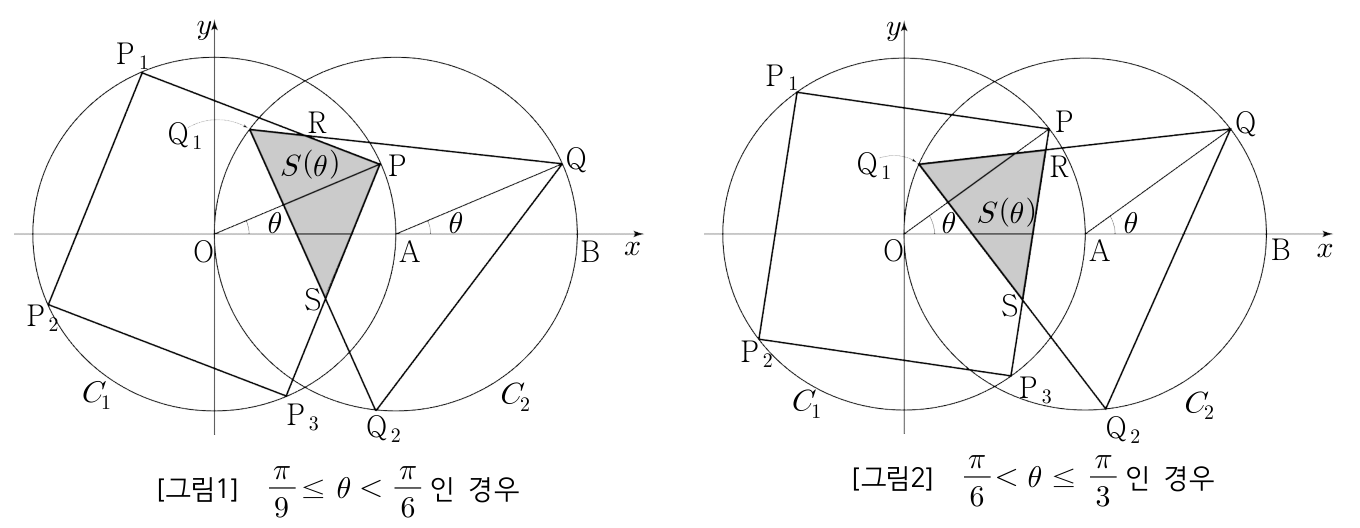
좌표평면에서 두 점 O(0,0)\displaystyle \mathrm O(0,0)과 A(1,0)\displaystyle \mathrm A(1,0)을 각각 중심으로 하고 반지름의 길이가 1인 두 원을 C1,C2\displaystyle C_1,C_2라 하자.점 B(2,0)\displaystyle \mathrm B(2,0)에 대하여 원 C1\displaystyle C_1 위의 점 P와 원 C2\displaystyle C_2 위의 점 Q를 ∠AOP=∠BAQ=θ  (π9≤θ≤π3)\displaystyle \angle\mathrm{AOP}=\angle\mathrm{BAQ}=\theta\;\left(\frac\pi9\le\theta\le\frac\pi3\right)가 되도록 잡고, 원 C1\displaystyle C_1에 내접하는 정사각형 PP1P2P3\displaystyle \mathrm{PP}_1\mathrm P_2\mathrm P_3과 원 C2\displaystyle C_2에 내접하는 정삼각형 QQ1Q2\displaystyle \mathrm{QQ}_1\mathrm Q_2를 그린다. 두 선분 QQ1,Q1Q2\displaystyle \mathrm{QQ}_1,\mathrm Q_1\mathrm Q_2가 정사각형 PP1P2P3\displaystyle \mathrm{PP}_1\mathrm P_2\mathrm P_3과 만나는 두 점을 각각 R, S라 하자. 이때 정사각형 PP1P2P3\displaystyle \mathrm{PP}_1\mathrm P_2\mathrm P_3의 내부와 정삼각형 QQ1Q2\displaystyle \mathrm{QQ}_1\mathrm Q_2의 내부의 공통부분의 넓이를 S(θ)\displaystyle S(\theta)라 하자.

θ의 범위에 따른 두 도형의 공통부분

[2-1] 점 Q1\displaystyle \mathrm Q_1과 직선 PP3\displaystyle \mathrm{PP}_3 사이의 거리를 d1\displaystyle d_1, 점 P와 직선 QQ1\displaystyle \mathrm{QQ}_1 사이의 거리를 d2\displaystyle d_2라 할 때, 다음이 성립함을 보이시오. (20점)d1=12(3+32−cos⁡θ−sin⁡θ),d2=∣sin⁡(θ−π6)∣\displaystyle d_1=\frac1{\sqrt2}\left(\frac{3+\sqrt3}2-\cos\theta-\sin\theta\right),\qquad d_2=\left|\sin\left(\theta-\frac\pi6\right)\right|

[2-2] [2-1]을 이용하여 lim⁡θ→π6S′(θ)\displaystyle \lim_{\theta\to\frac\pi6}S^{\prime}(\theta)의 값이 존재함을 보이시오. (20점)

해설강의 준비중
+6점 · 점과 직선 사이의 거리를 이용하여 d1\displaystyle d_1을 표현할 수 있다.

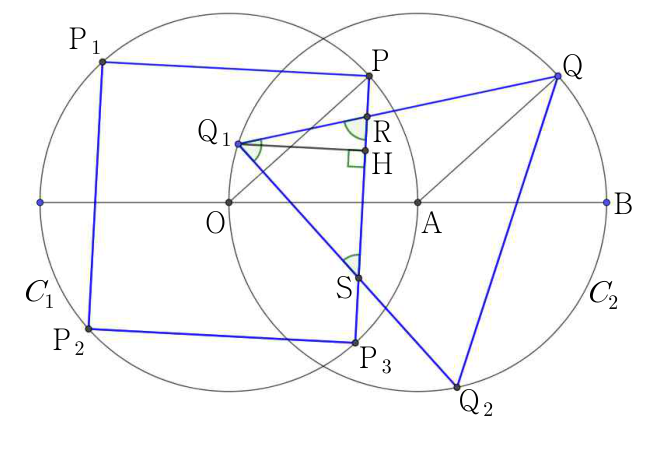
[2-1]우선 d1\displaystyle d_1을 구하자. 두 점 P와 P3\displaystyle \mathrm P_3의 좌표는P(cos⁡θ,sin⁡θ),P3(cos⁡(θ−π2),sin⁡(θ−π2))=(sin⁡θ,−cos⁡θ)\displaystyle \mathrm P(\cos\theta,\sin\theta),\quad\mathrm P_3\left(\cos\left(\theta-\frac\pi2\right),\sin\left(\theta-\frac\pi2\right)\right)=(\sin\theta,-\cos\theta)이므로 직선 PP3\displaystyle \mathrm{PP}_3의 방정식은 (cos⁡θ+sin⁡θ)x−(cos⁡θ−sin⁡θ)y−1=0\displaystyle (\cos\theta+\sin\theta)x-(\cos\theta-\sin\theta)y-1=0이다.한편, 점 Q1\displaystyle \mathrm Q_1의 좌표가(1+cos⁡(θ+2π3),sin⁡(θ+2π3))=(1−12cos⁡θ−32sin⁡θ,−12sin⁡θ+32cos⁡θ)\displaystyle \left(1+\cos\left(\theta+\frac{2\pi}3\right),\sin\left(\theta+\frac{2\pi}3\right)\right)=\left(1-\frac12\cos\theta-\frac{\sqrt3}2\sin\theta,-\frac12\sin\theta+\frac{\sqrt3}2\cos\theta\right)이므로 점 Q1\displaystyle \mathrm Q_1과 직선 PP3\displaystyle \mathrm{PP}_3 사이의 거리 d1\displaystyle d_1을 구하면,d1=∣(cos⁡θ+sin⁡θ)(1−12cos⁡θ−32sin⁡θ)−(cos⁡θ−sin⁡θ)(−12sin⁡θ+32cos⁡θ)−1∣(cos⁡θ+sin⁡θ)2+(cos⁡θ−sin⁡θ)2\displaystyle d_1=\frac{\left|(\cos\theta+\sin\theta)\left(1-\frac12\cos\theta-\frac{\sqrt3}2\sin\theta\right)-(\cos\theta-\sin\theta)\left(-\frac12\sin\theta+\frac{\sqrt3}2\cos\theta\right)-1\right|}{\sqrt{(\cos\theta+\sin\theta)^2+(\cos\theta-\sin\theta)^2}}

+4점 · d1=12(3+32−cos⁡θ−sin⁡θ)\displaystyle d_1=\frac1{\sqrt2}\left(\frac{3+\sqrt3}2-\cos\theta-\sin\theta\right)임을 보일 수 있다.

d1=∣cos⁡θ+sin⁡θ−12cos⁡2θ−32sin⁡2θ−12sin⁡2θ−32cos⁡2θ−1∣(cos⁡2θ+2cos⁡θsin⁡θ+sin⁡2θ)+(cos⁡2θ−2cos⁡θsin⁡θ+sin⁡2θ)=12∣cos⁡θ+sin⁡θ−3+32∣=12(3+32−cos⁡θ−sin⁡θ)\displaystyle \begin{aligned}d_1&=\frac{\left|\cos\theta+\sin\theta-\frac12\cos^2\theta-\frac{\sqrt3}2\sin^2\theta-\frac12\sin^2\theta-\frac{\sqrt3}2\cos^2\theta-1\right|}{\sqrt{(\cos^2\theta+2\cos\theta\sin\theta+\sin^2\theta)+(\cos^2\theta-2\cos\theta\sin\theta+\sin^2\theta)}}\\&=\frac1{\sqrt2}\left|\cos\theta+\sin\theta-\frac{3+\sqrt3}2\right|=\frac1{\sqrt2}\left(\frac{3+\sqrt3}2-\cos\theta-\sin\theta\right)\end{aligned}이다.

+10점 · d2=∣sin⁡(θ−π6)∣\displaystyle d_2=\left|\sin\left(\theta-\frac\pi6\right)\right|임을 보일 수 있다.

다음으로 d2\displaystyle d_2를 구하자. 선분 PQ의 길이는 1이고 ∠AQQ1=π6,  ∠AQP=θ\displaystyle \angle\mathrm{AQQ}_1=\frac\pi6,\;\angle\mathrm{AQP}=\theta이므로[그림1]의 경우는 ∠PQQ1=π6−θ\displaystyle \angle\mathrm{PQQ}_1=\frac\pi6-\theta이고 [그림2]의 경우는 ∠PQQ1=θ−π6\displaystyle \angle\mathrm{PQQ}_1=\theta-\frac\pi6이다.따라서 d2=∣sin⁡(θ−π6)∣\displaystyle d_2=\left|\sin\left(\theta-\frac\pi6\right)\right|이다.

+2점 · 직선 PP3\displaystyle \mathrm{PP}_3과 직선 직선 Q1Q2\displaystyle \mathrm Q_1\mathrm Q_2가 이루는 예각의 크기가 π4\displaystyle \frac\pi4임을 보일 수 있다.

Correction. “직선 직선”에서 “직선”이 중복되었다. 그러나 원칙에 따라 원문 표기를 그대로 실었다.

[2-2]우선 두 개의 그림 모두에서 직선 PP3\displaystyle \mathrm{PP}_3이 x\displaystyle x축의 양의 방향과 이루는 각의 크기가 θ+π4\displaystyle \theta+\frac\pi4이고, 직선 Q1Q2\displaystyle \mathrm Q_1\mathrm Q_2가 x\displaystyle x축의 양의 방향과 이루는 각의 크기가 θ+π2\displaystyle \theta+\frac\pi2이므로∠PSQ1=(θ+π2)−(θ+π4)=π4\displaystyle \angle\mathrm{PSQ}_1=\left(\theta+\frac\pi2\right)-\left(\theta+\frac\pi4\right)=\frac\pi4임을 확인할 수 있다.

+5점 · π6<θ≤π3\displaystyle \frac\pi6<\theta\le\frac\pi3의 경우 S(θ)\displaystyle S(\theta)를 구할 수 있다.

(i) π6<θ≤π3\displaystyle \frac\pi6<\theta\le\frac\pi3인 경우 [그림2]에서 △Q1RS\displaystyle \triangle\mathrm Q_1\mathrm{RS}의 넓이 S(θ)\displaystyle S(\theta)를 구하자.

삼각형 Q₁RS와 수선의 발 H

∠RSQ1=π4\displaystyle \angle\mathrm{RSQ}_1=\frac\pi4이고 점 Q1\displaystyle \mathrm Q_1에서 PP3‾\displaystyle \overline{\mathrm{PP}_3}의 수선의 발을 H라 하면 △Q1HS\displaystyle \triangle\mathrm Q_1\mathrm{HS}는 직각이등변삼각형이다.그러므로 ∠HQ1R=π3−π4=π12\displaystyle \angle\mathrm{HQ}_1\mathrm R=\frac\pi3-\frac\pi4=\frac\pi{12}이고, 제시문 [I]에 의해tan⁡π12=tan⁡(π3−π4)=3−11+3=2−3\displaystyle \tan\frac\pi{12}=\tan\left(\frac\pi3-\frac\pi4\right)=\frac{\sqrt3-1}{1+\sqrt3}=2-\sqrt3이다.Q1H‾=d1\displaystyle \overline{\mathrm Q_1\mathrm H}=d_1이므로S(θ)=12×RS‾×Q1H‾=12×(d1+d1tan⁡π12)×d1=12(3−3)d12\displaystyle S(\theta)=\frac12\times\overline{\mathrm{RS}}\times\overline{\mathrm Q_1\mathrm H}=\frac12\times\left(d_1+d_1\tan\frac\pi{12}\right)\times d_1=\frac12(3-\sqrt3)d_1^2이고, [2-1]의 d1\displaystyle d_1에 의해S(θ)=3−34×(3+32−cos⁡θ−sin⁡θ)2(π6<θ≤π3)\displaystyle S(\theta)=\frac{3-\sqrt3}4\times\left(\frac{3+\sqrt3}2-\cos\theta-\sin\theta\right)^2\quad\left(\frac\pi6<\theta\le\frac\pi3\right)이다.

+8점 · 직각삼각형 RPT의 넓이와 π9≤θ<π6\displaystyle \frac\pi9\le\theta<\frac\pi6인 경우 S(θ)\displaystyle S(\theta)를 구할 수 있다.

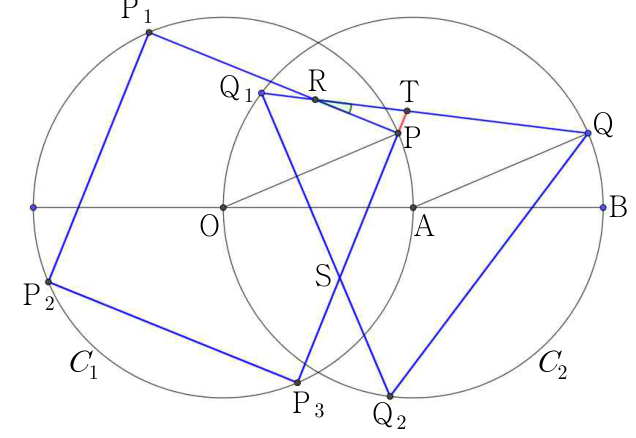
(ii) π9≤θ<π6\displaystyle \frac\pi9\le\theta<\frac\pi6인 경우 [그림1]에서 사각형 Q1SPR\displaystyle \mathrm Q_1\mathrm{SPR}의 넓이 S(θ)\displaystyle S(\theta)를 구하자.

사각형 Q₁SPR와 점 T

직선 PP3\displaystyle \mathrm{PP}_3가 QQ1‾\displaystyle \overline{\mathrm{QQ}_1}와 만나는 점을 T라 하자.사각형 Q1SPR\displaystyle \mathrm Q_1\mathrm{SPR}의 넓이 S(θ)\displaystyle S(\theta)는 △Q1ST\displaystyle \triangle\mathrm Q_1\mathrm{ST}의 넓이에서 △RPT\displaystyle \triangle\mathrm{RPT}의 넓이를 뺀 것이다.먼저, 직각삼각형 RPT에서 ∠PRT=π12,  ∠PTR=512π\displaystyle \angle\mathrm{PRT}=\frac\pi{12},\;\angle\mathrm{PTR}=\frac5{12}\pi이므로RP‾×sin⁡π12=d2,  PT‾×sin⁡512π=d2\displaystyle \overline{\mathrm{RP}}\times\sin\frac\pi{12}=d_2,\;\overline{\mathrm{PT}}\times\sin\frac5{12}\pi=d_2이고, 제시문 [I]에 의해cos⁡512π=cos⁡(π6+π4)=6−24,cos⁡π12=cos⁡(π3−π4)=6+24\displaystyle \cos\frac5{12}\pi=\cos\left(\frac\pi6+\frac\pi4\right)=\frac{\sqrt6-\sqrt2}4,\qquad\cos\frac\pi{12}=\cos\left(\frac\pi3-\frac\pi4\right)=\frac{\sqrt6+\sqrt2}4이므로 [2-1]의 d2\displaystyle d_2를 적용하여 직각삼각형 RPT의 넓이를 구하면12×d2cos⁡512π×d2cos⁡π12=2d22=2sin⁡2(θ−π6)\displaystyle \frac12\times\frac{d_2}{\cos\frac5{12}\pi}\times\frac{d_2}{\cos\frac\pi{12}}=2d_2^2=2\sin^2\left(\theta-\frac\pi6\right)이다.이때 △Q1ST\displaystyle \triangle\mathrm Q_1\mathrm{ST}의 넓이는 (i)에서 구한 △Q1RS\displaystyle \triangle\mathrm Q_1\mathrm{RS}의 넓이와 같은 식으로 표현되고,△Q1ST\displaystyle \triangle\mathrm Q_1\mathrm{ST}의 넓이는 3−34×(3+32−cos⁡θ−sin⁡θ)2\displaystyle \frac{3-\sqrt3}4\times\left(\frac{3+\sqrt3}2-\cos\theta-\sin\theta\right)^2이므로S(θ)=3−34×(3+32−cos⁡θ−sin⁡θ)2−2sin⁡2(θ−π6)(π9≤θ<π6)\displaystyle S(\theta)=\frac{3-\sqrt3}4\times\left(\frac{3+\sqrt3}2-\cos\theta-\sin\theta\right)^2-2\sin^2\left(\theta-\frac\pi6\right)\quad\left(\frac\pi9\le\theta<\frac\pi6\right)이다.

+5점 · S′(θ)\displaystyle S^{\prime}(\theta)를 구하고 이를 이용하여 lim⁡θ→π6S′(θ)\displaystyle \lim_{\theta\to\frac\pi6}S^{\prime}(\theta)가 존재함을 보일 수 있다.

(i), (ii)에 의하여 함수 S(θ)\displaystyle S(\theta)는S(θ)={3−34×(3+32−cos⁡θ−sin⁡θ)2−2sin⁡2(θ−π6)(π9≤θ<π6)3−34×(3+32−cos⁡θ−sin⁡θ)2(π6<θ≤π3)\displaystyle S(\theta)=\begin{cases}\frac{3-\sqrt3}4\times\left(\frac{3+\sqrt3}2-\cos\theta-\sin\theta\right)^2-2\sin^2\left(\theta-\frac\pi6\right)&\left(\frac\pi9\le\theta<\frac\pi6\right)\\\frac{3-\sqrt3}4\times\left(\frac{3+\sqrt3}2-\cos\theta-\sin\theta\right)^2&\left(\frac\pi6<\theta\le\frac\pi3\right)\end{cases}이다. 한편,S′(θ)={3−32(3+32−cos⁡θ−sin⁡θ)(sin⁡θ−cos⁡θ)−4sin⁡(θ−π6)cos⁡(θ−π6)(π9<θ<π6)3−32(3+32−cos⁡θ−sin⁡θ)(sin⁡θ−cos⁡θ)(π6<θ<π3)\displaystyle S^{\prime}(\theta)=\begin{cases}\frac{3-\sqrt3}2\left(\frac{3+\sqrt3}2-\cos\theta-\sin\theta\right)(\sin\theta-\cos\theta)-4\sin\left(\theta-\frac\pi6\right)\cos\left(\theta-\frac\pi6\right)&\left(\frac\pi9<\theta<\frac\pi6\right)\\\frac{3-\sqrt3}2\left(\frac{3+\sqrt3}2-\cos\theta-\sin\theta\right)(\sin\theta-\cos\theta)&\left(\frac\pi6<\theta<\frac\pi3\right)\end{cases}이고, 따라서 lim⁡θ→π6−S′(θ)=3−232,  lim⁡θ→π6+S′(θ)=3−232\displaystyle \lim_{\theta\to\frac\pi6-}S^{\prime}(\theta)=\frac{3-2\sqrt3}2,\;\lim_{\theta\to\frac\pi6+}S^{\prime}(\theta)=\frac{3-2\sqrt3}2이므로제시문 [II]에 의해 lim⁡θ→π6S′(θ)\displaystyle \lim_{\theta\to\frac\pi6}S^{\prime}(\theta)의 값은 존재하고 그 값은 3−232\displaystyle \frac{3-2\sqrt3}2이다.

첨삭 사례

아직 등록된 첨삭 사례가 없습니다.

질문과 답변 · 0개질문과 답변 · 고정 0개

아직 등록된 질문이 없습니다. 질문 작성은 멤버십 회원만 가능합니다.