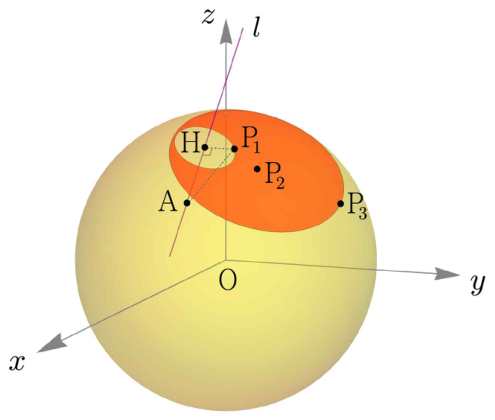
[문제 2]
(2-1)
위 그림과 같이 문제에서 주어진 직선을 l \displaystyle l l l \displaystyle l l P 1 \displaystyle \mathrm P_1 P 1 A P 1 ‾ \displaystyle \overline{\mathrm{AP}_1} AP 1
+30점 · ∣ A H ‾ ∣ = 6 \displaystyle |\overline{\mathrm{AH}}|=\sqrt6 ∣ AH ∣ = 6 A H ‾ = 6 \displaystyle \overline{\mathrm{AH}}=\sqrt6 AH = 6 H P 1 ‾ = 1 \displaystyle \overline{\mathrm{HP}_1}=1 HP 1 = 1
+30점 · 최종적으로 답 7 \displaystyle \sqrt7 7 피타고라스 정리에 의하여 답은 6 + 1 = 7 \displaystyle \sqrt{6+1}=\sqrt7 6 + 1 = 7
(2-2) 위 그림에서와 같이 P 2 \displaystyle \mathrm P_2 P 2 O P 2 ‾ \displaystyle \overline{\mathrm{OP}_2} OP 2 ∣ O P → ∣ \displaystyle |\overrightarrow{\mathrm{OP}}| ∣ OP ∣
평면의 방정식 x + y + 2 z − 10 = 0 \displaystyle x+y+2z-10=0 x + y + 2 z − 10 = 0 10 6 = 5 6 3 \displaystyle \frac{10}{\sqrt6}=\frac{5\sqrt6}3 6 10 = 3 5 6
60점 · k ( 1 , 1 , 2 ) \displaystyle k(1,1,2) k ( 1 , 1 , 2 ) ( 5 3 , 5 3 , 10 3 ) \displaystyle \left(\frac53,\frac53,\frac{10}3\right) ( 3 5 , 3 5 , 3 10 ) ( 1 , 1 , 2 ) \displaystyle (1,1,2) ( 1 , 1 , 2 ) O P → = 5 6 3 ( 1 , 1 , 2 ) 6 = ( 5 3 , 5 3 , 10 3 ) \displaystyle \overrightarrow{\mathrm{OP}}=\frac{5\sqrt6}3\frac{(1,1,2)}{\sqrt6}=\left(\frac53,\frac53,\frac{10}3\right) OP = 3 5 6 6 ( 1 , 1 , 2 ) = ( 3 5 , 3 5 , 3 10 ) ( 5 3 , 5 3 , 10 3 ) \displaystyle \left(\frac53,\frac53,\frac{10}3\right) ( 3 5 , 3 5 , 3 10 )
(2-3) 위 그림에서와 같이 H와 P 2 \displaystyle \mathrm P_2 P 2 P 3 \displaystyle \mathrm P_3 P 3
P = P 3 \displaystyle \mathrm P=\mathrm P_3 P = P 3 ∣ A P → ∣ \displaystyle |\overrightarrow{\mathrm{AP}}| ∣ AP ∣ H P 2 → = ( − 1 3 , 5 3 , − 2 3 ) \displaystyle \overrightarrow{\mathrm{HP}_2}=\left(-\frac13,\frac53,-\frac23\right) HP 2 = ( − 3 1 , 3 5 , − 3 2 ) P 2 P 3 → \displaystyle \overrightarrow{\mathrm P_2\mathrm P_3} P 2 P 3
O P 2 ‾ \displaystyle \overline{\mathrm{OP}_2} OP 2 O P 3 ‾ \displaystyle \overline{\mathrm{OP}_3} OP 3 P 2 P 3 ‾ \displaystyle \overline{\mathrm P_2\mathrm P_3} P 2 P 3 5 3 = 5 3 3 \displaystyle \frac5{\sqrt3}=\frac{5\sqrt3}3 3 5 = 3 5 3
60점 · k ( − 1 3 , 5 3 , − 2 3 ) \displaystyle k\left(-\frac13,\frac53,-\frac23\right) k ( − 3 1 , 3 5 , − 3 2 ) 5 3 − 10 6 \displaystyle \frac53-\frac{\sqrt{10}}6 3 5 − 6 10 O P 3 → = O P 2 → + P 2 P 3 → = O P 2 → + 10 2 H P 2 → \displaystyle \overrightarrow{\mathrm{OP}_3}=\overrightarrow{\mathrm{OP}_2}+\overrightarrow{\mathrm P_2\mathrm P_3}=\overrightarrow{\mathrm{OP}_2}+\frac{\sqrt{10}}2\overrightarrow{\mathrm{HP}_2} OP 3 = OP 2 + P 2 P 3 = OP 2 + 2 10 HP 2 5 3 − 10 6 ( = 10 − 10 6 ) \displaystyle \frac53-\frac{\sqrt{10}}6\left(=\frac{10-\sqrt{10}}6\right) 3 5 − 6 10 ( = 6 10 − 10 )
(2-2) k ( 1 , 1 , 2 ) \displaystyle k(1,1,2) k ( 1 , 1 , 2 )
(2-3) k ( − 1 3 , 5 3 , − 2 3 ) \displaystyle k\left(-\frac13,\frac53,-\frac23\right) k ( − 3 1 , 3 5 , − 3 2 )
 수리논술, 배움에서 논증의 완성까지.