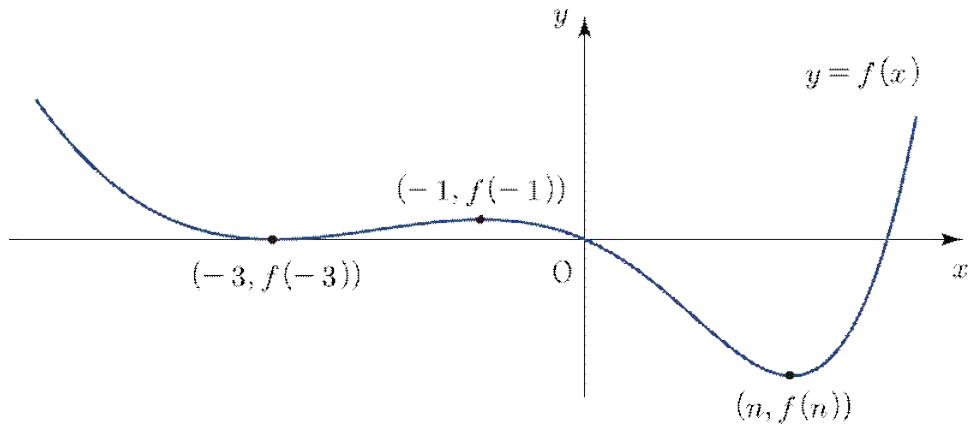
+20점 · f ′ ( x ) = − ( x + 3 ) ( x + 1 ) ( n + 3 ) ( n + 1 ) \displaystyle f\prime(x)=-\frac{(x+3)(x+1)}{(n+3)(n+1)} f ′ ( x ) = − ( n + 3 ) ( n + 1 ) ( x + 3 ) ( x + 1 ) (1-1) x < 0 \displaystyle x<0 x < 0 f ′ ( x ) = − ( x + 3 ) ( x + 1 ) ( n + 3 ) ( n + 1 ) \displaystyle f\prime(x)=-\frac{(x+3)(x+1)}{(n+3)(n+1)} f ′ ( x ) = − ( n + 3 ) ( n + 1 ) ( x + 3 ) ( x + 1 )
x \displaystyle x x ⋯ \displaystyle \cdots ⋯ − 3 \displaystyle -3 − 3 ⋯ \displaystyle \cdots ⋯ − 1 \displaystyle -1 − 1 ⋯ \displaystyle \cdots ⋯ 0 \displaystyle 0 0 f ′ ( x ) \displaystyle f\prime(x) f ′ ( x ) − \displaystyle - − 0 \displaystyle 0 0 + \displaystyle + + 0 \displaystyle 0 0 − \displaystyle - − f ( x ) \displaystyle f(x) f ( x ) ↘ \displaystyle \searrow ↘ 극소 ↗ \displaystyle \nearrow ↗ 극대 ↘ \displaystyle \searrow ↘ 0 \displaystyle 0 0
+20점 · x = − 3 \displaystyle x=-3 x = − 3 +30점 · 극솟값 f ( − 3 ) = 0 \displaystyle f(-3)=0 f ( − 3 ) = 0 그러므로 f ( x ) \displaystyle f(x) f ( x ) x = − 3 \displaystyle x=-3 x = − 3 f ( − 3 ) = − ∫ 0 − 3 ( t + 3 ) ( t + 1 ) ( n + 3 ) ( n + 1 ) d t = − 1 ( n + 3 ) ( n + 1 ) [ 1 3 t 3 + 2 t 2 + 3 t ] 0 − 3 = 0 \displaystyle f(-3)=-\int_0^{-3}\frac{(t+3)(t+1)}{(n+3)(n+1)}dt=-\frac1{(n+3)(n+1)}\Biggl[\frac13t^3+2t^2+3t\Biggr]_0^{-3}=0 f ( − 3 ) = − ∫ 0 − 3 ( n + 3 ) ( n + 1 ) ( t + 3 ) ( t + 1 ) d t = − ( n + 3 ) ( n + 1 ) 1 [ 3 1 t 3 + 2 t 2 + 3 t ] 0 − 3 = 0
+20점 · f ′ ( x ) = x 3 n 3 − ( x + 3 ) ( x + 1 ) ( n + 3 ) ( n + 1 ) \displaystyle f\prime(x)=\frac{x^3}{n^3}-\frac{(x+3)(x+1)}{(n+3)(n+1)} f ′ ( x ) = n 3 x 3 − ( n + 3 ) ( n + 1 ) ( x + 3 ) ( x + 1 ) +30점 · x = n \displaystyle x=n x = n (1-2) x < 0 \displaystyle x<0 x < 0 f ( x ) \displaystyle f(x) f ( x ) f ( − 3 ) = 0 \displaystyle f(-3)=0 f ( − 3 ) = 0 f ( − 1 ) \displaystyle f(-1) f ( − 1 ) f ( 0 ) = 0 \displaystyle f(0)=0 f ( 0 ) = 0 x ≤ 0 \displaystyle x\le0 x ≤ 0 f ( x ) ≥ 0 \displaystyle f(x)\ge0 f ( x ) ≥ 0 x > 0 \displaystyle x>0 x > 0 f ′ ( x ) = x 3 n 3 − ( x + 3 ) ( x + 1 ) ( n + 3 ) ( n + 1 ) = ( x − n ) { ( n 2 + 4 n + 3 ) x 2 + ( 4 n 2 + 3 n ) x + 3 n 2 } n 3 ( n + 3 ) ( n + 1 ) \displaystyle f\prime(x)=\frac{x^3}{n^3}-\frac{(x+3)(x+1)}{(n+3)(n+1)}=\frac{(x-n)\{(n^2+4n+3)x^2+(4n^2+3n)x+3n^2\}}{n^3(n+3)(n+1)} f ′ ( x ) = n 3 x 3 − ( n + 3 ) ( n + 1 ) ( x + 3 ) ( x + 1 ) = n 3 ( n + 3 ) ( n + 1 ) ( x − n ) {( n 2 + 4 n + 3 ) x 2 + ( 4 n 2 + 3 n ) x + 3 n 2 } 이고, 자연수 n \displaystyle n n x \displaystyle x x ( n 2 + 4 n + 3 ) x 2 + ( 4 n 2 + 3 n ) x + 3 n 2 n 3 ( n + 3 ) ( n + 1 ) > 0 \displaystyle \frac{(n^2+4n+3)x^2+(4n^2+3n)x+3n^2}{n^3(n+3)(n+1)}>0 n 3 ( n + 3 ) ( n + 1 ) ( n 2 + 4 n + 3 ) x 2 + ( 4 n 2 + 3 n ) x + 3 n 2 > 0 x > 0 \displaystyle x>0 x > 0 f ′ ( x ) = 0 \displaystyle f\prime(x)=0 f ′ ( x ) = 0 x = n \displaystyle x=n x = n 0 < x < n \displaystyle 0<x<n 0 < x < n f ′ ( x ) < 0 \displaystyle f\prime(x)<0 f ′ ( x ) < 0 f ( x ) \displaystyle f(x) f ( x ) x > n \displaystyle x>n x > n f ′ ( x ) > 0 \displaystyle f\prime(x)>0 f ′ ( x ) > 0 f ( x ) \displaystyle f(x) f ( x ) f ( x ) \displaystyle f(x) f ( x ) x = n \displaystyle x=n x = n
+30점 · 최솟값 f ( n ) = − n ( n + 9 ) 12 ( n + 1 ) ( = − n 3 + 12 n 2 + 27 n 12 ( n + 1 ) ( n + 3 ) ) \displaystyle f(n)=-\frac{n(n+9)}{12(n+1)}\;(=-\frac{n^3+12n^2+27n}{12(n+1)(n+3)}) f ( n ) = − 12 ( n + 1 ) n ( n + 9 ) ( = − 12 ( n + 1 ) ( n + 3 ) n 3 + 12 n 2 + 27 n ) 그러므로 f ( x ) \displaystyle f(x) f ( x ) f ( n ) = ∫ 0 n { t 3 n 3 − ( t + 3 ) ( t + 1 ) ( n + 3 ) ( n + 1 ) } d t = − n ( n + 9 ) 12 ( n + 1 ) \displaystyle f(n)=\int_0^n\{\frac{t^3}{n^3}-\frac{(t+3)(t+1)}{(n+3)(n+1)}\}dt=-\frac{n(n+9)}{12(n+1)} f ( n ) = ∫ 0 n { n 3 t 3 − ( n + 3 ) ( n + 1 ) ( t + 3 ) ( t + 1 ) } d t = − 12 ( n + 1 ) n ( n + 9 )
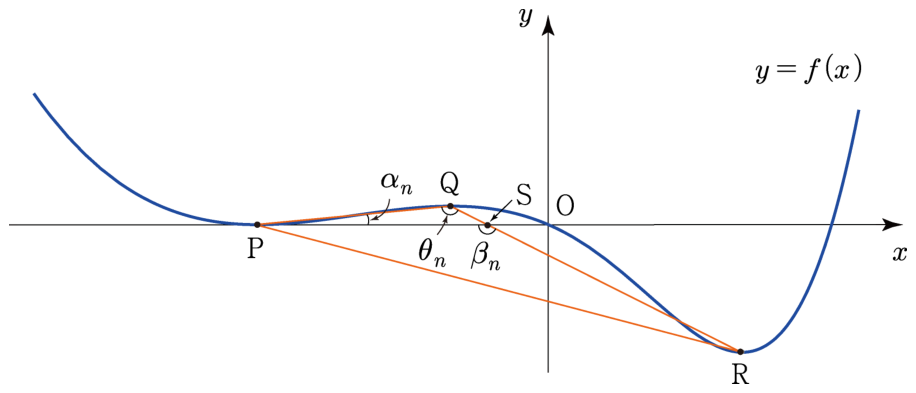
+20점 · f ( − 1 ) = 4 3 ( n + 3 ) ( n + 1 ) \displaystyle f(-1)=\frac4{3(n+3)(n+1)} f ( − 1 ) = 3 ( n + 3 ) ( n + 1 ) 4 (1-3) 곡선 y = f ( x ) \displaystyle y=f(x) y = f ( x ) 0 \displaystyle 0 0 f ′ ( x ) = 0 \displaystyle f\prime(x)=0 f ′ ( x ) = 0 x < 0 \displaystyle x<0 x < 0 f ′ ( x ) = 0 \displaystyle f\prime(x)=0 f ′ ( x ) = 0 x = − 3 \displaystyle x=-3 x = − 3 x = − 1 \displaystyle x=-1 x = − 1 f ( − 1 ) = − ∫ 0 − 1 ( t + 3 ) ( t + 1 ) ( n + 3 ) ( n + 1 ) d t = − 1 ( n + 3 ) ( n + 1 ) [ 1 3 t 3 + 2 t 2 + 3 t ] 0 − 1 = 4 3 ( n + 3 ) ( n + 1 ) \displaystyle f(-1)=-\int_0^{-1}\frac{(t+3)(t+1)}{(n+3)(n+1)}dt=-\frac1{(n+3)(n+1)}\Biggl[\frac13t^3+2t^2+3t\Biggr]_0^{-1}=\frac4{3(n+3)(n+1)} f ( − 1 ) = − ∫ 0 − 1 ( n + 3 ) ( n + 1 ) ( t + 3 ) ( t + 1 ) d t = − ( n + 3 ) ( n + 1 ) 1 [ 3 1 t 3 + 2 t 2 + 3 t ] 0 − 1 = 3 ( n + 3 ) ( n + 1 ) 4 이다. (1-2)의 풀이에서 x > 0 \displaystyle x>0 x > 0 f ′ ( x ) = 0 \displaystyle f\prime(x)=0 f ′ ( x ) = 0 x = n \displaystyle x=n x = n lim x → 0 − f ( x ) − f ( 0 ) x = − 3 ( n + 3 ) ( n + 1 ) ≠ 0 \displaystyle \lim_{x\to0-}\frac{f(x)-f(0)}x=-\frac3{(n+3)(n+1)}\ne0 x → 0 − lim x f ( x ) − f ( 0 ) = − ( n + 3 ) ( n + 1 ) 3 = 0 이므로 접선의 기울기가 0 \displaystyle 0 0 P ( − 3 , 0 ) , Q ( − 1 , f ( − 1 ) ) , R ( n , f ( n ) ) \displaystyle \mathrm P(-3,0),\;\mathrm Q(-1,f(-1)),\;\mathrm R(n,f(n)) P ( − 3 , 0 ) , Q ( − 1 , f ( − 1 )) , R ( n , f ( n )) 또한 두 점 Q \displaystyle \mathrm Q Q R \displaystyle \mathrm R R x \displaystyle x x S \displaystyle \mathrm S S α n = ∠ Q P S \displaystyle \alpha_n=\angle\mathrm{QPS} α n = ∠ QPS β n = ∠ P S R \displaystyle \beta_n=\angle\mathrm{PSR} β n = ∠ PSR
이때 tan α n = 2 3 ( n + 1 ) ( n + 3 ) \displaystyle \tan\alpha_n=\frac2{3(n+1)(n+3)} tan α n = 3 ( n + 1 ) ( n + 3 ) 2 tan β n = f ( n ) − f ( − 1 ) n + 1 = − n ( n + 3 ) ( n + 9 ) + 16 12 ( n + 3 ) ( n + 1 ) 2 \displaystyle \tan\beta_n=\frac{f(n)-f(-1)}{n+1}=-\frac{n(n+3)(n+9)+16}{12(n+3)(n+1)^2} tan β n = n + 1 f ( n ) − f ( − 1 ) = − 12 ( n + 3 ) ( n + 1 ) 2 n ( n + 3 ) ( n + 9 ) + 16 tan ( ∠ P Q R ) = tan ( β n − α n ) = tan β n − tan α n 1 + tan β n tan α n = − n ( n + 3 ) ( n + 9 ) + 16 12 ( n + 3 ) ( n + 1 ) 2 − 2 3 ( n + 1 ) ( n + 3 ) 1 − n ( n + 3 ) ( n + 9 ) + 16 12 ( n + 3 ) ( n + 1 ) 2 × 2 3 ( n + 1 ) ( n + 3 ) < 0 \displaystyle \begin{aligned}\tan(\angle\mathrm{PQR})&=\tan(\beta_n-\alpha_n)=\frac{\tan\beta_n-\tan\alpha_n}{1+\tan\beta_n\tan\alpha_n}\\&=\frac{-\frac{n(n+3)(n+9)+16}{12(n+3)(n+1)^2}-\frac2{3(n+1)(n+3)}}{1-\frac{n(n+3)(n+9)+16}{12(n+3)(n+1)^2}\times\frac2{3(n+1)(n+3)}}<0\end{aligned} tan ( ∠ PQR ) = tan ( β n − α n ) = 1 + tan β n tan α n tan β n − tan α n = 1 − 12 ( n + 3 ) ( n + 1 ) 2 n ( n + 3 ) ( n + 9 ) + 16 × 3 ( n + 1 ) ( n + 3 ) 2 − 12 ( n + 3 ) ( n + 1 ) 2 n ( n + 3 ) ( n + 9 ) + 16 − 3 ( n + 1 ) ( n + 3 ) 2 < 0
+10점 · θ n = ∠ P Q R \displaystyle \theta_n=\angle\mathrm{PQR} θ n = ∠ PQR +50점 · lim n → ∞ tan θ n = − 1 12 \displaystyle \lim_{n\to\infty}\tan\theta_n=-\frac1{12} n → ∞ lim tan θ n = − 12 1 이다. 따라서 ∠ P Q R \displaystyle \angle\mathrm{PQR} ∠ PQR θ n = ∠ P Q R \displaystyle \theta_n=\angle\mathrm{PQR} θ n = ∠ PQR lim n → ∞ tan θ n = lim n → ∞ tan ( ∠ P Q R ) = − 1 12 \displaystyle \lim_{n\to\infty}\tan\theta_n=\lim_{n\to\infty}\tan(\angle\mathrm{PQR})=-\frac1{12} n → ∞ lim tan θ n = n → ∞ lim tan ( ∠ PQR ) = − 12 1
(참고) f ( − 1 ) = 4 3 ( n + 3 ) ( n + 1 ) \displaystyle f(-1)=\frac4{3(n+3)(n+1)} f ( − 1 ) = 3 ( n + 3 ) ( n + 1 ) 4 f ( n ) = − n ( n + 9 ) 12 ( n + 1 ) \displaystyle f(n)=-\frac{n(n+9)}{12(n+1)} f ( n ) = − 12 ( n + 1 ) n ( n + 9 ) P Q ‾ 2 = 4 + { f ( − 1 ) } 2 \displaystyle \overline{\mathrm{PQ}}^2=4+\{f(-1)\}^2 PQ 2 = 4 + { f ( − 1 ) } 2 Q R ‾ 2 = ( n + 1 ) 2 + { f ( − 1 ) − f ( n ) } 2 \displaystyle \overline{\mathrm{QR}}^2=(n+1)^2+\{f(-1)-f(n)\}^2 QR 2 = ( n + 1 ) 2 + { f ( − 1 ) − f ( n ) } 2 P Q ‾ < Q R ‾ \displaystyle \overline{\mathrm{PQ}}<\overline{\mathrm{QR}} PQ < QR 또한 P R ‾ 2 = ( n + 3 ) 2 + { f ( n ) } 2 \displaystyle \overline{\mathrm{PR}}^2=(n+3)^2+\{f(n)\}^2 PR 2 = ( n + 3 ) 2 + { f ( n ) } 2 P R ‾ 2 − Q R ‾ 2 = 4 n + 8 + 2 f ( − 1 ) f ( n ) − { f ( − 1 ) } 2 = 4 n + 8 − 2 ( n 3 + 12 n 2 + 27 n + 8 ) 9 ( n 4 + 8 n 3 + 22 n 2 + 24 n + 9 ) \displaystyle \overline{\mathrm{PR}}^2-\overline{\mathrm{QR}}^2=4n+8+2f(-1)f(n)-\{f(-1)\}^2=4n+8-\frac{2(n^3+12n^2+27n+8)}{9(n^4+8n^3+22n^2+24n+9)} PR 2 − QR 2 = 4 n + 8 + 2 f ( − 1 ) f ( n ) − { f ( − 1 ) } 2 = 4 n + 8 − 9 ( n 4 + 8 n 3 + 22 n 2 + 24 n + 9 ) 2 ( n 3 + 12 n 2 + 27 n + 8 ) 이다. 그런데 n 3 + 12 n 2 + 27 n + 8 n 4 + 8 n 3 + 22 n 2 + 24 n + 9 < 1 \displaystyle \frac{n^3+12n^2+27n+8}{n^4+8n^3+22n^2+24n+9}<1 n 4 + 8 n 3 + 22 n 2 + 24 n + 9 n 3 + 12 n 2 + 27 n + 8 < 1 P R ‾ > Q R ‾ \displaystyle \overline{\mathrm{PR}}>\overline{\mathrm{QR}} PR > QR P Q R \displaystyle \mathrm{PQR} PQR P R ‾ \displaystyle \overline{\mathrm{PR}} PR θ n = ∠ P Q R \displaystyle \theta_n=\angle\mathrm{PQR} θ n = ∠ PQR
 수리논술, 배움에서 논증의 완성까지.