수리논술, 이게 다다.

자연계열 A 2번

오류 제보

전체 시험 시간 120분

문제

[문제 2] 최고차항의 계수가 1\displaystyle 1인 사차함수 f(x)\displaystyle f(x)는 다음 조건을 만족시킨다.

(가) 곡선 y=f(x)\displaystyle y=f(x)는 서로 다른 두 점 A(a,f(a))\displaystyle \mathrm A(a,f(a)), B(b,f(b))\displaystyle \mathrm B(b,f(b))에서 직선 y=2x+1\displaystyle y=2x+1에 접한다. (단, a<b\displaystyle a<b)

(나) 두 점 A\displaystyle \mathrm A와 B\displaystyle \mathrm B 사이의 거리는 5\displaystyle \sqrt5이다.

(다) f′(c)=2\displaystyle f\prime(c)=2를 만족시키는 c  (a<c<b)\displaystyle c\;(a<c<b)에 대하여, a+b+c=32\displaystyle a+b+c=\frac32이다.

(2-1) c\displaystyle c의 값을 구하시오. (70점)

(2-2) a<x<c\displaystyle a<x<c에서 f(x)\displaystyle f(x)의 역함수가 존재함을 보이고, f(a)<x<f(c)\displaystyle f(a)<x<f(c)인 x\displaystyle x에 대하여 (f−1)′(x)\displaystyle (f^{-1})\prime(x)의 최솟값을 구하시오. (80점)

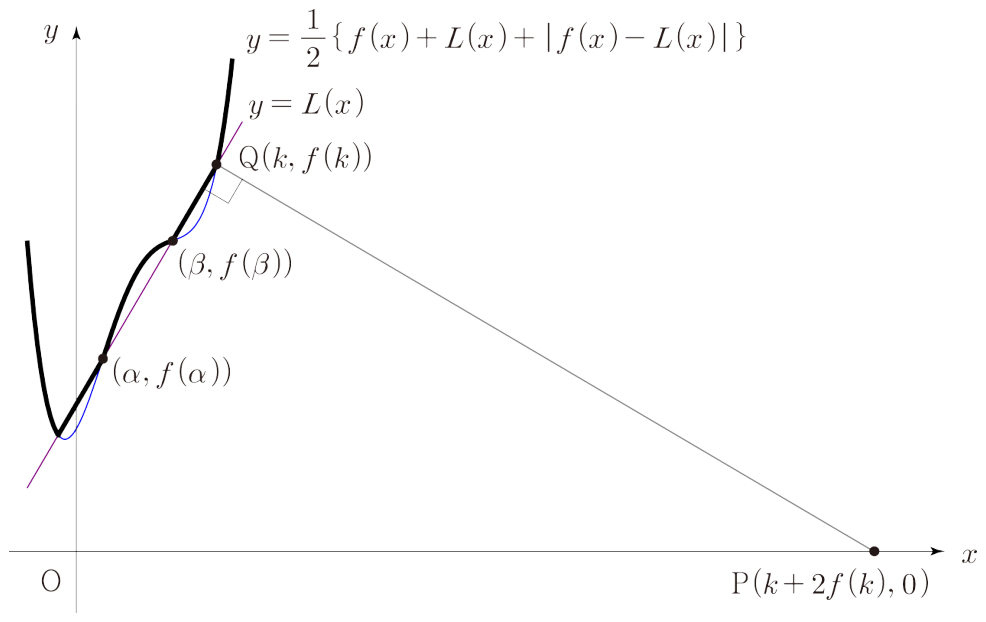
(2-3) 곡선 y=f(x)\displaystyle y=f(x) 위의 두 변곡점 (α,f(α))\displaystyle (\alpha,f(\alpha)), (β,f(β))\displaystyle (\beta,f(\beta))를 지나는 직선의 방정식을 y=L(x)\displaystyle y=L(x)라 하고, y=f(x)\displaystyle y=f(x)와 y=L(x)\displaystyle y=L(x)의 교점의 x\displaystyle x좌표의 최댓값을 k\displaystyle k라 하자. 이때, 점 P(k+2f(k),0)\displaystyle \mathrm P(k+2f(k),0)과 곡선 y=12{f(x)+L(x)+∣f(x)−L(x)∣}\displaystyle y=\frac12\{f(x)+L(x)+|f(x)-L(x)|\} 위의 점 Q\displaystyle \mathrm Q에 대하여, 선분 PQ\displaystyle \mathrm{PQ}의 길이가 최소가 되도록 하는 점 Q\displaystyle \mathrm Q의 x\displaystyle x좌표를 구하시오. (80점)

해설강의 준비중
+20점

(2-1) 조건 (가)로부터 f(x)=2x+1+(x−a)2(x−b)2\displaystyle f(x)=2x+1+(x-a)^2(x-b)^2으로 쓸 수 있다.

+20점 · c=a+b2\displaystyle c=\frac{a+b}2를 구하면

이로부터2=f′(c)=2+2(c−a)(c−b)(2c−a−b)\displaystyle 2=f\prime(c)=2+2(c-a)(c-b)(2c-a-b)를 얻고, c=a+b2\displaystyle c=\frac{a+b}2가 된다.

+20점 · b=a+1\displaystyle b=a+1를 구하면

조건 (나)로부터5=(b−a)2+{f(b)−f(a)}2=(b−a)2+{2(b−a)}2=5(b−a)2\displaystyle 5=(b-a)^2+\{f(b)-f(a)\}^2=(b-a)^2+\{2(b-a)\}^2=5(b-a)^2을 얻는다. 따라서 b=a+1\displaystyle b=a+1이다.

+10점 · 답 c=12\displaystyle c=\frac12을 구하면

또한 조건 (다)로부터32=a+b+c=a+a+1+a+a+12=3a+32\displaystyle \frac32=a+b+c=a+a+1+\frac{a+a+1}2=3a+\frac32이므로 a=0\displaystyle a=0, b=1\displaystyle b=1이고, c=a+b2=12\displaystyle c=\frac{a+b}2=\frac12이다.

+10점 · 0  (=a)<x<12−36\displaystyle 0\;(=a)<x<\frac12-\frac{\sqrt3}6일 때 f′′(x)>0\displaystyle f\prime\prime(x)>0을 보이면

(2-2) f(x)=x2(x−1)2+2x+1\displaystyle f(x)=x^2(x-1)^2+2x+1, f′(x)=4x3−6x2+2x+2\displaystyle f\prime(x)=4x^3-6x^2+2x+2, f′′(x)=2(6x2−6x+1)\displaystyle f\prime\prime(x)=2(6x^2-6x+1)이다.따라서 0  (=a)<x<12−36\displaystyle 0\;(=a)<x<\frac12-\frac{\sqrt3}6일 때 f′′(x)>0\displaystyle f\prime\prime(x)>0이므로 f′(x)\displaystyle f\prime(x)는 증가

+10점 · 12−36<x<12  (=c)\displaystyle \frac12-\frac{\sqrt3}6<x<\frac12\;(=c)일 때 f′′(x)<0\displaystyle f\prime\prime(x)<0을 보이면

하고, 12−36<x<12  (=c)\displaystyle \frac12-\frac{\sqrt3}6<x<\frac12\;(=c)일 때 f′′(x)<0\displaystyle f\prime\prime(x)<0이므로 f′(x)\displaystyle f\prime(x)는 감소한다.

+20점 · f′(0)=f′(12)=2\displaystyle f\prime(0)=f\prime(\frac12)=2이므로 f′(x)>0\displaystyle f\prime(x)>0이 되어 f(x)\displaystyle f(x)는 역함수를 가진다.

또한 f′(0)=f′(12)=2\displaystyle f\prime(0)=f\prime(\frac12)=2이므로 a<x<c\displaystyle a<x<c일 때 f′(x)>0\displaystyle f\prime(x)>0이다. 그러므로 f(x)\displaystyle f(x)는 a<x<c\displaystyle a<x<c일 때 증가함수가 되어 역함수를 가진다.

+30점 · f′(t)\displaystyle f\prime(t)의 최댓값은 f′′(t)=0\displaystyle f\prime\prime(t)=0을 만족시키는 t=12−36\displaystyle t=\frac12-\frac{\sqrt3}6일 때임을 설명하면

(f−1)′(x)=1f′(f−1(x))\displaystyle (f^{-1})\prime(x)=\frac1{f\prime(f^{-1}(x))}로부터 f(a)<x<f(c)\displaystyle f(a)<x<f(c)인 x\displaystyle x에 대하여 (f−1)′(x)\displaystyle (f^{-1})\prime(x)의 최솟값은 0  (=a)<t<12  (=c)\displaystyle 0\;(=a)<t<\frac12\;(=c)에서 f′(t)\displaystyle f\prime(t)가 최대일 때이다. f′(t)\displaystyle f\prime(t)의 최댓값은 f′′(t)=0\displaystyle f\prime\prime(t)=0을 만족시키는 t=12−36\displaystyle t=\frac12-\frac{\sqrt3}6일 때 생긴다.

+10점 · 답 918+3=3(18−3)107\displaystyle \frac9{18+\sqrt3}=\frac{3(18-\sqrt3)}{107}

따라서 f′(t)\displaystyle f\prime(t)의 최댓값은 f′(12−36)=18+39\displaystyle f\prime(\frac12-\frac{\sqrt3}6)=\frac{18+\sqrt3}9이고, 답은 918+3=3(18−3)107\displaystyle \frac9{18+\sqrt3}=\frac{3(18-\sqrt3)}{107}이다.

(2-3) f(x)=x2(x−1)2+2x+1\displaystyle f(x)=x^2(x-1)^2+2x+1, f′(x)=4x3−6x2+2x+2\displaystyle f\prime(x)=4x^3-6x^2+2x+2, f′′(x)=2(6x2−6x+1)\displaystyle f\prime\prime(x)=2(6x^2-6x+1)이다.따라서 0  (=a)<x<12−36\displaystyle 0\;(=a)<x<\frac12-\frac{\sqrt3}6일 때 f′′(x)>0\displaystyle f\prime\prime(x)>0이므로 f′(x)\displaystyle f\prime(x)는 증가하고, 12−36<x<12  (=c)\displaystyle \frac12-\frac{\sqrt3}6<x<\frac12\;(=c)일 때 f′′(x)<0\displaystyle f\prime\prime(x)<0이므로 f′(x)\displaystyle f\prime(x)는 감소한다. 또한 f′(0)=f′(12)=2\displaystyle f\prime(0)=f\prime(\frac12)=2이므로 a<x<c\displaystyle a<x<c일 때 f′(x)>0\displaystyle f\prime(x)>0이다. 그러므로 f(x)\displaystyle f(x)는 a<x<c\displaystyle a<x<c일 때 증가함수가 되어 역함수를 가진다.(f−1)′(x)=1f′(f−1(x))\displaystyle (f^{-1})\prime(x)=\frac1{f\prime(f^{-1}(x))}로부터 f(a)<x<f(c)\displaystyle f(a)<x<f(c)인 x\displaystyle x에 대하여 (f−1)′(x)\displaystyle (f^{-1})\prime(x)의 최솟값은 0  (=a)<t<12  (=c)\displaystyle 0\;(=a)<t<\frac12\;(=c)에서 f′(t)\displaystyle f\prime(t)가 최대일 때이다. f′(t)\displaystyle f\prime(t)의 최댓값은 f′′(t)=0\displaystyle f\prime\prime(t)=0을 만족시키는 t=12−36\displaystyle t=\frac12-\frac{\sqrt3}6일 때 생긴다. 따라서 f′(t)\displaystyle f\prime(t)의 최댓값은 f′(12−36)=18+39\displaystyle f\prime(\frac12-\frac{\sqrt3}6)=\frac{18+\sqrt3}9이고, 답은 918+3=3(18−3)107\displaystyle \frac9{18+\sqrt3}=\frac{3(18-\sqrt3)}{107}이다.

+20점 · L(x)\displaystyle L(x)의 기울기 2\displaystyle 2를 구하면

(2-3) 방정식 f′′(x)=2(6x2−6x+1)=0\displaystyle f\prime\prime(x)=2(6x^2-6x+1)=0의 두 근이 α\displaystyle \alpha, β\displaystyle \beta이므로 α+β=1\displaystyle \alpha+\beta=1, αβ=16\displaystyle \alpha\beta=\frac16이다.그런데 f(x)=x4−2x3+x2+2x+1\displaystyle f(x)=x^4-2x^3+x^2+2x+1이므로, 직선 y=L(x)\displaystyle y=L(x)의 기울기는 다음과 같다.f(β)−f(α)β−α=β4−α4−2(β3−α3)+(β2−α2)+2(β−α)β−α=(β+α)(β2+α2)−2(β2+βα+α2)+β+α+2=−(α+β)2+α+β+2=2\displaystyle \begin{aligned}\frac{f(\beta)-f(\alpha)}{\beta-\alpha}&=\frac{\beta^4-\alpha^4-2(\beta^3-\alpha^3)+(\beta^2-\alpha^2)+2(\beta-\alpha)}{\beta-\alpha}\\&=(\beta+\alpha)(\beta^2+\alpha^2)-2(\beta^2+\beta\alpha+\alpha^2)+\beta+\alpha+2\\&=-(\alpha+\beta)^2+\alpha+\beta+2\\&=2\end{aligned}

+20점 · (k,f(k))\displaystyle (k,f(k))와 점 (k+2f(k),0)\displaystyle (k+2f(k),0)을 지나는 직선의 기울기 −12\displaystyle -\frac12을 구하면

또한 점 (k,f(k))\displaystyle (k,f(k))와 점 (k+2f(k),0)\displaystyle (k+2f(k),0)을 지나는 직선의 기울기는 −f(k)2f(k)=−12\displaystyle -\frac{f(k)}{2f(k)}=-\frac12이므로 이 직선은 직선 y=L(x)\displaystyle y=L(x)와 수직이다. 그런데12{f(x)+L(x)+∣f(x)−L(x)∣}={f(x)(f(x)≥L(x)일 때)L(x)(L(x)≥f(x)일 때)\displaystyle \frac12\{f(x)+L(x)+|f(x)-L(x)|\}=\begin{cases}f(x)&(f(x)\ge L(x)\text{일 때})\\L(x)&(L(x)\ge f(x)\text{일 때})\end{cases}이므로 곡선 y=12{f(x)+L(x)+∣f(x)−L(x)∣}\displaystyle y=\frac12\{f(x)+L(x)+|f(x)-L(x)|\}는 아래 그림에서 두껍게 표시된 부분이다. (단, α<β\displaystyle \alpha<\beta라 하자.)

사차곡선과 직선 중 위쪽 그래프에 내린 수선 PQ
+30점 · 방정식 x2−x−16=0\displaystyle x^2-x-\frac16=0을 구하면

그러므로 선분 PQ\displaystyle \mathrm{PQ}의 길이가 최소가 되도록 하는 점 Q\displaystyle \mathrm Q는 (k,f(k))\displaystyle (k,f(k))이다.방정식 f(x)=L(x)\displaystyle f(x)=L(x)로부터x2(x−1)2+2x+1=2(x−α)+f(α)=2(x−α)+α2(α−1)2+2α+1\displaystyle x^2(x-1)^2+2x+1=2(x-\alpha)+f(\alpha)=2(x-\alpha)+\alpha^2(\alpha-1)^2+2\alpha+1을 얻고, 이를 정리하면 x2(x−1)2=α2(α−1)2\displaystyle x^2(x-1)^2=\alpha^2(\alpha-1)^2이다. 이제 α(α−1)=−αβ=−16\displaystyle \alpha(\alpha-1)=-\alpha\beta=-\frac16임을 이용하여 인수분해하면{x2−x−α(α−1)}{x2−x+α(α−1)}=(x2−x+16)(x2−x−16)=0\displaystyle \{x^2-x-\alpha(\alpha-1)\}\{x^2-x+\alpha(\alpha-1)\}=(x^2-x+\frac16)(x^2-x-\frac16)=0

+10점 · 답 k=12+156\displaystyle k=\frac12+\frac{\sqrt{15}}6를 구하면

이며, 이 방정식의 근을 모두 구하면 12±36\displaystyle \frac12\pm\frac{\sqrt3}6, 12±156\displaystyle \frac12\pm\frac{\sqrt{15}}6이고, 이 중에서 가장 큰 것이 k\displaystyle k이므로 k=12+156\displaystyle k=\frac12+\frac{\sqrt{15}}6이다.

참고: f(x)=x2(x−1)2+2x+1\displaystyle f(x)=x^2(x-1)^2+2x+1이고 α+β=1\displaystyle \alpha+\beta=1이므로 직선 y=L(x)\displaystyle y=L(x)의 기울기를 다음과 같이 계산할 수도 있다.f(β)−f(α)β−α=β2(β−1)2+2β−α2(α−1)2−2αβ−α={β(β−1)+α(α−1)}{β(β−1)−α(α−1)}+2(β−α)β−α={β(β−1)+α(α−1)}{β2−α2−(β−α)}+2(β−α)β−α={β(β−1)+α(α−1)}{β+α−1}+2=0+2=2\displaystyle \begin{aligned}\frac{f(\beta)-f(\alpha)}{\beta-\alpha}&=\frac{\beta^2(\beta-1)^2+2\beta-\alpha^2(\alpha-1)^2-2\alpha}{\beta-\alpha}\\&=\frac{\{\beta(\beta-1)+\alpha(\alpha-1)\}\{\beta(\beta-1)-\alpha(\alpha-1)\}+2(\beta-\alpha)}{\beta-\alpha}\\&=\frac{\{\beta(\beta-1)+\alpha(\alpha-1)\}\{\beta^2-\alpha^2-(\beta-\alpha)\}+2(\beta-\alpha)}{\beta-\alpha}\\&=\{\beta(\beta-1)+\alpha(\alpha-1)\}\{\beta+\alpha-1\}+2\\&=0+2\\&=2\end{aligned}

첨삭 사례

아직 등록된 첨삭 사례가 없습니다.

질문과 답변 · 0개질문과 답변 · 고정 0개

아직 등록된 질문이 없습니다. 질문 작성은 멤버십 회원만 가능합니다.