수리논술, 이게 다다.

자연계 3교시 수학2

오류 제보

문제

[수학2]

<제시문1>(ⅰ) 두 함수 f(x)\displaystyle f(x)와 g(x)\displaystyle g(x)를 다음과 같이 정의하자.f(x)={2x2+4x+3(x≤0)1x+2(x>0)\displaystyle f(x)=\begin{cases}2x^{2}+4x+3&(x\le0)\\\frac1x+2&(x>0)\end{cases}이고, g(x)=x+3\displaystyle g(x)=x+3(ⅱ) 두 함수 y=f(x)\displaystyle y=f(x)와 y=g(x)\displaystyle y=g(x)의 그래프를 좌표평면에 그렸을 때 나타나는 세 교점을 왼쪽부터 차례대로 Q1\displaystyle \mathrm{Q}_{1}, Q2\displaystyle \mathrm{Q}_{2}, Q3\displaystyle \mathrm{Q}_{3}이라고 하자.(ⅲ) 함수 h(x)\displaystyle h(x)를 h(x)={f(x)(f(x)<g(x))g(x)(f(x)≥g(x))\displaystyle h(x)=\begin{cases}f(x)&(f(x)<g(x))\\g(x)&(f(x)\ge g(x))\end{cases}로 정의하자. 이때, 0<t<1\displaystyle 0<t<1인 실수 t\displaystyle t에 대하여 직선 y=t(x+3)\displaystyle y=t(x+3)과 곡선 y=h(x)\displaystyle y=h(x)의 교점의 개수를 t\displaystyle t에 대한 함수 k(t)\displaystyle k(t)라 하자.

<제시문2>(ⅰ) 양의 정수 n\displaystyle n에 대하여, 점 (n,0)\displaystyle (n,0)에서 곡선 y=h(x)\displaystyle y=h(x)에 그은 접선 위의 접점 중 제2사분면에 있는 점을 Pn(αn,βn)\displaystyle \mathrm{P}_{n}(\alpha_{n},\beta_{n})이라고 하고 이때의 접선을 ln\displaystyle l_{n}이라 하자.(ⅱ) 직선 ln\displaystyle l_{n}이 y\displaystyle y축과 만나는 점을 Tn\displaystyle \mathrm{T}_{n}이라고 하고, 직선 ln\displaystyle l_{n}이 접점 Pn\displaystyle \mathrm{P}_{n}을 제외한 곡선 y=h(x)\displaystyle y=h(x)와 다시 만나는 점을 Rn\displaystyle \mathrm{R}_{n}이라고 하자.(ⅲ) 직선 ln\displaystyle l_{n}, y\displaystyle y축, 곡선 y=h(x)\displaystyle y=h(x)로 둘러싸인 영역의 넓이를 Sn\displaystyle S_{n}이라고 하자.

[수학2-ⅰ] <제시문1>에서 세 교점 Q1\displaystyle \mathrm{Q}_{1}, Q2\displaystyle \mathrm{Q}_{2}, Q3\displaystyle \mathrm{Q}_{3}의 좌표를 모두 구하고, 그 이유를 논하시오.

[수학2-ⅱ] <제시문1>의 함수 y=h(x)\displaystyle y=h(x)의 그래프의 개형을 그리고, 0<t<1\displaystyle 0<t<1인 실수 t\displaystyle t의 범위에 따른 함수 k(t)\displaystyle k(t)의 값을 표로 나타내고, 그 이유를 논하시오.

[수학2-ⅲ] <제시문2>에서 αn\displaystyle \alpha_{n}, βn\displaystyle \beta_{n}을 각각 n\displaystyle n에 대한 식으로 나타내고, lim⁡n→∞αn\displaystyle \lim_{n\to\infty}\alpha_{n}과 lim⁡n→∞βn\displaystyle \lim_{n\to\infty}\beta_{n}의 값을 구하고 그 이유를 논하시오.

[수학2-ⅳ] <제시문2>에서 점 Tn\displaystyle \mathrm{T}_{n}의 y\displaystyle y좌표, 점 Rn\displaystyle \mathrm{R}_{n}의 x\displaystyle x좌표, 넓이 Sn\displaystyle S_{n}을 각각 αn\displaystyle \alpha_{n}, βn\displaystyle \beta_{n}에 대한 식으로 나타낸 후 lim⁡n→∞Sn\displaystyle \lim_{n\to\infty}S_{n}을 구하고, 그 이유를 논하시오.

해설강의 준비중
+6점 · 교점 Q1\displaystyle \mathrm{Q}_{1}, Q2\displaystyle \mathrm{Q}_{2}, Q3\displaystyle \mathrm{Q}_{3}의 좌표를 구한다.

[수학2-ⅰ]

(a) x≤0\displaystyle x\le0: 두 식 y=2x2+4x+3\displaystyle y=2x^{2}+4x+3과 y=x+3\displaystyle y=x+3을 연립하여 풀면, 두 교점 (−32,32)\displaystyle \left(-\frac32,\frac32\right)과 (0,3)\displaystyle (0,3)을 얻는다.

(b) x>0\displaystyle x>0: 두 식 y=1x+2\displaystyle y=\frac1x+2와 y=x+3\displaystyle y=x+3을 연립하여 풀면, 교점 Q3(−1+52,5+52)\displaystyle \mathrm{Q}_{3}\left(\frac{-1+\sqrt5}{2},\frac{5+\sqrt5}{2}\right)를 얻는다.

답: Q1(−32,32)\displaystyle \mathrm{Q}_{1}\left(-\frac32,\frac32\right), Q2(0,3)\displaystyle \mathrm{Q}_{2}(0,3), Q3(−1+52,5+52)\displaystyle \mathrm{Q}_{3}\left(\frac{-1+\sqrt5}{2},\frac{5+\sqrt5}{2}\right)

+4점 · 함수 y=h(x)\displaystyle y=h(x)의 그래프의 개형을 그린다.

[수학2-ⅱ]

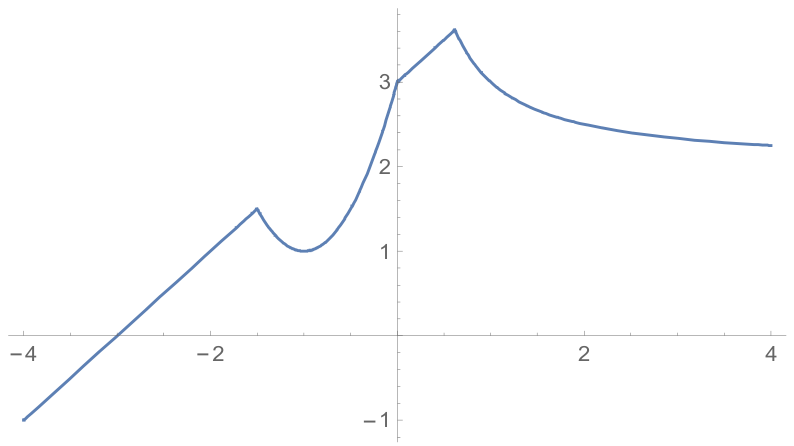
(a) x≤0\displaystyle x\le0: f(x)<g(x)\displaystyle f(x)<g(x)인 부분을 살펴보면, 부등식 2x2+4x+3<x+3\displaystyle 2x^{2}+4x+3<x+3 으로부터 −32<x<0\displaystyle -\frac32<x<0을 얻는다. 또한 f(0)=g(0)\displaystyle f(0)=g(0)이다. 따라서 x≤0\displaystyle x\le0일 때, 함수 h(x)\displaystyle h(x)는 다음과 같다. h(x)={x+3(x≤−32)2x2+4x+3(−32<x≤0)\displaystyle h(x)=\begin{cases}x+3&\left(x\le-\frac32\right)\\2x^{2}+4x+3&\left(-\frac32<x\le0\right)\end{cases}

(b) x>0\displaystyle x>0: f(x)<g(x)\displaystyle f(x)<g(x)인 부분을 살펴보면, 부등식 1x+2<x+3\displaystyle \frac1x+2<x+3 로부터 x>−1+52\displaystyle x>\frac{-1+\sqrt5}{2}을 얻는다. 따라서 x>0\displaystyle x>0일 때, 함수 h(x)\displaystyle h(x)는 다음과 같다. h(x)={x+3(0<x≤−1+52)1x+2(x>−1+52)\displaystyle h(x)=\begin{cases}x+3&\left(0<x\le\frac{-1+\sqrt5}{2}\right)\\\frac1x+2&\left(x>\frac{-1+\sqrt5}{2}\right)\end{cases}

이로부터 곡선 y=h(x)\displaystyle y=h(x)의 그래프의 개형은 아래와 같다.

직선, 포물선, 유리함수의 일부로 이루어진 h(x)의 그래프
+4점 · 실수 t\displaystyle t의 범위에 따른 함수 k(t)\displaystyle k(t)의 값을 표로 나타낸다.

이 곡선 위에 (−3,0)\displaystyle (-3,0)을 지나고 기울기가 t\displaystyle t인 직선을 그으면, 아래 그림에 있는 것처럼 2사분면에서 곡선과 접할 때, 3개의 교점을 가짐을 알 수 있다.
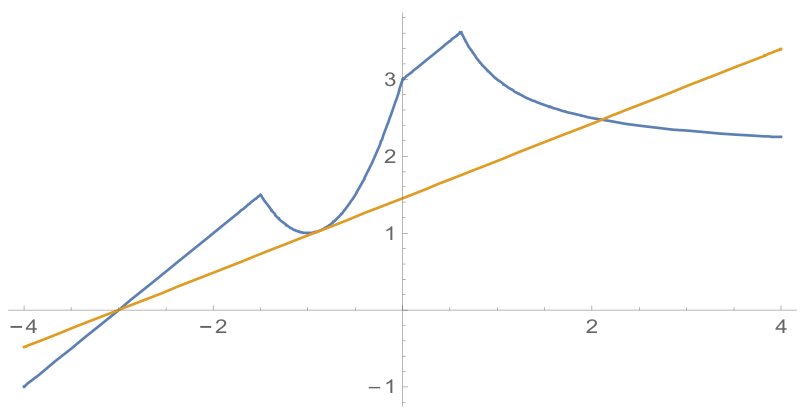
점 (-3,0)을 지나는 직선이 제2사분면에서 접하고 세 교점을 갖는 경우

위 그림에서 접선의 기울기가 t\displaystyle t일 때, 이차방정식 2x2+4x+3=t(x+3)\displaystyle 2x^{2}+4x+3=t(x+3)이 중근을 가지므로, 판별식은 0이 되어, t=−8+62\displaystyle t=-8+6\sqrt2를 얻는다. 이로부터 아래와 같은 표를 얻는다.

t\displaystyle t의 범위k(t)\displaystyle k(t)
0<t<−8+62\displaystyle 0<t<-8+6\sqrt22\displaystyle 2
t=−8+62\displaystyle t=-8+6\sqrt23\displaystyle 3
−8+62<t<1\displaystyle -8+6\sqrt2<t<14\displaystyle 4

+4점 · αn\displaystyle \alpha_{n}, βn\displaystyle \beta_{n}을 각각 n\displaystyle n에 대한 식으로 나타낸다.

[수학2-ⅲ]

Pn(αn,βn)\displaystyle \mathrm{P}_{n}(\alpha_{n},\beta_{n})에서 편의상 α=αn\displaystyle \alpha=\alpha_{n}, β=βn\displaystyle \beta=\beta_{n}이라고 표기하자. 접점 Pn\displaystyle \mathrm{P}_{n}이 2사분면 위에 놓여있어야 하므로, Pn\displaystyle \mathrm{P}_{n}은 포물선 y=2x2+4x+3\displaystyle y=2x^{2}+4x+3 위에 놓여있어야 한다. 또한 Pn(α,β)\displaystyle \mathrm{P}_{n}(\alpha,\beta)의 x\displaystyle x-좌표인 α\displaystyle \alpha는 점 Q1\displaystyle \mathrm{Q}_{1}의 x\displaystyle x-좌표인 −32\displaystyle -\frac32와 점 Q2\displaystyle \mathrm{Q}_{2}의 x\displaystyle x-좌표인 0\displaystyle 0 사이에 놓여있게 된다. 포물선 y=2x2+4x+3=2(x+1)2+1\displaystyle y=2x^{2}+4x+3=2(x+1)^{2}+1 위의 점 Pn(α,β)\displaystyle \mathrm{P}_{n}(\alpha,\beta)에서의 접선의 방정식은 (α+1)(x+1)=14(y−1+β−1)\displaystyle (\alpha+1)(x+1)=\frac14(y-1+\beta-1)로 주어지고, 이 직선이 점 (n,0)\displaystyle (n,0)을 지나므로, 식 (α+1)(n+1)=14(β−2)\displaystyle (\alpha+1)(n+1)=\frac14(\beta-2)를 얻는다. 이제 이 식에 β=2α2+4α+3\displaystyle \beta=2\alpha^{2}+4\alpha+3을 대입하고 정리하면, α\displaystyle \alpha는 2차방정식 2x2−4nx−(4n+3)=0\displaystyle 2x^{2}-4nx-(4n+3)=0이 근이 됨을 알 수 있다. 근의 공식과 α\displaystyle \alpha의 범위를 고려하면, αn=n−124n2+8n+6\displaystyle \alpha_{n}=n-\frac12\sqrt{4n^{2}+8n+6}을 얻고, 식 (α+1)(n+1)=14(β−2)\displaystyle (\alpha+1)(n+1)=\frac14(\beta-2)로부터 βn=(4n2+8n+6)−(2n+2)4n2+8n+6\displaystyle \beta_{n}=(4n^{2}+8n+6)-(2n+2)\sqrt{4n^{2}+8n+6}을 얻게 된다.

+4점 · lim⁡n→∞αn\displaystyle \lim_{n\to\infty}\alpha_{n}과 lim⁡n→∞βn\displaystyle \lim_{n\to\infty}\beta_{n}의 값을 구한다.

이제 α\displaystyle \alpha와 β\displaystyle \beta의 극한값에 대하여 논해보자. 편의상 4n2+8n+6\displaystyle 4n^{2}+8n+6을 A\displaystyle A로 치환하면, α=n−12A\displaystyle \alpha=n-\frac12\sqrt{A}이고, 분모와 분자에 각각 n+12A\displaystyle n+\frac12\sqrt{A}를 곱해서 정리하면, α=−2n−32n+12A\displaystyle \alpha=\frac{-2n-\frac32}{n+\frac12\sqrt{A}}이 된다. 분모와 분자를 각각 n\displaystyle n으로 나누어주면, α=−2−32n1+4n2+8n+62n\displaystyle \alpha=\frac{-2-\frac3{2n}}{1+\frac{\sqrt{4n^{2}+8n+6}}{2n}}이 되어 lim⁡n→∞αn=−1\displaystyle \lim_{n\to\infty}\alpha_{n}=-1 이 됨을 알 수 있다. 비슷한 방법으로 β=A−(2n+2)A\displaystyle \beta=A-(2n+2)\sqrt{A}이고, 분모와 분자에 각각 A+(2n+2)A\displaystyle A+(2n+2)\sqrt{A}를 곱해서 정리하면, β=2AA+(2n+2)A\displaystyle \beta=\frac{2A}{A+(2n+2)\sqrt{A}}이 된다. 분모와 분자를 각각 A\displaystyle A로 나누어주면, β=21+(2n+2)A\displaystyle \beta=\frac2{1+\frac{(2n+2)}{\sqrt{A}}}이 되어 lim⁡n→∞βn=1\displaystyle \lim_{n\to\infty}\beta_{n}=1이 됨을 알 수 있다.

답: αn=n−124n2+8n+6\displaystyle \alpha_{n}=n-\frac12\sqrt{4n^{2}+8n+6}, βn=(4n2+8n+6)−(2n+2)4n2+8n+6\displaystyle \beta_{n}=(4n^{2}+8n+6)-(2n+2)\sqrt{4n^{2}+8n+6},lim⁡n→∞αn=−1\displaystyle \lim_{n\to\infty}\alpha_{n}=-1, lim⁡n→∞βn=1\displaystyle \lim_{n\to\infty}\beta_{n}=1

+4점 · 점 Tn\displaystyle \mathrm{T}_{n}의 y\displaystyle y좌표와 점 Rn\displaystyle \mathrm{R}_{n}의 x\displaystyle x좌표를 각각 αn\displaystyle \alpha_{n}, βn\displaystyle \beta_{n}에 대한 식으로 나타낸다.

[수학2-ⅳ]

(iii)번의 풀이에서 접선 ln\displaystyle l_{n}의 방정식은 (α+1)(x+1)=14(y−1+β−1)\displaystyle (\alpha+1)(x+1)=\frac14(y-1+\beta-1)로 주어지므로, 이 식에 x=0\displaystyle x=0을 대입하면, y=4α−β+6\displaystyle y=4\alpha-\beta+6 이 되므로, 점 Tn\displaystyle \mathrm{T}_{n}의 y\displaystyle y-좌표는 4α−β+6\displaystyle 4\alpha-\beta+6 과 같다. 또한 접선 ln\displaystyle l_{n}은 곡선 y=h(x)\displaystyle y=h(x)와 2사분면에 있는 직선부분과 만나므로, 두 식 (α+1)(x+1)=14(y−1+β−1)\displaystyle (\alpha+1)(x+1)=\frac14(y-1+\beta-1)과 y=x+3\displaystyle y=x+3을 연립해서 풀면, x=β−4α−34α+3\displaystyle x=\frac{\beta-4\alpha-3}{4\alpha+3}이 되므로, 교점 Rn\displaystyle \mathrm{R}_{n}의 x\displaystyle x-좌표는 β−4α−34α+3\displaystyle \frac{\beta-4\alpha-3}{4\alpha+3}이 된다.

+4점 · 넓이 Sn\displaystyle S_{n}을 αn\displaystyle \alpha_{n}, βn\displaystyle \beta_{n}에 대한 식으로 나타내고, lim⁡n→∞Sn\displaystyle \lim_{n\to\infty}S_{n}을 구한다.

넓이 Sn=△Q2RnTn−∫−320((x+3)−(2x2+4x+3))dx=△Q2RnTn−98\displaystyle S_{n}=\triangle\mathrm{Q}_{2}\mathrm{R}_{n}\mathrm{T}_{n}-\int_{-\frac32}^{0}((x+3)-(2x^{2}+4x+3))dx=\triangle\mathrm{Q}_{2}\mathrm{R}_{n}\mathrm{T}_{n}-\frac98 이고, 여기서 △Q2RnTn=12(3−tn)(−rn)\displaystyle \triangle\mathrm{Q}_{2}\mathrm{R}_{n}\mathrm{T}_{n}=\frac12(3-t_{n})(-r_{n})이 된다. 여기서 tn\displaystyle t_{n}은 점 Tn\displaystyle \mathrm{T}_{n}의 y\displaystyle y-좌표이며, rn\displaystyle r_{n}은 점 Rn\displaystyle \mathrm{R}_{n}의 x\displaystyle x-좌표이다. 앞에서 구한 tn\displaystyle t_{n}과 rn\displaystyle r_{n}의 식을 대입해서 정리하면, Sn=−12(β−4α+3)24α+3−98\displaystyle S_{n}=-\frac12\frac{(\beta-4\alpha+3)^{2}}{4\alpha+3}-\frac98이 되며, (iii)번에서 구한 α\displaystyle \alpha의 극한값과 β\displaystyle \beta의 극한값을 적용하면, Sn\displaystyle S_{n}의 극한값은 78\displaystyle \frac78과 같게 된다.

답: (점 Tn\displaystyle \mathrm{T}_{n}의 y\displaystyle y-좌표)=4αn−βn+6\displaystyle 4\alpha_{n}-\beta_{n}+6, (점 Rn\displaystyle \mathrm{R}_{n}의 x\displaystyle x-좌표)=βn−4αn−34αn+3\displaystyle \frac{\beta_{n}-4\alpha_{n}-3}{4\alpha_{n}+3},Sn=−12(βn−4αn+3)24αn+3−98\displaystyle S_{n}=-\frac12\frac{(\beta_{n}-4\alpha_{n}+3)^{2}}{4\alpha_{n}+3}-\frac98, lim⁡n→∞Sn=78\displaystyle \lim_{n\to\infty}S_{n}=\frac78Correction. 넓이 식의 분자 (βn−4αn+3)2\displaystyle (\beta_n-4\alpha_n+3)^2는 (βn−4αn−3)2\displaystyle (\beta_n-4\alpha_n-3)^2의 오기이다. 그러나 원칙에 따라 원문 표기를 그대로 실었다.

첨삭 사례

아직 등록된 첨삭 사례가 없습니다.

질문과 답변 · 0개질문과 답변 · 고정 0개

아직 등록된 질문이 없습니다. 질문 작성은 멤버십 회원만 가능합니다.