수리논술, 배움에서 논증의 완성까지.

자연계 1교시 1번

문제

🔒
짧은 시간에 너무 많은 문제를 여셔서 열람을 잠시 제한했습니다. 잠시 후 다시 시도하시거나 로그인해 주세요.
해설강의 준비중

[문제 1-ⅰ]

+10점 · 직선과 곡선의 교점에서의 접선이 원과 만나는 두 점의 거리를 근과 계수의 관계를 이용하여 구할 수 있다.

원점 O\displaystyle \mathrm{O}와 점 P\displaystyle \mathrm{P}를 지나는 직선의 방정식 y=12x\displaystyle y=-\frac{1}{2}x과 곡선 y=(x+1)2\displaystyle y=(x+1)^{2} 연립하면12x=(x+1)2\displaystyle -\frac{1}{2}x=(x+1)^{2}이를 정리하면2x2+5x+2=0\displaystyle 2x^{2}+5x+2=0이다. 두 개의 해 중 1<x<0\displaystyle -1<x<0을 만족하는 해는x=12\displaystyle x=-\frac{1}{2}따라서P(12,14)\displaystyle \mathrm{P}\left(-\frac{1}{2},\frac{1}{4}\right)이고 P\displaystyle \mathrm{P}를 지나는 접선의 방정식은y=2(12+1)(x+12)+14=x+34\displaystyle y=2\left(-\frac{1}{2}+1\right)\left(x+\frac{1}{2}\right)+\frac{1}{4}=x+\frac{3}{4}이를 원의 방정식에 대입하면32x2+24x7=0\displaystyle 32x^{2}+24x-7=0

이 방정식의 두 근을 α,β (α<β)\displaystyle \alpha,\beta\ (\alpha<\beta)라 하면 근과 계수의 공식에 의해α+β=34, αβ=732\displaystyle \alpha+\beta=-\frac{3}{4},\ \alpha\beta=-\frac{7}{32}만족하고 점 E,F\displaystyle \mathrm{E},\mathrm{F}E=(α,1α2),F=(β,1β2)\displaystyle \mathrm{E}=\left(\alpha,-\sqrt{1-\alpha^{2}}\right),\quad\mathrm{F}=\left(\beta,\sqrt{1-\beta^{2}}\right)가 된다. 따라서EF2=(αβ)2+(1α2+1β2)2=22αβ+21α2β2+α2β2=22αβ+21(α+β)2+2αβ+α2β2=22(732)+21(34)2+2(732)+(732)2=238\displaystyle \begin{aligned} \overline{\mathrm{EF}}^{2} &=(\alpha-\beta)^{2}+\left(\sqrt{1-\alpha^{2}}+\sqrt{1-\beta^{2}}\right)^{2} \\ &=2-2\alpha\beta+2\sqrt{1-\alpha^{2}-\beta^{2}+\alpha^{2}\beta^{2}} \\ &=2-2\alpha\beta+2\sqrt{1-(\alpha+\beta)^{2}+2\alpha\beta+\alpha^{2}\beta^{2}} \\ &=2-2\left(-\frac{7}{32}\right)+2\sqrt{1-\left(-\frac{3}{4}\right)^{2}+2\left(-\frac{7}{32}\right)+\left(-\frac{7}{32}\right)^{2}} \\ &=\frac{23}{8} \end{aligned}

[문제 1-ⅱ]

+10점 · 원점 O\displaystyle \mathrm{O}과 곡선 위의 한 점 사이의 거리가 최소가 될 때 직선 L\displaystyle L과 선분 OP\displaystyle \mathrm{OP}가 수직임을 보일 수 있다.

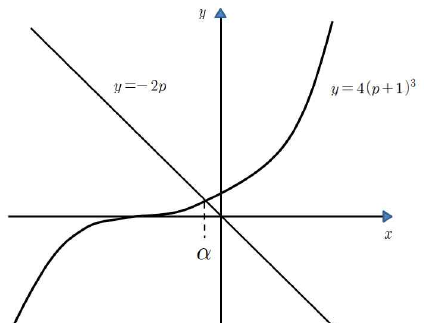
P(p,(p+1)2) (1<p<0)\displaystyle \mathrm{P}(p,(p+1)^{2})\ (-1<p<0) 이라 하면OP2=p2+(p+1)4=p4+4p3+7p2+4p+1\displaystyle \overline{\mathrm{OP}}^{2}=p^{2}+(p+1)^{4}=p^{4}+4p^{3}+7p^{2}+4p+1이다. 따라서 1<p<0\displaystyle -1<p<0에서 정의된 함수 g(p)\displaystyle g(p)g(p)=p2+(p+1)4=p4+4p3+7p2+4p+1\displaystyle g(p)=p^{2}+(p+1)^{4}=p^{4}+4p^{3}+7p^{2}+4p+1로 정의하고 함수 g(p)\displaystyle g(p)의 최솟값을 조사하면 된다. 함수 g(p)\displaystyle g(p)를 미분하면g(p)=4p3+12p2+14p+4\displaystyle g^{\prime}(p)=4p^{3}+12p^{2}+14p+4이는g(p)=4(p+1)3+2p\displaystyle g^{\prime}(p)=4(p+1)^{3}+2p로 적을 수 있다. 따라서y=4(p+1)3,y=2p\displaystyle y=4(p+1)^{3},\quad y=-2p의 교점에서 g(p)=0\displaystyle g^{\prime}(p)=0가 됨을 알 수 있다.오른쪽 그림과 같이 두 곡선과 직선의 그래프를 고려하면4(α+1)3=2α\displaystyle 4(\alpha+1)^{3}=-2\alpha0<α<1\displaystyle 0<\alpha<1가 유일하게 존재함을 알 수 있다.Correction. 풀이에서 4(α+1)3=2α\displaystyle 4(\alpha+1)^3=-2\alpha를 만족하는 α\displaystyle \alpha의 범위는 0<α<1\displaystyle 0<\alpha<1이 아니라 1<α<0\displaystyle -1<\alpha<0이다. 그러나 원칙에 따라 원문 표기를 그대로 실었다.

곡선 y=4(p+1)³과 직선 y=−2p를 한 좌표평면에 그린 그림. 두 그래프가 x좌표 α에서 만난다.

이로부터 함수의 증감을 조사하면pαg(p)0+g(p)g(α)\displaystyle \begin{array}{|c|c|c|c|} \hline p & & \alpha & \\ \hline g^{\prime}(p) & - & 0 & + \\ \hline g(p) & \searrow & g(\alpha) & \nearrow \\ \hline \end{array}따라서 g(p)\displaystyle g(p)α\displaystyle \alpha에서 최소가 되고 α\displaystyle \alphaα=2(α+1)3——- (1)\displaystyle \alpha=-2(\alpha+1)^{3}\qquad\text{------- (1)}을 만족한다.

직선 L\displaystyle L의 기울기는 2(α+1)\displaystyle 2(\alpha+1)이고 직선 OP\displaystyle \mathrm{OP}의 기울기는0(α+1)20α=(α+1)2α\displaystyle \frac{0-(\alpha+1)^{2}}{0-\alpha}=\frac{(\alpha+1)^{2}}{\alpha}이므로 (1)을 사용하면 L\displaystyle L의 기울기와 직선 OP\displaystyle \mathrm{OP}의 기울기의 곱은2(α+1)×(α+1)2α=2(α+1)3α=1\displaystyle 2(\alpha+1)\times\frac{(\alpha+1)^{2}}{\alpha}=\frac{2(\alpha+1)^{3}}{\alpha}=-1이다. 따라서 직선 L\displaystyle L과 선분 OP\displaystyle \mathrm{OP}는 수직이다.

[문제 1-ⅲ]

+10점 · AP×PB\displaystyle \overline{\mathrm{AP}}\times\overline{\mathrm{PB}}가 최댓값을 가질 때 직선 L\displaystyle L과 선분 OP\displaystyle \mathrm{OP}가 수직임을 보일 수 있다.

P(p,(p+1)2)\displaystyle \mathrm{P}(p,(p+1)^{2}) 라 두면 A,B\displaystyle \mathrm{A},\mathrm{B} 를 다음과 같이 나타낼 수 있다.A(1(p+1)4,(p+1)2),B(1(p+1)4,(p+1)2)\displaystyle \mathrm{A}\left(-\sqrt{1-(p+1)^{4}},(p+1)^{2}\right),\quad\mathrm{B}\left(\sqrt{1-(p+1)^{4}},(p+1)^{2}\right)따라서AP×PB=(p+1(1+p)4)(1(1+p)4p)=1p2(1+p)4=1OP2\displaystyle \begin{aligned} \overline{\mathrm{AP}}\times\overline{\mathrm{PB}} &=\left(p+\sqrt{1-(1+p)^{4}}\right)\left(\sqrt{1-(1+p)^{4}}-p\right) \\ &=1-p^{2}-(1+p)^{4} \\ &=1-\overline{\mathrm{OP}}^{2} \end{aligned}이로부터 AP×PB\displaystyle \overline{\mathrm{AP}}\times\overline{\mathrm{PB}}가 최대가 될 때는 OP\displaystyle \overline{\mathrm{OP}}가 최소가 될 때 임을 알 수 있다. 따라서 [문제 1-ⅱ]에 의해 AP×PB\displaystyle \overline{\mathrm{AP}}\times\overline{\mathrm{PB}}가 최댓값을 가질 때 직선 L\displaystyle L과 선분 OP\displaystyle \mathrm{OP}가 수직이다.

첨삭 사례

아직 등록된 첨삭 사례가 없습니다.

질문과 답변 · 0개질문과 답변 · 고정 0개

아직 등록된 질문이 없습니다. 질문 작성은 멤버십 회원만 가능합니다.