수리논술, 이게 다다.

자연계 1교시 1번

오류 제보

문제

[문제 1] 다음 <제시문 1>과 <제시문 2>를 읽고 [문제 1-ⅰ] ~ [문제 1-ⅲ]을 문항별로 풀이와 함께 답하시오. (30점)

<제시문 1>곡선 y=f(x)\displaystyle y=f(x) 위의 점 (a,f(a))\displaystyle (a,f(a))에서의 접선의 방정식은 y=f′(a)(x−a)+f(a)\displaystyle y=f^{\prime}(a)(x-a)+f(a)이다.

<제시문 2>좌표평면 위의 네 점 A,B,C,D\displaystyle \mathrm{A},\mathrm{B},\mathrm{C},\mathrm{D}가 다음의 조건을 만족한다.· 점 A\displaystyle \mathrm{A}는 곡선 y=x−1\displaystyle y=\sqrt{x-1} 위의 점이다. (단, x≥1\displaystyle x\ge1)· 점 B\displaystyle \mathrm{B}는 직선 y=x\displaystyle y=x 위의 점이다.· 점 C\displaystyle \mathrm{C}는 직선 y=0\displaystyle y=0 위의 점이다.· 점 D\displaystyle \mathrm{D}는 곡선 y=2x2−30x+113\displaystyle y=2x^{2}-30x+113 위의 점이다.

[문제 1-ⅰ] 실수 전체의 집합에서 미분가능한 함수 f(x)\displaystyle f(x)에 대하여 곡선 y=f(x)\displaystyle y=f(x)와 이 곡선 위에 있지 않은 점 P\displaystyle \mathrm{P}가 주어져 있다. 이 곡선 위의 점 중에서 주어진 점 P\displaystyle \mathrm{P}까지의 거리가 최소가 되는 점을 Q\displaystyle \mathrm{Q}라고 하자. 이때, 점 Q\displaystyle \mathrm{Q}에서 곡선 y=f(x)\displaystyle y=f(x)에 접하는 접선이 직선 PQ\displaystyle \mathrm{PQ}에 수직인 이유를 논하시오.

[문제 1-ⅱ] 실수 전체의 집합에서 미분가능한 두 함수 g(x)\displaystyle g(x)와 h(x)\displaystyle h(x)에 대하여, 곡선 y=g(x)\displaystyle y=g(x)와 곡선 y=h(x)\displaystyle y=h(x)가 서로 만나지 않는다고 하자. 곡선 y=g(x)\displaystyle y=g(x) 위의 점 Q\displaystyle \mathrm{Q}와 곡선 y=h(x)\displaystyle y=h(x) 위의 점 R\displaystyle \mathrm{R}에 대해 선분 QR\displaystyle \mathrm{QR}의 길이가 최소일 때, 점 Q\displaystyle \mathrm{Q}에서 곡선 y=g(x)\displaystyle y=g(x)에 접하는 접선과 점 R\displaystyle \mathrm{R}에서 곡선 y=h(x)\displaystyle y=h(x)에 접하는 접선이 모두 직선 QR\displaystyle \mathrm{QR}에 수직인 이유를 논하시오.

[문제 1-ⅲ] <제시문2>의 네 점 A,B,C,D\displaystyle \mathrm{A},\mathrm{B},\mathrm{C},\mathrm{D}에 대해 AB‾+BC‾+CD‾\displaystyle \overline{\mathrm{AB}}+\overline{\mathrm{BC}}+\overline{\mathrm{CD}}의 값이 최소가 될 때, 점 D\displaystyle \mathrm{D}의 x\displaystyle x좌표와 점 A\displaystyle \mathrm{A}의 y\displaystyle y좌표의 차가 6\displaystyle 6이라고 한다. 이때, 점 A\displaystyle \mathrm{A}와 D\displaystyle \mathrm{D}의 좌표를 구하고 그 이유를 논하시오.

해설강의 준비중

[문제 1-ⅰ]

+8점 · 접선의 방정식을 계산할 수 있다.

곡선 y=f(x)\displaystyle y=f(x) 위의 점 Q(c,f(c))\displaystyle \mathrm{Q}(c,f(c))에서 곡선 y=f(x)\displaystyle y=f(x)에 접하는 접선과 수직이며 점 Q\displaystyle \mathrm{Q}를 지나는 직선을 ℓ\displaystyle \ell이라 하자. 이 직선 ℓ\displaystyle \ell이 점 P(a,b)\displaystyle \mathrm{P}(a,b)를 지난다는 것을 보이면 된다. 직선 ℓ\displaystyle \ell의 방정식은y=−1f′(c)(x−c)+f(c)\displaystyle y=-\frac{1}{f^{\prime}(c)}(x-c)+f(c)이므로 다음을 만족함을 보이면 된다.b=−1f′(c)(a−c)+f(c) ⋯⋯⋯⋯ (\*)\displaystyle b=-\frac{1}{f^{\prime}(c)}(a-c)+f(c)\ \cdots\cdots\cdots\cdots\ (\*)이제 곡선 위의 점 (x,f(x))\displaystyle (x,f(x))에서 점 P\displaystyle \mathrm{P}까지의 거리의 제곱을g(x)=(x−a)2+(f(x)−b)2=x2−2ax+a2+f(x)⋅f(x)−2bf(x)+b2\displaystyle g(x)=(x-a)^{2}+(f(x)-b)^{2}=x^{2}-2ax+a^{2}+f(x)\cdot f(x)-2bf(x)+b^{2}이라 하자. 그러면 미분가능한 함수 g(x)\displaystyle g(x)는 x=c\displaystyle x=c에서 최솟값을 가지므로 극소가 된다. 그러므로 도함수g′(x)=2x−2a+f′(x)f(x)+f(x)f′(x)−2bf′(x)=2(x−a)+2f′(x)(f(x)−b)\displaystyle g^{\prime}(x)=2x-2a+f^{\prime}(x)f(x)+f(x)f^{\prime}(x)-2bf^{\prime}(x)=2(x-a)+2f^{\prime}(x)(f(x)-b)는 g′(c)=0\displaystyle g^{\prime}(c)=0을 만족한다. 따라서2(c−a)+2f′(c)(f(c)−b)=0\displaystyle 2(c-a)+2f^{\prime}(c)(f(c)-b)=0을 얻는다. 이 식은 식 (\*)과 같으므로 직선 ℓ\displaystyle \ell은 점 P\displaystyle \mathrm{P}를 지난다.

참고: 만약 f′(c)=0\displaystyle f^{\prime}(c)=0인 경우 위에서 얻은 식 2(c−a)+2f′(c)(f(c)−b)=0\displaystyle 2(c-a)+2f^{\prime}(c)(f(c)-b)=0으로부터 a=c\displaystyle a=c가 되고 직선 ℓ\displaystyle \ell의 방정식은 x=c\displaystyle x=c가 된다. 따라서 이 경우에도 직선 ℓ\displaystyle \ell은 점 P\displaystyle \mathrm{P}를 지난다.

[문제 1-ⅱ]

+6점 · 접선의 성질을 이해하고 문제를 해결할 수 있다.

점 Q\displaystyle \mathrm{Q}에서 곡선 y=g(x)\displaystyle y=g(x)에 접하는 접선과 수직이며 점 Q\displaystyle \mathrm{Q}를 지나는 직선을 ℓ1\displaystyle \ell_{1}이라 하고 점 R\displaystyle \mathrm{R}에서 곡선 y=h(x)\displaystyle y=h(x)에 접하는 접선과 수직이며 점 R\displaystyle \mathrm{R}를 지나는 직선을 ℓ2\displaystyle \ell_{2}라 하자. 점 Q\displaystyle \mathrm{Q}를 고정하고 곡선 y=h(x)\displaystyle y=h(x) 위의 점 중에서 점 Q\displaystyle \mathrm{Q}까지의 거리가 최소인 점을 R\displaystyle \mathrm{R}이라고 할 때, 선분 QR\displaystyle \mathrm{QR}의 길이가 최소가 되어야 하므로 [문제 1-ⅰ]에 의해 직선 ℓ1\displaystyle \ell_{1}이 점 R\displaystyle \mathrm{R}을 지난다. 같은 이유로 직선 ℓ2\displaystyle \ell_{2}는 점 Q\displaystyle \mathrm{Q}를 지난다. 따라서 직선 ℓ1\displaystyle \ell_{1}과 ℓ2\displaystyle \ell_{2}는 모두 직선 QR\displaystyle \mathrm{QR}와 같으므로 점 Q\displaystyle \mathrm{Q}에서 곡선 y=g(x)\displaystyle y=g(x)에 접하는 접선과 점 R\displaystyle \mathrm{R}에서 곡선 y=h(x)\displaystyle y=h(x)에 접하는 접선은 모두 직선 QR\displaystyle \mathrm{QR}에 수직이다.Correction. Q\displaystyle Q를 고정하고 R\displaystyle R을 움직여 거리가 최소가 되는 경우, [문제 1-ⅰ]로 얻는 것은 ℓ2\displaystyle \ell_2가 Q\displaystyle Q를 지난다는 사실이다. 반대로 R\displaystyle R을 고정하면 ℓ1\displaystyle \ell_1이 R\displaystyle R을 지난다. 해당 설명에서 두 직선이 서로 뒤바뀌었다. 그러나 원칙에 따라 원문 표기를 그대로 실었다.

[문제 1-ⅲ]

+16점 · 함수의 그래프를 직선에 대해 대칭할 수 있다.

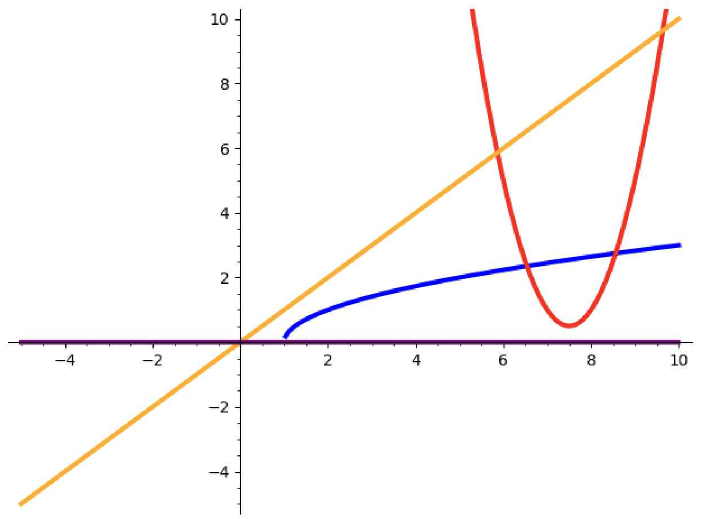
주어진 곡선과 직선의 개형을 그리면 아래와 같다.

곡선 y=√(x−1)(파랑), 곡선 y=2x²−30x+113(빨강), 직선 y=x(주황), x축을 한 좌표평면에 그린 그림.

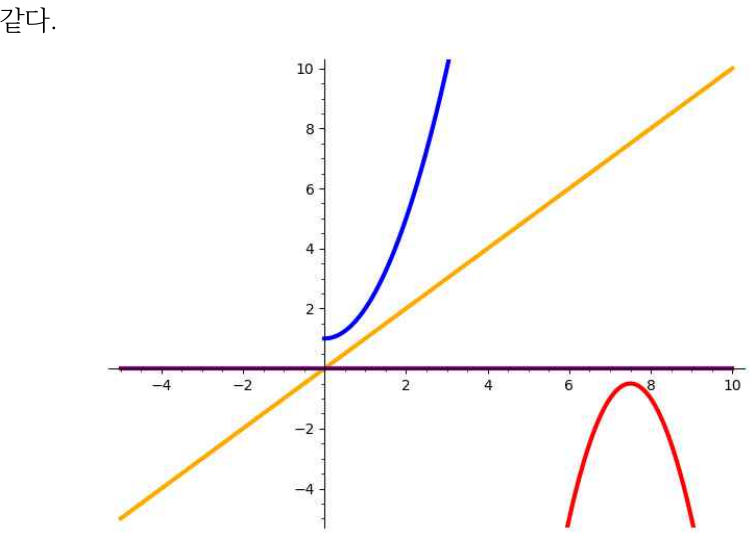
곡선 y=x−1 (x≥1)\displaystyle y=\sqrt{x-1}\ (x\ge1)을 직선 y=x\displaystyle y=x에 대해 대칭시키면 y=x2+1 (x≥0)\displaystyle y=x^{2}+1\ (x\ge0)이 되고 곡선 y=2x2−30x+113\displaystyle y=2x^{2}-30x+113을 직선 y=0\displaystyle y=0에 대해 대칭시키면 y=−2x2+30x−113\displaystyle y=-2x^{2}+30x-113이 된다. 이렇게 얻어진 곡선의 개형을 그리면 아래와 같다.

곡선 y=x²+1(파랑)과 곡선 y=−2x²+30x−113(빨강), 직선 y=x(주황)를 한 좌표평면에 그린 그림.

따라서 선분 AB\displaystyle \mathrm{AB}, BC\displaystyle \mathrm{BC}, CD\displaystyle \mathrm{CD}의 길이의 합이 최소가 될 때는 점 A′\displaystyle \mathrm{A}^{\prime}, B\displaystyle \mathrm{B}, C\displaystyle \mathrm{C}, D′\displaystyle \mathrm{D}^{\prime}이 한 직선 위에 있고, 선분 A′D′\displaystyle \mathrm{A}^{\prime}\mathrm{D}^{\prime}의 길이가 두 포물선 사이의 최소 거리가 될 때이다. 점 A(a,b)\displaystyle \mathrm{A}(a,b)를 직선 y=x\displaystyle y=x에 대해 대칭시켜 얻은 점을 A′(b,a)\displaystyle \mathrm{A}^{\prime}(b,a)라 하고 점 D(c,d)\displaystyle \mathrm{D}(c,d)를 직선 y=0\displaystyle y=0에 대해 대칭시켜 얻은 점을 D′(c,−d)\displaystyle \mathrm{D}^{\prime}(c,-d)라 하면 주어진 조건으로부터 c−b=6\displaystyle c-b=6을 얻는다. 또한 [문제 1-ⅱ]에 의해 점 A′\displaystyle \mathrm{A}^{\prime}에서 곡선 y=x2+1\displaystyle y=x^{2}+1에 접하는 접선과 점 D′\displaystyle \mathrm{D}^{\prime}에서 곡선 y=−2x2+30x−113\displaystyle y=-2x^{2}+30x-113에 접하는 접선은 서로 평행하므로 기울기가 같다. 두 접선의 기울기를 비교하면 2b=−4c+30\displaystyle 2b=-4c+30이 되고, 이 식과 위에서 얻은 식을 연립하면 b=1\displaystyle b=1, c=7\displaystyle c=7을 얻는다. 따라서 A′=(1,2)\displaystyle \mathrm{A}^{\prime}=(1,2), D′=(7,−1)\displaystyle \mathrm{D}^{\prime}=(7,-1)이므로, 정답은 A=(2,1)\displaystyle \mathrm{A}=(2,1), D=(7,1)\displaystyle \mathrm{D}=(7,1)이다.

참고: 문제에서 주어진 조건 c−b=6\displaystyle c-b=6이 없어도 다음과 같이 답을 구할 수 있다. 점 A′(b,b2+1)\displaystyle \mathrm{A}^{\prime}(b,b^{2}+1)에서 곡선 y=x2+1\displaystyle y=x^{2}+1에 접하는 접선과 수직이며 점 A′\displaystyle \mathrm{A}^{\prime}을 지나는 직선과 점 D′=(c,−2c2+30c−113)\displaystyle \mathrm{D}^{\prime}=(c,-2c^{2}+30c-113)에서 곡선 y=−2x2+30x−113\displaystyle y=-2x^{2}+30x-113에 접하는 접선과 수직이며 점 D′\displaystyle \mathrm{D}^{\prime}을 지나는 직선은 각각 다음과 같다.y=−12b(x−b)+b2+1,y=−130−4c(x−c)−2c2+30c−113\displaystyle y=-\frac{1}{2b}(x-b)+b^{2}+1,\qquad y=-\frac{1}{30-4c}(x-c)-2c^{2}+30c-113이 두 직선은 일치하므로 기울기가 같고 y\displaystyle y절편이 같음을 이용하여 다음 식을 얻는다.2b=−4c+30,32+b2=c30−4c−2c2+30c−113\displaystyle 2b=-4c+30,\qquad\frac{3}{2}+b^{2}=\frac{c}{30-4c}-2c^{2}+30c-113첫 번째 식에서 얻은 b=15−2c\displaystyle b=15-2c를 두 번째 식에 대입하여 정리하면−24c3+540c2−4059c+10185=−3(8c2−124c+485)(c−7)=0\displaystyle -24c^{3}+540c^{2}-4059c+10185=-3(8c^{2}-124c+485)(c-7)=0이 되어 c=7\displaystyle c=7을 얻을 수 있다.

첨삭 사례

아직 등록된 첨삭 사례가 없습니다.

질문과 답변 · 0개질문과 답변 · 고정 0개

아직 등록된 질문이 없습니다. 질문 작성은 멤버십 회원만 가능합니다.