수리논술, 배움에서 논증의 완성까지.

자연계열 2교시 4번

문제

🔒
짧은 시간에 너무 많은 문제를 여셔서 열람을 잠시 제한했습니다. 잠시 후 다시 시도하시거나 로그인해 주세요.
해설강의 준비중

[문제 4-1]

k=±1\displaystyle k=\pm1인 경우, 두 접선이 이루는 각이 45\displaystyle 45^\circ가 아님을 쉽게 알 수 있다. 따라서 k±1\displaystyle k\ne\pm1이라 가정할 수 있다.

+5점 · 접선을 y=mx±m2+2\displaystyle y=mx\pm\sqrt{m^2+2}라 놓고, (k21)m223km+1=0\displaystyle (k^2-1)m^2-2\sqrt3km+1=0를 얻으면

접선을 y=mx±m2+2\displaystyle y=mx\pm\sqrt{m^2+2}라 놓자. 접선이 점 P(k,3)\displaystyle \mathrm P(k,\sqrt3)을 지나므로 대입하여 정리하여 m\displaystyle m에 대한 이차방정식 (k21)m223km+1=0\displaystyle (k^2-1)m^2-2\sqrt3km+1=0을 얻는다.

+5점 · 두 접선이 x\displaystyle x축과 이루는 각을 α,β\displaystyle \alpha,\beta라 놓고, tanα+tanβ=23kk21\displaystyle \tan\alpha+\tan\beta=\frac{2\sqrt3k}{k^2-1}tanαtanβ=1k21\displaystyle \tan\alpha\tan\beta=\frac1{k^2-1}을 얻으면

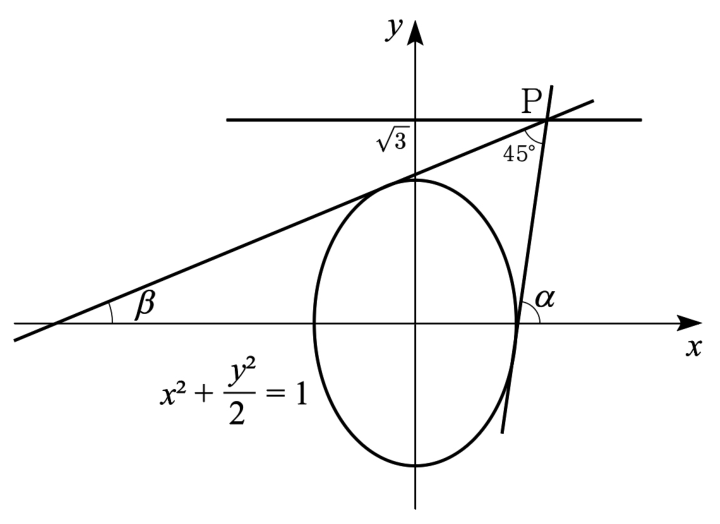
아래 그림과 같이 두 접선이 x\displaystyle x축과 이루는 각을 α,β\displaystyle \alpha,\beta (α>β)\displaystyle (\alpha>\beta)라 하면 tanα\displaystyle \tan\alpha, tanβ\displaystyle \tan\beta는 이 이차방정식의 두 근이고, 근과 계수의 관계에 의하여tanα+tanβ=23kk21\displaystyle \tan\alpha+\tan\beta=\frac{2\sqrt3k}{k^2-1}tanαtanβ=1k21\displaystyle \tan\alpha\tan\beta=\frac1{k^2-1}이다.

+5점 · k2=4+25\displaystyle k^2=4+2\sqrt5를 구하면

αβ=45\displaystyle \alpha-\beta=45^\circ이므로1=tan2(αβ)=(tanαtanβ1+tanαtanβ)2=(tanα+tanβ)24tanαtanβ(1+tanαtanβ)2=(23kk21)24k21(1+1k21)2\displaystyle 1=\tan^2(\alpha-\beta)=\left(\frac{\tan\alpha-\tan\beta}{1+\tan\alpha\tan\beta}\right)^2=\frac{(\tan\alpha+\tan\beta)^2-4\tan\alpha\tan\beta}{(1+\tan\alpha\tan\beta)^2}=\frac{\left(\frac{2\sqrt3k}{k^2-1}\right)^2-\frac4{k^2-1}}{\left(1+\frac1{k^2-1}\right)^2}Comment. k=0\displaystyle k=0이면 두 접선의 기울기는 1\displaystyle 1, 1\displaystyle -1이므로 서로 수직이다. 따라서 주어진 조건에서 제외하고 k0\displaystyle k\ne0인 경우에 탄젠트 식을 사용한다.정리하여 방정식 (k2)28k24=0\displaystyle (k^2)^2-8k^2-4=0을 얻는다. k2>0\displaystyle k^2>0이므로 k2=4+25\displaystyle k^2=4+2\sqrt5

타원에 그은 두 접선이 이루는 각 45도

[문제 4-2]

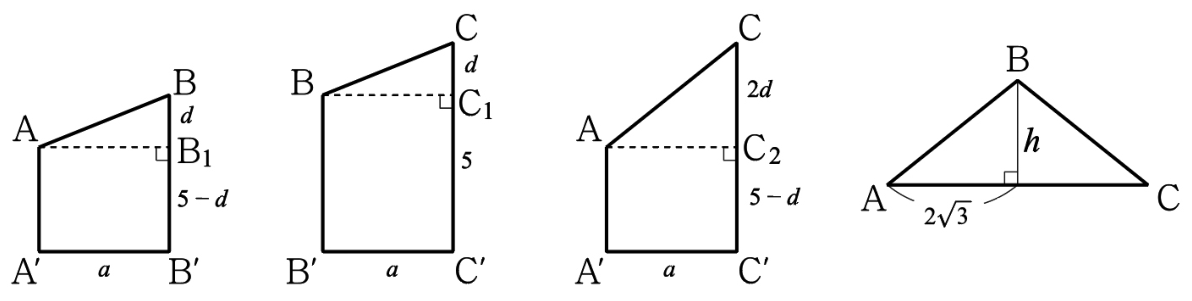
AA=5d\displaystyle \overline{\mathrm{AA^{\prime}}}=5-d, BB=5\displaystyle \overline{\mathrm{BB^{\prime}}}=5, CC=5+d\displaystyle \overline{\mathrm{CC^{\prime}}}=5+d라 하고, 정삼각형 A′B′C′의 한 변의 길이를 a\displaystyle a라 하자. 아래 그림과 같이 점 B1\displaystyle \mathrm B_1, C1\displaystyle \mathrm C_1, C2\displaystyle \mathrm C_2를 선분 BB′ 또는 CC′ 위에서 잡자.

높이 차를 나타내는 세 직각사다리꼴과 이등변삼각형 ABC
+5점 · AB=BC=21\displaystyle \overline{\mathrm{AB}}=\overline{\mathrm{BC}}=\sqrt{21}를 구하면

직각삼각형 AB1B\displaystyle \mathrm{AB}_1\mathrm B, BC1C\displaystyle \mathrm{BC}_1\mathrm C에서 AB=BC=a2+d2\displaystyle \overline{\mathrm{AB}}=\overline{\mathrm{BC}}=\sqrt{a^2+d^2}이므로 삼각형 ABC는 이등변삼각형이다. 위 그림과 같이 점 B와 선분 AC사이의 거리를 h\displaystyle h라 하면 삼각형 ABC의 넓이가 63\displaystyle 6\sqrt3이므로 h=3\displaystyle h=3이고 AB=BC=21\displaystyle \overline{\mathrm{AB}}=\overline{\mathrm{BC}}=\sqrt{21}이다.

+5점 · 삼각형 A′B′C′의 넓이 33\displaystyle 3\sqrt3을 구하면

직각삼각형 AB1B\displaystyle \mathrm{AB}_1\mathrm BAC2C\displaystyle \mathrm{AC}_2\mathrm C에서 a2+d2=21\displaystyle a^2+d^2=21, a2+4d2=48\displaystyle a^2+4d^2=48이므로 a=23\displaystyle a=2\sqrt3 (d=±3)\displaystyle (d=\pm3)을 얻는다. 따라서 삼각형 A′B′C′의 넓이는 33\displaystyle 3\sqrt3이고, 평면 ABC와 평면 α\displaystyle \alpha가 이루는 각을 θ\displaystyle \theta라 하면 cosθ=12\displaystyle \cos\theta=\frac12이다.

+5점 · 그림자의 넓이 2(1147)π\displaystyle 2(11-4\sqrt7)\pi를 구하면 (그림자의 넓이를 18π11+47\displaystyle \frac{18\pi}{11+4\sqrt7}로 구해도 +5점)

삼각형 ABC의 내접원의 반지름의 길이를 r\displaystyle r라 하고 삼각형 ABC의 넓이를 S\displaystyle S라 하면 12(43+221)r=S=63\displaystyle \frac12(4\sqrt3+2\sqrt{21})r=S=6\sqrt3이므로 r=2(72)\displaystyle r=2(\sqrt7-2)를 얻는다. 삼각형 ABC의 내접원의 그림자의 넓이는 πr2cosθ=12πr2=2(1147)π\displaystyle \pi r^2\cos\theta=\frac12\pi r^2=2(11-4\sqrt7)\pi이다.

※ 논리 전개 과정이 맞으면 답이 틀리더라도 부분 점수를 부여할 수 있습니다.

※ 채점자는 답안의 완성도에 따라 ±1점을 부여할 수 있습니다.

첨삭 사례

아직 등록된 첨삭 사례가 없습니다.

질문과 답변 · 0개질문과 답변 · 고정 0개

아직 등록된 질문이 없습니다. 질문 작성은 멤버십 회원만 가능합니다.