수리논술, 배움에서 논증의 완성까지.

자연계열 1교시 4번

문제

🔒
짧은 시간에 너무 많은 문제를 여셔서 열람을 잠시 제한했습니다. 잠시 후 다시 시도하시거나 로그인해 주세요.
해설강의 준비중

[문제 4-1]

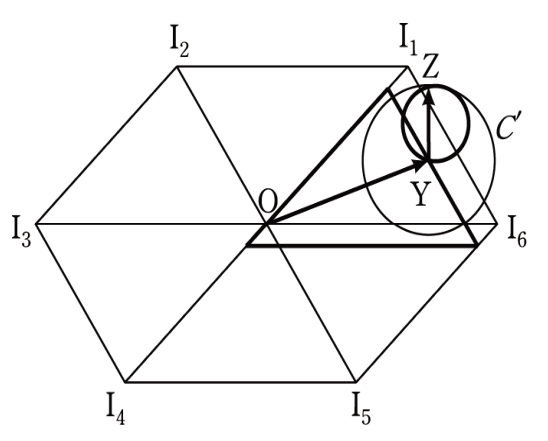
삼각형 6개를 이어 붙인 육각형과 원 C′
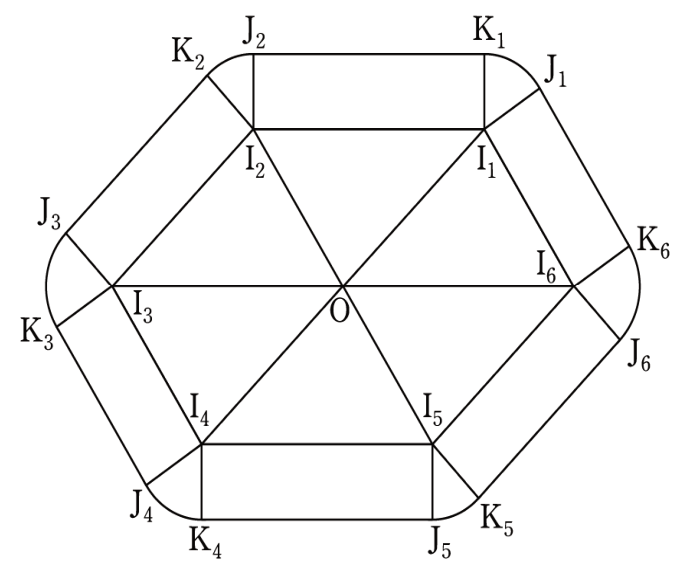
육각형의 둘레에 붙인 직사각형과 부채꼴
+2점 · PS+RQ=RS+PQ\displaystyle \overrightarrow{\mathrm{PS}}+\overrightarrow{\mathrm{RQ}}=\overrightarrow{\mathrm{RS}}+\overrightarrow{\mathrm{PQ}}를 찾으면

PS+RQ=OSOP+OQOR=OQOP+OSOR=PQ+RS=RS+PQ\displaystyle \overrightarrow{\mathrm{PS}}+\overrightarrow{\mathrm{RQ}}=\overrightarrow{\mathrm{OS}}-\overrightarrow{\mathrm{OP}}+\overrightarrow{\mathrm{OQ}}-\overrightarrow{\mathrm{OR}}=\overrightarrow{\mathrm{OQ}}-\overrightarrow{\mathrm{OP}}+\overrightarrow{\mathrm{OS}}-\overrightarrow{\mathrm{OR}}=\overrightarrow{\mathrm{PQ}}+\overrightarrow{\mathrm{RS}}=\overrightarrow{\mathrm{RS}}+\overrightarrow{\mathrm{PQ}}

+5점 · OY=RS\displaystyle \overrightarrow{\mathrm{OY}}=\overrightarrow{\mathrm{RS}}를 만족시키는 점 Y가 육각형 I1I2I3I4I5I6\displaystyle \mathrm I_1\mathrm I_2\mathrm I_3\mathrm I_4\mathrm I_5\mathrm I_6의 변 또는 그 내부의 임의의 점인 것을 진술하면

점 O를 한 꼭짓점으로 갖고 삼각형 ABC와 합동인 삼각형 6개를 그림과 같이 맞물리게 이어 붙여, 두 직선 AB와 I6I1\displaystyle \mathrm I_6\mathrm I_1이 평행하도록, 육각형 I1I2I3I4I5I6\displaystyle \mathrm I_1\mathrm I_2\mathrm I_3\mathrm I_4\mathrm I_5\mathrm I_6을 만들자. OY=RS\displaystyle \overrightarrow{\mathrm{OY}}=\overrightarrow{\mathrm{RS}}가 되도록 이 육각형의 변 또는 그 내부에서 점 Y를 잡을 수 있고, 역으로 이 육각형의 변 또는 그 내부의 임의의 점 Y에 대하여 OY=RS\displaystyle \overrightarrow{\mathrm{OY}}=\overrightarrow{\mathrm{RS}}를 만족시키도록 두 점 R, S를 삼각형 ABC의 변 위에서 잡을 수 있다.

+3점 · YZ=PQ\displaystyle \overrightarrow{\mathrm{YZ}}=\overrightarrow{\mathrm{PQ}}를 만족시키는 점 Z가 원 C\displaystyle C^{\prime}과 그 내부의 임의의 점인 것을 진술하면

육각형 I1I2I3I4I5I6\displaystyle \mathrm I_1\mathrm I_2\mathrm I_3\mathrm I_4\mathrm I_5\mathrm I_6의 변 또는 그 내부의 점 Y를 중심으로 하고 반지름의 길이가 2인 원 C\displaystyle C^{\prime}을 생각하자. YZ=PQ\displaystyle \overrightarrow{\mathrm{YZ}}=\overrightarrow{\mathrm{PQ}}가 되도록 원 C\displaystyle C^{\prime}과 그 내부에서 점 Z를 잡을 수 있고, 역으로 원 C\displaystyle C^{\prime}과 그 내부의 임의의 점 Z에 대하여 YZ=PQ\displaystyle \overrightarrow{\mathrm{YZ}}=\overrightarrow{\mathrm{PQ}}를 만족시키도록 두 점 P, Q를 원 C\displaystyle C위에서 잡을 수 있다.

OX=PS+RQ=RS+PQ=OY+YZ=OZ\displaystyle \overrightarrow{\mathrm{OX}}=\overrightarrow{\mathrm{PS}}+\overrightarrow{\mathrm{RQ}}=\overrightarrow{\mathrm{RS}}+\overrightarrow{\mathrm{PQ}}=\overrightarrow{\mathrm{OY}}+\overrightarrow{\mathrm{YZ}}=\overrightarrow{\mathrm{OZ}}이므로 점 X가 존재하는 영역은, 6개의 직사각형 IiKiJi+1Ii+1\displaystyle \mathrm I_i\mathrm K_i\mathrm J_{i+1}\mathrm I_{i+1} (i=1,2,,6)\displaystyle (i=1,2,\cdots,6)과 6개의 부채꼴 IiJiKi\displaystyle \mathrm I_i\mathrm J_i\mathrm K_i를 육각형 I1I2I3I4I5I6\displaystyle \mathrm I_1\mathrm I_2\mathrm I_3\mathrm I_4\mathrm I_5\mathrm I_6의 둘레에 그림과 같이 이어 붙여 얻은 영역이다. 여기서 I7=I1\displaystyle \mathrm I_7=\mathrm I_1, J7=J1\displaystyle \mathrm J_7=\mathrm J_1로 간주하고 IiJi=2\displaystyle \overline{\mathrm I_i\mathrm J_i}=2이다. 6개의 직사각형의 넓이의 합은 2×2×(5+6+7)=72\displaystyle 2\times2\times(5+6+7)=72이다.

삼각형 ABC에서 코사인법칙에 의해 cosABC=15\displaystyle \cos\angle\mathrm{ABC}=\frac15이어서 sinABC=265\displaystyle \sin\angle\mathrm{ABC}=\frac{2\sqrt6}5이고 ABC=66\displaystyle \triangle\mathrm{ABC}=6\sqrt6이다.따라서 육각형 I1I2I3I4I5I6\displaystyle \mathrm I_1\mathrm I_2\mathrm I_3\mathrm I_4\mathrm I_5\mathrm I_6의 넓이는 366\displaystyle 36\sqrt6이다. 6개의 부채꼴의 중심각의 합은 2π\displaystyle 2\pi이므로 그 넓이의 합은 4π\displaystyle 4\pi이다.

+5점 · 점 X가 존재하는 영역의 넓이 72+366+4π\displaystyle 72+36\sqrt6+4\pi를 구하면

따라서 점 X가 존재하는 영역의 넓이는 72+366+4π\displaystyle 72+36\sqrt6+4\pi이다.

[문제 4-2]

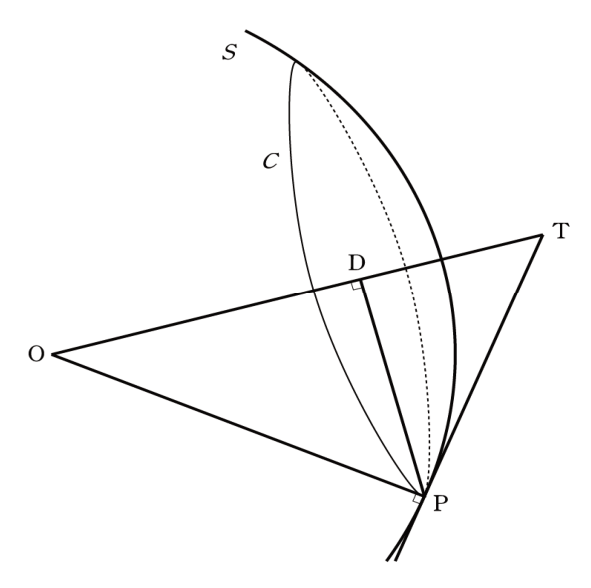
구 S의 접선 PT와 원 C
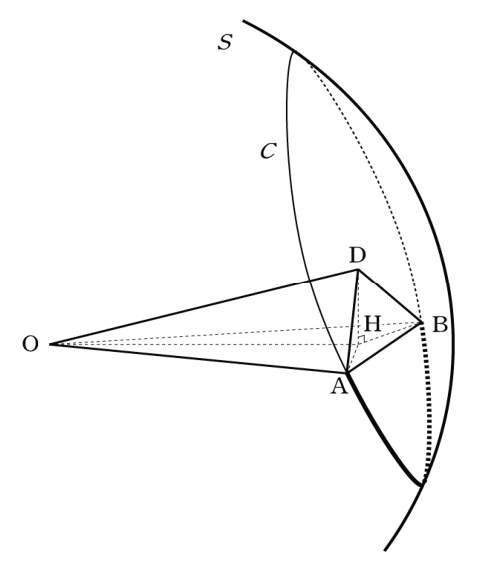
원 C와 xy평면의 교점 A, B
+4점 · 원 C\displaystyle C의 반지름 25\displaystyle 2\sqrt5를 구하면

S\displaystyle S의 중심을 O라 하면 OT=55\displaystyle \overline{\mathrm{OT}}=5\sqrt5이고 PT=OT2OP2=5\displaystyle \overline{\mathrm{PT}}=\sqrt{\overline{\mathrm{OT}}^2-\overline{\mathrm{OP}}^2}=5이다. (그림과 같이 구 S\displaystyle S는 평면 OPT와 원에서 만나고 직선 PT는 점 P에서 이 원에 접한다.) 점 P에서 직선 OT에 내린 수선의 발을 D\displaystyle D라 하면 50=2×OPT=OT×DP\displaystyle 50=2\times\triangle\mathrm{OPT}=\overline{\mathrm{OT}}\times\overline{\mathrm{DP}}에서 DP=25\displaystyle \overline{\mathrm{DP}}=2\sqrt5를 얻는다. 따라서 점 P는, 직선 OT에 수직이고 중심이 점 D이고 반지름이 25\displaystyle 2\sqrt5인 원 C\displaystyle C위에 있다. 원 C\displaystyle Cxy\displaystyle xy평면과 만나는 두 점을 A, B라 하면, 점 P가 나타내는 도형은, 선분 AB를 포함하는 부채꼴 ADB의 호 AB이다.

+3점 · OD=45\displaystyle \overline{\mathrm{OD}}=4\sqrt5를 구하면

두 삼각형 OPT와 ODP는 닮았으므로 OP:PT=OD:DP\displaystyle \overline{\mathrm{OP}}:\overline{\mathrm{PT}}=\overline{\mathrm{OD}}:\overline{\mathrm{DP}}에서 OD=45\displaystyle \overline{\mathrm{OD}}=4\sqrt5를 얻는다.

+3점 · DH=453(=2035)\displaystyle \overline{\mathrm{DH}}=\frac{4\sqrt5}3\left(=\frac{20}{3\sqrt5}\right)를 구하면

점 D는 선분 OT를 4:1\displaystyle 4:1로 내분하므로 그 좌표는 (8515,56515,453)\displaystyle \left(\frac{8\sqrt5}{15},\frac{56\sqrt5}{15},\frac{4\sqrt5}3\right)이다. 점 D에서 xy\displaystyle xy평면에 내린 수선의 발을 H라 하면, DH=453\displaystyle \overline{\mathrm{DH}}=\frac{4\sqrt5}3이므로 OH=OD2DH2=8103\displaystyle \overline{\mathrm{OH}}=\sqrt{\overline{\mathrm{OD}}^2-\overline{\mathrm{DH}}^2}=\frac{8\sqrt{10}}3이다.

+5점 · 호 AB의 길이 5π\displaystyle \sqrt5\pi를 구하면

선분 AB의 중점을 I라 하면, 닮은 두 직각삼각형 ODH와 OID에서 OH:DH=OD:ID\displaystyle \overline{\mathrm{OH}}:\overline{\mathrm{DH}}=\overline{\mathrm{OD}}:\overline{\mathrm{ID}}이므로 ID=10\displaystyle \overline{\mathrm{ID}}=\sqrt{10}이고, 두 직각삼각형 AID와 BID에서 cosADI=cosBDI=12\displaystyle \cos\angle\mathrm{ADI}=\cos\angle BDI=\frac1{\sqrt2}이다. 따라서 ADB=ADI+BDI=π2\displaystyle \angle\mathrm{ADB}=\angle\mathrm{ADI}+\angle\mathrm{BDI}=\frac\pi2이고 호 AB의 길이 l\displaystyle ll=AD×π2=5π\displaystyle l=\overline{\mathrm{AD}}\times\frac\pi2=\sqrt5\pi이다.

※ 논리 전개 과정이 맞으면 답이 틀리더라도 부분 점수를 부여할 수 있습니다.

※ 채점자는 답안의 완성도에 따라 ±1점을 부여할 수 있습니다.

첨삭 사례

아직 등록된 첨삭 사례가 없습니다.

질문과 답변 · 0개질문과 답변 · 고정 0개

아직 등록된 질문이 없습니다. 질문 작성은 멤버십 회원만 가능합니다.