수리논술, 배움에서 논증의 완성까지.

자연계열 II 3번

문제

🔒
짧은 시간에 너무 많은 문제를 여셔서 열람을 잠시 제한했습니다. 잠시 후 다시 시도하시거나 로그인해 주세요.
해설강의 준비중

(1) 기울기 m=23\displaystyle m=\frac{2}{3}에 대하여 위의 규칙에 따라 정해진 점들 Pn\displaystyle \mathrm{P}_{n} (n=1,2,3,\displaystyle n=1,2,3,\cdots)을 모두 구하시오.풀이: 규칙에 따라 P1=(0,0)\displaystyle \mathrm{P}_{1}=(0,0)이다. 점 P2\displaystyle \mathrm{P}_{2}는 기울기 m=23\displaystyle m=\frac{2}{3}이고 원점을 지나는 직선 y=23x\displaystyle y=\frac{2}{3}x과 직선 x=1\displaystyle x=1의 교점이므로 P2=(1,23)\displaystyle \mathrm{P}_{2}=\left(1,\frac{2}{3}\right)이다. 점 P3\displaystyle \mathrm{P}_{3}은 선분 BC\displaystyle \mathrm{BC}위의 점으로 기울기 m=23\displaystyle m=-\frac{2}{3}이고 점 P2=(1,23)\displaystyle \mathrm{P}_{2}=\left(1,\frac{2}{3}\right)를 지나는 직선 y=23(x1)+23\displaystyle y=-\frac{2}{3}(x-1)+\frac{2}{3}와 직선 y=1\displaystyle y=1의 교점이므로 P3=(12,1)\displaystyle \mathrm{P}_{3}=\left(\frac{1}{2},1\right)이다. 점 P4\displaystyle \mathrm{P}_{4}는 선분 CO\displaystyle \mathrm{CO}위의 점으로 기울기 m=23\displaystyle m=\frac{2}{3}이고 점 P3=(12,1)\displaystyle \mathrm{P}_{3}=\left(\frac{1}{2},1\right)을 지나는 직선 y=23(x12)+1\displaystyle y=\frac{2}{3}\left(x-\frac{1}{2}\right)+1y\displaystyle y축의 교점이므로 P4=(0,23)\displaystyle \mathrm{P}_{4}=\left(0,\frac{2}{3}\right)이다. 점 P5\displaystyle \mathrm{P}_{5}는 선분 OA\displaystyle \mathrm{OA}위의 점으로 기울기 m=23\displaystyle m=-\frac{2}{3}이고 점 P4=(0,23)\displaystyle \mathrm{P}_{4}=\left(0,\frac{2}{3}\right)를 지나는 직선 y=23x+23\displaystyle y=-\frac{2}{3}x+\frac{2}{3}x\displaystyle x축의 교점이므로 P5=(1,0)\displaystyle \mathrm{P}_{5}=(1,0)이다. P5=(1,0)\displaystyle \mathrm{P}_{5}=(1,0)가 꼭짓점 B\displaystyle \mathrm{B}이므로 끝점이다.Correction. 이 줄의 꼭짓점 B\displaystyle BA\displaystyle A의 오기다. 그러나 원칙에 따라 원문 표기를 그대로 실었다.따라서 구하는 점들은 P1=(0,0)\displaystyle \mathrm{P}_{1}=(0,0), P2=(1,23)\displaystyle \mathrm{P}_{2}=\left(1,\frac{2}{3}\right), P3=(12,1)\displaystyle \mathrm{P}_{3}=\left(\frac{1}{2},1\right), P4=(0,23)\displaystyle \mathrm{P}_{4}=\left(0,\frac{2}{3}\right), P5=(1,0)\displaystyle \mathrm{P}_{5}=(1,0)이다.

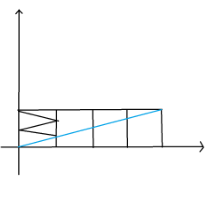
(2) 120<m<1\displaystyle \frac{1}{20}<m<1인 기울기 m\displaystyle m에 대하여 규칙에 따라 정해진 점들이 꼭짓점 C\displaystyle \mathrm{C}를 제외한 선분 BC\displaystyle \mathrm{BC}위에 있지 않고 꼭짓점 C(0,1)\displaystyle \mathrm{C}(0,1)이 끝점이 된다. 조건을 만족시키는 기울기 m\displaystyle m에 대하여 1m\displaystyle \frac{1}{m}을 모두 더한 값을 구하시오.풀이: 주어진 규칙(다)에 따라 점을 정하는 과정은 홀수 번째 점을 지나는 기울기 m\displaystyle m인 직선과 정사각형의 변의 다른 교점으로 다음 순서인 짝수 번째 점을 정하고, 짝수 번째 점을 지나는 기울기 m\displaystyle -m인 직선과 정사각형의 변의 다른 교점으로 다음 순서인 홀수 번째 점을 결정한다. 규칙 (다)에서'만약 점 Pn\displaystyle \mathrm{P}_{n}이 끝점이 아니면 (n+1)\displaystyle (n+1)번째 점 Pn+1\displaystyle \mathrm{P}_{n+1}을 선분 Pn1Pn\displaystyle \mathrm{P}_{n-1}\mathrm{P}_{n}과 정사각형의 점 Pn\displaystyle \mathrm{P}_{n}을 포함하는 변이 이루는 각의 크기가 선분 PnPn+1\displaystyle \mathrm{P}_{n}\mathrm{P}_{n+1}과 정사각형의 점 Pn\displaystyle \mathrm{P}_{n}을 포함하는 변이 이루는 각의 크기가 같도록 정한다.'는 조건을 점 Pn\displaystyle \mathrm{P}_{n}을 포함하는 정사각형의 한 변에 대하여 대칭이동한 정사각형에 관한 조건으로 생각하면'기울기 m\displaystyle m, m\displaystyle -m을 교차로 사용하는 대신 같은 기울기 m\displaystyle m에 대한 직선과 점 Pn\displaystyle \mathrm{P}_{n}을 포함하는 정사각형의 한 변에 대하여 대칭이동된 정사각형의 변의 교점을 구하고 이를 역으로 대칭 이동하여 점 Pn+1\displaystyle \mathrm{P}_{n+1}을 정한다.'로 바꾸어 활용할 수 있다.

가로로 대칭이동한 정사각형들과 기울기 m의 직선
[그림 2]

P1\displaystyle \mathrm{P}_{1}부터 차례로 n\displaystyle n (n>1\displaystyle n>1)번째 점 Pn\displaystyle \mathrm{P}_{n}이 정해졌을 때, 점 P2\displaystyle \mathrm{P}_{2}을 포함하는 변에 대하여 주어진 정사각형을 대칭이동하고 이동된 정사각형과 선 y=mx\displaystyle y=mx의 교점으로 P3\displaystyle \mathrm{P}_{3}에 대응하는 점을 정한다. 이렇게 이동된 정사각형과 점 P3\displaystyle \mathrm{P}_{3}에 대응하는 점에 대하여 이 대응점을 포함하는 변에 대하여 대칭이동하고 이 정사각형과 직선 y=mx\displaystyle y=mx의 교점으로 점 P4\displaystyle \mathrm{P}_{4}에 대응하는 점을 구한다. 이런 과정을 점 Pk\displaystyle \mathrm{P}_{k} (1kn1\displaystyle 1\le k\le n-1)에 대응하는 정사각형과 변에 대하여 차례로 시행하면 처음 주어진 정사각형을 오른쪽 또는 위쪽으로 차례로 대칭 이동하며 (n1)\displaystyle (n-1)개의 정사각형을 차례로 얻을 수 있으며 구하는 점들은 직선 y=mx\displaystyle y=mx와 이들 정사각형들의 변의 교점에 대응한다. 이때 꼭짓점 C(0,1)\displaystyle \mathrm{C}(0,1)이 이동될 수 있는 좌표평면의 점은 자연수 p,q\displaystyle p,q (pq\displaystyle p\ge q)에 대하여 (2p,2q1)\displaystyle (2p,2q-1)이다.꼭짓점 C(0,1)\displaystyle \mathrm{C}(0,1)이 끝점이므로 꼭짓점 C(0,1)\displaystyle \mathrm{C}(0,1)이 이동될 수 있는 점 (2p,2q1)\displaystyle (2p,2q-1)을 지나는 직선으로 점들이 정해진다. 이때 만약 2p\displaystyle 2p2q1\displaystyle 2q-1이 서로소가 아니면 점 (2p,2q1)\displaystyle (2p,2q-1)이전에 끝점에 대응하는 점이 결정되어 점 (2p,2q1)\displaystyle (2p,2q-1)에 대응하는 점을 끝점으로 정할 수 없다. 따라서 점 (2p,2q1)\displaystyle (2p,2q-1)이 끝점에 대응하기 위하여 2p\displaystyle 2p2q1\displaystyle 2q-1이 서로소이다.주어진 규칙에 따라 정해진 점들이 선분 BC\displaystyle \mathrm{BC}의 점을 포함하지 않으므로 위쪽으로의 대칭이동 없이 오른쪽으로만의 대칭이동이 이루어진다. 따라서 꼭짓점 C(0,1)\displaystyle \mathrm{C}(0,1)이 이동될 수 있는 (2p,2q1)\displaystyle (2p,2q-1)(2p,1)\displaystyle (2p,1)꼴이다.그러므로 꼭짓점 C\displaystyle \mathrm{C}를 제외한 선분 BC\displaystyle \mathrm{BC}의 점을 포함하지 않고 꼭짓점 C(0,1)\displaystyle \mathrm{C}(0,1)이 끝점이 되는 조건을 만족하며 C(0,1)\displaystyle \mathrm{C}(0,1)이 이동되는 점은 (2p,1)\displaystyle (2p,1)꼴이며 이 점과 P1=(0,0)\displaystyle \mathrm{P}_{1}=(0,0)를 지나는 직선의 기울기 m=12p\displaystyle m=\frac{1}{2p}이다. 자연수 2p,1\displaystyle 2p,1이 서로소이므로 120<12p<1\displaystyle \frac{1}{20}<\frac{1}{2p}<1을 만족하는 모든 자연수 p\displaystyle p에 대하여 성립한다. 12<p<10\displaystyle \frac{1}{2}<p<10이므로 구하는 값은p=19(12p)1=2p=19p=29(9+1)2=90\displaystyle \sum_{p=1}^{9}\left(\frac{1}{2p}\right)^{-1}=2\sum_{p=1}^{9}p=2\cdot\frac{9(9+1)}{2}=90이다.

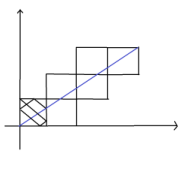
(3) 꼭짓점 C(0,1)\displaystyle \mathrm{C}(0,1)가 끝점 P15\displaystyle \mathrm{P}_{15}이 되는 기울기 m\displaystyle m을 모두 구하시오.풀이: 끝점 P15\displaystyle \mathrm{P}_{15}가 꼭짓점 C(0,1)\displaystyle \mathrm{C}(0,1)이 되기 위해서는 Pk\displaystyle \mathrm{P}_{k} (1k14\displaystyle 1\le k\le14)은 모두 꼭짓점이 아닌 변 위에 존재하고 이 변들은 문항 (2)의 풀이와 같이 대칭에 활용된다.Correction. 1k14\displaystyle 1\le k\le142k14\displaystyle 2\le k\le14의 오기다. 그러나 원칙에 따라 원문 표기를 그대로 실었다.꼭짓점 C(0,1)\displaystyle \mathrm{C}(0,1)을 대칭 이동하여 도달할 수 있는 점은 자연수 p,q\displaystyle p,q (pq\displaystyle p\ge q)에 대하여 (2p,2q1)\displaystyle (2p,2q-1)의 꼴이며 2p\displaystyle 2p2q1\displaystyle 2q-1이 서로소이다. 문항 (2)의 풀이와 주어진 정사각형을 오른쪽 또는 위로 대칭하여 (2p,2q1)\displaystyle (2p,2q-1)이 원점에서 가장 먼 점이 되려면 위로 2p1\displaystyle 2p-1번 대칭이동하고 오른쪽으로 2q2\displaystyle 2q-2번 대칭이동 해야 한다.Correction. 오른쪽으로 2p1\displaystyle 2p-1번, 위로 2q2\displaystyle 2q-2번 대칭이동한다. 두 방향이 서로 바뀌어 있다. 그러나 원칙에 따라 원문 표기를 그대로 실었다.끝점 P15\displaystyle \mathrm{P}_{15}가 꼭짓점 C(0,1)\displaystyle \mathrm{C}(0,1)이 되기 위해서는 총 13\displaystyle 13회 대칭 이동하여야 하므로 C(0,1)\displaystyle \mathrm{C}(0,1)에 대응하는 점 (2p,2q1)\displaystyle (2p,2q-1)에 대하여 (2p1)+(2q2)=13\displaystyle (2p-1)+(2q-2)=13를 만족한다. 따라서 p+q=8\displaystyle p+q=8이므로 조건을 만족하는 자연수 p,q\displaystyle p,q (pq\displaystyle p\ge q)에 대응하는 점 (2p,2q1)\displaystyle (2p,2q-1)(14,1),(12,3),(10,5),(8,7)\displaystyle (14,1),(12,3),(10,5),(8,7)이며 x\displaystyle x좌표와 y\displaystyle y좌표가 서로소인 것은 (14,1),(8,7)\displaystyle (14,1),(8,7)이므로 구하는 기울기는 114,78\displaystyle \frac{1}{14},\frac{7}{8}이다.

오른쪽과 위로 대칭이동한 정사각형들과 원점을 지나는 직선
[그림 3]

첨삭 사례

아직 등록된 첨삭 사례가 없습니다.

질문과 답변 · 0개질문과 답변 · 고정 0개

아직 등록된 질문이 없습니다. 질문 작성은 멤버십 회원만 가능합니다.