수리논술, 이게 다다.

자연계열 (오후1) 2번

오류 제보

문제

[문제 2] 다음 제시문을 읽고 물음에 답하시오. (50점)

공간에서 AB‾=1\displaystyle \overline{\mathrm{AB}}=1을 만족시키는 점 A와 점 B가 있다. 0<θ<π\displaystyle 0<\theta<\pi인 θ\displaystyle \theta에 대해, ∠APB=θ\displaystyle \angle\mathrm{APB}=\theta를 만족시키는 점 P들을 생각하자.

1. 두 점 A와 B를 포함하는 한 평면을 α\displaystyle \alpha라 하자. θ=π4\displaystyle \theta=\frac\pi4일 때, 평면 α\displaystyle \alpha 위에 있는 점 P들과 점 A, B가 이루는 곡선으로 둘러싸인 부분의 넓이를 구하시오.

2. θ=π12\displaystyle \theta=\frac\pi{12}일 때, AP‾\displaystyle \overline{\mathrm{AP}}의 최댓값을 구하고, AP‾\displaystyle \overline{\mathrm{AP}}를 최대로 하는 점 P들이 이루는 곡선의 길이를 l\displaystyle l이라 할 때, l2\displaystyle l^2의 값을 구하시오.

3. 점 P들이 이루는 입체도형의 점 A와 B를 포함하는 한 평면 위로의 정사영의 넓이를 θ\displaystyle \theta에 관한 식으로 나타내시오.

해설강의 준비중

[문제 2번]

+10점 · 평면에서 점 P들이 이루는 곡선을 구했는가?

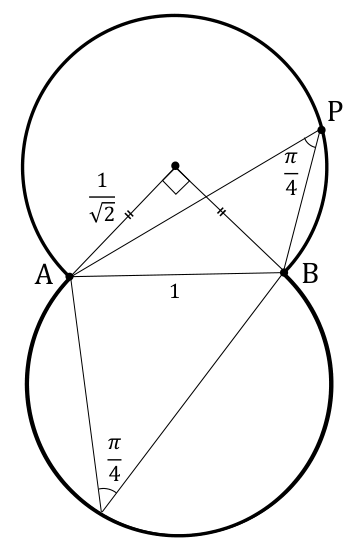
1. 평면 α\displaystyle \alpha위에서 ∠APB=π4\displaystyle \angle\mathrm{APB}=\frac\pi4를 만족하는 점 P는 선분 AB가 현이 되는 평면 α\displaystyle \alpha위의 두 개의 원 위에 있고, 각각의 원에서 현 AB의 중심각은 π2\displaystyle \frac\pi2이고, 점 P는 원주각 ∠APB=π4\displaystyle \angle\mathrm{APB}=\frac\pi4인 점이다.

원주각이 π/4인 점 P의 자취
+20점 · 이 곡선으로 둘러싸인 부분의 넓이를 구했는가?

오른쪽 그림에서 구하는 영역의 넓이는 2(π(12)2⋅34+12⋅12⋅12)=34π+12\displaystyle 2\left(\pi\left(\frac1{\sqrt2}\right)^2\cdot\frac34+\frac12\cdot\frac1{\sqrt2}\cdot\frac1{\sqrt2}\right)=\frac34\pi+\frac12이다.

+10점 · 선분의 길이 AP‾\displaystyle \overline{\mathrm{AP}}의 최댓값을 구했는가?

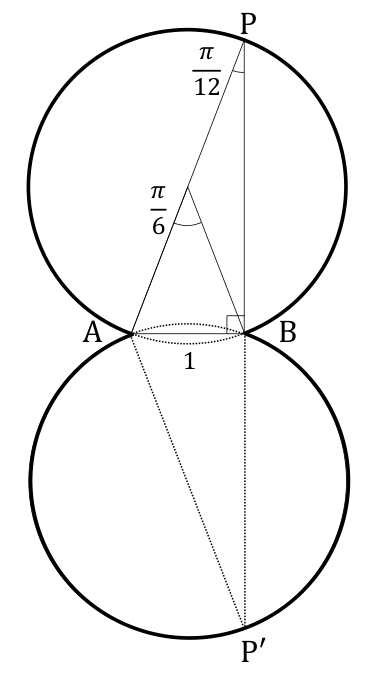
2. 먼저 점 A\displaystyle \mathrm{A}와 B\displaystyle \mathrm{B}를 포함하는 한 평면 α\displaystyle \alpha위에 있고, ∠APB=π12\displaystyle \angle \mathrm{APB} = \frac{\pi}{12}인 점 P\displaystyle \mathrm{P}는 물음 1에서와 마찬가지로 선분 AB\displaystyle \mathrm{AB}가 현이 되는 평면 α\displaystyle \alpha위의 두 개의 원 위에 있고, 각각의 원에서 현 AB\displaystyle \mathrm{AB}의 중심각은 π6\displaystyle \frac{\pi}{6}이고, 점 P\displaystyle \mathrm{P}는 원주각 ∠APB=π12\displaystyle \angle \mathrm{APB} = \frac{\pi}{12}인 점이다.평면 α\displaystyle \alpha위에서 AP‾\displaystyle \overline{\mathrm{AP}}가 최대인 점 P\displaystyle \mathrm{P}는 A\displaystyle \mathrm{A}와 각각의 원의 중심을 지나는 직선 위에 있다. (오른쪽 그림에서 P\displaystyle \mathrm{P}와 P′\displaystyle \mathrm{P}^{\prime})한편, 점 A\displaystyle \mathrm{A}, B\displaystyle \mathrm{B}를 포함하는 임의의 다른 평면에서도 점 P\displaystyle \mathrm{P}들이 이루는 곡선은 평면 α\displaystyle \alpha에서의 곡선과 동일한 모양을 가진다.따라서 각각의 평면에서 AP‾\displaystyle \overline{\mathrm{AP}}의 최댓값은 동일하며 그 값은 평면 위의 (두) 원의 지름인 2⋅12sin⁡π12=223−1=6+2\displaystyle 2 \cdot \frac{1}{2 \sin \frac{\pi}{12}} = \frac{{2 \sqrt{2}}}{\sqrt{3} - 1} = \sqrt{6} + \sqrt{2}이다.

원주각이 π/12이며 AP가 최대인 두 점
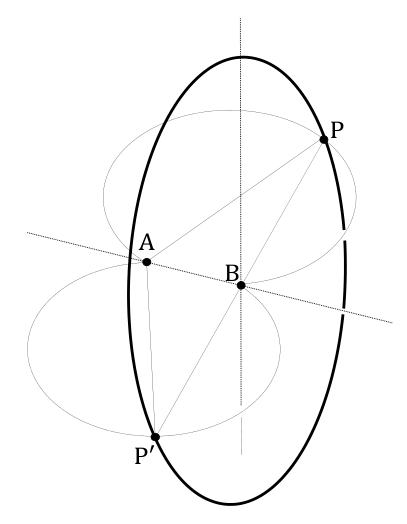
선분 AB를 축으로 회전한 점 P의 자취
+20점 · AP‾\displaystyle \overline{\mathrm{AP}}를 최대로 하는 점 P들이 이루는 곡선의 길이를 구했는가?

또한 위의 관찰로부터 공간에서 AP‾\displaystyle \overline{\mathrm{AP}}를 최대로 하는 점 P\displaystyle \mathrm{P}들이 이루는 곡선은 위 그림에서와 같이 중심이 B\displaystyle \mathrm{B}, 반지름이 BP‾\displaystyle \overline{\mathrm{BP}}인 원이다. (이 원을 포함하는 평면은 점 A\displaystyle \mathrm{A}, B\displaystyle \mathrm{B}를 지나는 직선에 수직이다.)따라서 구하는 곡선의 길이의 제곱은 l2=(2πBP‾)2=4π2((6+2)2−12)\displaystyle l^{2} = ( 2 \pi {\overline{\mathrm{BP}}} )^{2} = 4 \pi^{2} ( ( \sqrt{6} + \sqrt{2} )^{2} - 1^{2} )=4π2(7+212)\displaystyle = 4 \pi^{2} ( 7 + 2 \sqrt{12} )=(28+163)π2\displaystyle = ( 28 + 16 \sqrt{3} ) \pi^{2}이다.

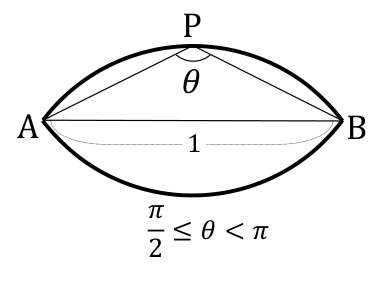
3. 물음 2에서와 마찬가지로 점 A\displaystyle \mathrm{A}와 B\displaystyle \mathrm{B}를 포함하는 한 평면 α\displaystyle \alpha위에 있고 ∠APB=θ\displaystyle \angle \mathrm{APB} = \theta인 점 P\displaystyle \mathrm{P}는, 선분 AB\displaystyle \mathrm{AB}가 현이 되는 평면 α\displaystyle \alpha위의 두 개의 원 위에 있고, 각각의 원에서 현 AB\displaystyle \mathrm{AB}의 중심각은 2θ\displaystyle 2 \theta이고, 점 P\displaystyle \mathrm{P}는 원주각 ∠APB=θ\displaystyle \angle \mathrm{APB} = \theta인 점이다.또한 공간에서 점 P\displaystyle \mathrm{P}들이 이루는 도형은 평면 α\displaystyle \alpha에 있는 점 P\displaystyle \mathrm{P}들이 이루는 곡선을 점 A\displaystyle \mathrm{A}, B\displaystyle \mathrm{B}를 지나는 직선을 중심으로 회전시켜 얻은 곡면이다.따라서 이 도형의 평면 α\displaystyle \alpha위로의 정사영의 넓이는

+20점 · 0<θ<π2\displaystyle 0<\theta<\frac\pi2일 때, 정사영의 넓이를 θ\displaystyle \theta에 관한 식으로 나타내었는가?

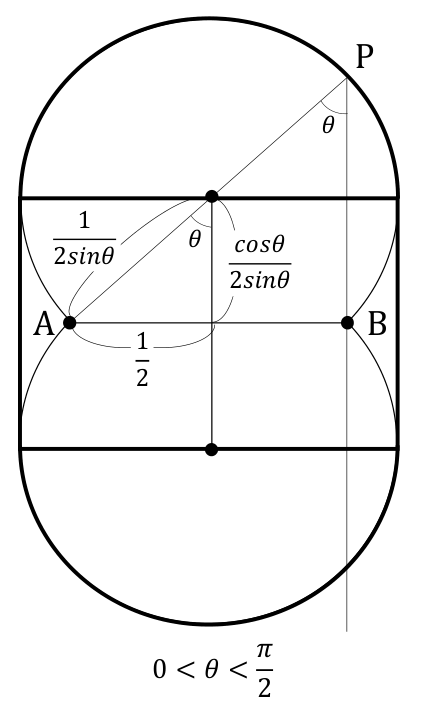
(1) 0<θ<π2\displaystyle 0<\theta<\frac\pi2일 때, (직사각형의 넓이)+2\displaystyle +2(반원의 넓이)=2⋅12sin⁡θ⋅2⋅cos⁡θ2sin⁡θ+2⋅12π(12sin⁡θ)2=4cos⁡θ+π4sin⁡2θ\displaystyle =2\cdot\frac1{2\sin\theta}\cdot2\cdot\frac{\cos\theta}{2\sin\theta}+2\cdot\frac12\pi\left(\frac1{2\sin\theta}\right)^2=\frac{4\cos\theta+\pi}{4\sin^2\theta}이고,

0<θ<π/2일 때 정사영의 직사각형과 반원
+20점 · π2≤θ<π\displaystyle \frac\pi2\le\theta<\pi일 때, 정사영의 넓이를 θ\displaystyle \theta에 관한 식으로 나타내었는가?

(2) π2≤θ<π\displaystyle \frac\pi2\le\theta<\pi일 때, 2⋅\displaystyle 2\cdot(각각의 원이 현 AB로 잘린 부분의 넓이)=2⋅\displaystyle =2\cdot{(AB를 현으로 하는 부채꼴의 넓이) −\displaystyle -(점 A, B와 원의 중심을 꼭짓점으로 하는 삼각형의 넓이)}=2⋅(π−θ4sin⁡2θ−(−cos⁡θ4sin⁡θ))=π−θ+cos⁡θsin⁡θ2sin⁡2θ\displaystyle =2\cdot\left(\frac{\pi-\theta}{4\sin^2\theta}-\left(-\frac{\cos\theta}{4\sin\theta}\right)\right)=\frac{\pi-\theta+\cos\theta\sin\theta}{2\sin^2\theta}이다.

π/2≤θ<π일 때 두 활꼴로 이루어진 정사영

첨삭 사례

아직 등록된 첨삭 사례가 없습니다.

질문과 답변 · 0개질문과 답변 · 고정 0개

아직 등록된 질문이 없습니다. 질문 작성은 멤버십 회원만 가능합니다.